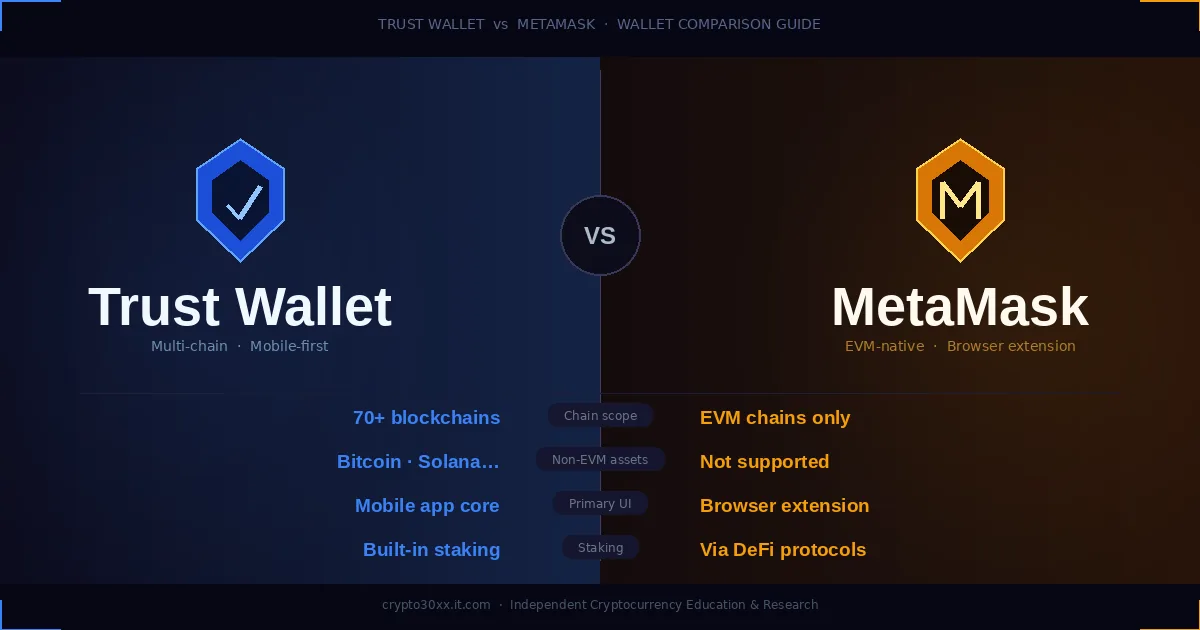
Trust Wallet vs MetaMask: complete comparison guide
A Trust Wallet vs MetaMask comparison comes down to a single architectural split: MetaMask was built for Ethereum and EVM-compatible networks, with a browser extension as its primary interface. Trust Wallet was built for broad multi-chain access across dozens of blockchains, with mobile as its primary environment. Both are non-custodial software wallets, meaning the user holds their own private keys rather than relying on a third party to custody assets. Both support DeFi protocols, token storage, and NFT display. The differences that matter are chain scope, interface design, and which usage pattern each fits best.
This guide is written for readers researching self-custody wallets. It covers how each wallet works mechanically, where they diverge structurally, and what factors determine which is suited to a particular setup.
What are Trust Wallet and MetaMask?
Trust Wallet and MetaMask are both non-custodial software wallets that generate and store cryptographic private keys locally on the user’s device. Neither product takes custody of user assets. Neither requires registration with a centralized authority. When either wallet is created, a recovery phrase is generated on-device, and that phrase is the sole master key to everything the wallet contains.
Trust Wallet: structure and origins
Trust Wallet is a mobile-first cryptocurrency wallet that supports over 70 blockchains within a single application. It was originally launched as an independent product and later acquired by Binance, though it continues to operate as a standalone, open-source wallet entirely separate from the Binance exchange platform. The wallet derives private keys for multiple blockchain networks from a single 12-word recovery phrase using the BIP-39 standard. That is why one app can manage assets on Bitcoin, Ethereum, Solana, and Cosmos simultaneously without requiring separate installations.
Trust Wallet includes a built-in dApp browser, native staking for select proof-of-stake tokens, and an NFT display function. A browser extension version is also available for desktop environments, though the mobile app remains the wallet’s primary form.
MetaMask: structure and origins
MetaMask is a browser extension and mobile wallet developed by ConsenSys, built around Ethereum and EVM-compatible blockchains. It was one of the first wallets to make self-custody interaction with Ethereum-based decentralized applications practical for non-developers. As a result, it became the default wallet connection method that most Ethereum protocol interfaces were designed to support.
MetaMask generates a 12-word secret recovery phrase using the BIP-39 standard. Its browser extension injects an Ethereum provider into web pages, which allows dApps to detect the wallet and request transaction signatures directly from the active browser tab. Networks beyond Ethereum require manual configuration, but any blockchain running the Ethereum Virtual Machine can be added through standard RPC settings.
How each wallet manages private keys
Both wallets use the same foundational key management model: a BIP-39 recovery phrase generated locally on the device, with private keys stored in encrypted form. No copy of the recovery phrase is transmitted to external servers during setup, and neither wallet operates a centralized key backup service.
Seed phrase and key derivation
The recovery phrase is the master credential for both wallets. Anyone who obtains it can reconstruct the wallet on any compatible device and access all associated assets. If the phrase is lost, access to the wallet is permanently and irrecoverably lost. This is not a product limitation; it is the defining property of non-custodial key ownership.
Both wallets encrypt local key storage using a user-set password. The password protects the keys on that specific device. The seed phrase restores access across devices. These are separate layers: losing a device while knowing the seed phrase is recoverable; losing the seed phrase is not, regardless of whether device access remains.
Device-level protections and hardware wallet options
MetaMask allows users to set a wallet password for local encryption. Biometric authentication can be enabled on mobile as an additional access layer. Trust Wallet uses a passcode or biometric lock to control app access on mobile. Both products make clear that these device controls are convenience measures and do not function as replacements for the seed phrase.
Both wallets support hardware wallet integration. MetaMask has well-documented direct support for Ledger and Trezor, which moves private key storage entirely off a networked device. Trust Wallet supports hardware wallet connection through WalletConnect. For users treating security as the primary variable, hardware wallet integration represents a substantially stronger configuration than software-only key storage.
Trust Wallet vs MetaMask: feature comparison
The table below maps the core structural differences between the two wallets across the dimensions most relevant to practical use. These are design differences, not quality rankings. Each column reflects a different architectural approach suited to a different usage pattern.
| Feature | Trust Wallet | MetaMask |
|---|---|---|
| Primary interface | Mobile app (extension also available) | Browser extension (mobile app also available) |
| Native chain support | 70+ blockchains, multi-chain by default | Ethereum + EVM chains (manual network add) |
| Non-EVM chain support | Yes (Bitcoin, Solana, Cosmos, and others) | No |
| dApp browser | Built-in on mobile | Extension native; in-app browser on mobile |
| NFT display | Built-in in mobile app | MetaMask Portfolio page; mobile app |
| Built-in staking | Yes (select proof-of-stake tokens) | Via third-party protocol connection |
| Hardware wallet support | Via WalletConnect | Direct Ledger and Trezor integration |
| Built-in swap function | Yes (service fee applies) | Yes, MetaMask Swaps (service fee applies) |
| Open source | Yes | Yes (extension code publicly auditable) |
| Custodial | No | No |
Supported blockchains and tokens
Chain support is the most consequential structural difference between the two wallets. MetaMask operates on Ethereum and EVM-compatible networks: BNB Chain, Polygon, Arbitrum, Optimism, Avalanche, and others that run the Ethereum Virtual Machine. Any EVM network can be imported into MetaMask by entering its chain ID and RPC endpoint. Networks that do not use the EVM, including Bitcoin, Solana, Cosmos, Tron, and Cardano, are not accessible through MetaMask.
Trust Wallet supports non-EVM blockchains natively alongside EVM chains. A user managing assets across Bitcoin, Ethereum, Solana, and Cosmos can do so within a single Trust Wallet installation, with all balances visible from one interface and all recoverable from one seed phrase.
Browser extension vs mobile-first design
MetaMask’s browser extension injects the Ethereum provider directly into the browser environment. When a dApp displays a “Connect Wallet” button, MetaMask appears as the default or primary option because the extension is already present inside the browser. This makes it the lowest-friction connection method for most Ethereum-based protocol interfaces.
Trust Wallet’s core interface is a mobile application. Its built-in dApp browser allows connection to decentralized protocols without switching to an external browser, which suits users who primarily interact with crypto from a smartphone. For dApps designed around browser extension interaction, Trust Wallet users can bridge to desktop interfaces through WalletConnect by scanning a QR code.
DeFi and dApp access in practice
Both wallets support decentralized finance interaction, but the specifics of how each connects and which protocols it reaches most naturally depend on interface design and chain scope. MetaMask reaches Ethereum-based protocols with the least friction. Trust Wallet reaches a broader set of blockchains from a mobile environment. The practical difference is most visible when examining each wallet’s connection model side by side.
MetaMask in the Ethereum DeFi context
MetaMask’s browser extension became the standard wallet interface for Ethereum DeFi for a structural reason: it integrates directly with the browser, which is where most DeFi protocol front-ends are served. Developers building Ethereum-based protocols have historically tested and optimized wallet connection for MetaMask first. The consequence is that MetaMask tends to have the most consistent compatibility across Ethereum protocol interfaces.
MetaMask Swaps aggregates token exchange rates from multiple decentralized exchange sources and executes swaps within the wallet. A service fee is applied to each swap using this interface. Users can also connect MetaMask directly to any DEX front-end independently, which bypasses the in-wallet swap fee entirely.
Trust Wallet and multi-chain DeFi
Trust Wallet’s built-in dApp browser supports connection to decentralized applications directly from mobile. For users interacting with DeFi on non-EVM chains, this eliminates the need for a separate application per blockchain. Solana-based DeFi protocols, for example, can be accessed natively in Trust Wallet where they cannot be reached in MetaMask at all.
WalletConnect extends Trust Wallet’s reach to desktop dApp interfaces. By scanning a WalletConnect QR code on a desktop protocol page, a Trust Wallet user can authorize transactions from their mobile device. This gives mobile wallet users access to the same protocol front-ends typically associated with browser extension wallets.
Security risks common to both wallets
Both wallets share the same fundamental key management model: locally generated BIP-39 keys, encrypted device storage, and full user responsibility for the recovery phrase. That shared architecture means they are exposed to structurally identical attack vectors. The risks are not wallet-specific; they follow from self-custody itself.
Phishing and malicious contract approvals
The most documented source of asset losses for users of both wallets involves phishing: fake dApp interfaces designed to resemble legitimate protocols that either request seed phrase entry or prompt users to sign malicious contract approvals. Both attack types exploit user behavior, not vulnerabilities in the wallet software itself.
Both wallets include domain-warning features that flag known malicious sites. These warnings are heuristic and do not cover every threat. Independently verifying contract addresses and site URLs before signing any transaction remains necessary regardless of which wallet is in use.
Seed phrase storage failures
Storing a seed phrase in a screenshot, email draft, notes application, or cloud sync service creates exposure independent of wallet security. If that storage medium is compromised, the seed phrase is compromised. Physical paper backup stored in a controlled offline location is standard guidance for both products.
Interoperability note: Both wallets use the BIP-39 standard for key derivation. A phrase created in Trust Wallet can be imported into MetaMask, and vice versa. Importing a Trust Wallet phrase into MetaMask will surface only Ethereum and EVM-chain balances; Bitcoin and Solana balances associated with the same phrase will not appear because MetaMask cannot access those networks.
Which wallet suits which use pattern
Translating the Trust Wallet vs MetaMask comparison into practical guidance requires matching each wallet’s design to a specific use pattern rather than applying a general ranking. The two wallets are not in direct competition for the same user. They are optimized for different environments, different devices, and different blockchain scope — and the better choice is the one that maps cleanest to how a user actually works.
When MetaMask has structural advantages
MetaMask is better suited to users who primarily operate within the Ethereum and EVM ecosystem on a desktop computer. The browser extension provides the most direct and broadly compatible interface for Ethereum DeFi, and its direct Ledger and Trezor integration is more thoroughly documented than equivalent configurations with other wallets. Developers building and testing on Ethereum also use MetaMask routinely because its provider injection model is what most Ethereum tooling is built to detect.
When Trust Wallet has structural advantages
Trust Wallet is better suited to users who hold assets across multiple blockchains that do not share the EVM architecture, who primarily use a mobile device, or who want a single interface covering broad chain support without managing multiple separate wallet applications. Its native multi-chain design means fewer recovery phrases to administer, a single app to maintain, and access to blockchain networks that MetaMask cannot reach.
FAQs
Is Trust Wallet safer than MetaMask? Neither wallet is inherently safer than the other. Both are non-custodial, open-source products built on the same BIP-39 key management standard. Security outcomes depend primarily on how the seed phrase is stored, which sites the wallet connects to, and whether the user reviews transaction details before signing. The wallet software itself is not the primary risk variable for either product.
Can the same seed phrase be used in both wallets? Yes. Both wallets use the BIP-39 standard, so a 12-word phrase from Trust Wallet can be imported into MetaMask and vice versa. However, importing a Trust Wallet phrase into MetaMask will surface only Ethereum and EVM-chain balances. Bitcoin, Solana, and other non-EVM assets tied to the same phrase will not appear because MetaMask cannot access those networks.
Does MetaMask support Bitcoin? MetaMask does not support native Bitcoin. It is designed exclusively for EVM-compatible blockchains. Wrapped Bitcoin (WBTC) is an ERC-20 token on Ethereum that tracks Bitcoin’s price, but holding WBTC in MetaMask is not the same as holding actual BTC. Native Bitcoin requires a wallet with direct Bitcoin support, such as Trust Wallet.
Does Trust Wallet work with Ethereum DeFi protocols? Yes. Trust Wallet connects to Ethereum DeFi through its built-in dApp browser and through WalletConnect, which bridges mobile wallets to desktop protocol interfaces. Some Ethereum protocol front-ends list fewer connection options for Trust Wallet than for MetaMask because many were originally built to prioritize browser extension detection.
What fees do Trust Wallet and MetaMask charge? Both wallets are free to download and do not charge fees for sending or receiving assets. Blockchain network fees, which go to validators rather than either wallet, apply to all on-chain transactions. Both wallets include built-in swap features that add a service fee on top of network costs. Users can avoid that fee by connecting directly to a DEX front-end instead of using the in-wallet swap interface.
Do both wallets support NFTs? Yes. Both wallets can display NFT holdings. Trust Wallet shows NFTs within its main mobile interface. MetaMask displays NFTs through its Portfolio page and within the mobile app. NFTs exist on the blockchain, not inside the wallet software. The wallet reads and displays ownership records; it does not store the NFT asset itself.
What happens if the wallet app is deleted or the company shuts down? Because both wallets are non-custodial and use the standardized BIP-39 format, assets remain recoverable by importing the seed phrase into any compatible wallet application. The assets are held on the blockchain, not inside the app. Wallet software is a key management interface. Deleting the app or any company-level disruption does not affect the underlying assets, provided the seed phrase is preserved.
Can both wallets be run simultaneously with different seed phrases? Yes. Running both wallets with separate seed phrases is a practical setup for users who want browser-native EVM access through MetaMask alongside Trust Wallet’s multi-chain mobile coverage. Each phrase must be backed up independently and securely, so this approach increases key management responsibility proportionally.
Disclaimer
This article is produced for educational and research purposes by an independent cryptocurrency education blog. Nothing in this guide constitutes financial advice, investment advice, or a recommendation to acquire, hold, or transfer any digital asset or financial product. Cryptocurrency wallets and digital assets carry significant risks, including permanent loss of funds from seed phrase mismanagement, phishing attacks, or smart contract vulnerabilities. Readers should conduct independent research and consult qualified professionals before making any decisions involving digital assets.
The structural divide between Trust Wallet and MetaMask is more precise than most wallet comparisons acknowledge. MetaMask’s browser extension and Ethereum focus make it the lowest-friction option for desktop-based EVM interaction. Trust Wallet’s multi-chain support and mobile-first design make it the more practical option for users operating across blockchain ecosystems outside the EVM architecture. Recognizing that distinction is more useful than a generic ranking — because the right wallet is the one that matches how a user actually works, not how a comparison chart is sorted.
Take the guesswork out of growth with our data-informed blog posts.