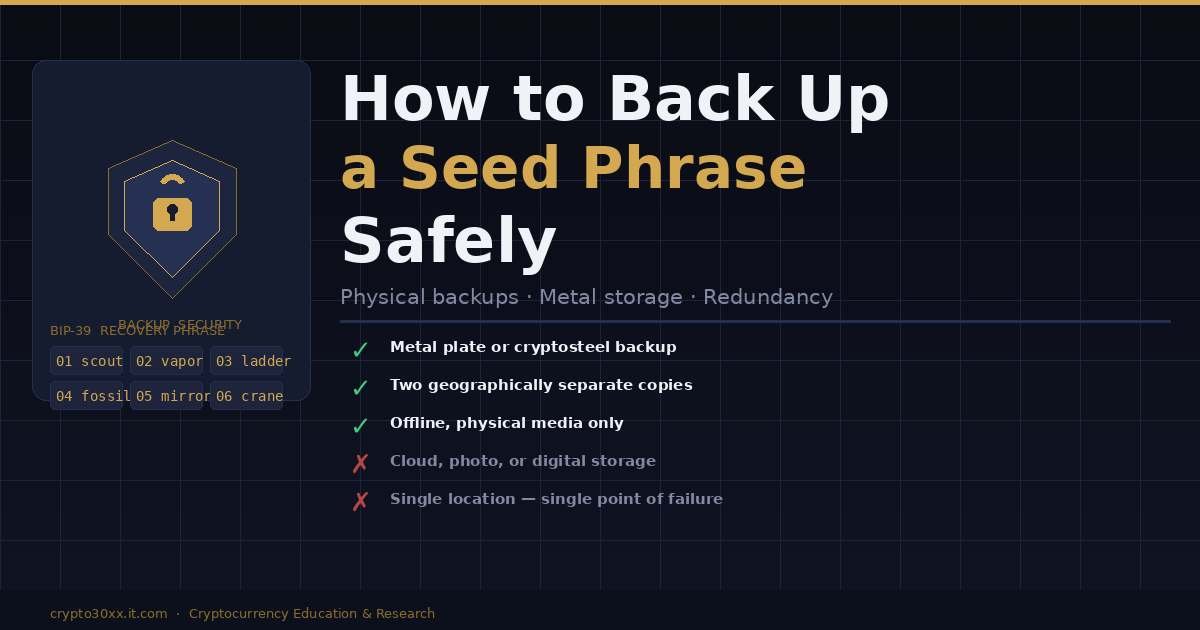
How to backup seed phrase safely: the complete guide
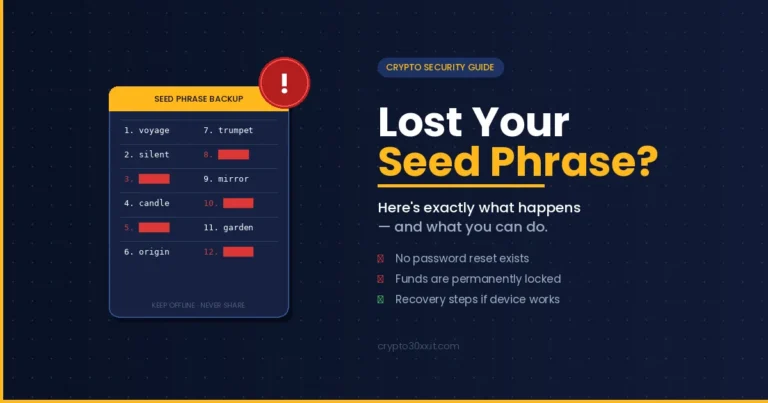
How to backup seed phrase safely: Losing access to a cryptocurrency wallet is almost always permanent. There is no password reset, no support ticket, no recovery process. The only safeguard is a seed phrase (a sequence of 12 or 24 words generated when the wallet is created), and the only way to protect that safeguard is to back it up correctly before anything goes wrong. This guide explains how to backup a seed phrase safely, why certain methods fail, what materials last long enough to be useful, and how to structure redundancy without creating new security problems.
What is a seed phrase and why does it matter?
A seed phrase (also called a recovery phrase or mnemonic phrase) is a human-readable representation of the master private key that controls an entire cryptocurrency wallet. It is typically 12 or 24 words drawn from the BIP-39 word list, a standardized set of 2,048 common English words designed so that any word can be identified from its first four letters alone.
The phrase encodes the root from which every private key in the wallet is mathematically derived. That means one seed phrase recovers every address, every coin, and every transaction history across all supported assets in a given wallet. Whoever holds the phrase holds the wallet, unconditionally.
How BIP-39 seed phrases work
BIP-39 (Bitcoin Improvement Proposal 39) defines the standard. The wallet software generates a random number, converts it into a word sequence, and then derives a master private key from that sequence using a one-way cryptographic function (PBKDF2-HMAC-SHA512). From the master key, individual account keys and addresses are produced through hierarchical deterministic (HD) derivation paths.
The word count determines security:
- 12 words: 128 bits of entropy, roughly 2¹²⁸ possible combinations
- 24 words: 256 bits of entropy, roughly 2²⁵⁶ possible combinations
Both are computationally infeasible to brute-force with any foreseeable technology. The security weakness is almost never the entropy level. It is physical exposure or improper storage.
Why backup failure is so common
Most people write the phrase on whatever paper is nearby, store it in one location, and treat it as a one-time task. That creates three distinct failure modes: fire, flood, and forgetfulness. A single paper copy stored next to the hardware wallet means both can be lost in the same event. Digital copies introduce different threats. Neither approach reflects how durable a backup needs to be.
How to backup a seed phrase safely: step-by-step
Backing up a seed phrase safely is not complicated, but the order of steps matters. Skipping ahead or taking shortcuts during wallet setup is where most backup failures begin.
Step 1: Record the phrase during wallet setup only
The seed phrase appears exactly once, during wallet creation. Write every word in order, and verify the sequence before the wallet app moves on. Most hardware wallets run a verification quiz immediately after display. This is not optional housekeeping; it is the only confirmation that what was written matches what the device generated.
Do not photograph the phrase on screen. Do not type it into any device. Write it on paper, in the physical space where the wallet is being set up.
Step 2: Write legibly and verify word order
Word order is as important as the words themselves. A phrase with two transposed words will fail to restore the wallet. Number each word (1 through 12 or 1 through 24), write in uppercase or print clearly, and read back each word before moving to the next.
Check for ambiguous letter pairs: 1 vs I, 0 vs O, B vs 8. These are common transcription errors that only surface months later during an actual recovery attempt.
Step 3: Create a primary backup on durable physical media
Paper is the starting point but rarely the endpoint. Standard printer paper degrades, fades, and burns. The minimum acceptable upgrade is acid-free archival paper in a waterproof, fire-resistant container. Dedicated seed phrase backup cards made from 300+ gsm cardstock, laminated after writing, offer meaningful improvement over a sticky note.
The best physical medium for long-term storage is stamped or engraved metal:
| Medium | Fire resistance | Water resistance | Longevity |
|---|---|---|---|
| Regular paper | Low (burns ~230°C) | None | 5–25 years |
| Archival paper + fire-safe | Medium (rated to ~800°C) | Limited | 25–100 years |
| Steel plate (stamped) | High (~1,400°C) | Complete | 100+ years |
| Titanium plate (engraved) | Very high (~1,668°C) | Complete | 100+ years |
| Stainless steel cryptosteel | High | Complete | 100+ years |
Metal backup products designed for seed phrases, such as tile-based letter systems or punch-stamp plates, hold up under conditions that destroy a fire safe’s paper contents. Standard residential fire safes are typically rated to protect paper at temperatures up to around 177°C (350°F) internal, but house fires routinely exceed 500°C.
Step 4: Establish geographic redundancy
One copy in one location is a single point of failure. The standard approach is two or three copies stored in physically separate, access-controlled locations.
Common configurations:
- Primary: home safe (steel backup plate)
- Secondary: bank safety deposit box or trusted family member’s location (second steel plate or sealed archival paper copy)
- Optional tertiary: third location, often for larger holdings
The copies should be identical. Do not split the phrase across locations, half in one place and half in another, unless using a specific cryptographic scheme designed for that purpose. Informal splitting reduces security without providing the redundancy benefit most people assume.
Step 5: Secure each copy against unauthorized access
A perfectly durable backup that anyone can read is not secure. Physical access controls matter:
- Use a locked, tamper-evident container for each copy
- Do not label the container with any reference to cryptocurrency or wallet type
- Avoid storing the seed phrase alongside the hardware wallet or the PIN needed to access it
- Tell a trusted person where the backup is located, not what it contains; this preserves inheritance access without exposing the phrase in daily life
What not to do: backup methods that create risk
Understanding failure modes is as important as understanding correct procedure.
Digital storage of any kind
The most common mistake is storing a seed phrase in a digital format: a photo in a cloud folder, a note in a notes app, a screenshot, an email to oneself, a password manager entry. Every digital storage method exposes the phrase to:
- Cloud account compromise
- Device malware or keyloggers
- Platform data breaches
- Inheritance and access problems when accounts are closed
Seed phrases belong offline, on physical media, in controlled physical locations. There is no digital storage method that provides equivalent security for this specific use case.
Photographs
A photograph of a seed phrase carries all the risks of digital storage and adds additional exposure. Camera roll backups sync automatically to cloud services on most devices. Photo metadata can reveal when and where the image was taken. The image may appear in app photo permissions or be accessible through device recovery tools.
Splitting the phrase without a proper scheme
Some guides suggest storing 8 words in one location and 16 in another, or dividing the phrase into thirds. The intuition is that no single location holds enough to restore the wallet. The reality is more complicated: an attacker who finds one partial set knows exactly what they are looking at and can reduce the brute-force search space dramatically. An incomplete phrase backup also creates recovery failure if one copy is lost.
Shamir’s Secret Sharing (SSS) is a mathematically sound alternative for users who want split redundancy. It divides a secret into N shares, of which any K shares (a threshold) can reconstruct the original, while fewer than K shares reveal nothing. Several hardware wallet manufacturers support SSS natively. This is a legitimate approach; informal splitting is not.
Memorization as the only backup
Memory is not a backup. It degrades, becomes inaccessible under stress or illness, and provides no inheritance path. A seed phrase memorized but never physically recorded is effectively unprotected. Memorization can supplement a physical backup, but it should never replace one.
Sharing the phrase with any third party
No legitimate wallet provider, exchange, support team, or application ever needs the seed phrase. Any request for it, regardless of how it is framed, is an attempt to steal the wallet. This applies to chat messages, email prompts, browser pop-ups, and any website that asks a user to “connect” by entering recovery words.
Storage material comparison: what to use and when
The choice of backup material should reflect the expected holding period and the stakes involved.
| Holding period | Recommended primary medium | Notes |
|---|---|---|
| Under 1 year, small amounts | Archival paper, waterproof pouch | Acceptable for short-term use; upgrade for larger holdings |
| 1–5 years, medium holdings | Archival card + fire-safe | Good for typical home security needs |
| 5+ years or significant value | Steel or titanium plate | Fire-, water-, and corrosion-resistant; designed for this use case |
| Inheritance planning | Metal backup + legal documentation | Requires combining backup security with estate communication |
Common misconceptions about seed phrase backups
“My hardware wallet keeps my backup safe”
The hardware wallet stores private keys for daily signing but does not store or protect the seed phrase. If the device is lost, damaged, or the manufacturer ceases operations, the wallet is inaccessible without the seed phrase. The backup exists precisely because the device cannot be relied upon indefinitely.
“A fire safe is sufficient protection”
Standard residential fire safes protect paper from the heat of house fires for a defined time window, often 30 to 60 minutes. In a slow-burning or prolonged fire, the internal temperature can exceed the paper protection threshold. A metal backup inside a fire safe provides better protection than paper alone.
“I only need one copy because I’ll remember where it is”
Physical copies can be lost to burglary, structural damage, mold, or flooding. They can be accidentally discarded during moves. Geographic redundancy accounts for the fact that life circumstances change over years and decades, which is the intended holding period for most cryptocurrency wallets.
“Encrypting the backup digitally makes it safe to store online”
Encrypted digital storage creates a new problem: the encryption password becomes a second secret to protect and pass on. If the password is forgotten or lost, the backup is inaccessible. If the password is stored alongside the backup, the encryption provides no real protection. Digital storage introduces complexity and attack surface that physical storage avoids entirely.
Seed phrase backup for inheritance planning
A backup that only one person can locate and access is not fully functional as a backup. If the wallet holder becomes incapacitated or dies, the assets may be permanently inaccessible unless others can locate the phrase.
Inheritance planning for seed phrases typically involves:
- Informing a trusted person of the backup’s existence and location (without revealing the phrase directly)
- Including instructions in a sealed letter held by a solicitor or estate administrator
- Using a tiered access approach: location information with one trusted person, container key or combination with another
- Documenting which wallets and assets correspond to which seed phrase, without putting that information in the same location as the phrase itself
This is a planning exercise, not a technical one. The goal is ensuring that the backup is findable and usable by the right people under the right circumstances, without making it accessible to anyone else.
FAQs
Can I store my seed phrase in a password manager? No. A password manager is a digital, often cloud-connected system. If the account is compromised, the seed phrase is exposed. Password managers are appropriate for passwords and logins, not for the master key of a cryptocurrency wallet. Seed phrases belong on physical media only.
What if I lose my seed phrase backup? If the hardware wallet still functions and the PIN is known, the device remains accessible. The urgent step is to create a new wallet, generate a new seed phrase, back it up correctly, and transfer all assets. Do not wait until the device fails to address a missing backup.
Should I laminate my paper seed phrase backup? Lamination adds moisture resistance and makes the paper harder to tear or damage. It is a worthwhile upgrade for paper backups. However, laminated paper still burns. For long-term or high-value storage, a metal plate is more appropriate than laminated paper.
How many copies of the seed phrase should I have? Two copies in separate geographic locations is the practical standard for most users. Three copies provide additional redundancy without meaningfully increasing exposure if each is stored securely. More than three copies typically creates more security surface area than it eliminates.
Is it safe to store a seed phrase backup in a bank safety deposit box? Yes, with caveats. A bank safety deposit box provides strong physical security and geographic separation from the home. The limitation is institutional access: the bank may restrict access during legal proceedings, banking hours, or in regions with financial instability. It should be one copy among several, not the sole backup.
What is the difference between a seed phrase and a private key? A private key controls one specific address. A seed phrase controls all addresses derived from the wallet; it is the root from which all private keys in the HD wallet are generated. Losing a private key loses one address. Losing the seed phrase loses the entire wallet.
Can someone steal my funds with a partial seed phrase? A partial phrase does not restore a wallet directly, but it reduces the work required for a brute-force search. The fewer unknown words, the more feasible the attack becomes with sufficient computing resources. Treat any partial exposure as a security event and move funds to a new wallet.
Do all wallets use BIP-39 seed phrases? Most major hardware and software wallets use BIP-39, but not all. Some wallets use proprietary word lists or recovery formats. Before setting up a wallet, confirm what standard it uses and whether the phrase is compatible with other wallets. This matters for recovery options if the original wallet software is unavailable.
Disclaimer
This article is produced for educational purposes by crypto30xx.it.com, an independent cryptocurrency education and blockchain research blog. Nothing in this guide constitutes financial, legal, or security advice. Readers are solely responsible for their own wallet security decisions and should conduct independent research appropriate to their circumstances. Cryptocurrency assets can be permanently lost; no recovery mechanism exists for lost seed phrases.
The key principle underlying every method described here is simple: a seed phrase backup needs to survive the scenarios most likely to destroy it, be accessible to the right people when needed, and remain inaccessible to everyone else. Physical, durable, geographically distributed, and clearly organized: that is the standard. Everything else is a shortcut that tends to surface at the worst possible moment.
Get from point A to point B faster with our shortcut-filled article guides.