What is a crypto wallet: a complete beginner’s guide
What is a crypto wallet: A crypto wallet is a software application or physical device that stores the private keys required to access and control cryptocurrency on a blockchain. The wallet itself holds no coins — all balances live on the blockchain network. What the wallet holds is the cryptographic proof of ownership: a private key that authorises transactions and a public key that others use to send funds to your address. Without a wallet, a person cannot send, receive, or interact with any cryptocurrency. Understanding what a crypto wallet is and how it functions is the first practical step for anyone entering the world of digital assets.
What does a crypto wallet actually do?
Many beginners assume a crypto wallet stores their coins the way a bank account holds cash. That framing is incorrect, and the mistake matters.
Your bitcoin, ether, or any other token exists as a record on a public ledger called a blockchain. The blockchain tracks who owns what. Your wallet does not hold those assets; it holds the keys that prove your right to control them. Think of the blockchain as a public registry of property ownership. The wallet is the set of documents that proves the property is yours and allows you to sign a transfer.
The two key types: public and private
Every crypto wallet generates two mathematically linked pieces of data:
- Public key — a long string of characters derived from the private key. It is used to create your wallet address and can be shared openly. Sending someone your wallet address is safe; it is the equivalent of giving out a bank account number.
- Private key — the secret counterpart. It cryptographically signs every outgoing transaction, proving that the authorisation came from the rightful owner. Anyone who holds your private key controls your funds, unconditionally.
The mathematical relationship between the two is one-directional: a public key can be derived from a private key, but a private key cannot be derived from a public key. That asymmetry is the foundation of blockchain security.
What is a seed phrase?
Most modern wallets do not show users their raw private key, which is an unwieldy string of 256 random bits. Instead, they display a seed phrase — a list of 12, 18, or 24 common English words generated at wallet setup.
The seed phrase is a human-readable representation of the master private key. From that one seed, the wallet can derive every private key and wallet address the user will ever need across multiple blockchains. Whoever holds the seed phrase holds complete access to the wallet and all assets controlled by it.
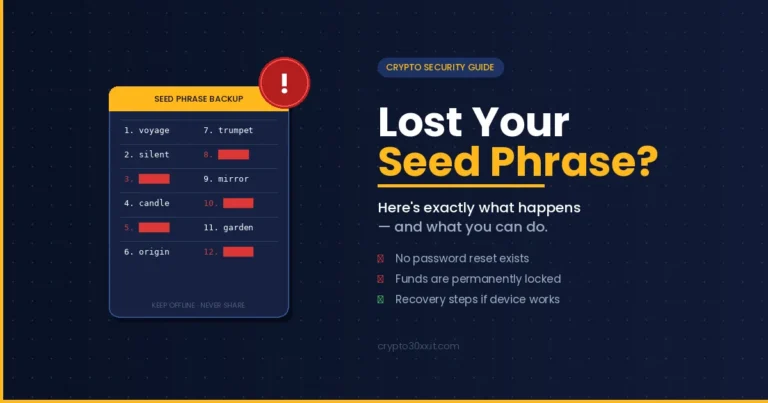
If a phone is lost or an app is deleted, the same wallet can be restored on any new device by entering the seed phrase in the correct order. Lose the seed phrase with no backup, and access to the assets is permanently gone — no password reset, no support ticket, no recovery.
How does a crypto wallet work step by step?
Understanding the mechanics removes a lot of the mystery around wallets.
- Wallet creation — The wallet generates a random number using the device’s entropy source. This becomes the seed.
- Seed phrase derivation — The seed is converted into the 12-to-24-word phrase using a standardised word list (BIP-39 is the most common standard).
- Key pair generation — From the seed, the wallet derives one or more private keys and their corresponding public keys.
- Address creation — The public key is processed through a hashing function to produce a shorter wallet address (e.g., a Bitcoin address starting with “1” or “bc1”, or an Ethereum address starting with “0x”).
- Receiving funds — You share your wallet address. The sender broadcasts a transaction to the blockchain, assigning some amount to that address.
- Sending funds — Your wallet software constructs a transaction, uses your private key to sign it, and broadcasts it to the network. Nodes verify that the signature matches the public key associated with the address holding the funds.
- Transaction confirmed — Miners or validators add the transaction to a block. The blockchain record updates. Your balance reflects the change.
None of this requires a central authority. The math verifies ownership; the network enforces the rules.
Types of crypto wallets: a practical comparison
Wallets divide across two axes: connection to the internet (hot vs cold) and who holds the keys (custodial vs non-custodial). These axes are independent — you can have a custodial hot wallet or a non-custodial cold wallet. Most beginners encounter all four combinations.
Hot wallets vs cold wallets
| Hot wallet | Cold wallet | |
|---|---|---|
| Internet connection | Always connected | Offline |
| Typical form | Mobile app, browser extension, desktop software | Hardware device, paper wallet |
| Convenience | High | Low |
| Security against remote attacks | Lower | Higher |
| Best suited for | Frequent transactions, small amounts | Long-term storage, large holdings |
| Setup complexity | Minimal | Moderate |
Hot wallets are convenient because they are always ready to send or receive. That convenience comes with exposure: any malware, phishing attack, or compromised device creates a direct path to the private keys.
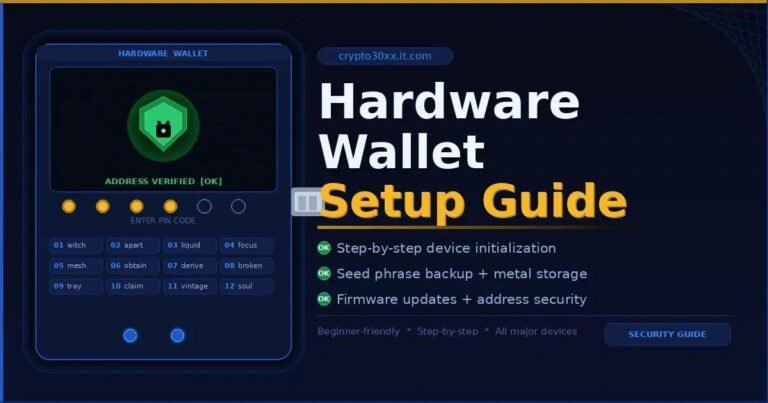
Cold wallets keep keys entirely offline. A hardware wallet is a small physical device that generates and stores keys in an isolated chip. To sign a transaction, the user connects the device manually and confirms the action on the device itself. Even if the connected computer is infected with malware, the key never leaves the device.
Custodial wallets vs non-custodial wallets
| Custodial | Non-custodial | |
|---|---|---|
| Who holds the keys | Third-party platform | The user |
| Recovery if locked out | Platform support | Seed phrase only |
| KYC/account required | Usually yes | Usually no |
| Risk if platform fails | Funds potentially inaccessible | None (user controls keys) |
| Risk if user loses keys | Can recover via support | Permanent loss |
| DeFi access | Limited | Full |
A custodial wallet is managed by a third party, typically an exchange. Users log in with an email and password. The platform holds the actual private keys on their behalf. This is functionally similar to holding money in a bank: the institution controls access, which makes things simple but introduces counterparty risk. If the platform is hacked, freezes withdrawals, or faces insolvency, user funds may become inaccessible.
A non-custodial wallet gives the user direct control over their private keys. No third party can freeze funds or restrict access. The trade-off is full responsibility: losing the seed phrase with no backup means losing the funds permanently.
The four common wallet configurations
Combining the two axes produces four practical categories:
- Custodial + hot: Exchange wallets (e.g. funds held on a centralised exchange). Convenient, account-based, lowest security ceiling.
- Non-custodial + hot: Software wallets (browser extensions, mobile apps). User holds keys; wallet is internet-connected.
- Non-custodial + cold: Hardware wallets. User holds keys; keys stored offline. Highest practical security for most holders.
- Custodial + cold: Institutional custody services. Keys held by a specialised firm using offline procedures; typically for professional or high-value use.
How to set up a crypto wallet: the key steps
The exact process varies by wallet type, but the structure is consistent.
- Choose a wallet type — For first-time holders, a reputable non-custodial mobile wallet or a custodial exchange account are the two most common starting points.
- Download or purchase from official sources — Software wallets should be downloaded from the developer’s official website or verified app store listing. Hardware wallets should only be purchased from the manufacturer directly, never secondhand.
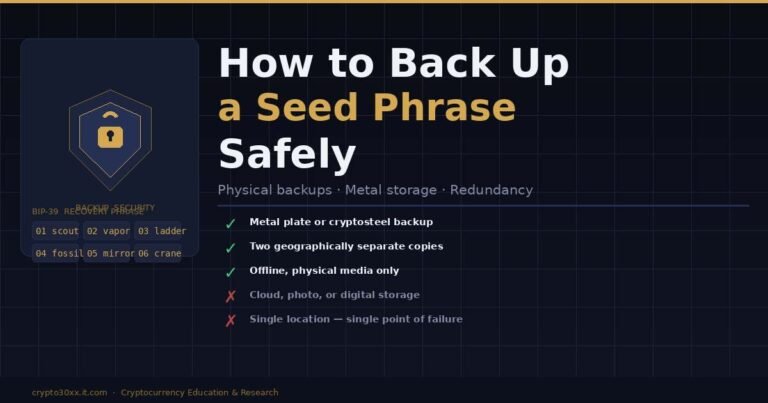
- Create a new wallet — The application will generate a seed phrase. This is the most critical moment. Write it down offline, in order, and store it somewhere physically secure.
- Confirm the seed phrase — Most wallets ask the user to confirm selected words from the phrase to ensure it was recorded correctly.
- Set a wallet PIN or password — This protects access to the app on the device but does not replace the seed phrase.
- Find your wallet address — The wallet displays an address for each supported cryptocurrency. This is what you share when receiving funds.
- Verify with a small test transaction — Before using the wallet for significant amounts, send a small test transaction to confirm everything functions correctly.
Risks, common mistakes, and security principles
A crypto wallet has no customer service department, no fraud protection, and no chargeback mechanism. Understanding the failure modes is not optional.
Seed phrase exposure
The single most common cause of lost funds is seed phrase compromise. This happens through:
- Storing the seed phrase digitally (screenshots, cloud notes, email) where it can be accessed remotely
- Entering the seed phrase into any website, app, or message that requests it (no legitimate wallet will ever ask for it this way)
- Physical theft of the written copy with no secondary backup location
The seed phrase should exist only as a physical, offline record. Metal backup plates are available for users who want durability against fire or water damage.
Phishing attacks
Attackers create convincing fake wallet websites, fake browser extensions, and fake support accounts. The goal is to trick users into entering their seed phrase. A real wallet application never needs your seed phrase to function once created — the phrase is only needed to restore the wallet on a new device.
Address errors
Blockchain transactions are irreversible. Sending funds to the wrong address — whether through a typo, clipboard malware that swaps addresses, or a network mismatch — means permanent loss. Always verify the full address before confirming any transaction. Many wallets display a QR code precisely to reduce manual entry errors.
Platform risk in custodial wallets
Custodial platforms have failed, been hacked, frozen withdrawals, or entered insolvency. A common principle in crypto security is: if you do not control the private keys, you do not fully control the assets. This does not make custodial wallets useless — for small amounts and active trading, the convenience trade-off may be reasonable. It does mean that large holdings kept indefinitely on a single custodial platform carry meaningful counterparty risk.
Device compromise
Hot wallets on infected devices are vulnerable. Malware can log keystrokes, capture screen activity, and extract wallet data files. Keeping wallet software on a dedicated device with minimal other applications reduces this exposure.
How blockchain wallets fit into the broader network
A wallet is the user’s interface to a blockchain network. It is worth understanding what happens on the network side.
When a transaction is broadcast from a wallet, it enters the network’s mempool — a waiting area where unconfirmed transactions sit until miners or validators include them in a block. Transaction fees (paid in the network’s native token) influence processing priority. Higher fees generally mean faster inclusion.
Different blockchains have different address formats, different fee structures, and different confirmation times. Bitcoin and Ethereum addresses, for example, are completely incompatible — sending Bitcoin to an Ethereum address, or vice versa, results in permanent loss. Most wallets clearly indicate which network an address belongs to, but the user must always confirm before sending.
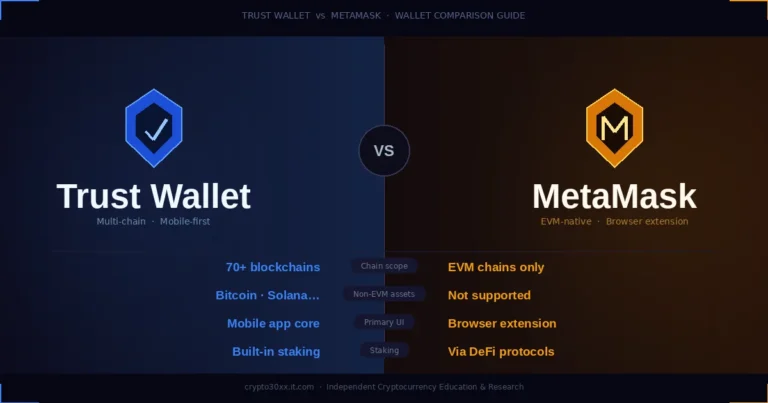
Multi-chain wallets support multiple blockchain networks within a single application. Each network maintains its own set of addresses derived from the same seed phrase, but the addresses are network-specific and not interchangeable.
FAQs
Can a crypto wallet be hacked? The wallet software itself can be compromised if the device is infected with malware or if a user installs a counterfeit application. The cryptographic keys themselves are not hackable through brute force given current computing constraints — the real attack surface is human behaviour, phishing, and insecure key storage.
What happens if I lose my phone with my wallet on it? If you have your seed phrase, nothing is permanently lost. Download the same wallet app on a new device, select “restore wallet,” and enter the seed phrase in the correct order. The wallet will regenerate all your addresses and balances.
Is a crypto wallet the same as an exchange account? No. An exchange account is typically a custodial wallet where the exchange holds the private keys. A self-custody wallet gives you direct control of your keys. Many people use both: an exchange account for buying or selling and a self-custody wallet for long-term holding.
How many wallets can I have? There is no limit. Users frequently maintain multiple wallets for different purposes — a hardware wallet for large holdings, a mobile wallet for everyday use, and separate addresses for different blockchains. Each non-custodial wallet generates its own seed phrase.
What is the difference between a wallet address and a private key? A wallet address is public and safe to share — it is where others send funds, comparable to an account number. A private key is secret and must never be shared — it authorises all outgoing transactions and gives complete control over funds at that address.
Do I need a different wallet for each cryptocurrency? Not necessarily. Multi-chain wallets support dozens of blockchains and thousands of tokens within one application. However, Bitcoin and Ethereum operate on separate networks, and funds must be managed according to which network they belong to. Always confirm network compatibility before sending.
What is a hardware wallet and do beginners need one? A hardware wallet is a physical device that stores private keys in an offline chip, signing transactions without exposing the key to an internet-connected device. Beginners holding small amounts for short periods may not need one immediately. For anyone planning to hold significant value for an extended period, a hardware wallet substantially reduces remote attack risk.
Can I recover a wallet without the seed phrase? Generally, no. Non-custodial wallets have no password recovery mechanism — the seed phrase is the only recovery path. This is why backing it up correctly at setup is so important. Custodial wallets may allow account recovery through customer support if login credentials are lost.
Disclaimer
This article is written for educational purposes only and is intended for learners and researchers exploring how cryptocurrency wallets function. Nothing in this guide constitutes financial, investment, or legal advice. Cryptocurrency assets involve significant risk, including the total loss of funds. Always conduct independent research and consult a qualified professional before making any financial decisions.
Understanding what a crypto wallet is comes down to one structural insight: the wallet manages keys, not coins. The coins live on the blockchain; the keys are what give you control over them. That distinction shapes every practical decision about wallet choice, security, and custody. A user who internalises it — and protects their seed phrase accordingly — has cleared the most important conceptual hurdle in managing digital assets.
Designed to empower, built to inform—our empowerment-driven articles do both.