Ethereum accounts vs wallets: what’s the difference
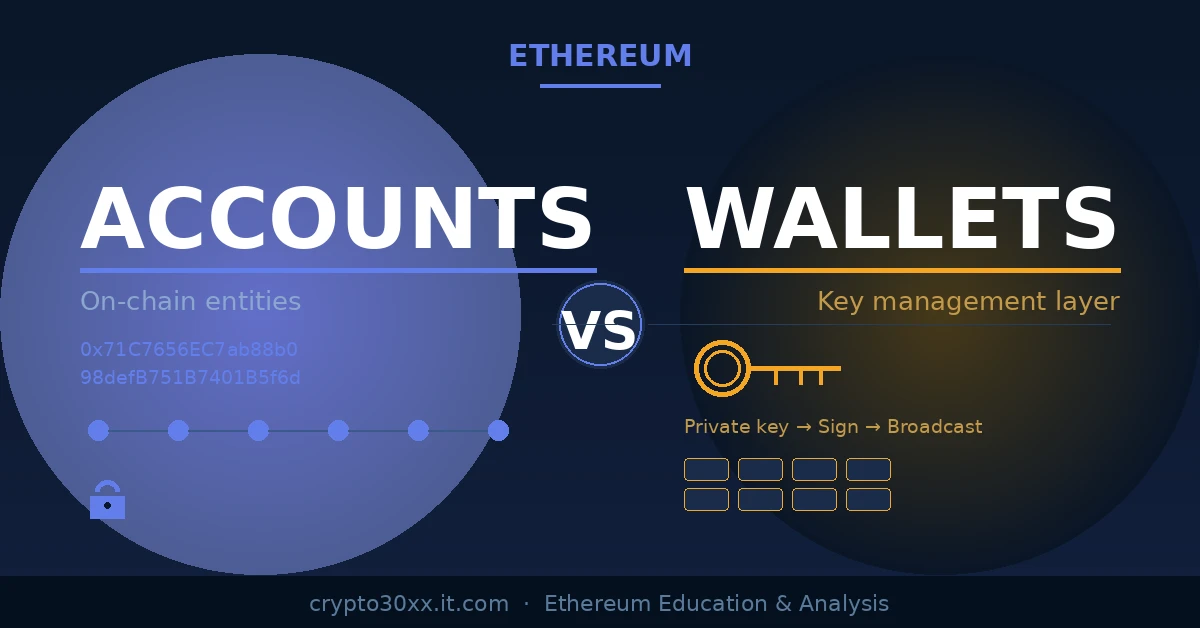
The two terms get used interchangeably in tutorials, wallet interfaces, and exchange help docs — but ethereum accounts vs wallets describe different things at different levels of the network. An Ethereum account is an entity on the blockchain itself: a unique address with a balance, a transaction history, and a state record maintained by the network. A wallet is software (or hardware) that stores private keys and provides the tools to create and control those accounts. Confusing them produces real mistakes around custody, device loss, and security decisions. This guide separates the concepts clearly, explains how they connect, and addresses the misconceptions that cause the most problems.
What is an Ethereum account?
An Ethereum account is a blockchain-level entity — a 42-character hexadecimal address tied to a balance and transaction history maintained by the network itself. No application needs to be running for the account to exist. Two fundamentally different types of accounts operate on Ethereum, and the distinction between them shapes how the network processes every interaction.
Externally owned accounts (EOAs)
EOAs are the accounts most users interact with directly. Each one is controlled by a single private key — a 256-bit number that only the holder possesses. Sending ETH or calling a smart contract from an EOA requires a cryptographic signature produced by that private key. The network verifies the signature and processes the transaction. No other form of authentication applies.
An EOA has four defining properties:
- An address (derived from the corresponding public key)
- An ETH balance, stored as on-chain state
- A nonce (a counter tracking the number of transactions sent from that address)
- No attached code
Whoever holds the private key controls the EOA. There is no recovery mechanism built into the protocol — the key is the account.
Contract accounts
A contract account is deployed to Ethereum by an EOA and governed by code rather than a private key. Once on-chain, it occupies a permanent address and executes logic when called. Unlike EOAs, contract accounts hold persistent storage — data that survives between transactions.
A contract account has:
- An address
- An ETH balance
- A nonce
- Executable code
- Persistent storage (state data)
Contract accounts cannot initiate transactions on their own. They respond only when an EOA sends a transaction to their address, at which point they run their code — which may transfer ETH, call other contracts, emit events, or modify storage.
| Feature | Externally owned account (EOA) | Contract account |
|---|---|---|
| Controlled by | Private key | Smart contract code |
| Can initiate transactions | Yes | No |
| Has executable code | No | Yes |
| Has persistent storage | No | Yes |
| Gas cost to deploy | No | Yes |
| Can hold ETH | Yes | Yes |
What is an Ethereum wallet?
An Ethereum wallet is software or hardware that generates private keys, stores them securely, and uses them to sign and broadcast transactions to the Ethereum network. The wallet does not hold ETH. All account balances exist as state on the Ethereum blockchain; the wallet provides only the cryptographic credentials needed to read and interact with that state.
What wallets actually do
A wallet performs five distinct functions:
- Key generation: Creates private keys using the BIP-39/BIP-44 standard, typically derived from a seed phrase.
- Key storage: Holds private keys locally, encrypted and password-protected.
- Transaction signing: Takes an unsigned transaction and applies the private key to produce a valid cryptographic signature.
- Broadcast: Submits the signed transaction to Ethereum nodes for inclusion in a block.
- Balance display: Queries Ethereum’s state for managed addresses and renders balances and transaction history.
None of these functions involve moving ETH into the application. The ETH has never been inside the wallet — it exists on the blockchain, associated with the account address.
Seed phrases and key derivation
Most software wallets generate a seed phrase on first use — a sequence of 12 or 24 words drawn from the BIP-39 wordlist. This phrase encodes a master private key. Using the BIP-32 hierarchical deterministic (HD) standard, the wallet derives a tree of child private keys from that master. Each branch in the tree corresponds to a separate Ethereum account with its own address.
The structural implication is significant: the seed phrase controls everything. Any compatible wallet given that phrase can re-derive every account the original wallet ever generated. Losing the wallet application is recoverable. Losing the seed phrase with no backup is not.
How Ethereum accounts and wallets relate to each other
The relationship runs one direction. A wallet manages access to accounts; accounts exist independently of any wallet. If every wallet application on earth were deleted tomorrow, all Ethereum account balances on-chain would remain exactly as they are — unchanged and permanent.
One wallet, multiple accounts
HD wallets derive multiple accounts from a single seed phrase using a branching key tree. MetaMask, Trust Wallet, Ledger, and most other mainstream wallets follow this standard. Each account a user adds inside the wallet interface is a new leaf in that derivation tree — a distinct private key and a distinct Ethereum address.
A user with one seed phrase and four accounts in their wallet has four independent EOAs on-chain. All four are recoverable from the seed phrase after reinstalling any compatible wallet. Each has its own address, balance, and transaction history.
Your address is not your wallet
An Ethereum address — a string like 0x71C7656EC7ab88b098defB751B7401B5f6d8976F — is the public-facing identifier of an account. Block explorers such as Etherscan display the balance and full transaction history of any address. Sharing an address is safe and necessary to receive ETH.
The private key that controls that address is the secret. The wallet stores it. The address is derived from the public key using a one-way mathematical function — the private key cannot be reconstructed from the address alone. This asymmetry is the security foundation of Ethereum accounts.
Key differences: accounts vs wallets
The confusion around ethereum accounts vs wallets often comes from how products are marketed. Applications call themselves “wallets” even though they are technically key managers, and they display “your” ETH as if it lives inside the app. The table below makes the structural difference precise.
| Aspect | Ethereum account | Ethereum wallet |
|---|---|---|
| What it is | On-chain entity (address + state) | Software or hardware managing keys |
| Where it lives | Ethereum blockchain | Device, browser extension, or hardware |
| Holds ETH? | Records balance as on-chain state | No — reads and displays balance only |
| Private key | Associated with the account | Stored inside the wallet |
| Permanently deletable? | No — blockchain records are immutable | Yes — app can be uninstalled |
| Recoverable after loss? | Yes, with private key or seed phrase | Yes, by reinstalling and importing seed phrase |
| Publicly visible? | Address is public | Never |
Common misconceptions about Ethereum accounts and wallets
The confusion between these two concepts generates specific, recurring errors. Three appear with enough frequency that addressing them directly is worth doing.
“My wallet holds my ETH”
This is the most widely repeated mistake in crypto education. A wallet application displays a balance — but that balance is a query result from the Ethereum blockchain, not ETH stored on a device. A useful parallel: a banking app shows an account balance, but the bank holds the money, not the phone. For Ethereum, the “bank” is the blockchain, and the wallet is the interface.
The practical consequence: removing a wallet app from a device moves no ETH. The on-chain account state is unchanged. The funds remain where they always were.
“Deleting the wallet means losing the funds”
A device failure, app crash, or phone upgrade should not cause panic. What a wallet stores is the private key. If the seed phrase was backed up when the wallet was first created, the same accounts are fully recoverable — install any compatible wallet, import the phrase, and the application reads the existing on-chain balances.
Permanent fund loss requires permanent loss of the private key or seed phrase with no backup. The application itself is replaceable.
Custodial wallets are structurally different
Exchange wallets — provided by platforms such as Binance, Coinbase, Kraken, and similar services — are custodial: the exchange holds the private keys. The user holds a balance claim recorded in the exchange’s internal database, not an Ethereum account they personally control.
This is a structural difference, not a user-interface feature. The phrase “not your keys, not your coins” names it exactly. Without the private key, the user controls no on-chain account — they hold a contractual relationship with a third party.
Account abstraction is changing the model
EIP-4337 introduced account abstraction to Ethereum — a system that allows smart contract accounts to function where EOAs were previously required. Under account abstraction, a user’s account can be a contract rather than a simple EOA, enabling capabilities that were not previously possible at the account level:
- Social recovery: Regaining access through trusted contacts, without a seed phrase
- Sponsored gas: A third party covers transaction costs on behalf of the user
- Multi-signature authorization: Multiple keys required to approve a transaction, built into the account itself
Wallets implementing EIP-4337 create a contract account for each user and route transactions through a bundler using UserOperations rather than standard signed transactions. The underlying relationship remains the same — wallets manage key material; accounts exist on-chain. But the account’s programmability expands substantially beyond the original EOA model.
FAQs
The following questions reflect what comes up most often when readers work through the relationship between accounts and wallets on Ethereum.
Is my Ethereum wallet address the same as my account address? Not exactly. A wallet manages multiple accounts, each with its own distinct address. The address most users call their “wallet address” is the address of the first account derived from the seed phrase. The wallet itself has no address — it is an application, not an on-chain entity.
What happens to my ETH if I lose my wallet app? The ETH stays on the Ethereum blockchain, unchanged. With the seed phrase backed up, any compatible wallet can import it and display the same account balances. The risk is not losing the app — it is losing the seed phrase with no backup anywhere.
Can two different wallet apps access the same Ethereum account? Yes. Any wallet holding the correct private key or seed phrase can read and control the same on-chain account. This is how account importing works: the wallet reads the key and queries the blockchain state for that address. The account has no loyalty to a specific application.
What is the difference between a hot wallet and a cold wallet? Both terms describe wallet types, not account types. A hot wallet stores private keys on an internet-connected device — a phone app or browser extension. A cold wallet stores keys offline on dedicated hardware. Both can manage the same kinds of on-chain EOA accounts. The difference is where and how the private key is held and whether transaction signing happens on a connected or isolated device.
Does an Ethereum account exist before anyone sends anything to it? An Ethereum address can be generated offline, before any on-chain activity, as a pure mathematical derivation from a private key. The address is valid from the moment it is derived. The account appears in the Ethereum state only once it receives a transaction — before that, it has no on-chain footprint, even though the address is already shareable.
What is a contract account, and do ordinary users interact with them? Every DeFi protocol, token contract, and NFT collection runs on a contract account — an Ethereum account governed by code rather than a private key. When a user swaps tokens on a decentralized exchange, mints an NFT, or deposits into a lending protocol, they send a transaction from their EOA to a contract account, which executes its logic in response.
Is it possible to use an Ethereum account without a wallet? Technically, an address can be funded without any wallet managing it. Practically, without something to store the private key and sign transactions, the account cannot be used. Any Ethereum account in active use has a corresponding wallet — software, hardware, or a custodian managing keys on the user’s behalf.
Disclaimer
This article is written for educational and research purposes only and does not constitute financial, investment, or legal advice. Cryptocurrency assets carry substantial risk, including the possibility of total loss of funds. Readers should conduct independent research and, where appropriate, seek guidance from qualified professionals before making any financial decisions.
The architecture becomes clear once the layers are separated. Ethereum accounts are permanent on-chain state records — addresses, balances, and histories stored on a decentralized network that no single party controls. Wallets are access tools — software or hardware that stores private keys and provides an interface for interacting with those accounts.
The ETH associated with any account has never been inside a wallet application. It exists on the blockchain. The seed phrase controls access to every account derived from it. That structural understanding is the foundation for making sound decisions about custody, key backup, and device management on Ethereum.
Our warm teachings are built for people who want to grow at their own pace in our quiet corner.