What is Ethereum? A simple explanation for beginners
Ethereum is a public blockchain network that allows developers to build and deploy software programs directly on a shared, decentralized ledger — without relying on any company, server, or central authority to keep those programs running. Unlike Bitcoin, which was designed primarily to transfer value, Ethereum was built to run programmable agreements called smart contracts. Anyone with an internet connection can interact with these contracts, and no single entity can shut them down. ETH, Ethereum’s native currency, powers every action on the network by paying for computation. Understanding how these pieces fit together is the foundation for understanding most of modern crypto.
What is Ethereum, exactly?
Ethereum is a decentralized blockchain platform that functions as a global, programmable computer — one where code runs across thousands of independent machines simultaneously, with no single point of control. It was proposed in a 2013 whitepaper by software developer Vitalik Buterin and launched in July 2015 by Buterin and a team of co-founders. The core insight was straightforward: blockchain technology could do more than record coin transfers. It could execute arbitrary programs.
To understand what that means in practice, a brief comparison helps.
Ethereum vs. Bitcoin: two different goals
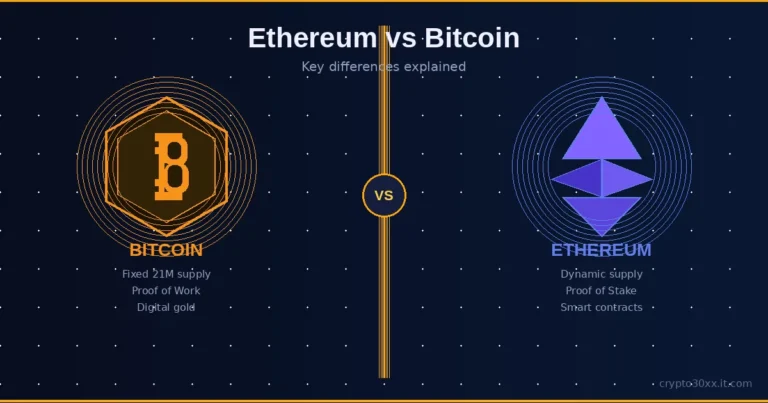
Bitcoin’s blockchain was designed with one primary function: recording and verifying transfers of bitcoin between addresses. Its scripting language is deliberately limited, which makes it secure and predictable but not flexible.
Ethereum’s designers wanted more. They built a blockchain with a built-in, general-purpose programming language. This meant developers could write programs — smart contracts — that live permanently on the chain and execute automatically when certain conditions are met.
| Feature | Bitcoin | Ethereum |
|---|---|---|
| Primary purpose | Digital value transfer | Programmable blockchain platform |
| Native asset | BTC | ETH (ether) |
| Programming language | Limited script | Solidity (Turing-complete) |
| Consensus mechanism | Proof of Work | Proof of Stake (since 2022) |
| Smart contracts | No | Yes |
| dApp support | No | Yes |
| Main use of native asset | Store of value / payments | Paying for computation (gas fees) |
The two networks are not competitors in the same category. Bitcoin is closer to digital gold — a store of value with a fixed supply and minimal programmability. Ethereum is closer to a programmable infrastructure layer — a base for building applications.
ETH vs. Ethereum: the distinction matters
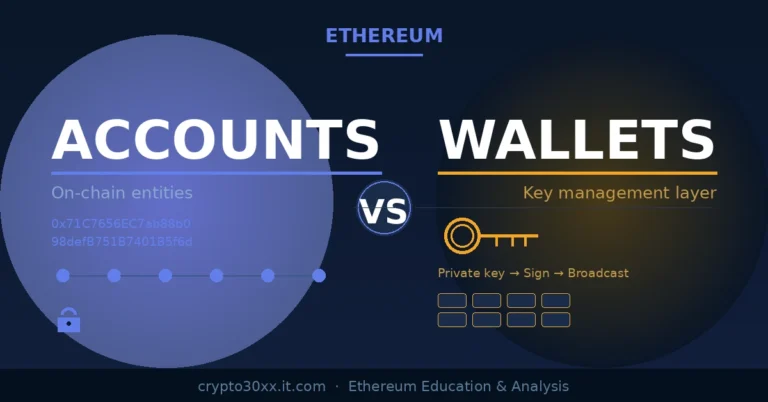
Ethereum is the name of the network. ETH (or ether) is the native cryptocurrency that runs on that network. The confusion between the two is common, especially because most exchanges list “ETH” and most people call it “Ethereum” in casual conversation.
ETH has two primary functions within the network. First, it pays for computation — every transaction and every smart contract interaction costs a small fee, denominated in ETH. Second, it serves as collateral for validators who help secure the network under Ethereum’s Proof of Stake system. Neither of these roles requires ETH to function like a traditional currency, though it can also be used for peer-to-peer transfers.
How does Ethereum work?
Ethereum maintains a shared database — the blockchain — spread across thousands of computers (nodes) worldwide. Every participant’s copy of this database must agree on its current state. That agreement process is called consensus.
The Ethereum Virtual Machine (EVM)
The EVM is Ethereum’s execution engine. Think of it as a single, global computer that every Ethereum node simulates in parallel. When a smart contract runs, the EVM processes its instructions step by step, updating the network’s shared state as it goes — recording changes to account balances, token amounts, or any other data the contract manages.
Every instruction the EVM processes costs gas, a unit that measures computational work. This prevents the network from being overwhelmed by infinitely looping programs or spam transactions. Gas is priced in ETH, so the more computation a transaction requires, the more ETH it costs.
What are smart contracts?
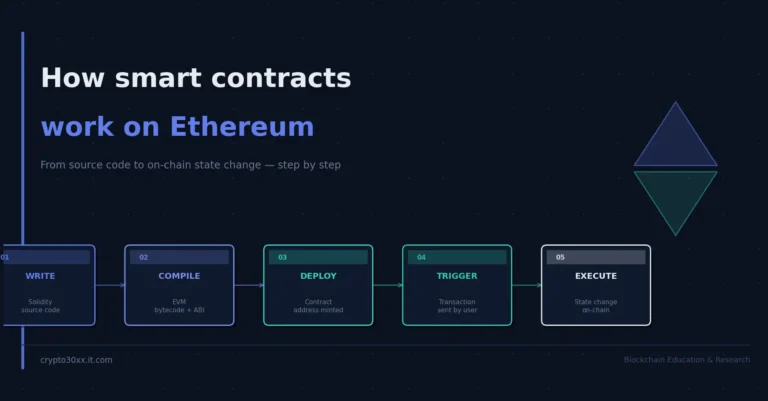
A smart contract is a program stored on the Ethereum blockchain that executes automatically when predefined conditions are met. The code is public, the rules are enforced by the network (not by any company), and once deployed, neither party to a contract can alter the terms without both parties’ agreement.
A useful analogy: imagine a vending machine. You insert a coin, press a button, and the machine delivers a product — no cashier, no negotiation, no trust required. A smart contract works the same way. Define the inputs, define the outputs, and the code handles the rest.
How a transaction flows through Ethereum
Understanding the step-by-step flow makes the mechanics concrete:
- A user creates a transaction in their wallet — this could be sending ETH, swapping tokens, or calling a function in a smart contract.
- The transaction is broadcast to the Ethereum network and enters a pool of pending transactions.
- The user attaches a gas fee (paid in ETH) to incentivize validators to process it.
- A validator selects transactions from the pool and proposes a new block.
- Other validators check the proposed block for validity.
- Once enough validators attest to the block, it is added to the chain.
- The EVM executes the transaction’s instructions and updates the shared state.
- The result is permanent and visible to anyone.
The base portion of the gas fee is permanently destroyed (burned) rather than paid to validators. This mechanism was introduced in a 2021 protocol upgrade called EIP-1559.
Proof of Stake: how Ethereum reaches consensus
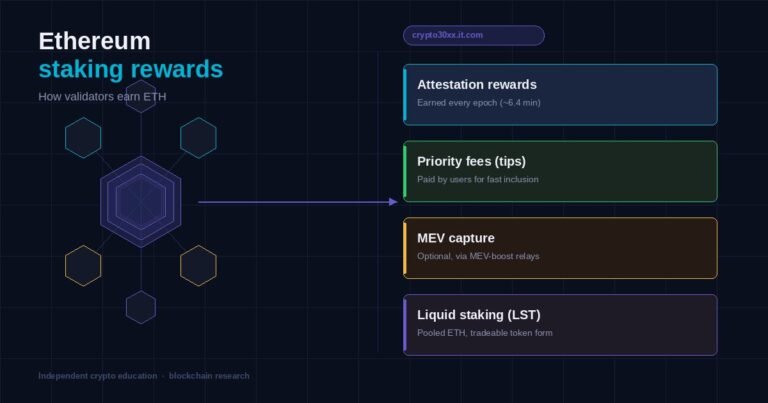
In September 2022, Ethereum completed a transition from Proof of Work to Proof of Stake, an event called the Merge. Under Proof of Stake, validators replace miners as the entities responsible for proposing and confirming new blocks.
To become a validator, a participant must lock up 32 ETH as collateral — this is called staking. Validators are randomly selected to propose blocks, and the rest of the validator set attests to whether the proposed block follows the rules. If a validator behaves dishonestly (for example, by signing contradictory blocks), a portion of their staked ETH can be destroyed through a process called slashing.
This design aligns financial incentives with honest behavior. Acting against the rules costs validators real money.
The Merge reduced Ethereum’s energy consumption by an estimated 99.95% compared to its previous Proof of Work system.
What can Ethereum actually do?
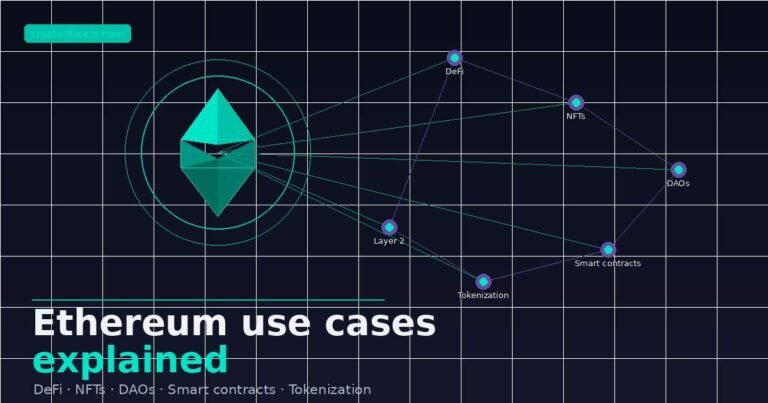
The programmability of Ethereum’s smart contract layer has produced a range of application categories that would not exist on a non-programmable blockchain.
Decentralized finance (DeFi)
DeFi refers to financial services — lending, borrowing, trading, earning yield — built entirely on smart contracts. No bank account is required. The contracts enforce the rules automatically.
Examples include protocols that let users lend assets and earn interest from borrowers, or automated exchanges where token swaps happen algorithmically with no order book or human market maker involved.
Tokens and token standards
Ethereum introduced a standardized way to create new digital assets on top of its network. The most widely used standard, ERC-20, defines a common interface that any fungible token must follow. This interoperability means a token built by one team can immediately work with wallets, exchanges, and applications built by other teams.
Non-fungible tokens (NFTs) use a different standard (ERC-721) to represent unique, non-interchangeable assets — digital art, collectibles, in-game items, or proof of ownership for real-world assets.
Decentralized applications (dApps)
A dApp is any application whose backend logic runs on a blockchain rather than a company’s server. Because the underlying smart contracts are public and permissionless, dApps can be built on top of one another — combining protocols the way software libraries are combined in traditional development.
DAOs (Decentralized Autonomous Organizations)
A DAO is an organization governed by smart contracts rather than by a board or management structure. Token holders vote on proposals, and the contracts automatically execute the outcome. This model allows groups of people to coordinate resources and make decisions without a central authority.
Key risks and limitations to understand
Ethereum’s programmability creates opportunities, but it also introduces risks that do not exist in simpler blockchain systems. Anyone studying or using the network should understand these clearly.
Smart contract risk
Smart contracts are code, and code can contain bugs. Once deployed, a contract cannot typically be altered. If a flaw exists in the logic, an attacker who discovers it can exploit the contract — sometimes draining funds that cannot be recovered. The history of Ethereum includes multiple incidents where poorly audited contracts were exploited for significant sums.
Gas fee volatility
Transaction fees on Ethereum fluctuate with network demand. During periods of high activity, gas costs can rise substantially, making small transactions economically impractical. This has been a persistent criticism and a driver of Layer 2 scaling solutions.
Layer 2 complexity
Layer 2 (L2) networks are separate blockchains that process transactions off the main Ethereum chain and periodically post compressed data back to Ethereum. They dramatically reduce costs and increase throughput, but they introduce additional complexity. Assets must be bridged between layers, and different L2 networks have different security models. Not all L2 solutions are equivalent in their trust assumptions.
Protocol risk
Ethereum is not static. The protocol changes through coordinated upgrades agreed upon by its developer community, validators, and node operators. These upgrades introduce the possibility of unintended consequences, though Ethereum’s track record of major upgrades has been generally stable.
Regulatory uncertainty
The regulatory status of ETH and Ethereum-based applications varies across jurisdictions and continues to evolve. What is permissible in one country may face restrictions in another. This guide does not constitute legal or compliance advice.
Concentration in validation
While Ethereum’s Proof of Stake design is decentralized in principle, staking participation is not uniformly distributed. Large staking pools and liquid staking protocols hold significant validator shares, which represents a practical concentration of influence even within a permissionless system.
Ethereum’s place in the broader blockchain landscape
Ethereum was not the first blockchain, but it introduced a model that most subsequent programmable blockchains have followed or explicitly competed with. Its developer ecosystem, documentation, tooling, and the volume of assets and protocols already deployed on it give it structural advantages that are difficult to replicate from scratch.
The EVM as an industry standard
One lasting consequence of Ethereum’s architecture is that the EVM has become a de facto standard. Many competing Layer 1 blockchains — networks that built their own alternatives to Ethereum — chose to make their virtual machines EVM-compatible. This means smart contracts written in Solidity (Ethereum’s main programming language) can be deployed on these other networks with minimal modification.
From an analytical perspective, this compatibility is significant. It suggests that even competitors acknowledged the network effects embedded in Ethereum’s developer tooling and code base.
Layer 2 scaling as Ethereum’s growth strategy
Ethereum’s roadmap prioritizes Layer 2 scaling over expanding capacity at the base layer. The reasoning is that the base layer should remain maximally secure and decentralized, while high-throughput activity moves to specialized L2 networks that inherit security from Ethereum through cryptographic proofs or fraud-proof systems.
Two dominant L2 architectures exist: optimistic rollups and ZK-rollups. Optimistic rollups assume submitted transaction batches are valid unless challenged during a dispute window. ZK-rollups (zero-knowledge rollups) submit cryptographic proofs that mathematically verify each batch’s correctness, enabling faster finality but with greater technical complexity in implementation.
FAQs
Is Ethereum the same as ETH? No. Ethereum is the name of the network — the blockchain and all the protocols running on it. ETH (ether) is the native cryptocurrency that exists on that network. Every transaction and smart contract interaction on Ethereum requires ETH to pay for computation, but the network itself is the platform, not the asset.
What is a smart contract in simple terms? A smart contract is a program stored on a blockchain that runs automatically when specific conditions are met, without needing a human intermediary to enforce it. Once deployed, the code executes exactly as written. Think of it as an automated agreement where the rules are enforced by the network itself, not by any company or individual.
What is gas in Ethereum? Gas is a unit that measures the computational work required to process a transaction or run a smart contract on Ethereum. Every operation in the EVM costs a certain amount of gas, and users pay for that gas in ETH. Gas fees prevent network spam and compensate validators for the resources they provide.
What is the Ethereum Merge? The Merge was a major protocol upgrade completed in September 2022 in which Ethereum switched its consensus mechanism from Proof of Work (mining) to Proof of Stake (validator staking). The transition eliminated energy-intensive mining and reduced Ethereum’s energy consumption by an estimated 99.95%.
What is the difference between Ethereum and Layer 2 networks? Ethereum’s base layer (Layer 1) is the main blockchain, responsible for security and final settlement. Layer 2 networks are separate blockchains that run on top of Ethereum, processing transactions more cheaply and quickly before posting compressed summaries back to the main chain. Common examples of L2 architectures include optimistic rollups and ZK-rollups.
Can Ethereum smart contracts be changed after deployment? By default, no. Once a smart contract is deployed to the Ethereum blockchain, its code is immutable. Some developers implement upgradeable contract patterns using proxy designs, but these require deliberate architectural choices and introduce their own tradeoffs in trust and complexity.
Who controls Ethereum? No single person, company, or organization controls Ethereum. Protocol changes go through a community process involving researchers, developers, validators, and node operators. The Ethereum Foundation is a non-profit that supports development but does not have unilateral authority over the protocol.
What is the EVM? The Ethereum Virtual Machine is the execution environment that processes smart contract code on Ethereum. Every Ethereum node runs an identical copy of the EVM, and all nodes must agree on the output of every computation. This shared execution environment is what allows decentralized programs to run consistently across the network.
Disclaimer
This article is written for educational and research purposes only by an independent cryptocurrency education blog. Nothing in this article constitutes financial, investment, or legal advice. Cryptocurrency investments carry significant risk, including the risk of total loss of funds. Readers should conduct their own research and, where appropriate, consult qualified professionals before making any financial decisions.
Ethereum’s fundamental contribution was proving that a blockchain could be a general-purpose computing platform, not just a ledger for one asset. The key components — the EVM, smart contracts, gas, Proof of Stake, and the Layer 2 ecosystem built around it — are each products of specific design choices made to solve specific problems. Understanding those choices, rather than treating Ethereum as a monolithic product, is what distinguishes a clear-eyed analysis of the network from surface-level familiarity with the ticker symbol.
Discover something deeply meaningful in our tender library written with you entirely in mind always.