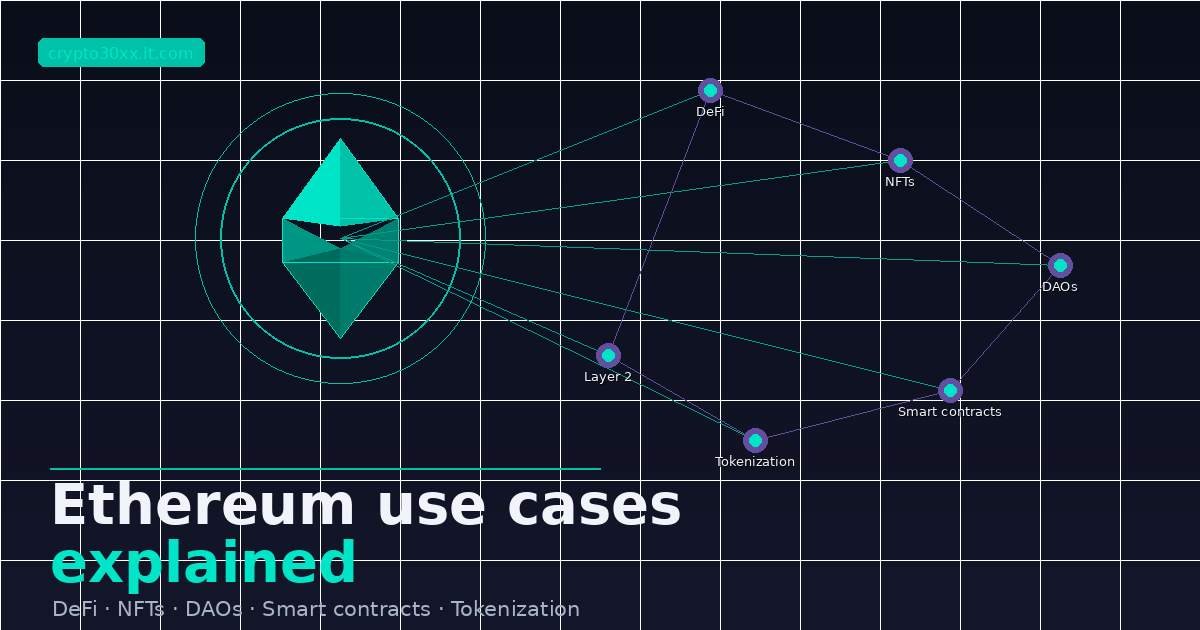
Ethereum use cases explained: the complete guide
Ethereum is a programmable blockchain that lets developers deploy self-executing contracts: code that runs automatically when predefined conditions are met. Unlike Bitcoin, which functions primarily as a value transfer network, Ethereum was designed from the start as a general-purpose computing platform. That design decision opened the door to a broad range of applications, from financial protocols with no central operator to governance systems run by token holders. This guide breaks down the main ethereum use cases explained through the lens of how each one actually works, not what its proponents hope it will become.
What makes Ethereum different from other blockchains?
Ethereum is a smart contract platform: a blockchain where programs, not just value transfers, can be stored and executed on-chain. Every node in the network runs the Ethereum Virtual Machine (EVM), a sandboxed runtime environment that processes the same contract code and reaches the same output. This shared computation is what makes trustless applications possible.
The distinction matters. A standard blockchain records who sent how much to whom. Ethereum records the same thing, but also stores arbitrary logic: “if address A deposits 1 ETH before block N, and oracle O confirms price P, release 0.5 ETH to address B.” No bank, broker, or intermediary needs to be involved. The contract executes when conditions are met.
The role of ETH as network fuel
Every operation on Ethereum costs gas, a unit of computation. Users pay gas fees in ETH, the network’s native currency. Gas serves two functions: it compensates validators for the computation they perform, and it prevents spam by making it expensive to run infinite loops.
The gas price fluctuates with network demand. When many users compete to get their transactions included quickly, they bid up gas prices. When activity is low, fees fall. This fee market is elastic: it doesn’t cap what applications can do, but it does affect what’s economically practical to build.
Why “programmable money” understates the scope
A common framing describes Ethereum as programmable money. That is technically accurate but too narrow. Smart contracts can encode any rule that can be expressed in logic: membership in a group, ownership of a digital object, the results of a vote, the terms of a loan, or the conditions under which a key can be rotated. The network is closer to a programmable trust layer than to a payment network with scripting features.
How smart contracts work in practice
Smart contracts are the foundation beneath every Ethereum application. Understanding how they function makes the specific use cases easier to evaluate.
Deployment and immutability
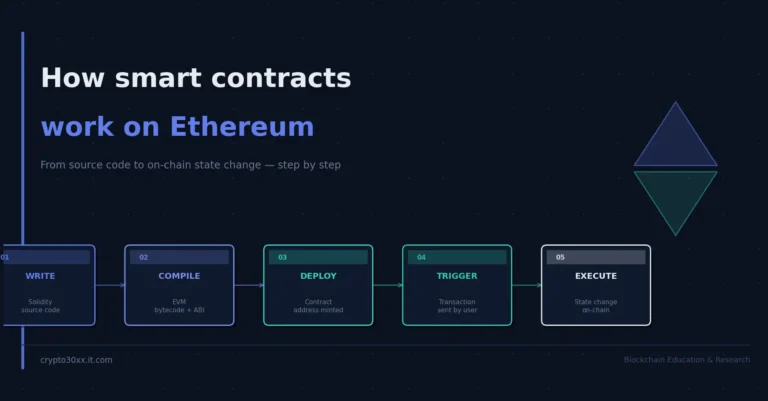
A developer writes contract code in Solidity (or a similar EVM-compatible language), compiles it, and submits a deployment transaction. Once confirmed, the contract lives at a permanent address on the blockchain. Its code cannot be altered after deployment, unless the contract was explicitly designed with an upgrade mechanism, in which case the upgrade logic is itself on-chain and auditable.
This immutability is what makes smart contracts trustworthy in the first place. No one can change the rules after the fact. It also means bugs are permanent unless the contract includes a migration path, which is why security audits matter considerably in this space.
Execution without permission
Anyone can call a public contract function by submitting a transaction. The contract doesn’t check who the caller is unless the code itself includes that check. This permissionless interaction is what makes open financial protocols possible: anyone with an Ethereum address can use them, without approval from any gatekeeper.
Oracles and off-chain data
Smart contracts cannot reach out to the internet. They can only read what is on the blockchain. To use real-world data (prices, weather results, sports scores), contracts must rely on oracles, services that post external data on-chain in a trusted or cryptographically verifiable way. Decentralized oracle networks reduce the single-point-of-failure risk that a single data provider would introduce.
The main ethereum use cases explained with examples
The applications built on Ethereum fall into several distinct categories. Each one exploits a different property of the smart contract model.
Decentralized finance (DeFi)
DeFi is the largest category by activity volume. It refers to financial protocols that operate through smart contracts rather than through licensed institutions. The basic operations (lending, borrowing, trading, earning yield) remain the same. What changes is the operator: a contract instead of a bank.
Lending and borrowing protocols
Overcollateralized lending is the dominant DeFi primitive. A user deposits one asset as collateral and borrows a different asset against it. The loan ratio is enforced algorithmically: if the collateral’s value drops below a threshold, the protocol liquidates enough collateral to cover the loan.
No credit check is required because the math handles solvency. The contract doesn’t need to know who you are or whether you have a job. It only needs to know that collateral value exceeds borrowed value by the required margin.
Decentralized exchanges (DEXs)
Traditional exchanges match buy and sell orders through a central limit order book. Decentralized exchanges use a different model: automated market makers (AMMs). Liquidity providers deposit pairs of tokens into a pool. The pool’s pricing formula, most commonly a constant-product curve, adjusts prices automatically as trades shift the ratio of tokens in the pool.
Traders interact directly with the pool contract. There is no matching engine, no order book, and no custodian. The contract holds the funds and executes swaps algorithmically.
Stablecoins
Stablecoins are tokens designed to maintain a stable value, usually pegged to the US dollar. Several types exist on Ethereum:
| Type | Collateral | Peg mechanism | Risk profile |
|---|---|---|---|
| Fiat-backed | USD held in bank accounts | 1:1 redemption | Custodial, regulatory |
| Crypto-backed | On-chain assets (overcollateralized) | Liquidation system | Smart contract, peg stability |
| Algorithmic | None or partial | Supply expansion/contraction | High — peg can fail |
The on-chain, crypto-backed model is the most compatible with Ethereum’s trustless design, but requires higher collateral ratios to buffer price volatility.
Non-fungible tokens (NFTs)
An NFT is a token with a unique ID, distinguishing it from fungible tokens where each unit is interchangeable. The ERC-721 and ERC-1155 token standards define how NFT contracts work on Ethereum.
The use cases break down into two categories that are often conflated:
Provenance and ownership records: NFTs can represent ownership of a digital file, a piece of in-game equipment, a music license, or a ticket. The token doesn’t store the file itself — it typically stores a pointer to the file and a cryptographic hash for verification. What the blockchain provides is an unforgeable, public record of who holds the token at any given moment.
Programmable royalties and secondary markets: Because the token’s transfer logic is on-chain, creators can embed rules like “pay the original creator 10% of every secondary sale.” This executes automatically on compliant marketplaces, without the creator needing to invoice anyone.
The criticism that NFTs are “just right-click-saveable JPEGs” conflates the image with the ownership record. The actual object being traded is the token, not the file.
Decentralized autonomous organizations (DAOs)
A DAO is an organization whose rules are encoded in smart contracts and whose decisions are made by token holders rather than a traditional management structure.
In practice, DAOs use governance contracts that accept proposal submissions, hold a voting period, and execute approved actions automatically. The treasury is held in a multi-signature wallet or a governance-controlled contract. No single person can unilaterally spend it.
DAOs have been used to govern DeFi protocols (where token holders vote on risk parameters and fee structures), to fund public goods, to manage shared investment pools, and to coordinate open-source software development. The model has real limitations (low voter participation, plutocratic dynamics when token distribution is concentrated) but it represents a genuine experiment in on-chain governance.
Tokenization of real-world assets
Ethereum’s programmability has attracted interest from institutions looking to represent traditional financial assets on-chain. Bonds, equities, real estate shares, and commodities can be tokenized: a smart contract mints tokens that represent fractional ownership, with the issuer holding the underlying asset and maintaining the legal connection between token and claim.
Tokenization improves settlement speed (from T+2 days to near-instant), enables fractionalization of high-value assets, and makes secondary trading programmable. The tradeoff is that the on-chain token is only as trustworthy as the off-chain issuer: tokenized bonds are not trustless, they are simply faster.
Identity and credentials
The Ethereum address functions as a persistent, self-sovereign identifier. Building on this, developers have proposed and partially deployed systems for on-chain credentials: attestations that one address makes about another.
Use cases include proof of personhood (verifying that an address is controlled by a unique human, without revealing who), reputation systems for lending protocols (allowing undercollateralized loans to users with verifiable credit histories), and credential verification for access control.
This space is less mature than DeFi. The key technical challenge is proving real-world facts on-chain without creating honeypots of personal data.
Layer 2 scaling and cross-chain infrastructure
Ethereum’s base layer processes a limited number of transactions per second. Layer 2 networks, rollups in particular, solve this by executing transactions off the main chain and posting compressed proofs back to Ethereum for verification.
From a use-case perspective, layer 2 networks don’t create new applications; they make existing applications cheaper and faster. A DEX that costs $20 in gas fees on the base layer might cost cents on a rollup. This price difference opens Ethereum’s application model to users who cannot afford high transaction costs.
Bridges between chains add a related category: protocols that let assets and messages move between Ethereum and other networks. This infrastructure expands the addressable user base for Ethereum-based applications.
Gaming and digital ownership
Blockchain games have experimented with placing in-game assets on-chain: characters, items, land parcels, and currency. The pitch is genuine ownership: a player’s sword exists as an NFT they control, not as a database entry a game company can delete.
The gap between the promise and the execution has been wide. Most early blockchain games sacrificed gameplay quality for tokenomics. The more credible version of the use case is limited: select high-value in-game assets whose provable scarcity and tradability justify the on-chain overhead, while keeping the rest of the game off-chain for performance.
Risks and limitations across Ethereum use cases
Every ethereum use case described above carries specific risks. These are not theoretical; they have materialized repeatedly in practice.
Smart contract vulnerabilities
Code deployed to Ethereum is immutable and publicly readable. That combination means bugs cannot be patched quietly, and attackers can study the code at leisure. Re-entrancy attacks, oracle manipulation, and integer overflow errors have all led to significant losses from DeFi protocols.
Audits reduce risk but don’t eliminate it. Formal verification (mathematically proving that code meets a specification) is more rigorous but expensive and limited in scope. Users of DeFi protocols are exposed to smart contract risk whether they understand this or not.
Oracle risk
Any protocol that depends on external data depends on the oracle that delivers it. If an oracle can be manipulated (for instance, by a trader who moves a low-liquidity price feed) the contract will act on false data. Flash loan attacks that distort on-chain price feeds and trigger favorable liquidations are the most common exploit pattern that involves oracle manipulation.
Regulatory uncertainty
Many Ethereum-based applications operate in regulatory gray areas. Whether a governance token is a security, whether a DeFi protocol is a money service business, and whether stablecoin issuers require banking licenses are open questions in most jurisdictions. Regulatory action can affect the accessibility or legality of specific applications.
User error and key management
Ethereum accounts are controlled by private keys. Losing the key means losing access to the account permanently. There is no customer service, no account recovery, no password reset. This is a real and permanent risk that centralized services do not impose on users.
Phishing, malicious contract approvals, and seed phrase theft account for a large portion of individual losses. The absence of a custodian is also the absence of a backstop.
Gas cost volatility
High network demand makes transactions expensive. During periods of peak activity, gas fees can make small transactions uneconomical on the base layer. This affects who can practically access applications and creates operational unpredictability for protocols that need frequent on-chain interactions.
Ethereum vs. competing smart contract platforms
Other blockchains have deployed EVM-compatible environments or purpose-built smart contract runtimes. Comparing them clarifies what is specific to Ethereum and what is portable.
| Attribute | Ethereum | EVM-compatible L1s | Non-EVM L1s |
|---|---|---|---|
| Decentralization | High validator count, long track record | Varies; often fewer validators | Varies; newer, less battle-tested |
| Developer tooling | Most mature | Compatible with Ethereum tooling | Custom tooling required |
| Liquidity depth | Largest in DeFi by most metrics | Growing, fragmented | Varies by chain |
| Transaction throughput | Limited at L1; expanded via L2 | Higher than Ethereum L1 | Often higher, tradeoffs differ |
| Security model | Proof of stake, ETH staked as slashable collateral | Varies | Varies |
The choice between chains is not purely technical. Application developers consider where the users and liquidity are, not just which chain has the fastest block time.
FAQs
What is the primary use case of Ethereum? Smart contract execution is Ethereum’s foundational function. Every other use case (DeFi, NFTs, DAOs, tokenization) runs on top of the smart contract layer. Without that programmable foundation, Ethereum would be a slower, less efficient value transfer network with no meaningful advantage over simpler alternatives.
Can Ethereum be used as a payment network? Technically yes, but it was not optimized for that role. ETH transfers work, but gas fees and confirmation times make small payments impractical on the base layer. Layer 2 networks make Ethereum-based payments more viable by reducing cost and increasing throughput significantly.
What is the difference between ETH and ERC-20 tokens? ETH is the native currency of the Ethereum network, used to pay gas fees and stake. ERC-20 tokens are smart contracts that follow a standard interface, allowing them to be transferred, approved, and listed on exchanges. They run on top of Ethereum but are not the same as ETH; they require ETH to pay the gas for their transactions.
How do DAOs make decisions on Ethereum? A DAO governance contract accepts proposals, holds a voting window during which token holders submit their votes, counts the results, and executes the winning action automatically if the threshold is met. The entire process (voting, counting, execution) runs on-chain. No administrator is needed to implement the outcome.
Are NFTs only used for art and collectibles? No. The art and collectible applications were the most publicized early uses, but the NFT standard is a general ownership record mechanism. Practical applications include event ticketing, music licenses, in-game items, membership credentials, and domain names. The core property, a unique and transferable on-chain token, applies wherever unique ownership records are useful.
What happens if a smart contract has a bug? Once deployed, contract code cannot be changed. If a vulnerability is found, developers can only respond by pausing the contract (if a pause mechanism was included), migrating users to a new contract, or in severe cases pursuing a governance vote to take emergency action. Several major DeFi protocols have been exploited due to contract vulnerabilities, resulting in permanent losses for users.
Is DeFi regulated? Regulatory frameworks vary by jurisdiction and are actively evolving. Some jurisdictions have proposed treating certain DeFi protocols as financial services providers. Others have issued guidance on specific token categories. Users of DeFi applications should be aware that the regulatory status of what they are using may change, and that current regulatory ambiguity does not mean permanent permission.
Disclaimer
This article is written for educational and research purposes only. Nothing in this guide constitutes financial, investment, or legal advice. Crypto assets, including ETH and tokens built on the Ethereum network, carry significant risks including loss of principal, smart contract vulnerabilities, regulatory uncertainty, and permanent loss from key mismanagement. Consult a qualified financial or legal professional before making any financial decisions.
Conclusion
Ethereum’s contribution is a single, general insight: if you can write a rule as code and deploy it to a shared, tamper-resistant network, you can enforce that rule without needing anyone to trust anyone else. From that insight flows every application covered here: lending protocols, token standards, governance systems, ownership records.
The range of ethereum use cases explained in this guide is real. So are the limitations. Smart contract bugs, oracle manipulation, gas costs, and regulatory exposure are not hypothetical edge cases. They are the practical constraints within which every Ethereum application operates.
The honest takeaway is that Ethereum provides a genuinely new type of infrastructure: programmable, permissionless, and publicly verifiable. What that infrastructure ultimately delivers depends on how well developers, users, and regulators navigate the risks that come with removing the middleman.
Our caring library holds space for every kind of reader who visits our healing space every day.