Ethereum network upgrades history: every major fork explained
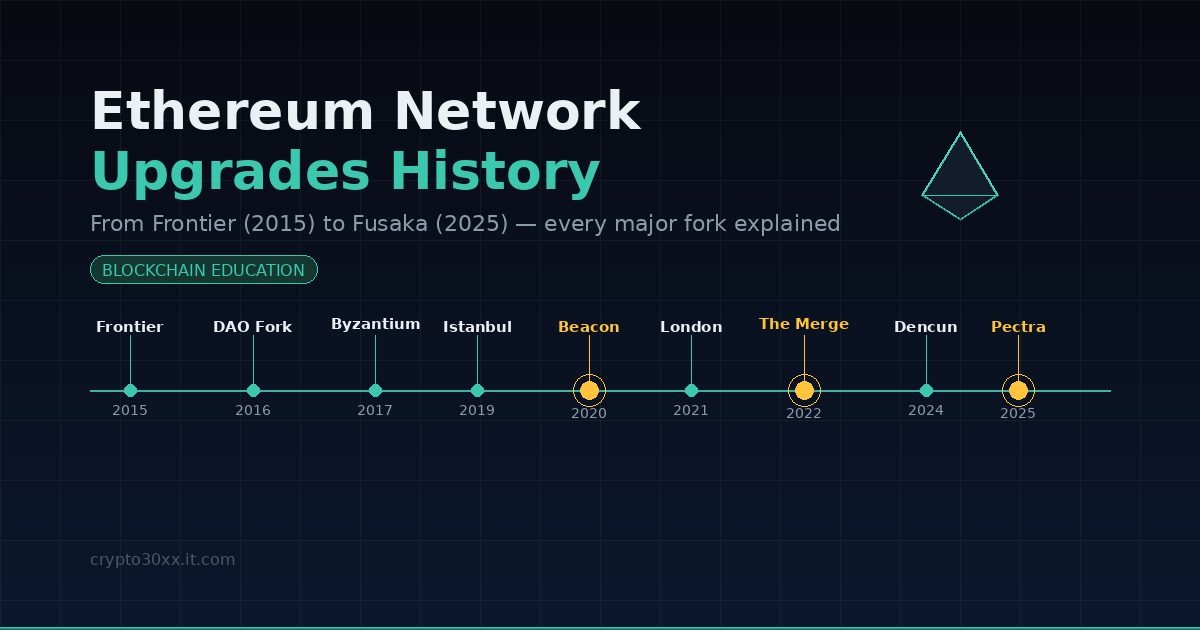
Ethereum network upgrades history is the story of a live, decentralized system reinventing itself from the inside out. Since the genesis block in July 2015, the network has completed more than 20 hard forks — each one bundling Ethereum Improvement Proposals (EIPs) that fix a specific limitation, introduce new capabilities, or prepare the ground for the next phase of growth. Understanding this sequence is one of the most direct ways to understand how Ethereum actually works today: why gas fees behave as they do, why staking is structured the way it is, and why Layer 2 networks exist at all.
What are Ethereum network upgrades and how do they work?
Ethereum network upgrades are coordinated protocol changes that require every node operator and validator to update their client software simultaneously. Unlike a company pushing a new software version to its own servers, Ethereum has no central authority — so upgrades must be agreed upon through a public process involving researchers, core developers, and node operators across the globe.
The process works through EIPs. Any community member can submit a proposal to the EIP repository. From there, proposals are discussed on forums such as Ethereum Magicians and in the protocol’s core developer calls, tested on developer testnets and public testnets, and eventually bundled into a named hard fork. If node operators update their software, the new rules take effect at a specified block number or epoch. If they don’t, they diverge onto a minority chain — which is how Ethereum Classic was created in 2016 after the DAO fork.
Execution layer vs. consensus layer naming
Since the Merge in September 2022, Ethereum’s architecture has two distinct components — and upgrades target both simultaneously. The execution layer handles transactions and smart contract logic. The consensus layer (originally the Beacon Chain) handles validator coordination and block finalization. Each side has its own naming convention, and the two halves are combined into a single colloquial name:
| Execution upgrade | Consensus upgrade | Short name |
|---|---|---|
| Shanghai | Capella | Shapella |
| Cancun | Deneb | Dencun |
| Prague | Electra | Pectra |
| Osaka | Fulu | Fusaka |
| Amsterdam | Gloas | Glamsterdam |
Execution upgrades are named after cities that hosted past Devcon or Devconnect events, in chronological order. Consensus upgrades are named after stars in alphabetical sequence.
Phase 1 — Foundation (2015–2016): building from scratch
Ethereum’s earliest upgrades were less about feature additions and more about removing training wheels from a system that launched intentionally bare-bones.
Frontier (July 2015)
The genesis block was mined on July 30, 2015. The Frontier release was a command-line-only environment for developers. The block gas limit was hardcoded at 5,000 — so low that complex smart contracts were essentially impossible to deploy. Its purpose was simple: prove the system worked on a public network before opening it to broader use.
Frontier Thawing (September 2015)
This small fork lifted the hardcoded gas limit and set a default gas price, making the network practically usable for the first time. It also introduced the difficulty bomb — a mechanism designed to gradually make proof-of-work mining so computationally intensive that it would eventually force the network’s transition to proof-of-stake. That bomb would be delayed five separate times over the following six years before finally being retired at the Merge.
Homestead (March 2016)
Homestead was the first planned, non-emergency hard fork. It stabilized the protocol, improved smart contract functionality, and removed “canary contracts” — centralized kill switches the Ethereum Foundation had held as emergency brakes on the network. Their removal was a meaningful step toward genuine decentralization.
The DAO fork (July 2016)
This upgrade was the most consequential and contested in Ethereum’s history. A decentralized venture fund called The DAO had raised roughly $150 million in ETH through a token sale. An attacker exploited a reentrancy vulnerability in its smart contract code and drained approximately 3.6 million ETH.
The community faced a direct conflict between two principles: “code is law” (meaning on-chain outcomes are final) or pragmatic intervention (returning funds to their original owners). The Ethereum Foundation proposed a hard fork to reverse the theft. A community vote showed over 85% support. At block 1,920,000, the network split: the majority followed the forked chain (which retained the Ethereum name), while a minority continued the original unforked chain as Ethereum Classic. The decision established a clear precedent — Ethereum’s governance prioritizes practical outcomes over ideological rigidity when the stakes are high enough.
Tangerine Whistle and Spurious Dragon (October–November 2016)
Two rapid-fire emergency forks addressed a wave of denial-of-service attacks that had clogged the network through the autumn of 2016. Tangerine Whistle repriced several opcodes that had been underpriced, making spam attacks more expensive. Spurious Dragon followed with additional repricing, replay attack protection between Ethereum and Ethereum Classic, and the ability to purge empty accounts that the DoS attacks had created to bloat the state.
Phase 2 — Metropolis and the long climb to proof-of-stake (2017–2020)
After the chaos of 2016, Ethereum entered a period of deliberate technical hardening and long-horizon preparation.
Byzantium (October 2017)
Byzantium was the first of the two Metropolis-era forks. It reduced block mining rewards from 5 ETH to 3 ETH — a deliberate signal that mining would eventually become obsolete. More technically significant, it added elliptic curve operations (EIP-196 and EIP-197) that made zero-knowledge proofs practical on Ethereum for the first time. Those zk-SNARK primitives would become central to Ethereum’s scaling approach nearly a decade later. The difficulty bomb was delayed by one year.
Constantinople and Petersburg (February 2019)
Constantinople was delayed once by a security vulnerability discovered during auditing — the final version shipped alongside a Petersburg patch that removed the vulnerable code. Together they reduced block rewards further to 2 ETH, optimized several EVM operations, and added the CREATE2 opcode, which allows smart contracts to predict the address of a contract before it is deployed. The difficulty bomb was pushed back again.
Istanbul (December 2019)
Istanbul optimized gas costs for several EVM operations, made the network more resistant to denial-of-service attacks, and — most notably for what came later — reduced the cost of zero-knowledge proof operations and calldata. Those reductions made Layer 2 scaling solutions using SNARKs and STARKs meaningfully cheaper to operate. Istanbul was the first upgrade that implicitly pointed toward a rollup-centric future, even though the term wasn’t in common use.
Muir Glacier (January 2020)
A single-purpose fork that delayed the difficulty bomb for approximately 611 days. By this point, it had been delayed four times. The joke in developer circles was that Ethereum kept writing promissory notes it would eventually have to honor.
Beacon Chain genesis (December 2020)
On December 1, 2020, the Beacon Chain went live as a separate, parallel proof-of-stake blockchain running alongside the existing proof-of-work mainnet. It processed no user transactions — its sole function was to coordinate validators and demonstrate that the new consensus mechanism worked at scale. To start producing blocks, it required 16,384 validator deposits of 32 ETH each, which was reached on November 27, 2020.
The strategic patience behind this approach is worth noting. Rather than attempting a single-step switch of the consensus mechanism on a live network, Ethereum ran two parallel chains for nearly two years, accumulating real-world validator data before committing. It was one of the most disciplined risk-management decisions in the network’s history.
Phase 3 — The great transition (2021–2022)
Berlin and London (April–August 2021)
Berlin optimized gas costs for state access operations and introduced typed transaction envelopes — a structural change that made the protocol easier to extend with new transaction formats in future upgrades.
London, four months later, was more economically significant. It included EIP-1559, which restructured how transaction fees work. Before London, fees operated as a simple auction: users bid against each other for block space, and miners kept all fees. EIP-1559 introduced a protocol-set base fee that adjusts automatically based on network demand. That base fee is burned — permanently removed from ETH supply — rather than paid to validators. Users can add a priority fee (tip) to speed up transactions, but the base fee’s predictability eliminated the worst of the fee-guessing behavior that made Ethereum expensive during busy periods. EIP-1559 introduced deflationary pressure on ETH supply for the first time.
### Altair, Arrow Glacier, Gray Glacier (2021–2022)
Altair was the first planned upgrade to the Beacon Chain, bringing validator inactivity and slashing penalties to their full intended values and adding sync committees to support lightweight clients. Arrow Glacier and Gray Glacier were both single-purpose difficulty bomb delays — the fifth and sixth times the bomb had been postponed.
The Merge (September 2022)
On September 15, 2022, at block 15,537,393, the proof-of-work execution layer merged with the proof-of-stake Beacon Chain. Mining stopped permanently. Ethereum’s energy consumption dropped by approximately 99.95% overnight. New ETH issuance fell by roughly 90% compared to proof-of-work rates. Combined with EIP-1559’s ongoing fee burning, the network became periodically net-deflationary for the first time.
The Merge executed without a single second of downtime — widely regarded as the most complex live infrastructure migration in the history of decentralized systems.
What the Merge did not do: reduce transaction fees or increase throughput. Those were never its objectives. Its purpose was sustainability and security — switching to a consensus mechanism that didn’t depend on competitive energy expenditure. Scaling would come through a separate set of upgrades.
| Metric | Before the Merge (PoW) | After the Merge (PoS) |
|---|---|---|
| Consensus mechanism | Proof-of-work | Proof-of-stake |
| New ETH issuance | ~13,000 ETH/day | ~1,700 ETH/day |
| Energy consumption | Comparable to a mid-size country | Down ~99.95% |
| Transaction throughput | ~15 TPS | ~15 TPS (unchanged) |
| Block time | ~13 seconds (variable) | 12 seconds (fixed) |
Phase 4 — The rollup era (2023–2025)
Shapella (April 2023)
Shanghai on the execution layer and Capella on the consensus layer deployed simultaneously, giving them the combined name “Shapella.” The headline feature was EIP-4895: validator withdrawals. Since the Beacon Chain launched in December 2020, staking had been a one-way door. Validators could deposit 32 ETH to join, but could not withdraw their stake or accumulated rewards. Shapella opened that door.
The upgrade also activated automatic reward sweeping, so validators passively receive rewards without manual withdrawal transactions. Contrary to expectations of a rush for the exit, most validators chose to remain staked once the option to leave actually existed.
Dencun (March 2024)
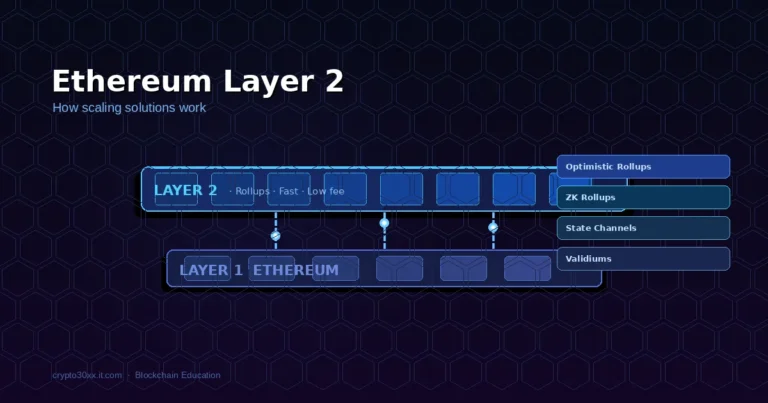
Dencun (Cancun on execution, Deneb on consensus) was a turning point in Ethereum’s scaling architecture. The centerpiece was EIP-4844, known as proto-danksharding, which introduced a new data type called blobs.
Blobs are temporary data packets attached to Ethereum blocks. Layer 2 rollups use them to post compressed transaction data back to Ethereum for security, at a small fraction of the cost of regular calldata. The data is available for roughly 18 days and then pruned — long enough for the network to verify it, short enough not to permanently inflate node storage requirements.
The impact on Layer 2 fees was immediate and significant. Transaction costs on rollup networks dropped by 90–95% within days of the upgrade activating. Dencun formalized Ethereum’s rollup-centric strategy in concrete terms: the base layer’s primary job is to be the best possible data availability and settlement layer for the networks that handle actual user transactions.
Pectra (May 2025)
Prague on the execution layer and Electra on the consensus layer shipped together as Pectra. With 11 EIPs included, it was the largest single upgrade in Ethereum’s history by number of proposals.
The headline on the user experience side was EIP-7702, which allows regular externally owned accounts (EOAs) to temporarily behave like smart contract wallets. This unlocked batch transactions, gas sponsorship (where a third party pays the fee), programmable spending controls, alternative authentication methods, and account recovery mechanisms — all without requiring users to migrate to a new wallet type.
On the staking side, EIP-7251 raised the maximum effective balance for a single validator from 32 ETH to 2,048 ETH, making large-scale staking more capital-efficient. EIP-7002 allowed stakers to trigger validator exits directly from their execution layer withdrawal address, removing dependency on node operators for exit operations. Blob capacity per block increased from a target of 3 to 6.
Fusaka (December 2025)
Fulu on consensus and Osaka on execution arrived as Fusaka, bringing deeper infrastructure changes than Pectra. The headline feature was PeerDAS (EIP-7594), a protocol for distributing data availability verification across the network. Before Fusaka, every node had to download and store every blob in full. PeerDAS introduced data availability sampling: nodes download small random samples of blob data and use cryptographic techniques to confirm the full dataset is available without anyone needing to store all of it. This distinction matters because blob demand from Layer 2 networks was approaching capacity limits, and PeerDAS makes scaling blob capacity viable without proportionally scaling per-node hardware requirements.
Fusaka also introduced Blob Parameter Only (BPO) forks, a mechanism enabling blob capacity adjustments between major hard forks. The gas limit rose from 45 million to 60 million per block, with a 16.7 million cap per individual transaction.
Ethereum’s six-phase roadmap: where the upgrades are heading
The long-term development plan is organized around six overlapping conceptual phases. These are not sequential checkboxes — active research and development occurs across multiple phases simultaneously, and any given hard fork typically advances several phases at once.
| Phase | Status | Core objective |
|---|---|---|
| The Merge | Complete | Transition to proof-of-stake consensus |
| The Surge | In progress | Massive scaling via rollups and danksharding; target 100,000+ TPS across L1 and L2 |
| The Scourge | In progress | Address MEV centralization and validator concentration; enshrined Proposer-Builder Separation (ePBS) |
| The Verge | In progress | Verkle Trees to enable stateless clients; anyone can validate without storing full chain history |
| The Purge | In progress | Remove historical data storage requirements; reduce node operating costs |
| The Splurge | In progress | Account abstraction, EVM improvements, advanced cryptography, post-quantum security |
Glamsterdam and beyond
The next scheduled upgrade is Glamsterdam (Amsterdam on execution, Gloas on consensus), targeted for the first half of 2026. Two confirmed headline features are enshrined Proposer-Builder Separation (ePBS) — which decouples the roles of block proposers and block builders to reduce MEV-driven centralization — and Block-level Access Lists (EIP-7928), which enable parallel transaction execution by pre-declaring which state each transaction will touch. The combination could meaningfully increase Layer 1 throughput.
Following Glamsterdam, the upgrade named Hegotá is in planning, with Verkle Trees frequently cited as a candidate for inclusion. Verkle Trees would restructure how Ethereum stores state data, enabling stateless clients that can validate blocks without downloading the entire chain history.
Longer-term, the research agenda includes single-slot finality (reducing transaction confirmation times from roughly 15 minutes to 12 seconds), full danksharding (replacing proto-danksharding’s limited blob capacity with a much larger permanent data availability layer), and post-quantum cryptographic preparations. The Ethereum Foundation has allocated dedicated research resources to post-quantum security given the long timeline of potential threats.
Common misconceptions about Ethereum upgrades
The Merge reduced transaction fees. It did not. The Merge changed the consensus mechanism and had no direct effect on Layer 1 transaction throughput or fee levels. Fee reduction came primarily through the Dencun upgrade’s blob implementation.
EIP-1559 made Ethereum deflationary. EIP-1559 introduced deflationary pressure, but whether ETH supply increases or decreases depends on network activity. During low-activity periods, issuance exceeds burning and supply grows. During high-activity periods, burning can exceed issuance. The direction has varied across different market conditions.
Hard forks are contentious splits. Most Ethereum hard forks are planned, coordinated upgrades where the entire active network follows the new rules. An actual chain split — where a meaningful minority continues on the old chain — has happened once in Ethereum’s history: the DAO fork in 2016 that created Ethereum Classic.
Staking validators earn high, guaranteed yields. Validator rewards depend on total ETH staked (which affects the issuance rate), network activity (which affects priority fees and MEV), and whether the validator maintains uptime. None of these factors are fixed, and the relationship between them changes with each upgrade.
FAQs
How many Ethereum network upgrades have there been? Ethereum has completed more than 20 mainnet hard forks since the genesis block in July 2015. These range from single-purpose bomb delays like Muir Glacier and Arrow Glacier to transformational upgrades like the Merge, which switched the entire consensus mechanism from proof-of-work to proof-of-stake.
What was the first Ethereum network upgrade? The first upgrade after the genesis launch was Frontier Thawing, activated at block 200,000 in September 2015. It lifted the initial gas limit hardcoded at 5,000, made the network practically usable for transactions, and introduced the difficulty bomb mechanism that would eventually push the network toward proof-of-stake.
Why does Ethereum use hard forks instead of soft forks? Most Ethereum upgrades are implemented as hard forks because they introduce changes that are not backward-compatible — nodes running old software would reject blocks created under the new rules. A soft fork, by contrast, tightens the rules in a way that keeps old nodes valid. Hard forks require full network coordination but allow more fundamental changes to the protocol.
What is the difficulty bomb and why was it repeatedly delayed? The difficulty bomb is a mechanism that exponentially increases proof-of-work mining difficulty over time, eventually making mining impractical. It was designed to force the eventual transition to proof-of-stake by making continued mining untenable. It was delayed six times between 2015 and 2022 because the Beacon Chain and the Merge itself required more development time than originally anticipated. The bomb was permanently retired when mining stopped at the Merge.
What is a blob and why did Dencun introduce them? A blob (binary large object) is a temporary data packet attached to Ethereum blocks, introduced by EIP-4844 in the Dencun upgrade. Layer 2 rollups post compressed transaction data to Ethereum via blobs rather than through regular calldata. Blobs are available on the network for roughly 18 days, then pruned, which keeps node storage requirements manageable while still providing data availability for verification. The result was a 90–95% reduction in Layer 2 transaction costs.
What is the difference between Pectra and a regular upgrade? Pectra (May 2025) was the largest Ethereum upgrade by EIP count, bundling 11 separate proposals. Most upgrades include 3–6 EIPs. The size reflected two previously planned upgrade tracks (Prague and Electra) being merged into a single delivery, and the breadth of changes covered user account functionality, staking mechanics, and blob capacity in one coordinated release.
What is the next Ethereum upgrade after Fusaka? Glamsterdam is the next planned upgrade. Its confirmed features include enshrined Proposer-Builder Separation (ePBS), which addresses MEV centralization at the protocol level, and Block-level Access Lists that enable parallel transaction execution. The upgrade targets the first half of 2026.
Can Ethereum upgrades break existing smart contracts? In theory, yes — protocol changes can affect how the EVM executes code. In practice, the Ethereum core developer process is specifically designed to prevent breaking changes to deployed contracts. EIP proposals that could affect existing contracts undergo extensive compatibility testing before inclusion. There have been cases where individual EIPs were delayed or modified because audits found potential contract interactions, Constantinople in 2019 being the clearest example.
Disclaimer
This article is written for educational and research purposes by an independent crypto education blog. Nothing in this article constitutes financial, investment, or legal advice. Ethereum’s protocol is complex, actively developing, and subject to change through future upgrades. Readers should conduct their own research and consult qualified professionals before making any decisions based on information about blockchain networks or digital assets.
Ethereum’s upgrade history follows a consistent pattern: each generation of changes creates the conditions for the next set of problems, and each upgrade cycle addresses them. Proof-of-work created the energy and centralization issues that motivated the Merge. The Merge’s reduced issuance and fee-burning combination created new questions about ETH economics. Rollup scaling lowered fees but surfaced interoperability and data availability constraints that Dencun and Fusaka address. The network’s strength is not that it got everything right the first time — it is that it has built a process capable of fixing what’s wrong while keeping everything running.
Find peace in our quiet writings and carry that stillness into everything you do throughout today.