Ethereum staking rewards guide: how validators earn ETH
Ethereum staking rewards guide: Ethereum staking rewards are the ETH paid to validators who lock up 32 ETH (or a pooled share of it) to help secure the network under its proof-of-stake consensus system. After the network switched from proof-of-work to proof-of-stake, validating blocks replaced mining as the mechanism for both processing transactions and issuing new ETH. Validators earn rewards for proposing and attesting to blocks; they also collect a share of priority fees and, occasionally, MEV (maximal extractable value). This guide explains how those reward streams work, what determines their size, and how the three main participation paths differ in structure, cost, and risk.
What is Ethereum staking and why does it pay rewards?
Staking on Ethereum is the act of depositing ETH as collateral in the consensus layer to participate in block production and attestation. The network needs validators — participants who hold real economic stake — to agree on which transactions are valid and which chain is canonical. Rewards are the mechanism that makes participation worth the capital and operational cost.
Without rewards, rational participants would have no incentive to lock up capital and run validator software around the clock. The protocol issues new ETH to compensate for this. It also passes through a portion of user-paid priority fees (the “tip” users add to get transactions included faster), and validators who use MEV-boost software can capture additional value from transaction ordering.
The three reward streams validators receive
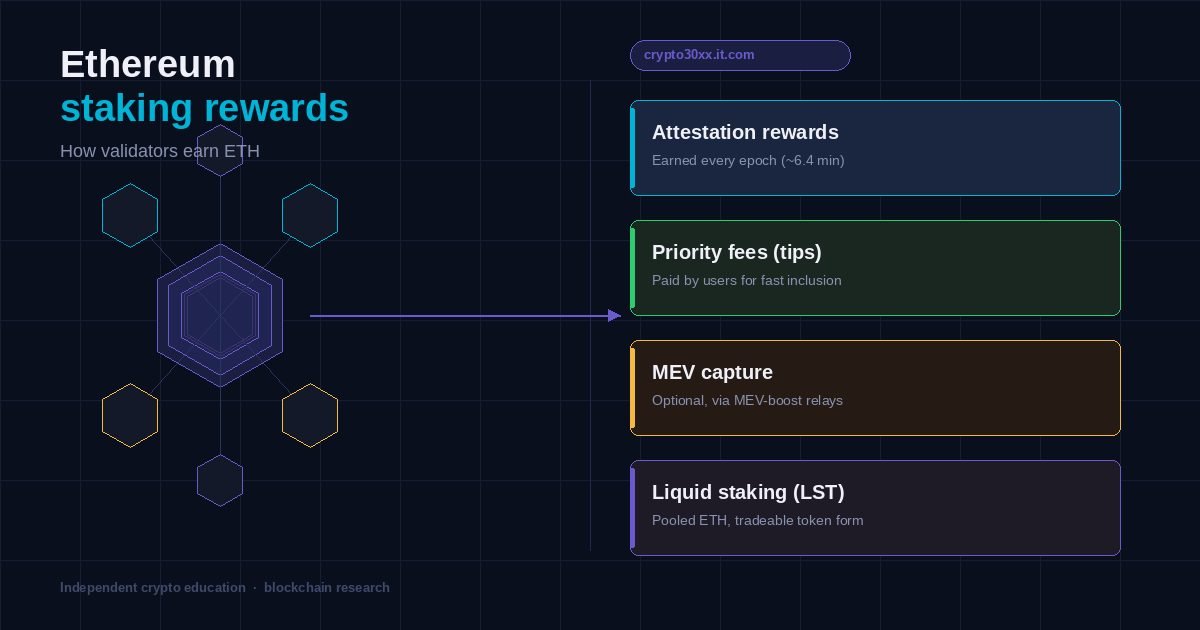
Ethereum validator income comes from distinct sources, each with different characteristics:
- Issuance rewards: New ETH created by the protocol and paid to validators for proposing and attesting to blocks. This is the baseline, predictable layer of staking income.
- Priority fees (tips): A portion of the transaction fee that users attach to get faster inclusion. These pass directly to the block proposer rather than being burned.
- MEV (maximal extractable value): Profit from reordering, inserting, or censoring transactions within a block. Captured via MEV-boost relays by validators who opt into this. Highly variable and not a guaranteed component.
The EIP-1559 upgrade introduced a base fee that is burned rather than paid to validators. This reduces net ETH issuance when network activity is high and acts as a deflationary pressure on total supply, independent of staking rewards.
How Ethereum staking rewards are calculated
The protocol calculates issuance rewards based on total ETH staked across the network. The relationship is inverse: as more ETH is staked, the annual percentage yield per validator falls. As less ETH is staked, yield rises. This self-correcting design keeps the network secure without over-issuing ETH.
The issuance formula
The annual issuance rate follows this general structure:
Annual issuance = Base reward factor × √(total ETH staked)
The base reward factor is a constant set in the protocol. Because it scales with the square root of total staked ETH, doubling the amount staked does not double total issuance — it increases it by roughly 41%. This means individual validator rewards decrease as participation grows.
In practical terms, when staked ETH is low (for example, 10 million ETH), individual validators earn higher yields because total issuance is shared among fewer participants. When staked ETH reaches high levels (for example, 30–40 million ETH), the same base factor generates less per validator even though total issuance is larger.
Effective balance and the 32 ETH ceiling
Each validator has an “effective balance” capped at 32 ETH. Rewards are proportional to effective balance, so a validator with 32 ETH earns rewards at the same rate per ETH as one with 33 ETH — the extra 1 ETH above the cap earns nothing until withdrawn and restaked in a new validator. Operators running multiple validators each fund them separately at 32 ETH each.
The impact of network activity on total yield
Priority fees and MEV are not predictable in the way issuance is. During periods of high transaction volume — for example, during heavy DeFi activity or major NFT minting events — block proposers collect substantially more in tips. During quieter periods, priority fees shrink to near zero. Validators track consensus-layer rewards (issuance) and execution-layer rewards (tips and MEV) separately.
Three ways to stake ETH and earn rewards
Participation in Ethereum staking falls into three broad categories. Each involves different technical requirements, capital minimums, custody arrangements, and fee structures.
Solo staking: full validator operation
Solo staking means running a full validator node with 32 ETH deposited directly to the consensus layer. The validator software runs on hardware the staker controls.
How it works:
- Deposit exactly 32 ETH to the official staking deposit contract.
- Run both an execution client (such as Geth or Nethermind) and a consensus client (such as Lighthouse or Prysm) on a machine with reliable uptime.
- Generate and securely store validator keys, including the withdrawal credentials.
- The node participates in attestations every ~6.4 minutes (one epoch) and is occasionally selected to propose a block.
Characteristics of solo staking:
| Factor | Solo staking |
|---|---|
| Minimum ETH | 32 ETH |
| Custody | Self-custody |
| Technical requirement | High (Linux, CLI, hardware) |
| Slashing risk | Yes (operator-controlled) |
| Reward percentage | Full (no fee deductions) |
| Withdrawal flexibility | Partial and full withdrawals enabled |
Solo staking captures the highest proportion of rewards because no intermediary takes a cut. It also carries the greatest operational responsibility: if a validator goes offline for extended periods, small inactivity penalties accumulate.
Pooled staking: third-party node operators
Pooled staking protocols (Lido, Rocket Pool, and similar services) aggregate ETH from many depositors to fund validators run by professional or permissioned node operators. Participants hold a token representing their share.
How it works:
- Deposit any amount of ETH to the pool’s smart contracts (minimums vary).
- Receive a liquid staking token (LST) in exchange — stETH in Lido’s case, rETH in Rocket Pool’s.
- The token accrues value over time as rewards accumulate, or the token balance increases directly.
- Withdraw by redeeming the LST through the protocol’s withdrawal mechanism.
Characteristics of pooled staking:
| Factor | Pooled staking |
|---|---|
| Minimum ETH | As low as 0.01 ETH (protocol-dependent) |
| Custody | Smart contract custody (non-custodial) |
| Technical requirement | None |
| Slashing risk | Socialized across pool participants |
| Reward percentage | Reduced by protocol fee (typically 5–15%) |
| Withdrawal flexibility | Dependent on protocol liquidity |
The protocol fee is split between the node operators who run the validators and the protocol’s treasury or DAO. The effective yield for a pooled depositor is therefore lower than solo yield by the fee amount.
Centralized staking: exchange-managed validators
Several centralized exchanges offer staking services where they run validators on behalf of users and distribute a share of rewards after taking a fee.
Characteristics of centralized staking:
| Factor | Centralized staking |
|---|---|
| Minimum ETH | Often none or very small |
| Custody | Exchange holds ETH |
| Technical requirement | None |
| Slashing risk | Typically absorbed or covered by exchange |
| Reward percentage | Reduced by exchange fee |
| Withdrawal flexibility | Exchange-dependent terms |
The main trade-off in centralized staking is custody: users do not hold their private keys. This introduces counterparty risk that does not exist in solo or smart-contract-based pooled staking.
What actually reduces your staking yield
Understanding the gross reward rate is only part of the picture. Several factors compress effective yield below the headline figure.
Protocol fees and commission rates
Pooled and centralized staking both extract fees before passing rewards to depositors. A pool quoting a 3.5% APY on a network where solo stakers earn 4.2% implies a fee around 17%. Fee structures vary and change over time — always calculate from current on-chain data or the protocol’s own dashboard rather than from any static figure.
Inactivity penalties
A validator that goes offline stops earning attestation rewards and accumulates small inactivity penalties. If a validator is offline during a major network event where the chain cannot finalize (called an “inactivity leak”), the penalties escalate rapidly and the validator’s balance is eroded until it corrects. For pooled services this risk is managed by professional operators; for solo stakers it requires reliable hardware and internet connection.
Slashing
Slashing is a severe penalty applied when a validator provably violates consensus rules — typically by double-voting or signing conflicting blocks. A slashed validator loses a portion of its 32 ETH balance, is forcibly exited from the validator set, and forfeits remaining rewards. Slashing requires a deliberate or catastrophically misconfigured validator action; it does not happen from simple downtime.
Gas costs and operational overhead
Solo stakers pay for server or hardware, electricity, and internet. For home stakers running a Raspberry Pi or a small server, these costs are modest but real. For pooled services, operational costs are factored into the protocol fee and do not appear as a separate line item to the depositor.
Withdrawal queue timing
Exiting from staking is not instant. The validator exit queue enforces a rate limit on withdrawals to prevent sudden drops in the validator set size that could destabilize network security. During periods of high exit demand, waiting times can extend substantially. This illiquidity has a real cost for depositors who need capital on short notice — one reason many participants prefer liquid staking tokens that can be sold on secondary markets without waiting in the exit queue.
Liquid staking tokens and their role in DeFi
Liquid staking tokens (LSTs) solve the illiquidity problem by representing a staked position in transferable token form. An LST holder earns staking rewards through the token’s appreciation or rebasing mechanism while also being able to use the token elsewhere.
How LST yield accrual works
Different protocols handle yield distribution differently:
- Rebasing tokens (like stETH from Lido) increase the token balance in the holder’s wallet to reflect accumulated rewards. If a user deposits 1 ETH and earns 4% over a year, their wallet shows approximately 1.04 stETH.
- Value-accruing tokens (like rETH from Rocket Pool) hold a constant balance but increase in ETH redemption value. The exchange rate between rETH and ETH rises over time.
Both models deliver the same economic outcome — staking yield — but have different tax and accounting implications depending on jurisdiction.
LSTs in DeFi composability
Because LSTs are standard ERC-20 tokens, they can be deposited into lending protocols, used as collateral, traded on decentralized exchanges, or deposited into liquidity pools. This “composability” means a user can theoretically earn staking yield on their ETH and lending yield on the same capital simultaneously — though combining mechanisms also compounds risks.
Risks of Ethereum staking: what the yield doesn’t tell you
Staking rewards do not exist in isolation. The yield figure attached to any staking mechanism does not reflect the full picture of what a depositor is taking on.
Smart contract risk
Pooled staking protocols are governed by smart contracts. Bugs in those contracts can result in loss of funds. Audited protocols with extensive track records carry lower (but never zero) smart contract risk than newer or untested ones.
Slashing and misconfiguration risk
Solo stakers who run their validator keys on multiple machines simultaneously risk double-signing, which triggers slashing. Key management errors — including importing the same validator key into different clients — are a documented cause of slashing events.
Market price risk
Staking rewards are denominated in ETH. If the ETH/USD exchange rate falls between the time of deposit and the time of withdrawal, the USD-equivalent value of both the original stake and the accumulated rewards may be lower at withdrawal than at entry. Staking yield does not hedge against price movements in the underlying asset.
Protocol and regulatory risk
The rules governing Ethereum staking — including reward formulas, fee parameters, and withdrawal mechanics — are controlled by protocol upgrades. Changes can alter economics for validators. Regulatory treatment of staking income also varies by jurisdiction and continues to evolve.
Centralization risk in pooled staking
A small number of large liquid staking protocols control a significant share of total staked ETH. This concentration introduces potential systemic risk: if a dominant protocol suffered a critical failure or governance attack, the effects could extend across the broader network.
Comparing staking paths: a structured overview
| Solo staking | Pooled (liquid) staking | Centralized staking | |
|---|---|---|---|
| Minimum deposit | 32 ETH | 0.01 ETH or less | Varies (often none) |
| ETH custody | Self-held | Smart contract | Exchange-held |
| Technical skill needed | High | None | None |
| Yield (relative) | Highest | Medium (fee deducted) | Lower (fee deducted) |
| Liquidity | Exit queue applies | LST tradeable | Platform-dependent |
| Slashing exposure | Direct | Socialized | Typically absorbed |
| Counterparty risk | None | Smart contract | Exchange |
FAQs
How long does it take to start earning Ethereum staking rewards? After depositing 32 ETH to the deposit contract, a new validator enters an activation queue before it can begin attesting. Queue times depend on how many validators are waiting to activate. Once active, attestation rewards accumulate every epoch (roughly 6.4 minutes). Pooled staking typically begins accruing yield as soon as the deposit is confirmed.
Can staking rewards be compounded automatically? Solo validators cannot auto-compound because rewards accumulate in the validator’s consensus-layer balance and require a manual withdrawal process to re-deploy. Some liquid staking protocols handle compounding internally by reinvesting rewards into new validators, which is reflected in the LST exchange rate or rebasing balance without user action.
What happens if a validator is offline? A validator that misses attestations stops earning rewards for those slots and may receive small inactivity penalties. If the network enters an inactivity leak — a state triggered when finality is lost — penalties escalate progressively until enough validators return. Normal short-duration downtime (a few hours) results in modest losses; extended outages during a network-level event are significantly more costly.
Is Ethereum staking income taxable? Tax treatment of staking rewards varies by country. In some jurisdictions, staking rewards are treated as ordinary income at the time they are received; in others, they may be taxed only upon sale. Neither this article nor crypto30xx.it.com provides tax advice. Consult a qualified tax professional familiar with digital asset regulations in your jurisdiction.
What is the minimum amount required to stake ETH? Solo staking requires exactly 32 ETH per validator. Pooled liquid staking protocols allow participation with much smaller amounts, sometimes as low as 0.01 ETH, by aggregating deposits from many users. Centralized exchange staking may have no enforced minimum.
What is slashing and how can it be avoided? Slashing is a protocol penalty for violating consensus rules, such as signing two conflicting blocks or submitting a conflicting attestation. It results in partial loss of staked ETH and forced exit from the validator set. The most common cause is running the same validator keys on two clients simultaneously. Solo stakers avoid it by keeping keys on a single machine and using the correct client configuration.
How does total staked ETH affect individual reward rates? The protocol’s issuance formula scales total ETH issuance with the square root of total staked ETH. More total stakers means the same issuance pool is divided among more validators, reducing per-validator yield. Conversely, if large numbers of validators exit, individual rewards rise. This design self-regulates validator participation without manual intervention.
Disclaimer
This article is written for educational and research purposes only. crypto30xx.it.com is an independent blog and is not a financial advisor, exchange, broker, or custodian. Nothing in this article constitutes financial advice, investment advice, or a recommendation to buy, sell, or hold any asset. Ethereum staking involves material risks, including but not limited to loss of staked capital, slashing penalties, smart contract vulnerabilities, and regulatory uncertainty. Past reward rates are not indicative of future rates. Always conduct your own research and consult a qualified financial or legal professional before making any financial decisions.
Final thoughts
Ethereum staking rewards are a protocol mechanism, not a passive income guarantee. The yield any participant earns depends on how much ETH is staked network-wide, which reward streams their setup captures, what fees they pay to intermediaries, and how they manage operational risk. Solo staking delivers the highest proportion of rewards but demands technical competence and 32 ETH. Liquid staking lowers both barriers in exchange for smart contract exposure and a fee haircut. Centralized staking simplifies everything at the cost of custody. The right path depends on capital size, technical confidence, and tolerance for each risk type — not on which option quotes the highest headline yield.
Let our gentle corner be where your daily worries quietly lose their grip inside our calm library.