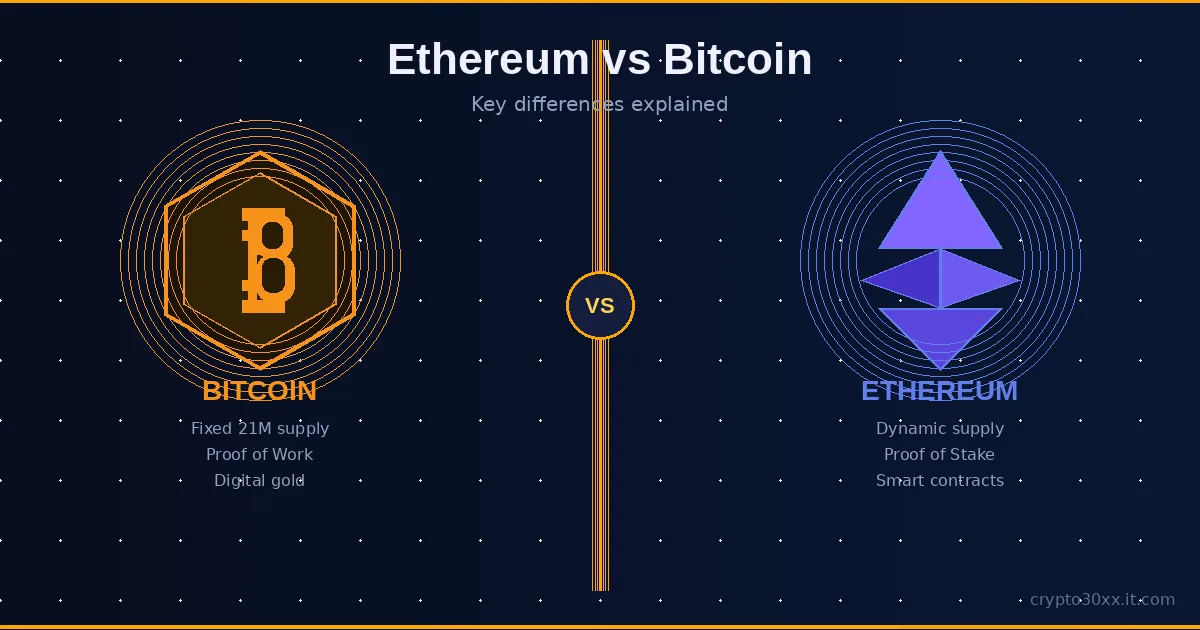
Ethereum vs bitcoin key differences: a complete guide
Bitcoin and Ethereum are the two largest blockchain networks by market capitalization, but they were built to solve different problems. Bitcoin, launched in 2009, functions primarily as a decentralized digital currency and store of value with a mathematically fixed supply of 21 million coins. Ethereum, launched in 2015, is a programmable blockchain platform that uses its native asset — Ether — as fuel for smart contracts and decentralized applications. Understanding the ethereum vs bitcoin key differences means looking beyond price: the two networks diverge on consensus mechanism, monetary policy, transaction speed, programmability, and fundamental design philosophy.
What are Bitcoin and Ethereum actually designed to do?
Bitcoin is a peer-to-peer electronic payment system with a deliberate emphasis on simplicity and security. It does one thing — record ownership and transfer of a scarce digital asset — and does it with minimal moving parts. Ethereum, by contrast, is a programmable world computer where developers deploy self-executing code. Both run on blockchain technology, but they pursue almost opposite objectives: Bitcoin minimizes complexity to maximize trust, while Ethereum maximizes programmability to enable an entire ecosystem of applications.
Bitcoin’s core purpose
Bitcoin was described in Satoshi Nakamoto’s 2008 whitepaper as “a peer-to-peer electronic cash system.” Its scripting language is intentionally limited — Bitcoin’s Script is non-Turing-complete, meaning it cannot run arbitrary programs. This constraint is a feature, not a bug. Fewer executable paths mean fewer attack surfaces and a more predictable, auditable system.
The network’s primary value proposition is credible scarcity. No central bank, foundation, or governance vote can increase the 21 million coin ceiling. That immutability is the point.
Ethereum’s core purpose
Ethereum was proposed by Vitalik Buterin in 2013 as a generalized programmable layer. Where Bitcoin’s Script handles simple conditions (“has the right key been provided?”), Ethereum’s EVM (Ethereum Virtual Machine) can run any computable logic — lending protocols, token issuance, automated market makers, governance systems, and more.
Ether serves a specific mechanical role: it pays for computation. Every operation on the Ethereum network costs a unit of gas, priced in ETH. Without ETH, no smart contract executes. This gives Ether an intrinsic utility that Bitcoin, as a pure monetary asset, does not share.
How do the consensus mechanisms differ?
The consensus mechanism is the ruleset by which a blockchain agrees on the correct version of its transaction history. Bitcoin and Ethereum use fundamentally different approaches, and those differences shape everything from energy use to decentralization philosophy.
Bitcoin: proof of work
Bitcoin uses Proof of Work (PoW). Miners compete to solve a computationally expensive cryptographic puzzle. The winner adds the next block and earns newly issued BTC plus any transaction fees. The process is energy-intensive by design — that energy expenditure is what makes falsifying the ledger prohibitively expensive.
Bitcoin’s block time targets approximately 10 minutes. The protocol automatically adjusts mining difficulty every 2,016 blocks (roughly every two weeks) to maintain that cadence regardless of how much computing power joins or leaves the network. For high-value transfers, most services wait for six confirmations — roughly 60 minutes — before treating a payment as settled.
Ethereum: proof of stake
In September 2022, Ethereum completed “The Merge,” transitioning from Proof of Work to Proof of Stake (PoS). Instead of miners expending energy, validators lock up a minimum of 32 ETH as collateral. The protocol selects validators to propose and attest to new blocks. Misbehavior — attempting to approve invalid transactions — results in slashing: the validator loses a portion of their staked ETH.
Ethereum produces a new block approximately every 12 seconds. Economic finality — the point at which reversing a confirmed transaction would require an attacker to destroy at least one-third of all staked ETH — arrives after two epochs, or roughly 12 to 13 minutes.
The energy reduction was dramatic. Ethereum’s electricity consumption fell by more than 99% after The Merge, addressing a long-standing criticism of blockchain technology.
Comparison at a glance
| Feature | Bitcoin | Ethereum |
|---|---|---|
| Consensus mechanism | Proof of Work (PoW) | Proof of Stake (PoS) |
| Block time | ~10 minutes | ~12 seconds |
| Layer-1 TPS | ~5–7 | ~12–20 |
| Finality convention | 6 confirmations (~60 min) | 2 epochs (~12–13 min) |
| Energy use | High (mining hardware) | Minimal (validators run software) |
| New participant requirement | Mining hardware + electricity | Minimum 32 ETH staked |
How does the supply model work for each network?
Supply mechanics are where the ethereum vs bitcoin key differences become most philosophically pronounced. Bitcoin treats fixed scarcity as its core value proposition. Ethereum treats adaptive supply as an engineering tool.
Bitcoin’s fixed supply
Bitcoin’s total supply is capped at 21 million BTC, coded into the protocol at its founding. New BTC enters circulation only through block rewards paid to miners. That reward halves approximately every four years — an event known as the halving. After the April 2024 halving, miners receive 3.125 BTC per block. The reward will continue halving until all 21 million BTC have been mined, a process expected to complete around the year 2140.
This disinflationary schedule makes Bitcoin’s monetary policy entirely predictable. No entity — including Satoshi Nakamoto, if they were to reappear — has the power to alter it without rewriting and replacing the entire network.
Ethereum’s dynamic supply
Ethereum has no hard supply cap. Its issuance model is governed by two countervailing forces:
- Validator issuance: New ETH is issued as rewards to validators securing the network via PoS. After The Merge, daily issuance dropped by roughly 88% compared to the PoW era.
- EIP-1559 fee burn: Introduced in August 2021, this upgrade burns the base fee of every transaction — permanently removing that ETH from circulation. When network activity is high, burned ETH can exceed newly issued ETH, making the supply net deflationary during those periods.
The result is a monetary system that contracts under demand pressure and expands slightly when the network is quiet. This flexibility allows Ethereum to maintain a perpetual security budget while still exerting deflationary pressure when its applications are heavily used.
What can each blockchain actually do?
Programmability is the clearest functional divide between the two networks.
Bitcoin’s scripting and layer-2 solutions
Bitcoin’s base layer handles value transfer with high security and low complexity. Its scripting language supports basic conditions: multi-signature authorization, time-locked transactions, and hash-locked contracts. These are sufficient for payment channels and atomic swaps.
The Lightning Network extends Bitcoin’s capabilities by creating off-chain payment channels between users. Parties can route many small transactions off-chain and settle the final balance on-chain, enabling fast, low-cost micropayments without touching Bitcoin’s 10-minute block cadence. Sidechains like Liquid and Rootstock add further functionality while anchoring security to the Bitcoin main chain.
Ethereum’s smart contracts and DeFi
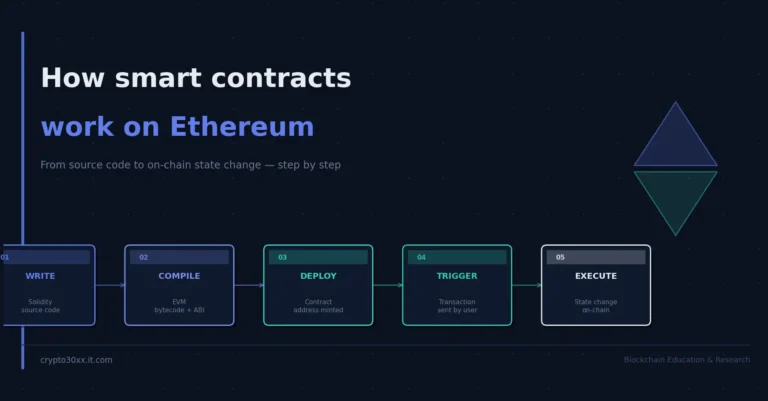
Ethereum’s EVM is Turing-complete, meaning it can, in theory, execute any computational logic. This opens the door to:
- DeFi (Decentralized Finance): Lending protocols, decentralized exchanges, and stablecoin issuers that operate without custodians.
- NFTs (Non-Fungible Tokens): Unique digital ownership records enforced by smart contract code, not a corporate database.
- DAOs (Decentralized Autonomous Organizations): On-chain governance systems where token holders vote on protocol changes.
- Token issuance: The ERC-20 standard allows anyone to create a new token on Ethereum without building a separate blockchain.
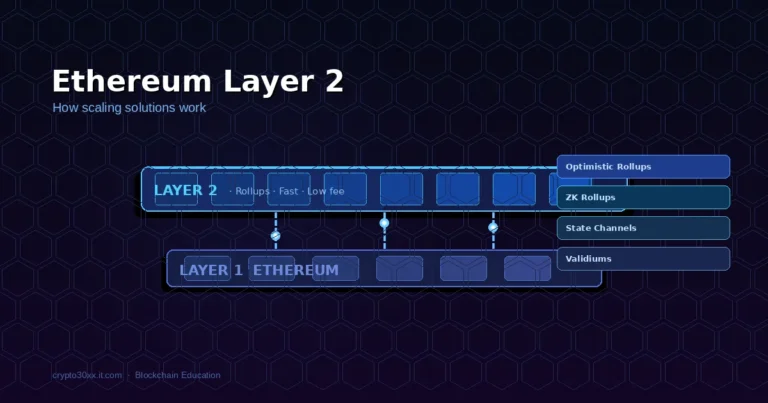
- Layer-2 scaling: Rollup networks like Optimism and Arbitrum process thousands of transactions per second, batch them cryptographically, and settle the proof on Ethereum’s base layer.
The tradeoff is complexity. More executable logic means more attack surface. The 2016 DAO hack — which exploited a reentrancy vulnerability and led to a controversial hard fork — illustrated that Ethereum’s programmability introduces risks that Bitcoin’s constrained scripting avoids by design.
How do transaction speed and fees compare?
Speed and cost are practical concerns for anyone using either network.
Bitcoin speed and fees
Bitcoin targets one block every 10 minutes. Throughput at the base layer runs approximately 5–7 transactions per second. Fees are determined by bidding: when block space is full, users compete by paying higher fees to have their transactions included sooner. During periods of heavy network demand, fees can rise substantially and wait times extend beyond one block.
The Lightning Network resolves this for small payments, enabling near-instant settlement at negligible cost — but it requires opening and funding payment channels, adding operational complexity.
Ethereum speed and fees
Ethereum’s 12-second block time and higher gas limits give it greater base-layer throughput than Bitcoin: roughly 12–20 TPS on layer 1. Layer-2 rollups push this into the thousands per second. Fees on Ethereum are denominated in ETH and paid as gas — the unit of computational effort. They fluctuate with network demand.
EIP-1559 changed the fee structure: transactions now include a base fee (burned) and an optional tip (paid to the validator). This made fees more predictable within a given block but did not eliminate their volatility during demand spikes.
What are the risks and limitations of each?
A clear-eyed account of both networks includes their structural weaknesses, not just their strengths.
Bitcoin risks and limitations
Throughput ceiling: Bitcoin’s base layer is slow by design. Without Lightning adoption growing proportionately with demand, congestion and fee spikes could inhibit Bitcoin’s utility as a payment medium.
Miner revenue transition: As block rewards continue halving, miners will rely increasingly on transaction fees for income. If fee revenue proves insufficient, the economic security of the network could weaken over decades — a long-horizon risk, but a real structural question.
Limited programmability: Bitcoin’s conservative scripting means it cannot natively support complex financial applications without relying on layer-2 bridges, which introduce their own trust assumptions.
Concentration of mining: Despite being decentralized in theory, a significant share of Bitcoin’s hash rate is concentrated in large mining pools. A coordinated attack by pools controlling more than 50% of hash rate would theoretically allow double-spending — though the economic incentives strongly discourage it.
Ethereum risks and limitations
Smart contract vulnerability: Every deployed smart contract is executable code. Bugs in that code have historically led to significant losses. The immutability of blockchain means that deployed vulnerabilities cannot be patched — only worked around with migration or governance action.
Validator centralization risk: Liquid staking protocols — which allow users to stake less than 32 ETH through a pool — now control a meaningful fraction of all staked ETH. If one such protocol became dominant, it could exert outsized influence over consensus.
Protocol complexity: Ethereum’s development roadmap involves continuous upgrades — The Merge, EIP-1559, the Dencun upgrade, ongoing sharding work. Each upgrade adds value but also represents new code surfaces that must be tested and vetted.
Competition: Newer proof-of-stake chains — Solana, Sui, Aptos — target Ethereum’s developer share with lower fees and higher throughput. Network effects and liquidity favor Ethereum for now, but competitive pressure is a structural, not cyclical, consideration.
Shared risks
Both networks share exposure to:
- Regulatory action in major jurisdictions
- Protocol-level bugs in their respective client software
- Broad market sentiment cycles that affect all digital assets
- The possibility of cryptographic vulnerabilities emerging over long time horizons (quantum computing is a distant but discussed concern)
What role does each asset play in a broader analysis?
From a structural standpoint, Bitcoin and Ethereum attract different analytical frameworks.
Bitcoin as a monetary network
Bitcoin is most frequently analyzed as a monetary asset — compared to gold, Treasury securities, or other stores of value. Its fixed supply and resistance to programmatic change make it legible to institutional allocators who need predictable parameters. It has no native yield: BTC holders earn returns only through price appreciation, not protocol issuance.
Ethereum as productive capital
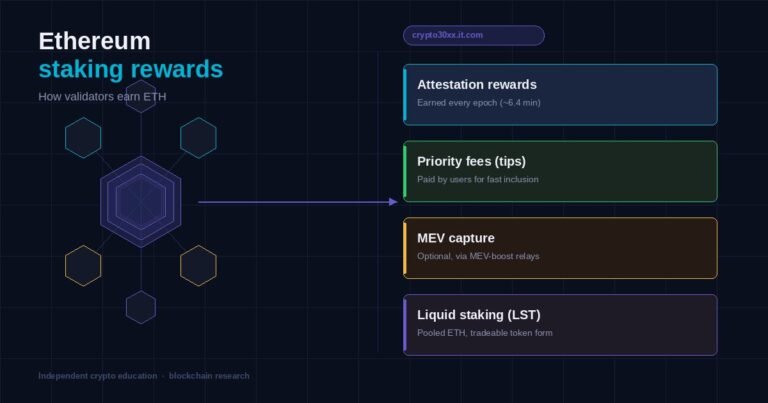
Staked ETH generates validator rewards — historically estimated in the low single-digit percentage range annually, paid in ETH. This native yield changes Ethereum’s character: it behaves more like a productive asset than a pure monetary one. For analysts comparing digital assets to traditional instruments, this distinction matters. ETH staking addresses a structural gap for yield-seeking allocators that Bitcoin cannot fill.
The philosophical implication is significant. Bitcoin optimizes for being a reliable, immutable ledger of ownership. Ethereum optimizes for being a general-purpose substrate for decentralized computation. These are complementary but distinct value propositions — not a ranking.
FAQs
Is Ethereum better than Bitcoin? Neither network is objectively better — they serve different purposes. Bitcoin is designed as a scarce digital currency and store of value with minimal complexity. Ethereum is a programmable platform for decentralized applications. The right comparison depends on the use case being evaluated.
Can Bitcoin do what Ethereum does? Not natively. Bitcoin’s scripting language is intentionally limited and non-Turing-complete. Layer-2 solutions and sidechains extend its functionality, but they operate with additional trust assumptions that the Bitcoin base layer does not require.
Why did Ethereum switch from proof of work to proof of stake? Ethereum transitioned to proof of stake in September 2022 (an event called “The Merge”) to reduce energy consumption by more than 99%, improve scalability foundations, and enable staking-based security rather than mining-based security.
Will Ethereum ever have a fixed supply like Bitcoin? Ethereum has no hard supply cap coded into its protocol. Its supply is governed by the interaction of validator issuance and the EIP-1559 fee burn. During periods of high network activity, ETH can become deflationary — but this is a dynamic outcome, not a guaranteed fixed ceiling.
What is gas in Ethereum? Gas is the unit that measures the computational effort required to execute a specific operation on the Ethereum network. Every transaction and smart contract interaction consumes gas, priced in ETH. Higher network demand pushes gas prices up; lower demand brings them down.
What is the Lightning Network for Bitcoin? The Lightning Network is a layer-2 protocol built on Bitcoin that enables fast, low-cost payments through off-chain payment channels. Parties open a channel, transact directly between themselves, and only settle the final balance on the Bitcoin main chain — bypassing the 10-minute block time for routine transactions.
Are Bitcoin and Ethereum completely separate blockchains? Yes. They are independent networks with separate protocols, validators or miners, and histories. There is no shared infrastructure between them at the base layer, though bridges and wrapped tokens allow value to move between them with additional trust assumptions.
Can both Bitcoin and Ethereum lose all their value? All digital assets carry the risk of significant or total value loss. Both networks have survived multiple market cycles and technical challenges since their inception, but past resilience does not guarantee future outcomes. Regulatory shifts, protocol failures, or shifts in market structure could negatively affect either asset.
Disclaimer
This article is written for educational and research purposes only. It does not constitute financial, investment, or legal advice. Cryptocurrency assets carry significant risk, including the risk of total loss. Nothing in this article should be interpreted as a recommendation to buy, sell, or hold any digital asset. Readers should conduct their own research and, where appropriate, consult a qualified financial professional before making any investment decisions.
The ethereum vs bitcoin key differences come down to a fundamental design choice each network made at its founding. Bitcoin chose constraint — a fixed supply, limited scripting, and slow but secure settlement — to function as a trustworthy monetary asset. Ethereum chose programmability — a Turing-complete virtual machine, adaptive supply mechanics, and rapid protocol evolution — to function as a platform for decentralized computation. Neither choice is wrong. They reflect two genuinely different theories of what a blockchain is for. Understanding that distinction is the starting point for any serious analysis of either network.
Let our calm insights carry you through the days that need a little extra gentle softness today.