Coin vs token difference explained: a complete guide
Coin vs token difference explained: “Coin” and “token” get used interchangeably across crypto conversations, articles, and exchange listings. They don’t mean the same thing.
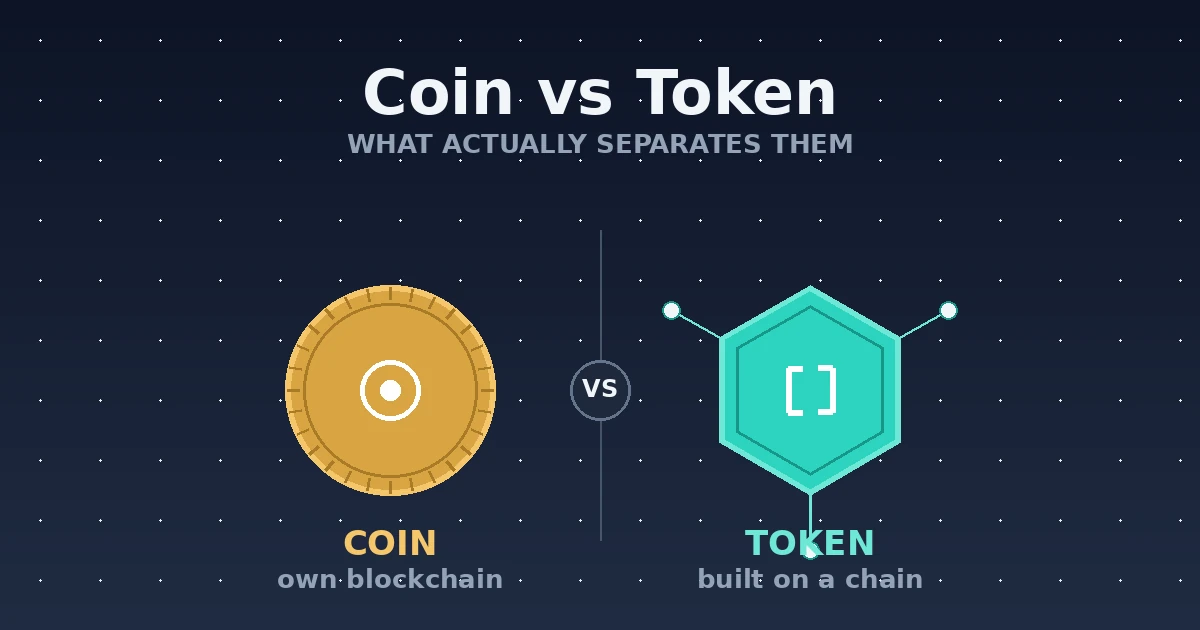
A coin is a digital asset that runs on its own independent blockchain. A token is a digital asset issued through a smart contract on someone else’s blockchain.
That single difference explains a surprising amount. It explains why moving a token sometimes requires holding a completely different asset to cover fees, why a project can start as a token and later become a coin, and why regulators can treat two assets very differently even though both get called “cryptocurrency” in casual use.
This guide breaks down what actually separates a coin from a token, how each is built, where the line gets blurry, and what the distinction means in practice.
What is the difference between a coin and a token?
A coin is a digital asset that operates on its own independent blockchain, secured by that network’s own miners or validators. A token is a digital asset issued through a smart contract deployed on an existing blockchain, rather than a dedicated network of its own.
The core question is infrastructure. Does the asset run its own chain, or does it depend on someone else’s?
What makes a digital asset a coin
Bitcoin is the clearest example. Its genesis block was mined on January 3, 2009, and every unit of BTC issued since has followed the Bitcoin protocol’s own consensus rules, not a smart contract on another network.
Litecoin, Monero, and Ether all work the same way. Each has its own blockchain, its own miners or validators, and its own rules for issuing new units.
A coin also tends to double as its network’s internal currency. It’s what miners or validators get paid in, and it’s what covers transaction fees on that specific chain.
What makes a digital asset a token
A token exists because a developer wrote smart contract code and deployed it on a blockchain that already existed, following that chain’s token standard. Ethereum’s ERC-20 standard, BNB Chain’s BEP-20, Solana’s SPL standard, and Tron’s TRC-20 are examples of the rules a token has to follow on its host chain.
Chainlink, Uniswap, and USD Coin are all tokens under this definition. None of them run independent validator networks. Each depends entirely on its host chain for security and transaction processing.
Three questions settle most cases quickly:
- Does the asset have its own blockchain, with its own miners or validators? If yes, it’s a coin.
- Was the asset created by deploying a smart contract on a blockchain that already existed? If yes, it’s a token.
- Which asset is actually required to pay that network’s transaction fees? That’s the coin, even when a token is what’s being sent.
How are coins and tokens actually created?
Coins are issued according to a blockchain’s own protocol rules, usually as a reward to whoever helps secure the network. Tokens are issued by deploying smart contract code on a chain that already handles security and transaction processing, so no new infrastructure is required.
How coins are created and secured
Two issuance models dominate. Proof-of-work coins, like Bitcoin, release new units as a reward for solving a computational puzzle, commonly called mining.
Proof-of-stake coins, like Ether since Ethereum’s transition in September 2022, reward validators who lock up capital instead of burning electricity on computation. Either way, the coin is inseparable from its network.
There’s no Bitcoin without Bitcoin miners, and no way to issue new BTC except through the protocol itself.
How tokens are created through smart contracts
Creating a token doesn’t require building a blockchain at all. A developer writes a contract specifying the total supply, the transfer rules, and any special functions such as minting or burning, then deploys that contract to an existing network.
The host chain’s validators handle everything else. They verify transfers, update balances, and enforce the contract’s rules.
This is a much lower barrier to entry than launching a coin. That gap is a large part of why far more tokens exist than independent blockchains.
Common token standards across blockchains
Each major blockchain defines its own standard for how tokens on that chain must behave:
- ERC-20 on Ethereum, the original and most widely copied standard for fungible tokens
- BEP-20 on BNB Chain, closely modeled on ERC-20
- SPL on Solana, built for that network’s account structure
- TRC-20 on Tron, another ERC-20-style standard
A token built to one standard generally cannot move directly to a chain using a different standard without a bridge or a wrapped version of itself.
Types of tokens by function
Tokens also get grouped by what they’re designed to do, separate from which chain they sit on:
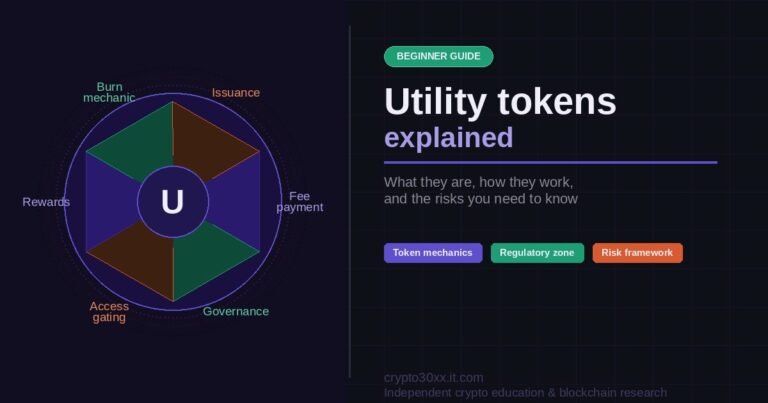
- Utility tokens grant access to a specific product, service, or network feature
- Governance tokens grant voting rights over a protocol’s future decisions
- Stablecoins are designed to track the value of a reference asset, most often the US dollar
- Security-like tokens represent a claim on profit, revenue, or ownership, which can trigger securities regulation depending on the jurisdiction
Tokens also split by whether units are interchangeable. Fungible tokens, like the ERC-20 examples above, are identical and interchangeable unit for unit. Non-fungible tokens use a different standard, such as ERC-721, to represent one-of-a-kind items instead, which is a separate topic from the coin vs token distinction covered here.
Coin vs token: practical examples and a comparison table
The clearest way to compare a coin and a token is side by side, since the technical differences touch almost every category that affects how the asset actually behaves in practice, including who secures it, what pays its fees, and what a holder actually owns.
| Feature | Coin | Token |
|---|---|---|
| Runs on | Its own independent blockchain | An existing blockchain, via smart contract |
| Created through | Mining, staking, or protocol-level issuance | Deploying smart contract code |
| Technical standard | Its own consensus rules | A standard set by the host chain, such as ERC-20 or SPL |
| Transaction fees paid in | The coin itself | The host blockchain’s native coin |
| Typical use | Native currency, network security, store of value | Utility, governance, or representing an asset |
| Examples | Bitcoin, Litecoin, Monero, Ether | Chainlink, Uniswap, USD Coin |
A concrete example: paying gas to move a token
Fees still need the host chain’s coin: sending $1,000 worth of an ERC-20 token on Ethereum still requires holding a separate, much smaller amount of ETH in the same wallet.
The token itself cannot pay for its own transfer. Ethereum’s validators are compensated in ETH regardless of which token is being moved, which is why a wallet can hold a token balance yet be unable to send it anywhere without also holding the underlying coin.
Wrapped tokens: when a coin gets a token version
Bitcoin has no smart contract capability, so it cannot exist as a token on its own. Wrapped Bitcoin solves that by issuing an ERC-20 token on Ethereum, backed one to one by real BTC held in custody.
Holding a wrapped version does not turn Bitcoin into a token. It creates a separate, Ethereum-native representation of Bitcoin’s value, which trades and moves like any other token while the actual BTC sits untouched elsewhere. The distinction between the original coin and its wrapped token version matters most if something goes wrong with the custody arrangement backing the wrapped version.
Risks, limitations, and common misconceptions
Neither category is inherently safer than the other, whatever their reputations suggest. A coin carries protocol- and consensus-level risk, tied to how well its network is secured, while a token carries smart contract risk layered on top of whatever risk already exists on its host chain.
Assuming a coin is automatically safer than a token
A coin’s security depends on its consensus mechanism, the number and distribution of its validators or miners, and how battle-tested its code is. A token’s security depends on those same factors for its host chain, plus the quality of its own smart contract code.
A poorly audited token on a secure chain can still be risky. A coin on a small, thinly secured network can be riskier than a well-audited token on a major chain.
Confusing “altcoin” with “token”
“Altcoin” is a market term for any cryptocurrency other than Bitcoin, and it gets applied to coins and tokens alike. Ether, a coin, is routinely called an altcoin. So is Uniswap’s UNI, which is a token.
The word describes market position, not technical structure. It isn’t a reliable way to tell whether something is a coin or a token.
Treating regulatory classification as fixed
Whether a specific coin or token is treated as a security, a commodity, or something else depends on the jurisdiction and the facts of how that asset is structured and sold. This classification is separate from the coin vs token technical distinction, and it can differ from one country to the next.
Readers researching a specific asset’s legal status should check the current rules in their own jurisdiction rather than assume the coin or token label settles the question.
Where the coin vs token distinction came from
The distinction didn’t exist for Bitcoin’s first several years, because there was no alternative to create. Bitcoin’s blockchain wasn’t built to run smart contracts, so every asset that existed on it had to be a coin by default, with no mechanism available for issuing anything else.
The ERC-20 standard and the rise of the token
Ethereum’s 2015 launch added a general-purpose scripting layer to the blockchain itself. The ERC-20 standard, proposed the same year, gave developers a template for issuing a new asset without writing a blockchain from scratch.
That template made token creation dramatically cheaper and faster than launching a coin. It’s a large part of why tokens now outnumber coins by a wide margin.
When a token becomes a coin
Some projects start as a token during an early fundraising phase, then launch an independent blockchain once development is further along. EOS is a well-documented example.
It was distributed as an ERC-20 token during its yearlong token sale, then migrated those tokens one-to-one onto its own independent blockchain when its mainnet launched in June 2018. From that point on, EOS functioned as a coin rather than a token.
FAQs
Is Ether a coin or a token? Ether (ETH) is a coin. It’s the native asset of the Ethereum blockchain, used to pay transaction fees and reward validators, and it doesn’t depend on another chain’s token standard the way an ERC-20 asset does.
Can a token turn into a coin? Yes. Some projects launch as a token on an existing chain during an early stage, then migrate to their own independent blockchain once that network is ready. Once the migration happens, the asset functions as a coin rather than a token.
Is every cryptocurrency a coin? No. Cryptocurrency is the umbrella term covering both coins and tokens. Calling every digital asset a coin is common shorthand, but it overlooks a real technical difference that matters once a project needs its own blockchain infrastructure, or chooses to rely on someone else’s instead.
Why do token transfers sometimes need a completely different asset to pay fees? Because a token transaction is processed by its host blockchain’s validators, who are paid in that chain’s native coin rather than the token being sent. Moving an ERC-20 token on Ethereum, for example, still requires holding some ETH to cover gas.
Are stablecoins coins or tokens? Despite the name, most stablecoins are technically tokens. Assets like USDT or USDC are typically issued through smart contracts on existing blockchains rather than running an independent network, even though “coin” shows up in their branding.
Is an NFT a coin or a token? An NFT is a type of token. It follows a non-fungible token standard, such as ERC-721, rather than a fungible standard like ERC-20, which makes each one unique instead of interchangeable. It is still issued through a smart contract on a host blockchain rather than running its own network.
What decides whether a token is a utility token, a governance token, or a security? It generally comes down to what rights the token grants holders and how regulators in a given jurisdiction interpret those rights. That classification can vary by country and isn’t fixed by the token’s code alone, so it’s worth checking the applicable rules directly.
Does the blockchain a token is built on affect how it performs? Yes. A token inherits its host chain’s transaction speed, fees, and security model, since it has no independent infrastructure of its own. The same type of token will typically be slower and more expensive to transact on a congested network than on a faster one.
Disclaimer
This article is written for educational purposes only and does not constitute financial, investment, tax, or legal advice. Cryptocurrency assets, including both coins and tokens, carry significant risk, including the risk of total loss, and their regulatory treatment varies by jurisdiction.
Readers should conduct independent research and consult a licensed professional before making any financial decision.
Final thoughts
The coin vs token difference sounds like a technicality until it starts explaining real behavior. It explains why a wallet needs two different assets to complete one transfer, why a project’s category can shift after a mainnet launch, and why “cryptocurrency” was never really a single category to begin with.
A coin runs on its own blockchain. A token borrows one. Once that single mechanical fact is clear, most of the confusion around coins, tokens, and altcoins tends to sort itself out.
Browse through articles designed to inspire, educate, and challenge your thinking—rest in our calm library.