How to research a token project: the complete guide
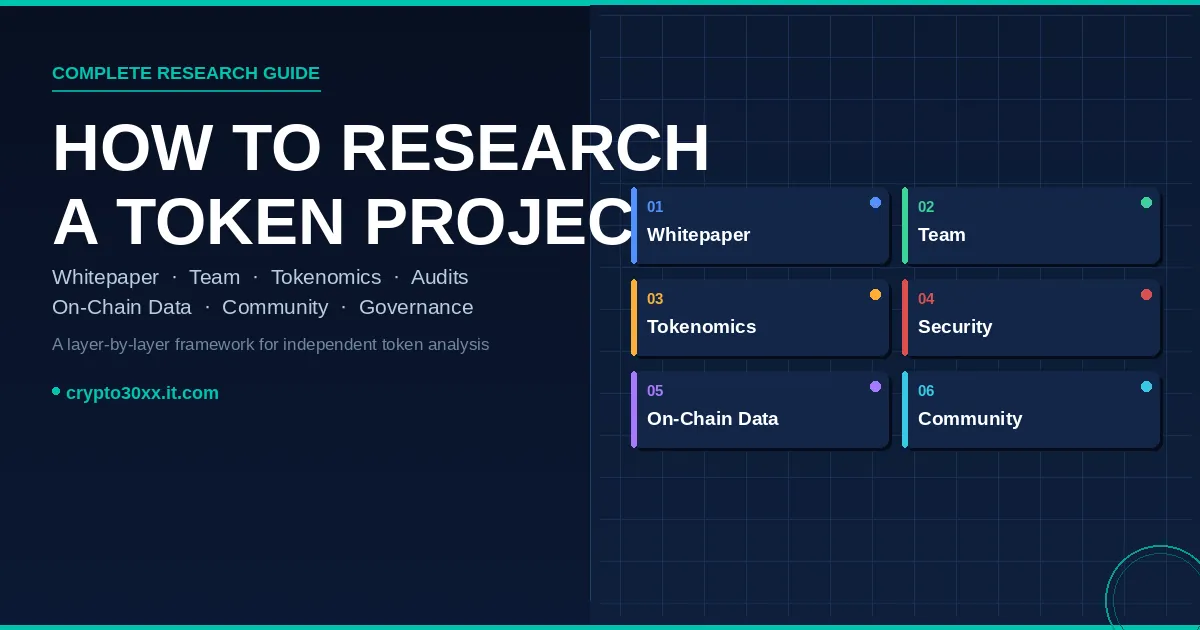
How to research a token project: Researching a token project means systematically examining its whitepaper, team credentials, tokenomics, smart contract audits, and on-chain activity to build an evidence-based picture of what the project actually is and how it functions. The goal is to distinguish projects with genuine technical foundations and sustainable economic design from those built on vague promises, unverifiable teams, or exploitative token structures. This guide walks through each research layer in sequence (whitepaper, team, tokenomics, security, on-chain data, and community), giving any researcher a repeatable framework for independent token analysis.
One principle runs through every layer: evidence over impressions. A polished website and an enthusiastic community are not evidence. A published audit report and verifiable developer history are.
What researching a token project actually means
Researching a token project means applying a structured evaluation across six distinct layers: the technology, the team, the economic model, the security posture, the community, and the on-chain data record. No single layer tells the full story. Genuine research triangulates signals across all six, treating strong results in one area as a reason to continue looking, not as permission to stop.
A project with an impressive whitepaper from an anonymous team is incomplete analysis. A credible team behind an unaudited smart contract managing user funds is equally incomplete. The discipline that makes this process useful is the habit of moving through every layer in order before drawing conclusions.
Why a fixed sequence reduces analytical error
Unstructured research produces confirmation bias. Starting with price action, community enthusiasm, or a single impressive document anchors the rest of the process around that first signal.
A fixed sequence (document review, team verification, economic analysis, security review, on-chain data, community) forces engagement with each layer before the next one begins. That structure is not inefficiency; it is the mechanism that prevents selective observation.
How to evaluate a token’s whitepaper
A whitepaper is the primary technical and economic specification of a blockchain project. Evaluating one means checking whether it defines a real problem with measurable scope, describes a credible technical architecture, ties the token to a specific protocol function, and models the economic incentives that sustain participation. A weak document at this stage is a meaningful signal: the research goal is to identify what the whitepaper does and does not specify, not to find reasons to approve it.
Core components to examine
For each whitepaper, work through five categories:
- Problem statement: Is the problem defined precisely enough to be solved? “Improving global finance” is a category, not a problem. “Reducing cross-border settlement finality to under five seconds on a permissionless chain” is something an engineering team can build toward.
- Technical architecture: Does the document specify how consensus works, what throughput assumptions are, and how data is stored or validated? Absence of technical detail in a technical product is a structural gap.
- Token utility: Is the token required for any protocol function: fee payment, staking, governance, or access rights? Or is it loosely associated with the project without a structural demand driver?
- Economic model: Does the document explain how supply changes over time through token issuance, burning, staking emissions, or treasury activity?
- Roadmap specificity: Are milestones defined by what will be delivered, or only by time period?
Red flags in whitepaper review
Several patterns indicate a document that does not meet research-grade standards:
- Conceptual papers presented as full technical specifications, without disclosing that scope limitation
- Language describing token value rather than token function (“as adoption grows, token holders benefit”)
- No named authors, no technical citations, no mathematical models
- Sections that appear paraphrased from other projects’ documentation (searchable with a basic query)
- Tokenomics presented as allocation percentages without any underlying economic rationale
How to assess the team behind a token
The team is the highest-variance factor in a token project’s research profile. A technically sound design executed by an unverifiable or inexperienced team carries risks the whitepaper cannot reveal. Evaluating the team before trusting the rest of the project’s documentation is the right order of operations, because credibility here is foundational to assessing whether every other claim deserves examination.
Verification methods
Work through each team member using public, independent sources:
- LinkedIn history cross-referenced against independent records: conference speaker listings, press mentions, archived product launch announcements
- GitHub contributions: real developers on technical projects leave traceable commit records on open-source repositories
- Academic and industry credentials checked against accessible institutional records where available
- Prior company affiliations cross-referenced with company registries, public reporting, or archived product pages
The goal is corroboration, not certainty. What matters is whether the stated background is internally consistent and supported by at least one external source per key team member.
Advisors and institutional backers
Advisors add genuine research value when their expertise matches the project’s design domain. An economist advising a protocol with a novel fee structure, or a cryptographer listed on a privacy-focused chain, carries analytical weight. A well-known name from an unrelated field provides social credibility but limited technical signal.
Institutional investors follow the same logic. A fund with a public portfolio of infrastructure projects at early stages provides a different kind of corroboration than a newly formed fund with no disclosed investments.
Understanding tokenomics in depth
Tokenomics describes the economic architecture of a token: its total supply, how that supply is distributed across stakeholders, what creates demand for the token inside or outside the protocol, and how the model is designed to sustain participation over time. This is the research layer where otherwise credible-looking projects most often reveal structural problems, not through deception but through economic models that cannot hold under realistic adoption conditions. Working through tokenomics means going beyond the allocation pie chart and examining the underlying mechanics.
Supply structure and distribution
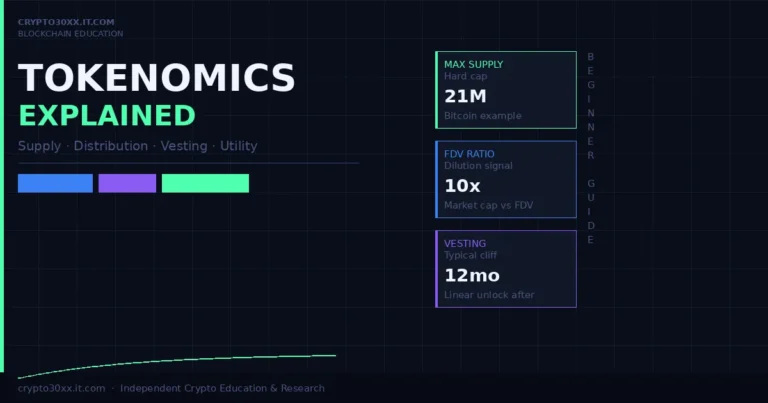
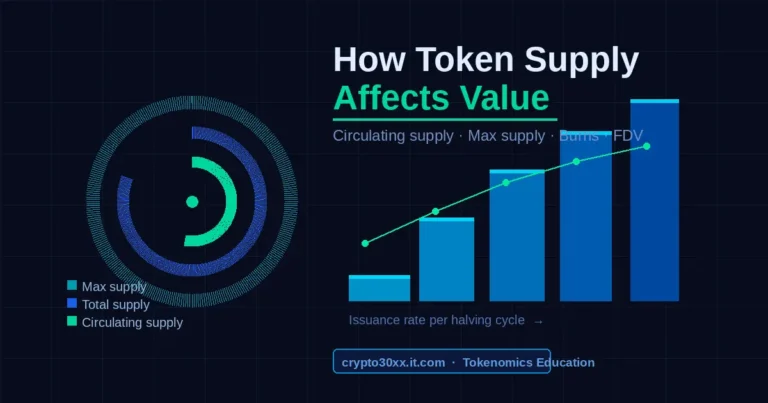
Begin with three numbers: total supply, circulating supply, and the gap between them. A project with 2 billion total tokens and 200 million circulating has 90% of supply outside the market. That supply will enter the market through some mechanism; identifying that mechanism is the research task.
Standard distribution categories and typical ranges across projects:
| Allocation category | Typical range observed |
|---|---|
| Public sale or community distribution | 15–40% |
| Team and founders | 10–20% |
| Early investors (seed and private rounds) | 10–25% |
| Grants and developer programs | 15–30% |
| Reserve or treasury | 5–15% |
These ranges are observational. No single allocation structure is inherently correct; the analytical question is whether the distribution concentrates control in a way that misaligns with the stated governance design.
Vesting schedules and unlock events
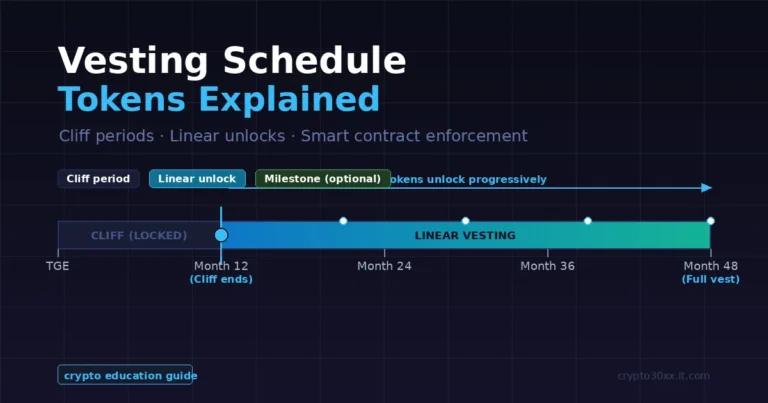
Vesting is the mechanism by which team and investor allocations become transferable over time. A 12-month cliff with 24-month linear vesting means the first tokens release one year after the trigger date (typically listing or mainnet launch), then continue releasing monthly for two more years.
The aggregate unlock schedule, meaning the total tokens becoming transferable in each period, is a data point researchers track alongside development milestones, because concentrated unlocks represent predictable supply changes.
Utility and demand drivers
A token with no structural role in its own protocol depends on external demand alone. Tokens required for protocol functions (fee payment, validator bonding, lending collateral, or governance with real authority) have demand drivers that scale with protocol usage.
For each claimed demand driver, examine the specifics: Is staking yield funded by protocol revenue or by token inflation? Does governance participation carry binding authority over protocol changes, or advisory-only function? Are fees denominated in the native token, or converted at the point of collection?
On-chain data and smart contract security
On-chain data is verifiable evidence, and it is the one research layer that cannot be altered retroactively. Blockchain transactions are publicly recorded by design, which makes on-chain analysis a distinct research category, one less subject to the narrative framing that shapes most project communications.
Key on-chain metrics to examine
For projects with live on-chain activity, examine these data points:
- Active address count over time: Growing unique address counts suggest genuine user adoption. Flat or declining counts on a project claiming rapid growth warrant investigation.
- Transaction volume relative to price: Price increases accompanied by rising transaction volume carry structurally different meaning than price increases on declining volume.
- Holder concentration: The distribution of holdings across addresses reveals whether supply is structurally concentrated. A small number of addresses holding a large proportion of circulating supply creates specific risks regardless of team intent.
- Developer activity: Commit history on public repositories is accessible for open-source projects. Consistent contributions over multiple years is a meaningful signal. A repository inactive for an extended period on a project claiming active development warrants a closer look.
Tools for on-chain research include Etherscan (Ethereum and EVM chains), Dune Analytics (custom cross-chain queries), DefiLlama (protocol TVL), Nansen (wallet labeling and fund flows), and Glassnode (macro on-chain indicators). Coverage varies by blockchain.
Reading smart contract audit reports
A smart contract audit is an independent technical review of a project’s code conducted by a third-party security firm. Audits reduce vulnerability risk; they do not eliminate it. They are snapshots; vulnerabilities introduced after the audit date fall outside their scope.
When evaluating an audit report:
- Identify the auditing firm and verify its track record independently
- Confirm the scope: which contracts were reviewed, and whether the deployed version matches the audited one
- Review the findings list, noting the severity classification of each issue: critical, high, medium, or low
- Check resolution status: were high and critical findings resolved, and was a re-audit conducted to confirm?
A project that declines to publish its audit, cites an informal community review, or carries unresolved critical findings on contracts managing user funds warrants additional scrutiny before analysis proceeds further.
Community, governance, and integration signals
Community behavior and governance structure provide signals that no other research layer can generate. On-chain data shows what users do; community research shows how a project communicates, handles criticism, and makes decisions. Governance analysis is particularly informative for projects that describe themselves as decentralized, because the gap between stated and actual governance structure is often visible in voting records and token concentration data.
Evaluating community health
When reviewing community channels (Discord, Telegram, Reddit, X/Twitter), distinguish substantive engagement from surface-level activity:
- Discussion quality: Are members asking technical questions, reporting integration issues, or debating protocol design? Or is discussion dominated by price speculation?
- Response to criticism: How does the team engage with skeptical questions? Documented, reasoned responses differ structurally from dismissed or deleted posts.
- Growth patterns: Follower count increases not correlated with announced development or product milestones can reflect purchased engagement.
- Cross-platform coherence: Large presence on one platform combined with minimal activity on another is worth examining.
Governance structure review
For projects with formal governance mechanisms, examine the mechanics directly:
- What token quantity is required to submit or pass a proposal?
- Are passed proposals binding on protocol changes, or advisory to a core team?
- Review the on-chain proposal history: has governance been used, and at what voter participation rate?
- Do addresses attributable to the team or foundation collectively hold enough tokens to determine outcomes without external participation?
Governance that concentrates effective control in a small number of addresses is a structural fact, whether or not it aligns with the project’s stated design.
Structured research checklist
A systematic checklist reduces the chance of skipping a research layer before drawing conclusions. Moving through every row forces engagement with each category regardless of how compelling early impressions have been. The table below surfaces the questions a full research process needs to answer.
| Research layer | Core questions to answer |
|---|---|
| Whitepaper | Problem defined precisely? Technical architecture specified? Token utility structural? |
| Team | Identities verifiable? Track record confirmable? Credentials relevant to project design? |
| Tokenomics | Distribution documented? Vesting schedules transparent? Demand drivers structural? |
| Smart contract security | Audit published by named firm? Scope covers live contracts? Critical findings resolved? |
| On-chain data | Address growth consistent with claims? Holder concentration examined? Developer activity tracked? |
| Community | Discussion substantive? Criticism addressed on record? Governance history reviewed? |
| Integrations | Claimed partnerships live on-chain? TVL or usage metrics independently verifiable? |
No single row carries veto authority over the others. A weak result in one layer may be offset by strong signals elsewhere, or it may indicate a systemic problem worth investigating further.
Common research mistakes and structural red flags
The most consequential errors in token project research are structural. They affect the entire analysis process, not just individual data points. Recognizing them before starting reduces the chance of selective observation, which is the failure mode that produces the most misleading conclusions.
Research process mistakes to avoid
- Starting with price action: Using chart history as the research entry point anchors the entire analysis in market sentiment rather than fundamentals. Price signals belong at the end of the process.
- Treating announcements as evidence: A partnership announcement is a claim. Live on-chain integration activity is evidence. Distinguishing between the two throughout the process is essential.
- Confusing technical density with technical validity: Heavy jargon in a whitepaper does not confirm technical substance. Genuine technical documentation is accompanied by citations, mathematical specifications, and open-source code reviewable by independent parties.
- Over-weighting social proof: A large community or a well-known advisor name does not substitute for substantive tokenomics analysis or a verified security audit.
Structural red flags
Projects displaying several of the following simultaneously warrant substantially heightened scrutiny:
- Anonymous team with no verifiable history on a project not specifically designed around privacy
- Circulating supply significantly below total supply, with undocumented or unclear unlock schedules
- No third-party audit on a contract that manages user-deposited funds
- Whitepaper focused on token appreciation mechanisms rather than protocol design
- Governance documentation with no corresponding on-chain governance activity
- On-chain activity inconsistent with the user metrics cited in project communications
- Treasury or foundation wallets with no disclosed spending policy or accountability mechanism
FAQs
What is the first step when learning how to research a token project? Start with the whitepaper before engaging with any other project material. It is the foundational specification against which all other claims (roadmap updates, partnership announcements, community statements) can be tested. Reading it first prevents later research from being framed by marketing narratives rather than documented facts.
How do I verify a crypto project team’s credentials? Cross-reference each team member’s claimed background across LinkedIn, GitHub commit history, and conference records independently. Published code, academic papers, and prior product launches leave verifiable traces accessible through public sources. The goal is at least one external corroboration per key team member.
What does tokenomics mean in the context of token research? Tokenomics refers to the economic structure of a token: its total and circulating supply, distribution schedule, vesting mechanisms, and the demand drivers built into the protocol design. Evaluating tokenomics means assessing whether the economic model can sustain participation under realistic adoption conditions, not just in the launch window.
How do I read a smart contract audit report? Identify the auditing firm and verify its track record through independent sources. Review the scope: which contracts were included and whether the deployed version matches the audited one. Read through the findings, focusing on severity classifications and resolution status; unresolved high-severity findings on live contracts managing user funds are a significant signal.
What on-chain tools are useful for researching token projects? Etherscan covers Ethereum and EVM-compatible chains; Dune Analytics supports custom cross-chain queries; DefiLlama tracks protocol TVL; Nansen provides wallet labeling and fund flow data; Glassnode covers macro on-chain indicators. Data depth and available metrics vary depending on which blockchain the project operates on.
Can a token project pass all research checks and still carry significant risk? Yes; research reduces uncertainty, not risk itself. A project that scores well across every research dimension can still face technical vulnerabilities, protocol failures, or external developments not predictable at the time of analysis. The result is a clearer picture of known and unknown risks, not a guarantee of outcomes.
What makes a whitepaper a red flag during token research? Whitepapers that focus on token price appreciation rather than protocol function, contain no technical architecture specification, lack named authors, or reproduce sections from other projects’ documentation do not meet research-grade standards. Absence of mathematical modeling in a document claiming to describe an economic system is a particularly clear gap.
How often should a previously researched token be re-examined? Any meaningful change in a research layer (a team change, a contract upgrade, a major unlock event, a governance vote, or a significant shift in on-chain metrics) warrants a fresh pass through the relevant checklist sections. For protocols in active development, research is an ongoing process, not a one-time review.
Disclaimer
This article is produced by an independent educational blog and is written for informational purposes only. Nothing in this guide constitutes financial, investment, or legal advice, nor does it represent a recommendation to buy, sell, or hold any cryptocurrency or digital asset. Cryptocurrency markets involve substantial risk of loss, and readers should conduct their own due diligence and consult qualified professionals before making any financial decisions.
Effective research on a token project comes down to one discipline: building an evidence-based picture across every research layer before drawing any conclusions. The whitepaper, team verification, tokenomics review, audit analysis, on-chain data, and community observation each provide a distinct category of signal, and each can be checked independently of what the others show.
No research process eliminates uncertainty. What a structured approach produces is clarity about what is known, what remains unverified, and where the specific risks in a given project sit. That is a substantially different analytical foundation than one built on price charts or community sentiment alone.
Ready to take the next step? Our expert warmth will simply stay beside you always.