Vesting schedule tokens explained: the complete guide
Vesting schedule tokens explained: Token vesting is the structured, time-based release of cryptocurrency tokens to founders, investors, advisors, and other stakeholders. Instead of receiving the full allocation at the moment a project launches, recipients unlock their tokens gradually over a predetermined period — governed either by a smart contract or, in less mature projects, by a written policy. The mechanism exists to align the financial incentives of insiders with the long-term health of the project, and to prevent large, sudden sell-offs that could destabilize circulating supply shortly after a token generation event (TGE). For analysts, researchers, and learners evaluating any blockchain project, the vesting schedule is one of the most informative sections of a tokenomics document.
What is a token vesting schedule?
A token vesting schedule is a predefined timeline that controls when, and in what quantities, locked tokens are released to their designated recipients. It defines three things simultaneously: the total allocation granted to a stakeholder, the conditions under which that allocation unlocks, and the pace of release once unlocking begins.
The schedule does not affect who owns the tokens — ownership is typically established at the TGE. What it controls is access. Until tokens vest, the recipient cannot transfer, sell, or otherwise deploy them. The tokens exist on-chain but remain locked inside a vesting contract or a manual hold arrangement, depending on implementation.
Why vesting exists in crypto projects
Before vesting became standard practice, early stakeholders in a project could receive large token allocations and liquidate them immediately at or after launch. The practical effect was predictable: insiders captured value early, circulating supply expanded rapidly, and holders who arrived later absorbed the selling pressure.
Vesting is the structural answer to that problem. By extending the timeline over which insiders can access their tokens, a well-designed schedule does several things at once:
- It ties insider financial outcomes to project progress, since tokens only become tradeable as the project matures
- It controls the pace at which new supply enters circulation, reducing the risk of supply-driven price collapses
- It signals to the broader market that core contributors are committed beyond the launch moment
- It gives the community a verifiable, on-chain record of who holds what and when they can sell it
From a market-design perspective, vesting is less a technical feature and more an alignment tool — a way of making sure the people who receive the most tokens at the lowest cost have reasons to stay invested in the outcome.
Token vesting vs. token locking: the distinction
These two terms are often used interchangeably but describe different mechanisms:
| Feature | Token vesting | Token lock |
|---|---|---|
| Release pattern | Gradual, incremental over time | All at once on a fixed date |
| Primary use | Team, investors, advisors | Liquidity pools, treasury, LP tokens |
| Flexibility | Multiple schedule types | Single unlock event |
| Enforcement | Smart contract or manual | Smart contract or manual |
| Signal | Long-term contributor alignment | Short-term supply restriction |
A token lock holds the entire allocation until a single condition is met, then releases everything. Vesting releases tokens progressively. Most mature projects use both: vesting contracts for team and investor allocations, and time-based locks for liquidity pool tokens and treasury reserves.
How does a token vesting schedule work?
The mechanics of a vesting schedule are built around three components: the token generation event, the cliff, and the release model. Understanding how each functions — and how they interact — is the foundation for reading any tokenomics document.
The token generation event (TGE)
The TGE is the moment a project formally issues its tokens to the blockchain. It is typically the same event as the initial listing on an exchange, though not always. At the TGE, total allocations are assigned to each stakeholder category, and the vesting clocks begin.
Some projects release a portion of each allocation immediately at the TGE — called the TGE unlock percentage. A project might release 10% of the investor allocation at TGE and vest the remaining 90% over 24 months. The TGE unlock percentage is one of the first numbers worth examining in any tokenomics breakdown, because it sets the floor for immediate sell pressure on day one.
Conservative projects keep TGE unlocks below 15% for insider categories. When TGE unlocks for team or investor buckets exceed 25–30%, the structural conditions for immediate selling are already in place.
The cliff period
A cliff is an initial period — measured in months — during which no tokens from an allocation are released at all. The recipient has been granted the tokens, the vesting clock is running, but the balance remains inaccessible.
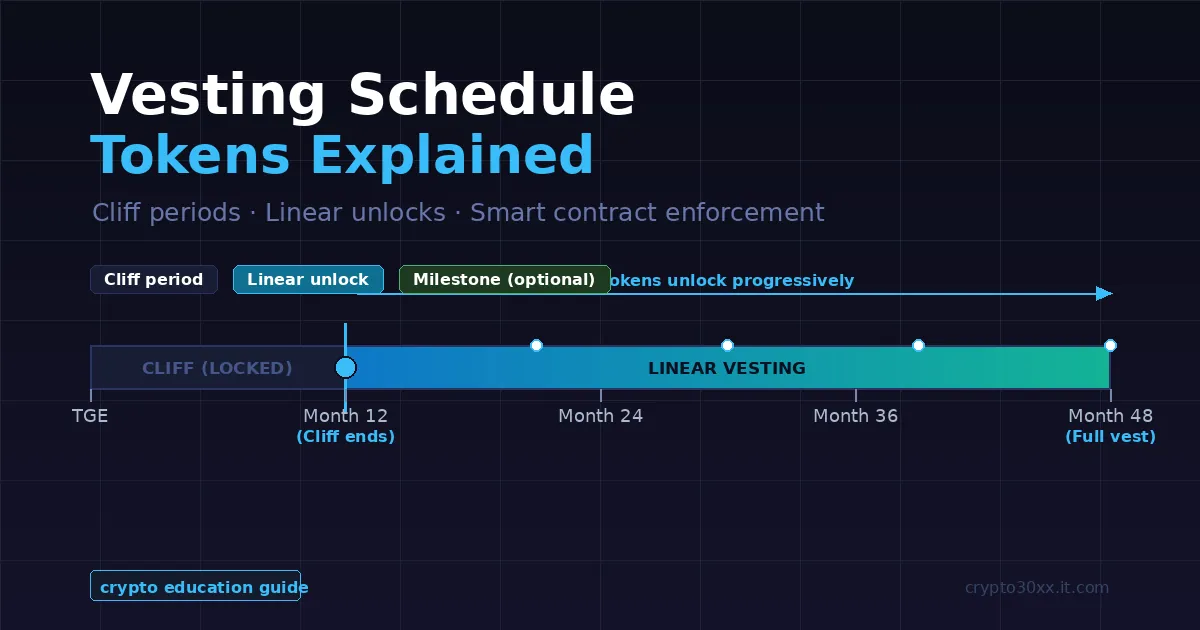
When the cliff expires, a defined portion unlocks in one batch. After that, the schedule transitions to its regular release pattern. A 12-month cliff with 36-month linear vesting, for example, releases nothing for the first year. On month 13, a lump sum unlocks (often 25% of the total, representing the first year’s worth of vesting credit). From month 13 onward, the remaining 75% releases in monthly increments over three more years.
The cliff serves two functions. First, it deters short-term participation — anyone who joins a project purely to collect tokens and exit cannot do so profitably if they must wait a full year before accessing anything. Second, it concentrates the reputational and financial commitment of insiders into the early, highest-risk period of a project’s development.
The industry benchmark for founding teams is a 12-month cliff. For early investors (seed and private rounds), cliffs typically fall between 6 and 12 months.
The release model: how tokens unlock after the cliff
After the cliff ends, the schedule defines how the remaining allocation is distributed. The three most common models are:
Linear vesting: tokens release at a fixed, even rate across the remaining schedule — monthly, quarterly, or continuously. A 36-month linear vest after a 12-month cliff releases the same fraction every month for three years. This is the most common structure for team and early investor allocations.
Graded (step) vesting: tokens release in defined percentage steps rather than continuously. For example, 25% per year over four years, releasing once annually. This model works when distribution is meant to align with annual milestones rather than time elapsed.
Milestone-based vesting: tokens unlock when a specific project condition is met — a product launch, a protocol upgrade, a governance vote. This model is rare for standard allocations but appears frequently in contributor agreements and ecosystem fund releases.
Some projects combine models. A team allocation might use a 12-month cliff, then step-vest 25% annually for four years. The combination creates strong early lockup while still rewarding milestones over time.
Types of vesting schedules and when each is used
Different stakeholder groups receive different vesting structures, and the terms often reflect the nature of their contribution and the leverage they held during negotiation. Reading the vesting schedule by category is how analysts identify whether a project’s tokenomics are aligned or extractive.
Founding team and core contributors
Founders receive the largest insider allocations. They also bear the most responsibility for the project’s success. Long vesting periods are a signal that founders are building for a multi-year timeline rather than an exit at launch.
The structure considered standard for founding teams is a 12-month cliff followed by 36 months of linear vesting — four years total. This means a founder cannot liquidate any tokens for the first year, and their full allocation takes four years to vest.
Founders with vesting periods shorter than 24 months, or no cliff at all, hold tokens that could be fully accessible within the first two years of a project’s existence. That structural fact is worth noting as a researcher.
Early investors: seed and private rounds
Early investors typically negotiate vesting terms during their investment round. Seed investors, who take on the highest risk by entering earliest, often receive shorter cliffs (6 months) and shorter total vesting periods (18–24 months). Private round investors sit in between seed and public buyers, with cliffs of 3–6 months and 18–24 months of total vesting.
The asymmetry to watch for is the discount at which early investors purchased their tokens. Investors who acquired tokens at a fraction of the public launch price hold tokens with substantially more room to absorb selling costs. Even a moderate decline from the launch price leaves them in profit. This is why the discount-to-launch-price ratio matters as much as the vesting duration when modeling unlock risk.
Advisors
Advisors typically receive smaller allocations over shorter schedules — a 6-month cliff and 12–18 months of total vesting is common. Projects sometimes implement revocation clauses: if an advisor fails to deliver agreed contributions, unvested tokens revert to the project treasury. An advisor allocation with no cliff and immediate or near-immediate vesting is a structural inconsistency, since it suggests the advisory relationship carries no ongoing commitment requirement.
Ecosystem and community funds
Ecosystem allocations — for grants, developer incentives, or protocol rewards — are increasingly governed by milestone-based or performance-gated releases rather than fixed schedules. This structure ties fund disbursement to actual protocol activity, reducing the risk of large unlocks happening regardless of whether the ecosystem is ready to absorb them.
Time-based ecosystem releases with no milestones are a weaker design. They create predictable supply windows that sophisticated market participants can position around in advance.
Public sale participants
Buyers in a public token sale typically receive no vesting or very short vesting — one to three months. This reflects the fact that public buyers paid market rates at launch and have no informational advantage. The structural constraint here is that the public sale tranche must be small enough that even full immediate selling doesn’t overwhelm initial liquidity.
On-chain vs. off-chain vesting enforcement
A vesting schedule in a whitepaper is a statement of intent. A vesting schedule enforced by a smart contract is a binding rule. The distinction is significant for anyone evaluating a project’s credibility.
Smart contract vesting
An on-chain vesting contract holds the total token allocation and executes releases automatically according to the encoded schedule. No human can override it, delay it, or accelerate it after deployment. Recipients can verify the contract directly using a blockchain explorer — the cliff date, release model, and remaining balance are all readable on-chain.
Smart contract vesting eliminates the risk of manual interference. It also creates a public, auditable record: the market can see exactly which tokens are locked, who holds them, and when they unlock. For researchers, this is the gold standard. If a project claims to have a 24-month vesting schedule but no on-chain contract exists, the schedule is a promise, not an enforced rule.
Off-chain vesting
Some projects, particularly those without technical infrastructure at launch, rely on custodial arrangements or written agreements. The tokens may be held in a multi-signature wallet controlled by the project or a trusted third party, with unlocks executed manually. This approach depends entirely on the trustworthiness of the custodian and the strength of the legal agreement.
Off-chain vesting is not inherently fraudulent, but it carries counterparty risk that on-chain vesting eliminates. Evaluating a project with only off-chain vesting requires additional due diligence: who controls the wallet, what are the multisig thresholds, and is the agreement publicly documented?
Reading vesting schedules as a research tool
For anyone analyzing a crypto project, the vesting schedule section of a tokenomics document carries dense information about the project’s structure, the incentives of its insiders, and the timeline of future supply expansion. Here is a structured way to read it.
What to look for in a healthy vesting structure
A well-designed vesting schedule across stakeholder categories typically shows:
- 12-month cliff for team: the industry standard; projects deviating below this without explanation warrant additional scrutiny
- 4-year total vesting for founders: aligns founder financial outcomes with long development timelines
- On-chain enforcement: a verifiable smart contract address for the vesting contract
- Gradual ecosystem releases: milestone-based or performance-gated rather than purely time-based
- TGE unlock below 15% for insider categories: minimizes day-one supply shock
- Team vesting equal to or longer than investor vesting: insiders should not be able to exit before their investors
Warning signs in vesting design
Certain structural patterns in vesting schedules are worth flagging:
- No cliff for team or investors: without an initial lockup, insiders can begin selling immediately after the TGE
- Total vesting under 24 months for core teams: a two-year timeline means founders can fully liquidate within the same window as many early investors
- TGE unlocks above 25–30% for insiders: large immediate unlocks create concentrated supply pressure at the worst possible moment — when price discovery is still forming
- Missing or unverifiable on-chain contracts: whitepaper-only schedules carry enforcement risk
- Vesting schedule changes post-launch: any alteration to an existing schedule after the token is trading should be treated as a material event and requires transparent communication and community rationale
How to find vesting data for a specific project
Vesting information is typically disclosed in one or more of these locations:
- Project whitepaper or tokenomics document: the primary source; look for a section labeled “token distribution,” “token allocation,” or “tokenomics”
- Token unlock tracker platforms: aggregated databases maintain unlock calendars across hundreds of projects, showing cliff dates and upcoming unlock events
- On-chain explorers: for projects with smart contract vesting, the contract address is readable directly; the encoded schedule and remaining locked balance are verifiable
- Project dashboards or transparency pages: some projects publish live vesting progress dashboards as a governance and trust signal
If none of these sources yield a clear, verifiable schedule, that absence of information is itself meaningful. Vesting data is not proprietary — projects that withhold it have no structural reason to do so.
Common misconceptions about token vesting
“Vesting guarantees commitment”
Vesting aligns incentives, but it is not a guarantee of behavior. A cliff ensures an insider cannot sell in year one. It does not guarantee they will contribute meaningfully during that year. Vesting reduces the financial reward for early exit, but it does not make exit impossible, especially if the vesting contract includes provisions for early termination or token buybacks.
“Long vesting means a project is safe”
Vesting duration is one signal among many. A project can have four-year team vesting and still face fundamental problems: weak product, poor market fit, governance failures, or insufficient liquidity. Vesting reduces one specific risk — early insider selling — but does not address the full range of factors that determine a project’s long-term viability.
“All token unlocks cause price drops”
This is an oversimplification. The market impact of an unlock event depends on multiple factors: the size of the unlock relative to circulating supply, the discount at which the unlocking holders originally acquired their tokens, broader market conditions at the time of the unlock, and whether the market has already priced the event in advance. Large unlocks from early investors with substantial discounts carry more structural sell pressure than small unlocks to long-term contributors who have been publicly committed to the project.
“If there’s a smart contract, the schedule can’t change”
Smart contracts are immutable once deployed, but not all vesting contracts are deployed at launch. Some projects use upgradeable proxy contracts, where an administrator key can modify the underlying logic. Researchers evaluating a vesting contract should check whether it is fully immutable or upgradeable — and if upgradeable, who holds the administrator key.
How vesting schedules interact with tokenomics
A vesting schedule does not operate in isolation. It is one layer of a broader tokenomics structure that includes total supply, emissions, utility mechanisms, and governance. Understanding how vesting integrates with those elements gives a more complete picture.
Vesting and circulating supply
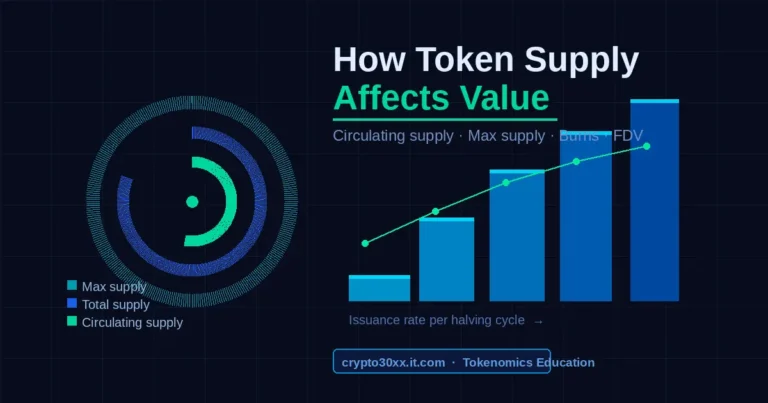
Circulating supply is the number of tokens freely available to trade at any moment. Tokens locked in vesting contracts are counted in total supply (and in fully diluted valuation calculations) but not in circulating supply until they unlock. A project with a small circulating supply at launch but large vested allocations scheduled for release over 18 months is structurally different from one where circulating supply at launch represents a majority of total supply.
The ratio of circulating supply to fully diluted valuation (FDV) at launch is a useful analytical metric. A very low circulating-to-FDV ratio means a large percentage of total supply is still locked — and will eventually unlock. Understanding when that supply unlocks, and to whom, is the core function of vesting analysis.
Vesting and sell pressure windows
Each cliff date on a project’s vesting calendar represents a predictable supply event. When a large allocation unlocks — particularly for holders with early-round discounts — the market may begin pricing in anticipated selling before the date arrives. This phenomenon, sometimes called “cliff-date front-running,” means that understanding a project’s vesting calendar can inform how researchers model supply-side pressure across different time windows.
Monthly unlock size relative to circulating supply is one practical metric. An unlock that adds 5% to circulating supply in a single month is structurally more significant than one that adds 0.5% — even if the absolute token numbers are similar.
FAQs
What does “vesting schedule” mean in crypto? A vesting schedule in crypto is the predefined timeline that controls when locked tokens are released to their recipients — founders, investors, advisors, or contributors. It sets the pace of access, not ownership: recipients are allocated tokens at the TGE, but can only transfer or sell them as they vest according to the schedule.
What is a cliff in a token vesting schedule? A cliff is an initial period — typically six to twelve months — during which no tokens from an allocation are released at all. Once the cliff expires, a batch unlocks at once, and the remaining allocation then begins releasing on the regular schedule. The cliff ensures insiders remain committed through the earliest, highest-risk phase of the project.
What is the difference between linear and graded vesting? Linear vesting releases tokens at a fixed, even rate across the full schedule — the same amount unlocks each month. Graded vesting releases tokens in defined steps — for example, 25% per year over four years. Linear vesting creates smoother, more continuous supply additions. Graded vesting creates discrete unlock events at defined intervals.
Can a vesting schedule be changed after a project launches? It depends on the implementation. If vesting is enforced by a fully immutable smart contract, the schedule cannot be changed. If the contract is upgradeable, or if vesting is managed off-chain, terms may be modifiable. Any change to a vesting schedule after launch should be treated as a material event requiring full community disclosure.
What is TGE unlock in a vesting schedule? The TGE (token generation event) unlock is the percentage of an allocation released immediately when the token launches. Conservative projects keep insider TGE unlocks below 15%. High TGE unlocks for team or investor allocations create concentrated supply pressure at the moment price discovery is least established.
Where can I find a project’s vesting schedule? Start with the project’s whitepaper or official tokenomics documentation. For aggregated data across many projects, token unlock tracker platforms maintain vesting calendars and upcoming cliff dates. For on-chain verification, use a blockchain explorer to read the vesting contract directly if one has been deployed.
Is a long vesting schedule always good? A long vesting schedule reduces one specific risk: early insider selling. It does not guarantee product quality, sustainable tokenomics, or long-term value. Treat vesting duration as one input in a broader evaluation, not as a standalone quality signal.
What is milestone-based vesting? Milestone-based vesting releases tokens when a defined project condition is met, rather than on a fixed time schedule. Common triggers include product launches, protocol upgrades, or governance thresholds. This model is used primarily for ecosystem and contributor allocations where token release should be tied to delivery, not just the passage of time.
Disclaimer
This article is written for educational and research purposes by crypto30xx.it.com, an independent blockchain education and market analysis resource. Nothing in this article constitutes financial, investment, or trading advice. Cryptocurrency markets carry substantial risk of loss. Readers should conduct independent research and consult qualified professionals before making any financial decisions. This article does not endorse or recommend any specific project, token, platform, or investment strategy.
Understanding a project’s vesting schedule is one of the clearest windows into how its tokenomics are actually structured. The cliff period tells you how long insiders are required to stay. The release model tells you how quickly supply expands after that. The TGE unlock percentage tells you how much immediate selling pressure the market absorbs on day one. And the enforcement mechanism — on-chain contract or written agreement — tells you how binding those rules actually are. Together, these four elements give analysts and researchers a structured, verifiable way to assess whether a project’s supply design aligns insider incentives with the long-term participation of its community.
Unlock new possibilities by visiting our gentle space built especially for open and curious minds.