Utility tokens explained: what they are and how they work
Utility tokens explained: Utility tokens are a category of cryptocurrency token that grant holders access to a specific product, service, or function within a blockchain-based system. They are not issued as investments — at least not in their design intent. A utility token gives you something to do: pay fees, vote on proposals, access features, or interact with a protocol. That function is what defines it. Understanding how utility tokens work — and where the line sits between genuine utility and speculative instruments — is one of the more useful distinctions you can learn as a crypto researcher.
What is a utility token?
A utility token is a digital asset issued on a blockchain that provides access to a product or service, typically on the same platform that issued it. The token has a defined function built into the protocol — it pays transaction fees, grants governance rights, gates access to premium features, or serves as the unit of exchange within a specific application. Without the token, the relevant function is unavailable or more expensive.
The clearest structural definition: utility tokens are access rights encoded on a blockchain. They are created by a protocol or application and consumed or used within that same system. Ether (ETH), used to pay transaction fees on Ethereum, is the most-cited reference point in discussions of utility tokens — though its classification is contested and more complex than simple examples suggest. Simpler cases include tokens that grant voting rights within a specific governance system, or tokens that pay for decentralized storage or computing.
How utility tokens differ from other token types
The word “token” gets applied loosely in crypto. Three categories come up most often when comparing utility tokens:
| Token type | Primary function | Returns to holder? | Regulatory treatment |
|---|---|---|---|
| Utility token | Access to a service or function | No (by design) | Usually unregulated, but jurisdiction-dependent |
| Security token | Represents ownership or profit rights | Yes (dividends, equity share) | Regulated as a financial security in most jurisdictions |
| Governance token | Voting rights over protocol decisions | No direct financial return | Grey area; often treated like utility tokens |
| Stablecoin | Peg to a reference asset (USD, EUR) | No | Emerging dedicated regulation in many regions |
The core legal distinction is the Howey Test, a framework from US case law used to determine whether an asset is an investment contract — and therefore a security. Under the Howey Test, an asset qualifies as a security if someone invests money in a common enterprise with an expectation of profit from others’ efforts. A true utility token, in theory, does not meet this bar because holders acquire it for use rather than profit expectation. In practice, regulators and courts have found this line difficult to draw. Many tokens marketed as utilities have been treated as securities after examination.
How utility tokens work in practice
Utility tokens operate through smart contracts — self-executing code on a blockchain that enforces the token’s rules without a central authority. When you hold a utility token, you hold a balance in that smart contract system. When you use the token’s function, the smart contract processes the transaction.
Common utility token mechanics
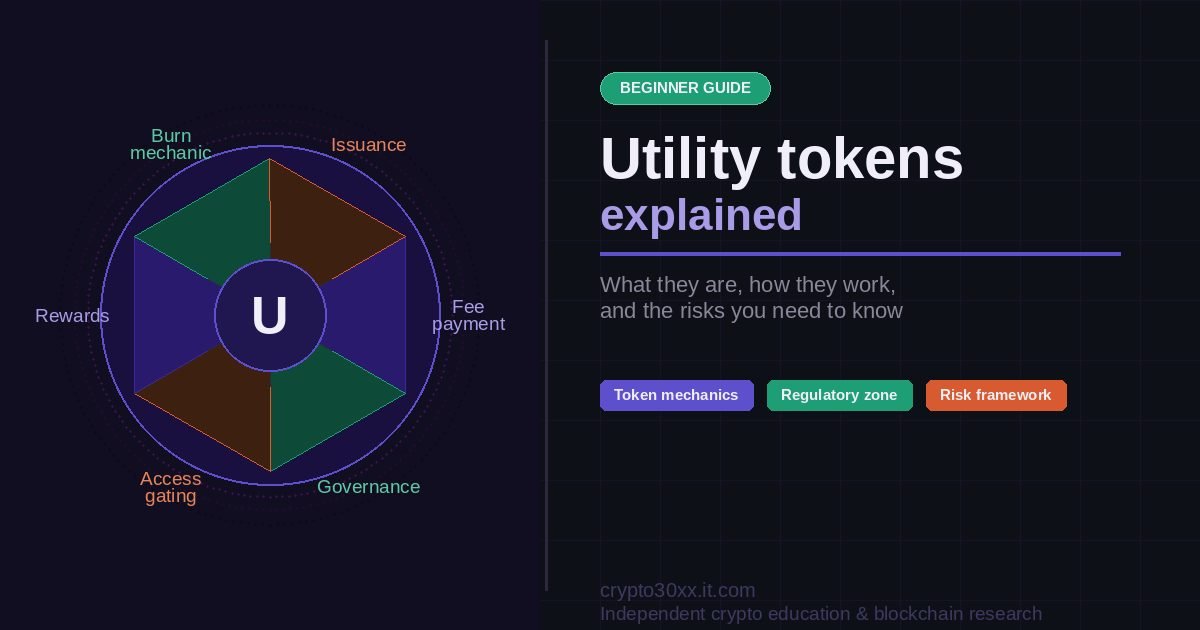
Different protocols design utility differently. The major functional categories:
Transaction fee payment: Some protocols denominate all fees in their native token. To use the network, you need the token. Gas on Ethereum is the familiar example: every transaction requires ETH to compensate the validators who process it. Similar fee mechanics appear on other smart contract platforms.
Access and service gating: Some applications require holding a minimum token balance to access features. This might be a data platform requiring a certain token holding to query its API, or a professional tool reserving advanced features for token holders.
Governance participation: Many decentralized protocols issue tokens that grant voting rights on parameter changes, treasury allocations, or protocol upgrades. Token holders submit and vote on proposals. Weight is typically proportional to token holdings. This is governance utility — the token grants decision rights rather than service access.
Incentive and reward distribution: Some utility tokens are used to pay participants in a protocol’s operation. Validators, liquidity providers, or content creators receive token distributions for contributing work. The token is the unit of account for those payments.
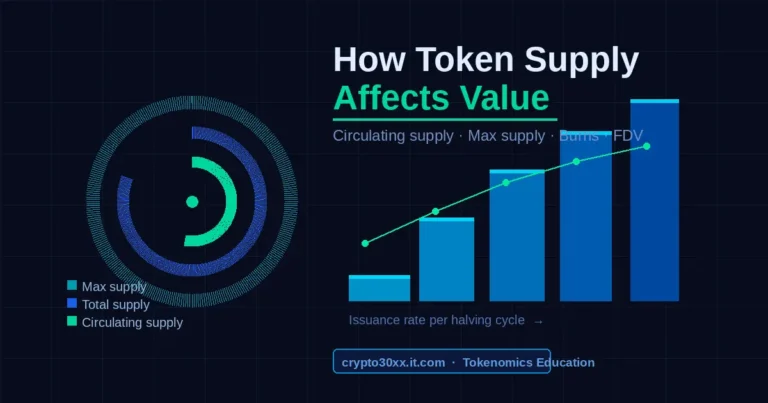
Burn and deflationary mechanics: Some protocols build in token burning — taking a portion of fees and permanently removing those tokens from supply. This links usage volume to supply reduction. EIP-1559 on Ethereum introduced a base fee burn mechanism that removes ETH from circulation proportional to network demand.
Token issuance: how utility tokens reach circulation
Utility tokens typically enter circulation through one of several mechanisms:
- Initial offerings — Projects sold tokens before launch to raise development capital. Early structures included ICOs (initial coin offerings), IEOs (exchange-based), and IDOs (decentralized exchange-based). Regulatory scrutiny has tightened significantly around all of these.
- Mining or validation rewards — Some tokens are issued as block rewards to participants who secure the network.
- Liquidity mining — Protocols issue tokens to users who provide liquidity to their pools, incentivizing early adoption.
- Treasury distributions — Governance-controlled treasuries distribute tokens for contributor grants, partnerships, or community programs.
Utility token examples: how the concept plays out
Looking at how specific protocols implement utility helps clarify the concept beyond abstract definition. Examples here are structural and educational — they illustrate mechanics, not investment cases.
ETH as a fee token
Ethereum’s native asset, ETH, is required to pay for every action on the Ethereum network. Transfer an ERC-20 token? You need ETH. Deploy a smart contract? ETH. Interact with a DeFi protocol? ETH. This is pure utility: without ETH, the network is not accessible. Validators also receive ETH for processing transactions and blocks.
The nuance: ETH is also widely held for speculative reasons, staked for yield, and used as collateral in DeFi protocols. This layering of functions makes single-category classification difficult. Most practitioners treat ETH as a utility token by design while acknowledging its secondary market trading activity.
Storage and compute tokens
Some protocols issue tokens specifically as payment for decentralized services. Decentralized storage networks use tokens to pay storage providers; decentralized compute networks use tokens to pay computation providers. Clients buy the token and spend it on services; providers earn it by supplying resources. The token is a two-sided marketplace unit, not an investment instrument in its design intent.
Governance tokens in DeFi
Many DeFi protocols issue governance tokens that allow holders to vote on protocol parameters — fee rates, supported collateral types, treasury spending, and protocol upgrades go to token-weighted votes. The “utility” is political rather than technical: you can influence how a protocol evolves.
Governance tokens trade on secondary markets and fluctuate in price, which makes them look like investments. Whether they qualify as securities is an active regulatory question, and the answer differs by jurisdiction.
The regulatory grey zone
The utility vs. security question is not settled law in most countries. It is one of the most consequential unresolved questions in crypto policy. Researchers following token classification should treat regulatory status as dynamic rather than fixed.
The Howey Test and its limits
The US Securities and Exchange Commission (SEC) applies the Howey Test to digital assets. Under this framework, a utility token fails to be a security only if buyers acquire it primarily for use, with no significant profit expectation from the issuer’s efforts. That bar is harder to clear than it sounds.
If a project raised capital by selling tokens before its product existed, buyers could not possibly be buying for current utility — there was no utility yet. If the project’s team holds a large token allocation that vests over time, their incentive to build is clearly aligned with token price appreciation. Courts and regulators have found these situations sufficient to classify many “utility” tokens as unregistered securities.
The SEC vs. Ripple case involving XRP provided some clarity on secondary market sales but left much unresolved. The legal landscape continues to develop, and a token legal under one analysis could face reclassification later.
International variation
Regulatory treatment varies across jurisdictions:
- The European Union’s Markets in Crypto-Assets (MiCA) regulation creates a category for “utility tokens” with specific disclosure requirements but generally lighter treatment than financial instruments.
- The UK Financial Conduct Authority distinguishes “exchange tokens,” “utility tokens,” and “security tokens” with different rules applying to each.
- Many jurisdictions have no specific crypto legislation and apply existing securities or financial instruments law on a case-by-case basis.
Risks of utility tokens
Utility tokens carry a distinct risk profile. Understanding the mechanisms behind each risk matters more than a general warning label.
Demand-dependency risk
A utility token’s value is structurally linked to demand for the underlying service. If the service fails, loses users, or faces a stronger competitor, demand for the token falls. Unlike equity, there is no claim on assets or revenue streams. Holders cannot vote to distribute remaining treasury funds or liquidate the protocol. The token’s value is contingent on continued protocol usage.
Inflation and issuance risk
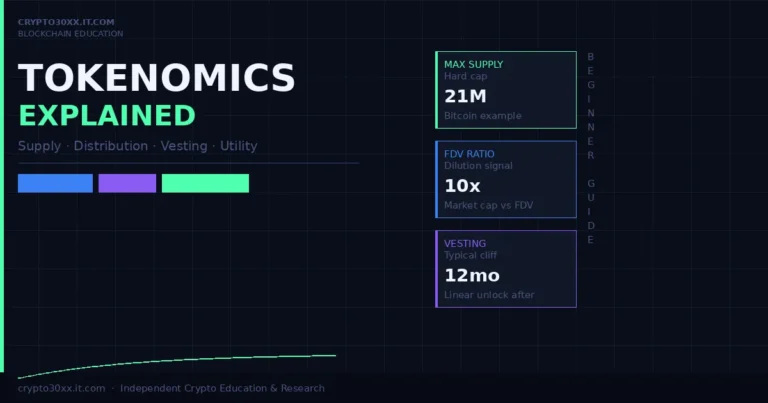
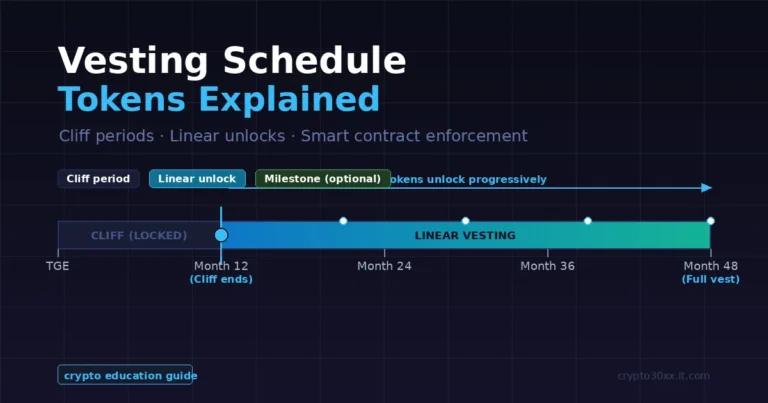
Many utility tokens have high ongoing issuance rates — particularly those distributed as liquidity mining rewards. When token emissions to liquidity providers and contributors exceed demand from new users, supply pressure builds. A token can lose purchasing power even as the protocol grows if issuance outpaces genuine demand. Tokenomics schedules — vesting timelines, total supply, circulating supply, and emission rates relative to usage metrics — matter here.
Regulatory reclassification risk
A token treated as a utility today can be reclassified as a security by regulators. This can trigger exchange delistings, restrict trading for residents of certain countries, or expose issuers to legal liability. Holders may find liquidity reduced suddenly when a major exchange removes a token following a regulatory action.
Smart contract risk
Utility tokens live inside smart contracts. Bugs, design flaws, or exploits in those contracts can result in token theft, locked funds, or complete protocol failure. This is not hypothetical — significant amounts have been lost to smart contract exploits across DeFi protocols. A token’s utility exists only as long as the contracts powering it remain functional and secure.
Concentration risk
Token distributions often concentrate ownership among early investors, founders, and the protocol team. When large vesting schedules release, those holders can sell significant quantities. Large holders can also dominate governance votes, directing protocol decisions toward their interests rather than the broader user base.
Risk summary
| Risk category | Mechanism | Warning signs |
|---|---|---|
| Demand-dependency | Token value falls with protocol usage | Declining active users, fee revenue, or TVL |
| Issuance inflation | Emissions exceed demand | High annual emission rate, low fee burn, falling price despite usage growth |
| Regulatory | Reclassification triggers delisting | Ongoing enforcement actions, unregistered ICO history |
| Smart contract | Bug or exploit destroys token utility | Unaudited code, complex upgrade paths, recent protocol incidents |
| Concentration | Large holders dump or dominate governance | Top 10 addresses hold majority of supply, short vesting cliffs |
Utility tokens vs. governance tokens: are they the same?
This question comes up often. The two categories overlap but are not identical.
A governance token’s primary function is voting rights. Some governance tokens also carry other functions — paying fees, staking for protocol rewards, or serving as collateral. When a token serves both roles, it is sometimes called a utility-governance token, though this is informal rather than standardized terminology.
The distinction matters for one specific reason: purely governance-focused tokens arguably resemble voting shares more than service access tokens. A share of voting power in a protocol that controls significant assets starts to look structurally similar to an equity stake. This is part of why governance tokens attract more regulatory scrutiny in some legal analyses.
FAQs
What is a utility token in simple terms? A utility token is a digital asset that grants access to a specific function within a blockchain protocol. Holding or spending the token lets you use a service — pay fees, vote on decisions, or access features. It is designed for use rather than as an investment instrument.
Is ETH a utility token? ETH functions as a utility token in its design: it pays for transaction fees on Ethereum and is required to interact with the network. It also has additional characteristics — it is staked for validation rewards and used as collateral in DeFi. Most analysts treat it as a utility token by function while recognizing that its widespread trading activity complicates a single-category label.
What is the difference between a utility token and a security token? A utility token gives access to a product or service. A security token represents ownership rights, profit participation, or a claim on an asset’s returns. Security tokens are regulated as financial instruments in most jurisdictions. The legal distinction depends on whether buyers expect profit from the efforts of others — utility tokens are not supposed to meet that threshold.
Can utility tokens lose all their value? Yes. If the underlying protocol shuts down, loses users, or is abandoned, the token’s utility disappears and its market value can approach zero. Unlike equity, there is no residual claim on assets. Many utility tokens from early project launches have lost the vast majority of their value as their ecosystems declined.
Do you earn money by holding utility tokens? Not automatically. Some protocols distribute token rewards to stakers or liquidity providers, but this is not guaranteed income — reward rates change, token prices fluctuate, and emission-based yields can dilute value over time. Utility tokens are not dividend-paying instruments by design.
What is token burning and how does it relate to utility tokens? Token burning removes tokens permanently from circulating supply. Some protocols burn a portion of transaction fees paid in their native token. This creates a deflationary mechanic: higher protocol usage leads to more burns, which reduces supply. Whether burns meaningfully offset ongoing issuance depends on the specific tokenomics of each protocol.
Are all cryptocurrency tokens utility tokens? No. Stablecoins, wrapped assets, synthetic tokens, non-fungible tokens (NFTs), and security tokens all serve different purposes. Even within the utility token category, significant design variation exists. The term is a broad classification rather than a precise technical specification.
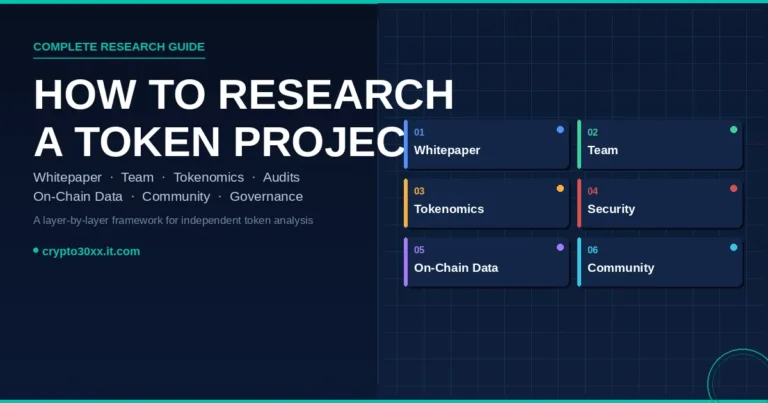
How can I research a utility token’s tokenomics? Check the project’s documentation for total supply, circulating supply, emission schedule, and vesting timelines. Tools like DefiLlama show protocol fee revenue and TVL. On-chain explorers let you examine large holder addresses and vesting contract release schedules. Evaluating fee revenue relative to token market capitalization gives a rough sense of how much economic activity the token is actually capturing.
Disclaimer
This article is written for educational purposes only and does not constitute financial advice, investment advice, or a recommendation to buy, sell, or hold any digital asset. Cryptocurrency markets carry substantial risk, including the risk of total loss. Always conduct independent research and consult qualified professionals before making any financial decisions.
Understanding utility tokens means looking past the marketing and examining what a token actually does inside its protocol. Access rights, fee payment, governance participation, and reward distribution are the main functions. The risks — demand dependency, issuance inflation, smart contract exposure, regulatory uncertainty — are structural, not secondary. The cleaner your understanding of the mechanism, the better positioned you are to evaluate any individual case.
Your guide to getting things done lives inside our productivity-focused content hub.