Ethereum layer 2 solutions explained: the complete guide
Ethereum layer 2 solutions explained: Ethereum layer 2 solutions are protocols built on top of the Ethereum base layer that process transactions off-chain, then settle the results back to mainnet — inheriting Ethereum’s security while eliminating most of its cost and congestion. Where Ethereum’s base layer handles roughly 15 transactions per second with gas fees that can climb steeply during high-demand periods, layer 2 networks routinely process hundreds to thousands of transactions per second for a fraction of a cent each. Understanding how that works — and why different architectures make different tradeoffs — is the subject of this guide.
Why Ethereum needs a layer 2 in the first place
Ethereum’s base layer was deliberately designed to prioritize two properties above all others: decentralization and security. The consequence of that design is limited throughput. A network in which every node independently verifies every transaction is, by definition, only as fast as its slowest full participant — and that ceiling sits around 15 transactions per second on layer 1.
This constraint has a formal name in blockchain research: the scalability trilemma. The premise is that a blockchain system can optimize for at most two of three properties — decentralization, security, and scalability — at any given time. Ethereum chose the first two. Layer 2 solutions resolve the tension by moving execution off the main chain while anchoring its security there.
What “inheriting Ethereum’s security” actually means
When a layer 2 network claims to inherit Ethereum’s security, the claim has a specific technical meaning. Transactions are executed on the layer 2, but the data or proof that validates those transactions is posted to Ethereum mainnet. If the layer 2 operator disappears or behaves dishonestly, users can reconstruct and verify the state of their funds from the data on Ethereum itself. The base layer acts as a permanent, tamper-resistant record.
This distinguishes legitimate layer 2 systems from sidechains, which run their own independent consensus and do not derive security from Ethereum. A sidechain failure can result in loss of funds; a properly designed layer 2 cannot, because the fallback is always Ethereum mainnet.
The four main types of Ethereum layer 2 solutions
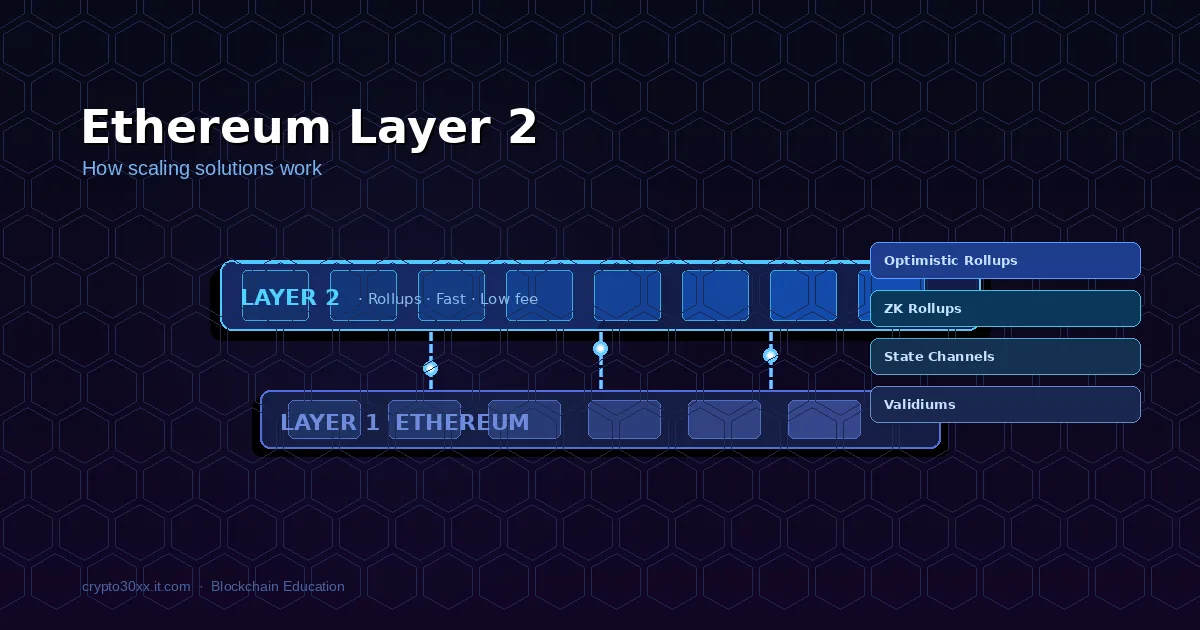
Not all layer 2 architectures work the same way. The four main categories — optimistic rollups, ZK rollups, state channels, and validiums — each make distinct tradeoffs between speed, cost, finality time, and security guarantees.
Optimistic rollups
Optimistic rollups execute transactions off-chain and post a compressed batch of transaction data to Ethereum mainnet, along with a new state root representing the resulting state. The “optimistic” label refers to the core assumption: transactions are presumed valid unless someone challenges them.
The challenge mechanism works through what the system calls a fraud proof. During a fixed dispute window — typically around seven days — any observer can submit evidence that a batched transaction was invalid. If the challenge succeeds, the invalid state is rolled back and the party who submitted it is penalized. If no challenge arrives within the window, the state is finalized on Ethereum.
The tradeoff is direct: faster and simpler to implement, but withdrawals from the layer 2 back to mainnet require waiting out the dispute window. Protocols like Arbitrum and Optimism are the most widely used examples of this architecture.
ZK rollups (zero-knowledge rollups)
ZK rollups take the opposite approach to validity. Rather than assuming correctness and waiting for a challenge, a ZK rollup generates a cryptographic proof — called a validity proof — that mathematically demonstrates every transaction in a batch is correct before the batch is accepted on Ethereum.
The two dominant proof systems in use are zk-SNARKs (Succinct Non-Interactive Arguments of Knowledge) and zk-STARKs (Scalable Transparent Arguments of Knowledge). Both allow one party to prove to another that a computation was performed correctly without revealing the underlying data. The EVM-compatible variants of this technology — often called zkEVMs — allow ZK rollups to run general-purpose smart contracts rather than only simple transfers.
Because validity is proven upfront, ZK rollup withdrawals to mainnet can settle much faster than optimistic rollups — sometimes within minutes rather than days. The tradeoff is computational complexity: generating validity proofs is computationally intensive, and building zkEVM-compatible proof systems required years of cryptographic research. zkSync Era, StarkNet, and Polygon zkEVM represent mature examples of this approach.
State channels
State channels work differently from rollups. Two or more parties lock funds in a smart contract on Ethereum, then conduct an unlimited number of transactions between themselves entirely off-chain, signing each update locally. Only the opening and closing states hit Ethereum mainnet. The channel records intermediate states as signed messages, not as on-chain transactions.
This makes state channels extraordinarily fast and cheap for repeated interactions between fixed parties — a pair of users, a payment application, a game. The limitation is the fixed participant set: a state channel cannot serve arbitrary users the way a general-purpose rollup can. The Lightning Network on Bitcoin is the most well-known application of this concept; on Ethereum, the Raiden Network is the main implementation.
Validiums
Validiums use the same cryptographic validity proofs as ZK rollups, but store transaction data off-chain rather than on Ethereum. This cuts costs further — because posting data to Ethereum is one of the primary costs for rollups — but it introduces a new risk: if the off-chain data availability provider withholds data, users cannot independently reconstruct the rollup’s state.
Validiums occupy a middle ground between pure ZK rollups and fully off-chain systems. They are appropriate for applications where throughput and cost take priority and where the data availability provider can be trusted or is governed by a committee. StarkEx, the infrastructure powering several large trading applications, operates as a validium.
How rollups work: the mechanics step by step
Rollups are the dominant form of Ethereum layer 2 today. The mechanics are worth understanding in detail, because the differences between optimistic and ZK variants flow directly from one point in the process.
- Users submit transactions to the layer 2 sequencer. The sequencer is the node responsible for ordering and batching incoming transactions. Most deployed rollups use a centralized sequencer for speed, though decentralized sequencer designs are an active area of development.
- The sequencer executes transactions and updates state. Off-chain execution happens on the layer 2’s own runtime, which mirrors Ethereum’s EVM in most major rollups. This is where the throughput advantage comes from — no global consensus is needed at this stage.
- Transactions are compressed and batched. Multiple transactions are aggregated into a single batch. Compression reduces the amount of data that needs to be posted to Ethereum mainnet. A batch representing hundreds of individual transactions may occupy only a fraction of the on-chain space those transactions would otherwise require.
- The batch and a validity proof (ZK) or state root (optimistic) are posted to Ethereum. This is the step where the layer 2’s costs originate: posting data to Ethereum mainnet consumes gas. The cost per transaction scales inversely with batch size — larger batches spread the fixed posting cost across more users.
- Ethereum accepts or challenges the submission. For optimistic rollups, the dispute window begins. For ZK rollups, the validity proof is verified by a smart contract on Ethereum. Once accepted, the state root is final on the base layer.
- Users can withdraw to mainnet by referencing the settled state. With an optimistic rollup, this requires the dispute window to pass. With a ZK rollup, withdrawal can proceed once the proof is verified on-chain.
Optimistic rollups vs. ZK rollups: a direct comparison
The choice between these two architectures affects users, developers, and application designers differently. The table below captures the primary dimensions of that comparison.
| Dimension | Optimistic rollups | ZK rollups |
|---|---|---|
| Validity mechanism | Fraud proofs (challenge window) | Cryptographic validity proofs |
| Withdrawal time to mainnet | ~7 days (dispute window) | Minutes to hours (proof verification) |
| EVM compatibility | High — mirrors Ethereum EVM closely | Evolving — zkEVM designs close the gap |
| Computational cost for operators | Lower — no proof generation required | Higher — generating proofs is computationally intensive |
| Security assumption | At least one honest verifier will challenge fraud | Cryptographic soundness of the proof system |
| Best suited for | General-purpose dApps, DeFi, developer tools | High-frequency payments, trading, applications requiring fast finality |
| Leading examples | Arbitrum, Optimism, Base | zkSync Era, StarkNet, Polygon zkEVM |
Neither architecture is universally superior. Optimistic rollups reached production earlier and have more mature tooling. ZK rollups offer stronger security guarantees and faster finality but require more complex infrastructure to operate. Both continue to develop rapidly.
How EIP-4844 changed the economics of layer 2
Data costs are the primary recurring expense for rollup operators. Every batch posted to Ethereum mainnet consumes block space. Historically, rollups stored this data in a part of the transaction called calldata, which is permanently stored by Ethereum nodes. That permanence made it expensive.
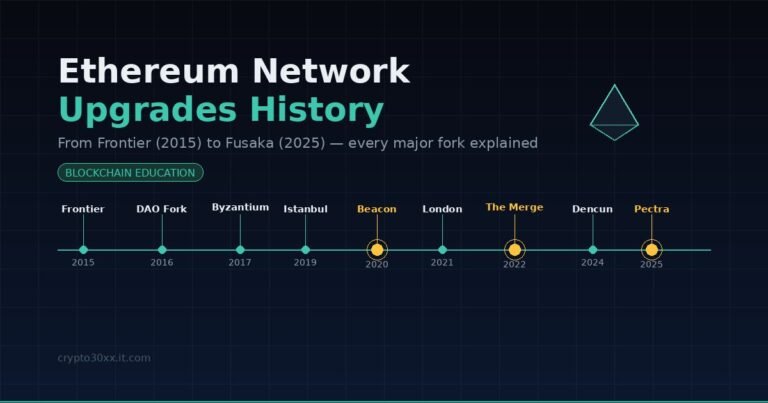
EIP-4844, activated on Ethereum mainnet as part of the Dencun upgrade, introduced a new transaction type carrying what it calls blobs — large, temporary data payloads attached to transactions. Blob data is stored on Ethereum’s consensus layer for approximately 18 days, long enough to serve the verification needs of rollups, then pruned. Because blobs do not compete with ordinary Ethereum transactions for execution gas, and because they are not permanently stored, they cost significantly less than calldata.
The practical effect was a reduction in per-transaction costs on major rollups by one to two orders of magnitude in many cases. A transaction that previously cost several cents on a rollup moved toward fractions of a cent.
EIP-4844 is described as proto-danksharding — a first step toward full danksharding, the long-term Ethereum scaling roadmap that aims to expand blob capacity substantially. The full implementation of danksharding would allow Ethereum to support far larger numbers of rollups and transactions simultaneously.
What layer 2 solutions mean for users and developers
For users
The practical difference when using a layer 2 versus Ethereum mainnet is primarily cost and speed. Operations that might cost several dollars to tens of dollars in gas on mainnet during periods of congestion execute for fractions of a cent on major rollups. This makes smaller transactions — micropayments, frequent DeFi interactions, gaming assets, social applications — economically viable in a way they are not on layer 1.
The tradeoff for users is bridge risk. Moving assets from Ethereum mainnet to a layer 2 requires using a bridge contract, which represents a smart contract risk. Bridging in the other direction, from layer 2 back to mainnet, takes time with optimistic rollups and a small fee with any rollup. Understanding these mechanics before using a bridge is important.
For developers
EVM-compatible rollups allow developers to deploy existing Ethereum smart contracts with minimal changes, using the same languages, tooling, and test environments. The main differences are operational: gas dynamics, sequencer behavior, and bridge mechanics require explicit handling. Each major rollup also maintains its own developer documentation and grant programs.
ZK rollups with zkEVM compatibility have narrowed the development experience gap considerably, though some edge cases in EVM behavior still require attention when porting contracts.
Risks and limitations of layer 2 solutions
Layer 2 networks improve Ethereum’s scalability, but they introduce new risk dimensions that do not exist on mainnet. Any honest evaluation needs to address these directly.
Sequencer centralization
Most deployed rollups use a single, centralized sequencer to order transactions. A centralized sequencer can censor specific transactions, experience downtime, or in theory front-run user orders by reordering transactions to its own advantage. Decentralized sequencer designs are under active development across major rollups, but most production systems have not yet implemented them. Users relying on censorship resistance should understand this limitation.
Bridge contract risk
The smart contracts that govern asset transfers between Ethereum and a layer 2 hold large amounts of value and are complex systems. A bug in bridge contract code has historically been the source of major exploits across the broader blockchain space. Audits reduce but do not eliminate this risk.
Proof system and cryptographic assumptions
ZK rollups depend on the mathematical soundness of their proof systems. A flaw in a zk-SNARK or zk-STARK implementation, or a break in the underlying cryptographic assumptions, could theoretically allow invalid state transitions to be accepted. This risk is considered very low given the maturity of the cryptography involved, but it is not zero.
Data availability in validiums
As noted earlier, validiums store transaction data off-chain. If the data availability provider withholds data, users may be unable to exit the system or verify their balances. Systems that use a trusted committee for data availability transfer some security assumptions off-chain in a way that pure rollups do not.
Upgrade key risk
Many rollup contracts retain admin keys that allow the protocol to be upgraded or paused. During early development phases, this is necessary for fixing bugs, but it also means the protocol is not fully trustless. A compromised or malicious admin key could affect user funds. Most major rollups publish their upgrade key holders and security council structures, and the industry trend is toward decentralizing or time-locking upgrade mechanisms over time.
FAQs
What is a layer 2 solution on Ethereum? An Ethereum layer 2 is a separate network that processes transactions off the main Ethereum chain and then posts a compressed record or proof of those transactions back to mainnet. This allows significantly higher transaction throughput and lower fees while inheriting Ethereum’s security guarantees.
What is the difference between a rollup and a sidechain? A rollup derives its security from Ethereum mainnet by posting transaction data or validity proofs on-chain, meaning users can always recover their funds from the Ethereum record. A sidechain runs its own independent consensus mechanism and does not anchor to Ethereum’s security. A sidechain failure can result in loss of funds; a properly designed rollup cannot, because the fallback is always Ethereum itself.
Why do optimistic rollup withdrawals take 7 days? Optimistic rollups assume transactions are valid unless challenged. The seven-day window gives any honest observer time to detect and prove fraud before the state is finalized on Ethereum. Third-party bridge services can speed up withdrawals by providing liquidity in exchange for a fee, but native protocol withdrawals require the full dispute window.
Are ZK rollups always safer than optimistic rollups? Not necessarily in absolute terms. ZK rollups prove validity upfront and do not require a dispute window, which eliminates certain fraud scenarios. But they depend on the correctness of complex proof systems, and their zkEVM implementations are newer and less battle-tested than optimistic rollups in some respects. Both architectures have distinct risk profiles rather than a clear safety hierarchy.
What is EIP-4844 and why does it matter for layer 2? EIP-4844 introduced blob transactions on Ethereum mainnet as part of the Dencun upgrade. Blobs are temporary data payloads that rollups can use to post batch data at a significantly lower cost than the previous calldata approach. The result was a large reduction in per-transaction costs on most major rollups.
Can I use a layer 2 without understanding the technical details? Most major rollups offer user interfaces that abstract away the underlying mechanics. However, understanding bridge risk, withdrawal times, and the difference between native and third-party bridges is practically important before moving significant value. The technical details in this guide exist to support that understanding, not as a prerequisite for casual use.
What are the main Ethereum layer 2 networks? The most widely used networks span both architectures: Arbitrum and Optimism (and its OP Stack derivatives, including Base) are the leading optimistic rollups; zkSync Era, StarkNet, and Polygon zkEVM are the leading ZK rollup implementations. Each has its own ecosystem of applications, governance structure, and fee dynamics.
Disclaimer
This article is produced by crypto30xx.it.com for educational and research purposes only. It does not constitute financial advice, investment advice, or a recommendation to buy, sell, or hold any asset. Cryptocurrency and blockchain systems involve significant risk, including the potential loss of principal. Readers should conduct independent research and consult qualified professionals before making any financial decisions.
Understanding the architecture of Ethereum layer 2 solutions is foundational to understanding how the broader Ethereum ecosystem functions today. The base layer handles security and decentralized settlement; layer 2 networks handle execution at scale. The two primary approaches — optimistic and ZK rollups — represent different tradeoffs in how validity is established, and both continue to evolve. What was once experimental infrastructure now underpins a substantial portion of daily Ethereum activity, and the economic improvements from protocol upgrades like EIP-4844 have made that shift structural rather than temporary
Our featured articles hold the kind of wisdom that stays with you beyond our gentle teachings page.