How smart contracts work on Ethereum: a complete guide
How smart contracts work on Ethereum: Smart contracts on Ethereum are programs stored on a public blockchain that execute automatically when predefined conditions are met, without any central authority enforcing or overseeing the agreement. Their terms are written in code, deployed to the Ethereum network, and carried out simultaneously by thousands of independent nodes. Once triggered, no single party can alter the outcome. This architecture is what makes Ethereum the foundation for decentralized finance, digital ownership systems, and programmable collective governance.
This guide explains how smart contracts work at a mechanical level: how they are written, compiled, deployed, and triggered, along with their real-world applications, structural limitations, and the most persistent points of confusion about what they can and cannot do.
What is a smart contract?
A smart contract is a self-executing program deployed to a blockchain that runs its logic automatically when predefined conditions are met, requiring no trusted third party to enforce or oversee the agreement. The terms live in code rather than natural language, and the blockchain network carries out execution exactly as written, on behalf of no single controlling party. The contract cannot deviate from its own instructions.
Computer scientist Nick Szabo described the concept in the 1990s, years before blockchain technology existed. His analogy was a vending machine: deposit the right amount, make a selection, receive the item. The machine enforces its rule mechanically. Ethereum brought that model to a global, permissionless network.
The if-then foundation
Every smart contract runs on conditional logic: if condition X is satisfied, execute action Y. A decentralized exchange might specify that if a user deposits a particular token and a matching offer exists at the agreed price, settle the trade. A lending protocol might specify that if a borrower’s collateral-to-debt ratio falls below a defined threshold, initiate liquidation.
That logic is not interpreted by a human. It runs as code on every node in the network.
How Ethereum extends Bitcoin’s scripting
Bitcoin supports a limited scripting language adequate for basic conditional transactions (timelock releases and multi-signature authorization are two common examples). Ethereum was designed from the ground up to be Turing-complete, capable in principle of expressing any computable logic given sufficient resources. This architectural difference explains why nearly all programmable blockchain applications either run on Ethereum or on networks built to be compatible with it.
How smart contracts work on Ethereum: the mechanics
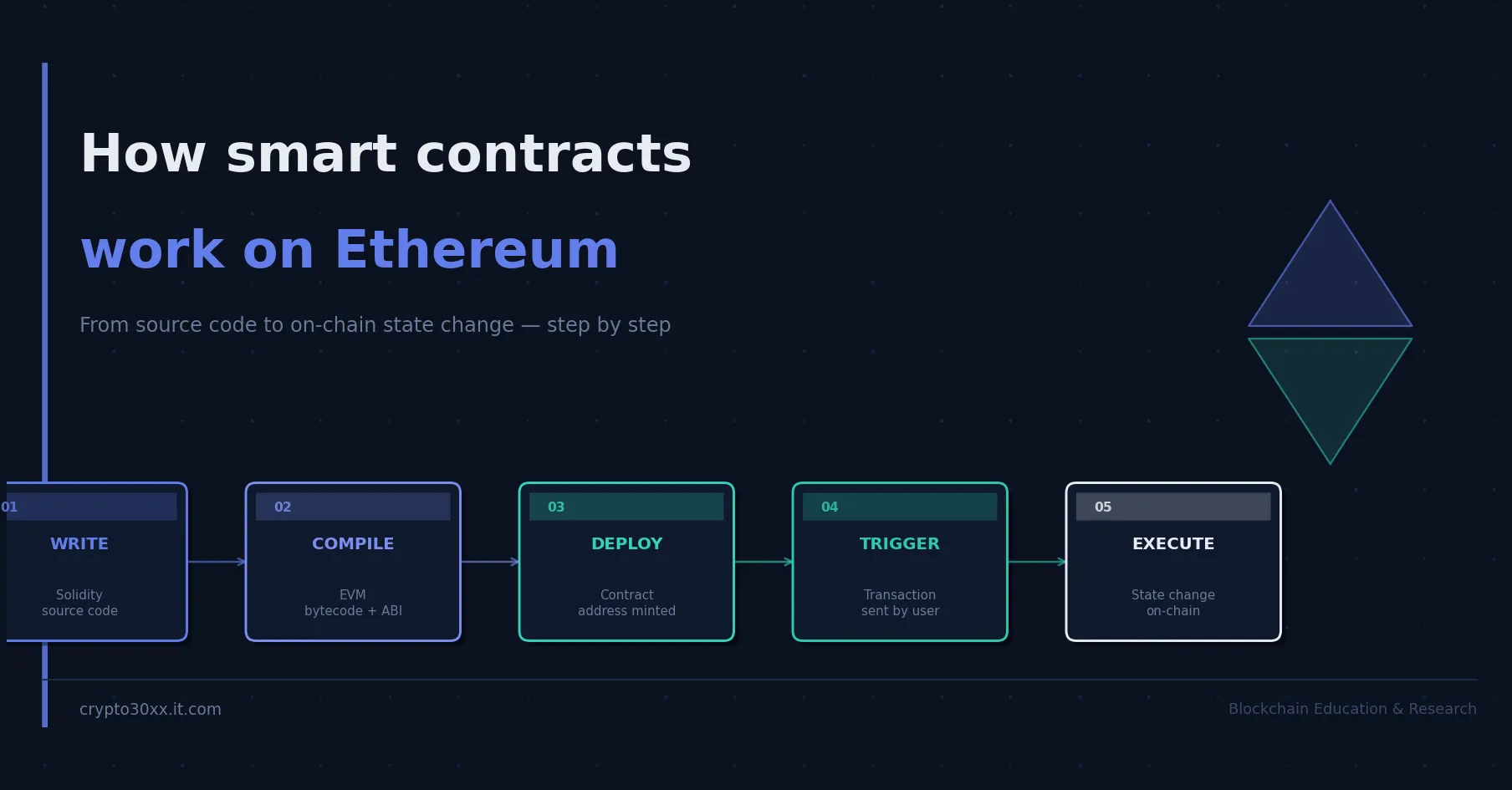
Understanding how smart contracts work on Ethereum means tracing a contract from developer-written code through to on-chain state change. The process spans four distinct stages: writing, compiling, deploying, and executing. Each is handled by a different layer of Ethereum’s infrastructure, with no human intermediary involved at any point.
Writing contract code in Solidity
Solidity is the primary language for writing Ethereum smart contracts. It is statically typed, object-oriented in structure, and compiles into bytecode that the Ethereum Virtual Machine processes. A Solidity contract defines four core components:
- State variables: persistent data stored on-chain, such as token balances or ownership records
- Functions: operations that read or modify state variables when called by an external transaction
- Events: log entries emitted when specific contract actions occur, readable by external applications
- Modifiers: access controls that restrict which accounts can invoke specific functions
Vyper is an alternative Ethereum-compatible language that enforces simpler syntax to reduce the risk of security errors. It has a smaller developer base than Solidity but is used in protocols that prioritize auditability above flexibility.
Compilation to EVM bytecode
Human-readable Solidity cannot run on Ethereum directly. A compiler transforms it into EVM bytecode: a compact sequence of operation codes (opcodes) that the Ethereum Virtual Machine understands. The compiler also produces an Application Binary Interface (ABI), which describes the contract’s functions and data types so that wallets, protocols, and front-end applications know how to communicate with it.
Bytecode is what gets stored permanently on-chain. Source code is not stored on the blockchain by default, though developers routinely publish it to block explorers so that anyone can verify the logic before interacting with a contract.
Deployment and contract addresses
Deploying a contract means sending a transaction to Ethereum with the compiled bytecode attached as the data payload. The network confirms the transaction and assigns the contract a permanent address: a 42-character hexadecimal string formatted identically to a standard wallet address. From that point, the contract exists as an independent on-chain entity with its own storage, its own capacity to hold ETH, and its own executable logic.
Administrative authority over the contract does not exist by default. Any owner function or upgrade mechanism must be written explicitly into the contract’s code before deployment.
Triggering execution: transactions and calls
A deployed contract sits dormant until an external action activates it. Two mechanisms do this:
- Transactions: signed messages sent from a user wallet that modify contract state, consume gas, and are recorded permanently on the blockchain
- Calls: read-only queries that retrieve data from a contract without changing state, at no cost to the caller
When a transaction targets a contract function, every Ethereum full node executes that function independently and must arrive at the same result. Nodes that reach a different output reject the block. This deterministic, replicated execution is the mechanism behind trustlessness: no single operator controls what the contract returns.
Gas as the execution fee
Every operation a smart contract performs consumes gas, Ethereum’s unit of computational work. Writing to storage costs gas. Arithmetic operations cost gas. Sending ETH from inside a contract costs gas. Gas serves two purposes: it compensates validators for their work, and it prevents attackers from submitting computationally unbounded code without cost.
The fee a sender pays equals gas units consumed multiplied by the prevailing gas price, measured in gwei (a small fraction of one ETH). A basic ETH transfer consumes a fixed 21,000 gas units. A complex DeFi transaction routing through multiple contracts may consume several hundred thousand. Total fee amounts fluctuate directly with network demand.
From deployment to execution: a step-by-step walkthrough
Deploying and using an Ethereum smart contract follows a consistent, reproducible process: from the moment a developer writes the first line of code to the moment a user’s transaction permanently alters on-chain state. The sequence below traces this end to end.
- A developer writes the contract logic in Solidity, defining state variables, functions, access rules, and events.
- The source code is compiled into EVM bytecode and an ABI using a tool such as the solc compiler.
- The developer sends a deployment transaction to Ethereum with the bytecode attached as the transaction’s data field.
- The network confirms the transaction and assigns the contract a permanent, unique address.
- A user sends a transaction to the contract address, specifying the function to call and any required input parameters.
- Every Ethereum full node executes the specified bytecode function independently, using the inputs provided.
- If all nodes reach the same valid output, the transaction is included in a block and confirmed on the network.
- The state changes produced by execution — updated balances, new ownership records, logged events — are written permanently to the blockchain.
No human reviews, approves, or modifies any individual step in this process.
Smart contracts vs traditional contracts
Comparing smart contracts to traditional legal agreements reveals a set of structural trade-offs rather than a clear hierarchy. Smart contracts outperform in speed, transparency, and global access. Traditional contracts outperform in flexibility, ambiguity handling, and dispute resolution. The table below maps these differences across key functional dimensions.
| Feature | Traditional contract | Smart contract |
|---|---|---|
| Enforcement | Courts, lawyers, arbitrators | Code executed by the blockchain |
| Modification after signing | By mutual agreement or court order | Only if the contract’s code permits it |
| Transparency | Private by default | Public and auditable by default |
| Execution speed | Days to months | Seconds to minutes |
| Geographic scope | Jurisdiction-bound | Global, permissionless |
| Handling of ambiguity | Human interpretation | Cannot interpret ambiguity |
| Dispute resolution | Formal legal process | None built in |
| Counterparty risk | Present | Replaced by code risk |
Where smart contracts fall short
Smart contracts cannot interpret vague or ambiguous terms. Legal language like “reasonable effort” or “material breach” has no equivalent in code; every condition must be precisely and exhaustively defined before deployment. They also cannot access external data without outside services, and a bug in a deployed contract is not correctable without a mechanism the original code must have included for that purpose.
What smart contracts power
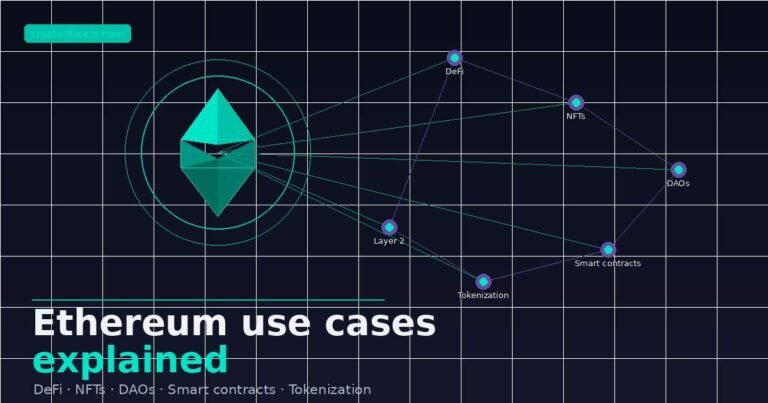
Most substantive Ethereum applications are built from collections of smart contracts, each governing a specific piece of logic that together replicates functions once performed by centralized institutions. Three application categories represent a significant share of Ethereum’s contract activity and illustrate the range of what programmable on-chain execution can achieve.
DeFi protocols
Decentralized finance protocols use smart contracts to handle lending, borrowing, asset trading, and yield distribution without central operators. In a lending protocol, a smart contract holds pooled assets, calculates interest rates algorithmically from supply and demand, and enforces collateral requirements uniformly for every user. No underwriter reviews individual applications or sets individual terms.
NFTs and token standards
Non-fungible tokens are smart contracts that record ownership of unique digital assets. The ERC-721 standard defines a contract interface in which each token has a distinct ID and a recorded owner address. ERC-1155 extends this to manage both fungible and non-fungible tokens inside a single contract, reducing deployment costs for applications that require both types.
ERC-20 fungible tokens (the category covering most tradeable tokens on Ethereum) are themselves smart contracts. When a wallet displays a token balance, it reads a value stored inside that token contract’s internal data structure.
DAOs and on-chain governance
Decentralized autonomous organizations encode collective decision-making in smart contracts. A governance contract lets token holders submit proposals and vote, with outcomes executed on-chain automatically once a defined threshold is reached. The participation rules, vote weighting, and execution conditions are fixed in code and applied uniformly to every participant.
Risks, limitations, and common misconceptions
Smart contracts replace counterparty risk with code risk. The same properties that prevent tampering also prevent correction, and external data dependencies introduce trust assumptions that no amount of code alone can fully eliminate. Three categories of failure have each caused documented losses across Ethereum’s history.
Immutability as a double-edged property
A deployed contract’s bytecode cannot be changed. This property prevents unauthorized modification but also prevents correction of legitimate errors. A bug in a contract that holds user assets is a permanent liability with no administrative override. Developers address this through upgradeable proxy patterns that route function calls to a replaceable logic contract while preserving the original address. This approach works, but it reintroduces a degree of central control: the same authority the system was designed to remove.
The oracle problem
Smart contracts can only access data that exists on the blockchain. They cannot natively retrieve commodity prices, weather conditions, election results, or any other real-world information. Oracles are external services that carry data onto the chain and feed it to contracts. If an oracle provides incorrect, delayed, or manipulated data, the contract executes faithfully on bad inputs.
Oracle networks address this through decentralized data aggregation and economic incentives for accurate reporting, but no oracle design fully removes the data-trust dependency.
Code-level security vulnerabilities
Smart contract code has been exploited repeatedly. In a reentrancy attack, an external contract calls back into a function before the original call completes, draining funds across recursive calls. This technique exploited a logic flaw in one of Ethereum’s earliest large-scale collective funds. That event triggered a chain split that produced Ethereum and Ethereum Classic as two separate networks. Integer overflow, flash loan price manipulation, and misconfigured access controls are among other documented attack categories.
Code audits, formal verification, and ongoing bug bounty programs reduce exposure. None eliminate it.
“Smart” does not mean autonomous or intelligent
A smart contract executes exactly what its code specifies. It does not adapt to context, interpret intent, or recognize when conditions have changed in ways the original developer did not anticipate. If inputs satisfy the contract’s formal rules but are economically manipulated (via a flash loan that temporarily distorts asset prices in a liquidity pool, for example), the contract executes on those distorted values without resistance.
Smart contracts also do not trigger themselves on a schedule. A function designed to run daily will only run when an external transaction calls it. Keeper networks and on-chain automation protocols handle these triggers, but they are separate external dependencies outside the contract’s own code.
FAQs
What programming language is used to write Ethereum smart contracts? Solidity is the dominant language for Ethereum smart contract development. It is statically typed, object-oriented, and compiles to EVM bytecode. Vyper is an alternative that enforces simpler, more constrained syntax to reduce the likelihood of security errors. Both compile to the same EVM target; the choice affects developer experience and code structure, not the runtime environment.
Can a smart contract be modified after it is deployed? A standard deployed contract is immutable: its bytecode is fixed at deployment. Developers can implement upgradeable proxy patterns that route calls to a replaceable implementation contract without changing the original address. This allows logic updates but reintroduces a trusted administrator who can approve upgrades, which meaningfully changes the trust model of the application.
Who pays the gas fee when a smart contract executes? The account sending the triggering transaction pays the gas fee. If the transaction runs out of gas before the function completes, all state changes revert, but the gas spent up to that point is not refunded. Applications typically estimate gas costs and display them before submission so users can set appropriate limits.
Are smart contracts legally enforceable? Legal enforceability varies by jurisdiction and remains an evolving area of law. Some legal systems have passed legislation recognizing smart contract outputs as binding. In most jurisdictions, enforceability depends on whether the underlying arrangement satisfies standard contract law requirements (offer, acceptance, consideration, and intent to be bound), not on whether it ran on a blockchain.
What is the difference between a token and a smart contract? On Ethereum, a token is a smart contract. An ERC-20 token is a deployed contract that maintains a mapping of wallet addresses to balances and enforces transfer rules through its functions. When a wallet shows a token balance, it reads a value stored inside that contract’s state. The token has no independent existence separate from the contract that defines it.
Can a smart contract hold ETH? Yes. Smart contracts can receive, store, and send ETH, and many do. DeFi protocols routinely hold pooled ETH and other assets inside contracts. The contract’s own code defines the conditions under which assets can move. This ties the security of user funds directly to the correctness of the contract’s logic.
How does Ethereum’s proof-of-stake consensus relate to contract execution? Under proof-of-stake, validators propose and attest to new blocks. Every full node independently executes every transaction in each proposed block and must arrive at the same resulting state. A node that reaches a different output rejects the block. This deterministic, replicated execution across thousands of independent nodes is the mechanism that allows the network to agree on contract outputs without trusting any single participant.
Disclaimer
This article is written for educational and research purposes only. Nothing in this guide constitutes financial, investment, or legal advice. Smart contracts and decentralized protocols carry material technical and financial risks, including the partial or complete loss of assets. Readers should conduct independent research and consult qualified professionals before interacting with any blockchain protocol or decentralized application.
Understanding how smart contracts work on Ethereum is foundational to understanding the network’s role in decentralized applications. The mechanism is clear in principle: conditional code that executes on a shared machine no single party controls. The implications extend across finance, ownership, and governance. The risks are equally structural: immutability, external data dependencies, and code vulnerabilities are design properties of the system, not edge cases. Any rigorous analysis of Ethereum applications must account for both dimensions with equal weight.
Rest your thoughts inside our soft space and let the answers come to you without any pressure.