How to avoid liquidation in trading: a complete guide
How to avoid liquidation in trading: Liquidation in trading is the forced closure of a leveraged position by an exchange when losses reduce the trader’s margin below the required maintenance threshold. It happens automatically, without warning, and results in a partial or total loss of the collateral posted. For anyone using leverage (perpetual futures, margin accounts, or cross-collateral products), understanding how liquidation works, and how to manage the conditions that cause it, is the most consequential skill in leveraged trading.
This guide explains the mechanics in full: how liquidation prices are calculated, which account settings change your exposure, and what risk management methods are available to lower the probability of a forced close.
What is liquidation in crypto trading?
Liquidation occurs when a leveraged trading position’s margin balance falls to the exchange’s maintenance margin requirement, at which point the exchange closes the position to prevent the account from going into negative equity. The exchange, not the trader, executes the close. It often fills at a worse price than the liquidation trigger, resulting in the loss of posted collateral.
Every exchange that offers leveraged products maintains a liquidation engine: an automated system that monitors all open positions in real time. When a position’s unrealized loss consumes enough of the margin to bring the margin ratio below a set floor, the engine steps in.
How the liquidation price is calculated
The liquidation price is the asset price at which the position’s margin will be fully consumed by losses, after accounting for trading fees and funding charges. The general formula for a long position is:
Liquidation price (long) = Entry price × (1 − 1 / Leverage ratio + Maintenance margin rate)
For a short position, the formula inverts:
Liquidation price (short) = Entry price × (1 + 1 / Leverage ratio − Maintenance margin rate)
Using round numbers: a long position opened at $40,000 with 10× leverage and a 0.5% maintenance margin rate has a liquidation price of approximately $36,200. The higher the leverage, the closer that price is to the entry price.
Initial margin vs maintenance margin
Two margin concepts govern most liquidation scenarios:
| Term | What it means | Typical level |
|---|---|---|
| Initial margin | The collateral required to open the position | 1/leverage ratio (e.g. 10% for 10×) |
| Maintenance margin | The minimum collateral to keep the position open | Varies by exchange; commonly 0.5%–2% |
| Margin ratio | Current margin ÷ maintenance margin requirement | Falls as losses accumulate |
When the margin ratio hits 100%, liquidation is triggered. Most exchanges send a margin call (a warning notification) before this happens, but the window is often narrow under fast-moving conditions.
Why positions get liquidated: the real causes
Knowing the formula is not enough. Liquidations in practice stem from a cluster of structural and behavioral causes. Understanding each one makes avoidance concrete.
Excessive leverage relative to volatility
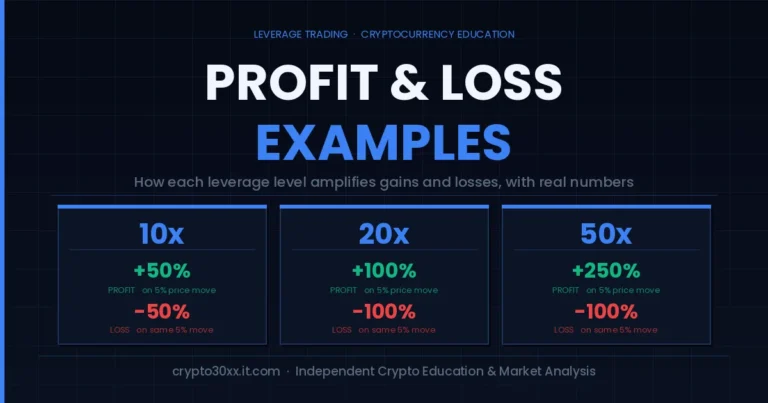
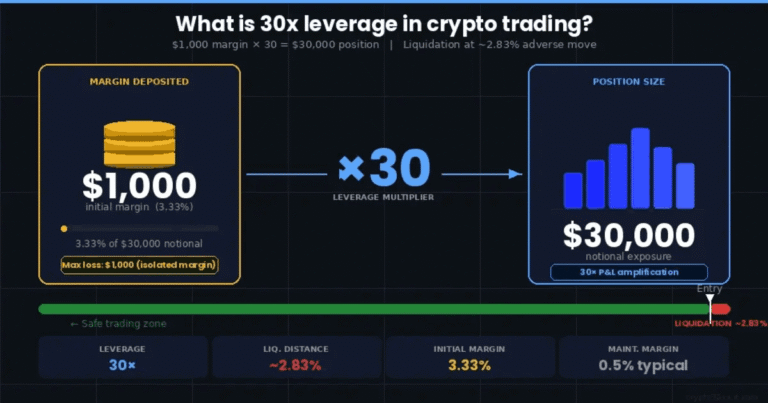
Leverage amplifies both gains and losses symmetrically. At 30× leverage, a 3.3% adverse move is enough to liquidate a position entirely (excluding fees). At 5× leverage, that same 3.3% move is a manageable 16.5% loss. The math is fixed. What changes is how easily the market can produce a 3.3% move. In crypto, intraday moves of 5%–15% are common even in relatively stable periods.
Traders often set leverage based on a desired position size rather than on the actual volatility of the asset. The result is a liquidation price that sits well within the normal daily price range.
Using cross margin without understanding it
Most exchanges offer two margin modes:
Cross margin pools the entire account balance as collateral for all open positions. A single large losing position can draw down the collateral supporting other, unrelated positions and trigger cascading liquidations across the account.
Isolated margin caps the collateral at risk for each position individually. A liquidation in one position does not affect other open trades.
Cross margin gives more flexibility and can delay a single position’s liquidation by drawing on wider funds. It does not eliminate the risk. It redistributes it across the entire account.
Funding rates accumulating against the position
Perpetual futures use a funding rate mechanism to keep the contract price anchored to the spot price. When the rate is negative and a trader is long, the position pays a fee every 8 hours (or at whatever interval the exchange uses). In a sideways or trending-against market, these fees accumulate and steadily erode margin. This effect is invisible on short trades but becomes significant over days or weeks.
Sudden volatility events
Flash crashes, large liquidation cascades, and order book gaps can move prices through a liquidation price faster than a stop loss order can execute. In these cases, even well-placed stops may not prevent a forced close, though they dramatically limit the exposure.
Not accounting for trading fees
Entry fees, exit fees, and spread all reduce effective margin. A position that appears safe at 5× leverage may have a true effective leverage slightly higher once fees are included. This detail is small on individual trades and meaningful in aggregate.
How to avoid liquidation in trading: methods ranked by impact
These methods are not equally effective. The first two, leverage and position sizing, account for the vast majority of liquidation events when done wrong, and for the vast majority of protection when done right.
1. Match leverage to asset volatility, not to desired profit
The single most effective method. Before opening a position, calculate the realistic daily price range for the asset. If that range routinely exceeds the distance between entry price and liquidation price, the leverage is too high.
A practical approach: set the liquidation price at least two to three times the average daily range away from the entry. For a highly volatile asset with 8% average daily moves, a 10× long position liquidating at 5% below entry is structurally unviable.
Lower leverage forces larger price moves to cause liquidation. It also reduces the profit per dollar of collateral. This tradeoff is the entire point of leverage control.
2. Size positions relative to total account, not to trade conviction
Position sizing is a separate control from leverage. Even at moderate leverage, a position that occupies 80% of account equity creates concentrated exposure. Standard risk management frameworks suggest risking 1%–3% of total account equity on any single trade. If the stop loss is hit, the loss is that percentage of the account, not the full position.
The formula: Position size = (Account equity × Risk percentage) ÷ Distance to stop loss
This keeps any single loss manageable without requiring the position to be liquidated first.
3. Use stop loss orders and understand their limits
A stop loss order instructs the exchange to close the position if the price reaches a specified level. Placed between the entry price and the liquidation price, it acts as a first line of defense, closing the trade at a known, controlled loss before the exchange’s liquidation engine takes over.
Important distinction: a stop market order triggers at the stop price and fills at whatever the next available market price is. In fast-moving conditions, this can result in slippage: execution at a worse price than intended. A stop limit order fires a limit order at the stop price, which avoids slippage but risks non-execution if the market gaps through the limit.
For liquidation avoidance, the stop loss must be set before the position is opened, not after watching the trade move against the position.
4. Prefer isolated margin for positions with different risk profiles
If running multiple positions simultaneously, isolated margin prevents one losing trade from contaminating others. Each position has a defined maximum loss equal to the collateral allocated to it. Cross margin offers efficiency at the cost of correlated account-wide exposure.
Isolated margin is the more conservative default for traders learning a new asset, strategy, or market condition.
5. Monitor and respond to margin ratio warnings
Every major exchange displays a margin ratio in real time. Establishing a personal alert threshold (for example, reviewing any position where the margin ratio rises above 50%) allows intervention before the exchange forces a close. Options at that point include adding collateral, partially closing the position, or closing fully at a controlled loss.
The exchange’s margin call alert is a late warning, not an early one. A self-monitored threshold buys more decision time.
6. Account for funding rates on held positions
Before holding a perpetual futures position for more than a few hours, check the funding rate and direction. A position paying a high funding rate in a sideways market is losing margin at a fixed rate regardless of price movement. Calculate how many funding periods the current margin balance can sustain and set an alert or exit plan if conditions persist.
7. Reduce position size before high-volatility events
Scheduled events such as protocol upgrades, macroeconomic announcements, exchange listings, and large token unlocks are associated with elevated short-term volatility. Reducing position size or closing a leveraged position before such events is a structural risk control, not a market call. The decision is based on the known volatility environment, not on predicting direction.
Comparing liquidation protection approaches
| Method | Liquidation risk reduction | Ease of implementation | Trade-off |
|---|---|---|---|
| Lower leverage | Very high | Simple | Reduces profit per dollar |
| Smaller position size | Very high | Simple | Reduces total position exposure |
| Stop loss (market) | High | Simple | Slippage risk in fast markets |
| Stop loss (limit) | High | Moderate | Non-execution risk in gaps |
| Isolated margin mode | Moderate-High | Simple | Reduces capital efficiency |
| Adding margin to position | Moderate | Simple | Increases at-risk capital |
| Monitoring margin ratio | Moderate | Requires discipline | Reactive, not preventive |
| Managing funding rate | Low-Moderate | Moderate | Only matters on held positions |
No single method eliminates liquidation risk. The most effective approaches combine low leverage, disciplined position sizing, and pre-set stop losses as a baseline.
Common misconceptions about avoiding liquidation
Misconception 1: adding margin after the position moves against you is a reliable rescue
Adding collateral to a losing position moves the liquidation price further away. It also increases total capital at risk in a trade that has already demonstrated adverse movement. This approach, sometimes called “defending the position,” can delay liquidation at the cost of larger eventual losses. It is not a substitute for correct leverage and sizing at the point of entry.
Misconception 2: a stop loss below the liquidation price is sufficient
A stop loss placed between the entry and liquidation price closes the position before forced liquidation, which is correct. A stop loss placed at or below the liquidation price provides no protection at all. The exchange will liquidate the position first. The stop loss must be closer to the entry than the liquidation price to serve its function.
Misconception 3: high-leverage positions only fail in bear markets
Liquidation is symmetric. A 20× short position is liquidated when the asset price rises by approximately 5%, regardless of the broader market direction. Traders using high leverage in strong trending markets, on either side of the trade, face the same arithmetic. Many liquidations happen in upward-trending markets where short sellers are caught.
Misconception 4: cross margin always protects individual positions
Cross margin delays individual position liquidation by drawing from the broader account. This only helps if the account has free margin to draw. If most account equity is already tied up in open positions, cross margin provides minimal protection and can cause a single large loss to pull multiple positions into liquidation simultaneously.
Understanding the liquidation cascade effect
Large liquidations do not happen in isolation. When a price level triggers a cluster of liquidations (common when many traders hold similar leveraged positions at similar entry prices), the exchange’s automated close of those positions creates additional sell (or buy) pressure, which moves the price further in the adverse direction, triggering the next layer of liquidations.
This self-reinforcing pattern is known as a liquidation cascade. It is visible in order book data as a sudden acceleration of price movement accompanied by a spike in trading volume, followed by a partial reversal once the cascade exhausts itself.
The practical implication: liquidation prices are not evenly distributed in the market. They cluster around round numbers, recent support and resistance levels, and high-volume entry zones. A price level that appears technically strong may have a concentration of leveraged positions just below it. If that level breaks, forced selling accelerates the breakdown. Traders managing open positions benefit from awareness of where the market’s visible liquidation clusters are, information that several on-chain data providers publish in real time.
FAQs
What is the difference between liquidation and a margin call? A margin call is a warning from the exchange that the margin ratio is approaching the maintenance threshold, prompting the trader to add collateral or reduce the position. Liquidation is the automated forced closure that occurs if the margin falls to the maintenance level before the trader acts. Margin calls precede liquidation; they do not prevent it.
Can I recover funds after liquidation? In most cases, no. Once a position is liquidated, the collateral used to open it is consumed by the loss. Some exchanges have an insurance fund that covers situations where the close price is worse than the liquidation price, preventing negative account balances. The trader does not receive a refund. The insurance fund absorbs the gap, if one exists.
Does using lower leverage guarantee I won’t be liquidated? Lower leverage moves the liquidation price further from the entry price, which reduces the probability of hitting it. It does not eliminate the possibility. A sufficiently large adverse move can still reach the liquidation price at any leverage level. The combination of lower leverage and a stop loss placed before the liquidation price is the more complete approach.
What happens to my position during a liquidation cascade? If the cascade moves the price rapidly through a liquidation price, the forced close may execute at a worse price than the official liquidation level. This is called negative slippage on liquidation and is covered by the exchange’s insurance fund in most cases, though specific rules vary by exchange. The trader may lose more than the initial margin.
Is isolated margin always better than cross margin? Not in all situations. Cross margin is more capital-efficient and can prevent an individual position from being liquidated during brief adverse spikes if the account has sufficient free margin. Isolated margin gives clearer per-position risk control and prevents one position from draining another. The choice depends on whether the trader prioritizes capital efficiency or risk containment per position.
How do I calculate my liquidation price before opening a position? Most exchanges display the estimated liquidation price on the order entry screen before submission. Traders can also calculate it manually using the entry price, leverage ratio, and maintenance margin rate. Formulas are provided in the exchange’s documentation. Verifying this figure before entering a position is a basic step that many traders skip.
What role do trading fees play in liquidation timing? Fees reduce the effective margin from the moment the position opens. Opening and closing fees, spread costs, and funding rate charges all reduce the margin available to absorb adverse moves. This means the effective liquidation price is marginally closer to the entry than the simple formula suggests. For short-term high-frequency positions, this effect is small. For large positions held across multiple funding periods, it compounds.
Disclaimer
This article is written for educational and informational purposes only. It does not constitute financial advice, investment advice, or a recommendation to trade any asset. Crypto30xx.it.com is an independent editorial and research site, not a trading platform or financial advisor. All trading involves risk. Leveraged trading carries a significantly higher risk of loss, including the loss of all posted collateral. Readers should conduct their own research and consult a qualified financial professional before making any trading decisions.
How to avoid liquidation in trading is ultimately a question of arithmetic before it becomes a question of market judgment. The liquidation price is a fixed output of three known inputs: entry price, leverage ratio, and maintenance margin rate. Setting those inputs thoughtfully, through lower leverage, accurate position sizing, and a stop loss between entry and liquidation price, changes the structural probability of a forced close before any directional view about the market enters the picture. Risk management of this kind is not a conservative alternative to trading skill. It is the precondition for applying trading skill over any meaningful number of positions.
Discover the difference our healing words can make when you read them with a truly open heart.