What is 30x leverage in crypto trading: complete guide
What is 30x leverage in crypto trading: 30x leverage in crypto trading means a trader controls a position thirty times larger than the collateral they deposit. With $1,000 as margin, the resulting exposure is $30,000 worth of the underlying asset. This guide is written for learners and researchers who want a mechanically precise understanding of how this leverage multiplier works, where liquidation thresholds sit, and what structural risks accompany high-multiple derivatives positions. No trading advice is offered here, only a clear analytical explanation of the mechanics.
What does 30x leverage actually mean?
30x leverage means one dollar of deposited collateral controls thirty dollars of market exposure. A trader depositing $500 as margin opens a position with $15,000 of notional value. Every percentage move in the underlying asset produces a 30-times magnified effect on that collateral, with gains and losses scaling at thirty times the rate they would in a fully funded spot trade.
The leverage ratio and what it controls
The core arithmetic is direct:
Position size = Margin × Leverage
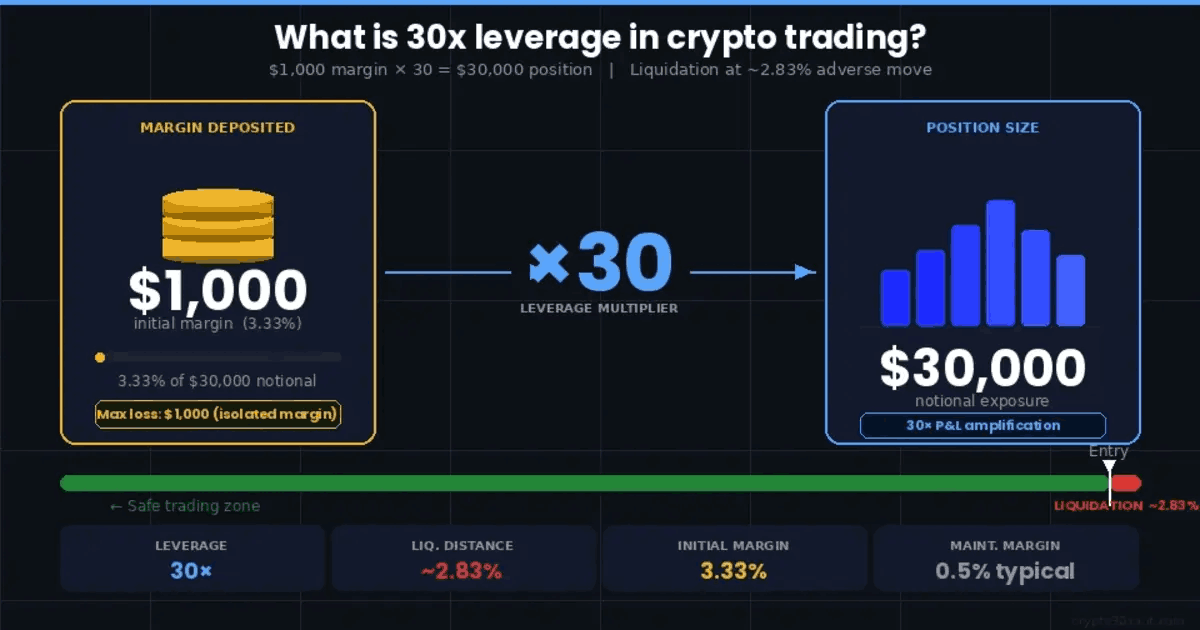
At 30x, a $1,000 margin deposit produces a $30,000 position. The exchange does not lend $29,000 in cash. Instead, it constructs a derivatives contract whose profit and loss calculations reference the full $30,000 notional value, while the $1,000 deposit serves as the security buffer.
The inverse of the leverage ratio is the initial margin rate: 1 ÷ 30 ≈ 3.33%. This means 3.33 cents of every dollar in position size must be held as collateral to open the trade. It also represents the approximate adverse price movement required to consume that buffer entirely.
How this differs from spot trading
In spot trading, capital deployed equals exposure held. A buyer who puts $1,000 into an asset loses at most $1,000 if the asset reaches zero. No amplification exists in either direction.
At 30x leverage, a 3.3% adverse price move inflicts the same capital damage as a 100% loss on a spot trade of equivalent size. The asset’s price does not need to collapse. It only needs to move 3.3% in the wrong direction to eliminate the full margin deposit. This structural asymmetry defines why position sizing, entry timing, and stop-loss placement become technically demanding at this leverage multiple.
How does 30x leverage work mechanically?
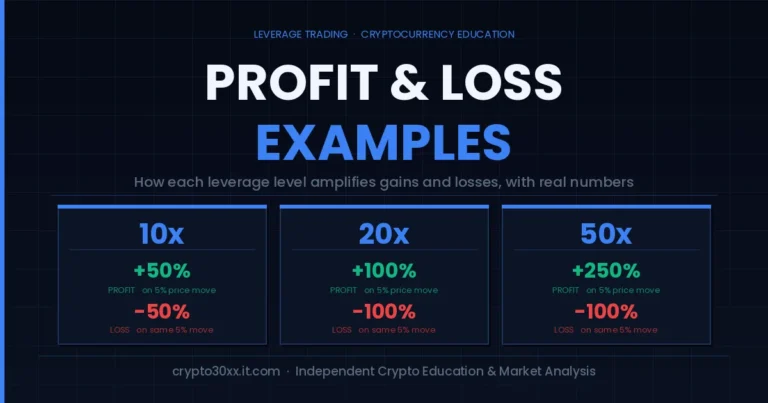
At 30x leverage, a trader deposits collateral and the exchange creates a derivatives position, typically a perpetual futures contract, whose value tracks the spot price of the underlying asset. Profit and loss are calculated against the full notional position value, not the margin alone. A $30,000 position gaining 1% generates $300 in profit, which represents a 30% return on the $1,000 margin deposit.
Margin types: initial and maintenance
Two margin thresholds govern every leveraged position:
- Initial margin: The collateral required to open the trade. At 30x leverage, this is approximately 3.33% of the position’s notional value.
- Maintenance margin: A lower floor, typically 0.5%–1% of notional value, set by the exchange. When account equity falls to this level, liquidation triggers automatically.
The gap between initial margin and maintenance margin defines how much adverse price movement the position can absorb before forced closure. At 30x, that gap is narrow by design.
Isolated margin vs cross margin at 30x
Most derivatives platforms offer two collateral allocation modes, and the distinction is operationally significant at high leverage:
Isolated margin assigns a fixed amount to a single position. If that position is liquidated, only the allocated margin is lost. The remainder of the account balance is protected from that event.
Cross margin draws on the full available account balance across all open positions simultaneously. It provides a larger buffer against liquidation on any single trade, but a sequence of losing positions can draw down the entire account.
At 30x leverage, isolated margin is commonly chosen for position-by-position risk containment. Cross margin at this leverage level creates the possibility of multiple simultaneous losses depleting the full account balance without a single forced liquidation event serving as a clear stopping point.
How close is the liquidation threshold at 30x leverage?
Liquidation is the automatic closure of a position when remaining equity falls below the exchange’s maintenance margin requirement. At 30x leverage, this threshold sits structurally close to the entry price, making it the central mechanical risk of high-multiple positions. A normal intraday price swing of 3% is sufficient to trigger forced closure before a trader can intervene manually, even with active monitoring.
Calculating the approximate liquidation distance
The distance from entry price to liquidation can be estimated using this formula:
Liquidation % ≈ (1 ÷ Leverage) − Maintenance Margin Rate
Using 30x leverage with a 0.5% maintenance margin rate:
(1 ÷ 30) − 0.005 ≈ 3.33% − 0.5% = 2.83%
In practical terms: a long position entered at $40,000 with 30x leverage and $1,000 margin would approach liquidation if the price falls approximately 2.83% from the entry point, placing the liquidation threshold near $38,868. A short position faces the mirror scenario: the liquidation price sits approximately 2.83% above the entry price.
Exact values depend on the platform’s specific maintenance margin rate, fee structure, and funding rate calculations.
What happens when liquidation triggers
When position equity reaches the maintenance margin floor, the exchange’s liquidation engine closes the trade at the best available market price. Any margin remaining after covering losses and applicable fees is returned to the trader. If the market moves too quickly for the liquidation to execute at or above the maintenance margin floor, a platform insurance fund typically absorbs the shortfall.
Most major derivatives exchanges publish their insurance fund balances and liquidation event data, making these processes auditable.
Adding margin to extend the survival buffer
Traders can deposit additional collateral into an open position to move the liquidation price further from the current market price. At 30x leverage, this produces a compressed effect. Adding $100 in margin to a $30,000 notional position increases total collateral by only 0.33% of the position size. The leverage ratio reduces the proportional impact of each additional unit of margin, making proactive stop-loss placement more reliable than reactive margin additions during adverse moves.
How does 30x compare to other leverage levels?
30x leverage occupies a specific position on the spectrum of available ratios, and understanding it requires comparing it directly to lower and higher multiples. Each level maps to a distinct initial margin requirement and a distinct liquidation distance from entry. These differences do not scale linearly. Compressing leverage from 10x to 30x triples the liquidation sensitivity, and operational demands on the trader increase sharply at each step up the scale.
| Leverage | Initial Margin | Approx. Liquidation Distance | Typical Use Context |
|---|---|---|---|
| 2x | 50% | ~49.5% | Conservative margin, longer-duration holds |
| 5x | 20% | ~19.5% | Swing trading |
| 10x | 10% | ~9.5% | Active directional day trading |
| 20x | 5% | ~4.75% | Short-term intraday trading |
| 30x | 3.33% | ~2.83% | Intraday scalping, short-duration positions |
| 50x | 2% | ~1.9% | High-frequency scalping |
| 100x | 1% | ~0.95% | Automated strategies, institutional hedging |
Approximate figures using a 0.5% maintenance margin rate. Actual values vary by exchange, contract type, and underlying asset.
At 30x, the liquidation distance falls within the normal intraday volatility range of most crypto assets. Many liquid tokens move 3%–8% within a single session, making a 30x leveraged position vulnerable to forced closure without any significant trend, news catalyst, or sustained directional move.
What are the structural risks of 30x leverage?
The primary risk of 30x leverage is the speed at which losses approach the liquidation threshold. A 3% adverse price move, achievable within minutes in active crypto markets, is sufficient to trigger forced closure of a position. Several compounding factors make this structural fragility more severe than the base liquidation percentage alone suggests.
Volatility and liquidation cascades
Many crypto assets regularly move 5%–15% within short windows during high-activity trading sessions. At 30x, a position entered at any point within a volatile session can be liquidated before a trader responds manually, even with active monitoring on a desktop or mobile platform. Stop-loss orders reduce this risk but do not eliminate it, particularly in fast-moving conditions where orders may execute at worse prices than specified.
A well-documented market dynamic in crypto derivatives is the liquidation cascade. When a large volume of leveraged positions is closed simultaneously, the resulting forced selling accelerates the price decline. This triggers more liquidations, which accelerate the decline further. The outcome is a price move amplified beyond what spot-market fundamentals alone would produce, and 30x leveraged positions are among the first to be swept in such events.
Funding rates in perpetual contracts
Perpetual futures contracts, the most common vehicle for 30x leverage in crypto, use a periodic funding rate to keep the contract price aligned with the underlying spot market. Long and short position holders exchange payments every 8 hours, with the payment direction determined by whether the contract price trades above or below spot.
During strongly trending markets with significant directional bias, funding rates can reach 0.1%–0.3% per 8-hour period. Over multiple sessions, these costs erode the margin buffer at 30x leverage. A position that is directionally correct on price can still lose effective margin ground to funding costs if held across numerous funding cycles.
Slippage and thin order books
Slippage occurs when a position closes at a worse price than expected because insufficient liquidity exists at the target level. At 30x leverage, a slippage event of just 0.5% can consume a meaningful portion of the available margin buffer. Slippage risk increases during off-peak trading hours, on less liquid asset pairs, and during periods of market stress when bid-ask spreads widen and order book depth thins.
For large positions, the act of closing itself can push the price against the trade, generating additional slippage on top of the base liquidation loss.
Operational dependencies at high leverage
A 30x leveraged position requires continuous access to reliable execution infrastructure. Internet connectivity failures, exchange platform disruptions, or order-processing delays can prevent a trader from closing a deteriorating position before liquidation triggers. The 2.83%–3.33% margin for error leaves a very limited response window. This dependency on operational reliability is a non-market risk that scales proportionally with leverage; it barely matters at 2x but becomes structurally significant at 30x.
Who uses 30x leverage in crypto markets?
30x leverage is most commonly used by traders operating on intraday or sub-hourly timeframes who aim to amplify small directional price movements into proportionally larger returns on margin. It is structurally misaligned with longer holding periods, where cumulative daily volatility substantially increases the probability of liquidation regardless of the long-term price direction of the underlying asset.
Scalpers targeting small price moves
Scalping strategies open and close positions within seconds or minutes, targeting price increments of 0.1%–0.5%. At 30x leverage, a 0.3% favorable price move produces approximately 9% return on the margin deposit. This amplification is what attracts scalpers to high-multiple leverage. The approach depends on precise entry timing, tight stop-loss placement, and high trade frequency. A high win rate at small increments offsets the cost of occasional stop-outs or funding payments.
Hedgers managing spot portfolio exposure
Traders holding significant spot crypto positions may use a short perpetual futures position at high leverage to offset temporary price decline risk. As the spot price falls, the futures short gains value, partially compensating for portfolio losses. The leverage allows the hedge to be constructed with a fraction of the notional capital required to fully cover the spot position, preserving liquidity and avoiding the need to reduce spot holdings.
The role of technical preparation
30x leverage does not tolerate imprecise direction calls or undefined exits. The margin buffer is narrow enough that a position opened without a clearly defined stop-loss and target carries a high mechanical probability of liquidation before the intended trade outcome materializes. Maintenance margin mechanics, funding rate schedules, margin mode selection (isolated vs cross), and position sizing relative to total account equity are technical prerequisites for operating at this leverage level, not supplementary reading.
FAQs
What is 30x leverage in simple terms? 30x leverage means a trading position is thirty times larger than the deposited margin. A $200 deposit opens a $6,000 position. Every 1% price move affects the margin as if it were a 30% move on that deposit, meaning a 3.3% adverse move eliminates the full margin if no stop-loss is in place.
How much can you lose with 30x leverage? With isolated margin, the maximum loss is limited to the margin allocated to that specific position. Liquidation closes the trade before losses exceed the deposit. With cross margin, multiple losing positions can collectively draw down the full account balance. The total loss exposure depends on which margin mode is active and how many positions are open simultaneously.
What price move triggers liquidation at 30x? An adverse price movement of approximately 2.83%–3.33% from the entry price triggers liquidation at 30x leverage, depending on the exchange’s maintenance margin rate. Actual liquidation occurs slightly before the full initial margin is consumed, to preserve the required maintenance margin threshold.
Is 30x leverage available on all crypto exchanges? Leverage availability varies significantly by platform and jurisdiction. Some exchanges restrict retail traders to 10x or 20x leverage for regulatory compliance reasons. Others offer up to 100x or 125x on specific contracts. Traders should verify current leverage tiers directly with any platform they intend to use, as terms and regulatory requirements change over time.
What is the difference between 10x and 30x leverage? At 10x leverage, approximately a 9.5% adverse price move triggers liquidation. At 30x, that threshold compresses to approximately 2.83%. Capital efficiency at 30x is three times higher, but the precision required for entry and exit is proportionally greater. A position that would survive a normal 5% market fluctuation at 10x would be liquidated at 30x without a stop-loss in place.
Can adding more margin prevent liquidation? Adding margin to an open position moves the liquidation price further from the current market price, buying additional buffer. At 30x, each additional unit of margin has a compressed protective effect because the position size is thirty times the collateral. The most reliable approach is proactive stop-loss placement before opening the position, rather than reactive margin additions once an adverse move is already underway.
How do funding rates affect a 30x leveraged position? Perpetual futures funding rates are exchanged every 8 hours and can range from near-zero to 0.1%–0.3% per period in trending markets. At 30x leverage, funding costs are applied to the full notional position value. Even moderate rates erode the effective margin buffer if a position is held across several funding cycles, because the costs accumulate against a relatively small margin deposit.
What is the relationship between leverage ratio and liquidation price? The liquidation distance from entry price is inversely proportional to the leverage level. Doubling the leverage roughly halves the allowable adverse price move before liquidation triggers. At 30x, this compression places the liquidation threshold within the range of normal daily volatility for most crypto assets, which is the defining structural constraint of trading at this multiple.
Disclaimer
This article is produced for educational and research purposes only and does not constitute financial advice, investment advice, or a recommendation to engage in any trading or investment activity. Leveraged derivatives trading carries a high risk of capital loss, including the complete loss of deposited margin. Readers should conduct independent research and consult qualified financial or professional advisors before making any trading or investment decisions.
Understanding what is 30x leverage in crypto trading comes down to one structural fact: a 3.3% adverse price move eliminates the full initial margin. Funding rate drag, liquidation cascades, slippage, and margin mode selection all compound this core mechanical reality. The leverage ratio amplifies returns and compresses the margin for error simultaneously, and the technical demands at this multiple are qualitatively different from what lower leverage levels require.
Let our warm corner be your daily return to what feels honest inside our quiet space today.