How to calculate liquidation price in crypto trading
Knowing how to calculate liquidation price is one of the most practical skills for anyone working with leveraged positions in crypto markets. The liquidation price is the mark price at which an exchange’s risk engine forcibly closes a position because the trader’s remaining equity has fallen to the maintenance margin threshold. Miss this number, and the entire margin deposit is gone. Understand it in advance, and position sizing and stop-loss placement become deliberate, measurable decisions rather than guesses.
This guide covers the formula from first principles, applies it to both long and short positions with clean worked examples, and explains how the choice of margin mode changes the outcome. Written for intermediate crypto learners and researchers, not as trading advice.
What is a liquidation price?
A liquidation price is the mark price at which an exchange automatically closes a leveraged position to prevent the account balance from going negative. It is determined by the entry price, leverage ratio, and the exchange’s maintenance margin rate, and it marks the exact point where remaining trader equity reaches the minimum required collateral threshold.
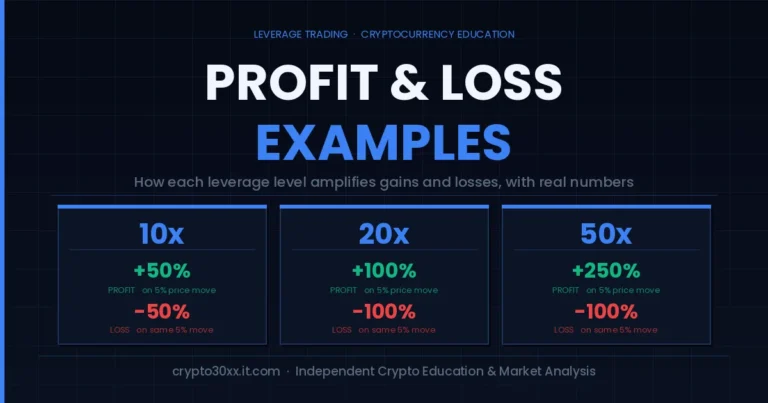
For long positions, the liquidation price sits below the entry price. For short positions, it sits above. The precise distance depends on leverage: at 10× leverage, the buffer is roughly 9.5% in each direction; at 50×, it shrinks to around 1.5%.
How a margin position creates liquidation exposure
When a trader opens a leveraged position, they post a fraction of the total position value as collateral, referred to as the initial margin. The exchange extends the remaining value. As the market moves against the position, unrealized losses reduce the effective collateral balance in real time.
Once collateral shrinks to the maintenance margin level, liquidation is triggered. The maintenance margin acts as a cushion. It gives the exchange enough buffer to close the position at market price and absorb slippage or fees before the balance reaches zero.
Why the exchange closes positions before zero equity
An exchange carries counterparty risk on every open leveraged position. If a losing position is held past its breakeven point, the unrealized loss can exceed the deposit, creating a shortfall the exchange or its insurance fund must absorb. Liquidation prevents that outcome. It is a structural risk management mechanism built into how margin markets operate.
Key variables in the liquidation price formula
Calculating the liquidation price requires four clearly defined inputs: entry price, leverage ratio, initial margin rate, and maintenance margin rate. Each is fixed at the time the position opens, except in cross margin mode, where account equity shifts dynamically. Accurate results depend on using the correct values for all four inputs, especially the maintenance margin rate, which many traders overlook.
Entry price
The price at which the position was opened. All unrealized profit and loss is measured against this baseline. If the entry price changes due to partial fills, the calculation must reflect the actual average entry.
Leverage ratio
The multiplier applied to the margin deposit. At 10× leverage, a $1,000 deposit controls a $10,000 position. Higher leverage compresses the gap between entry price and liquidation price.
Initial margin rate
The proportion of total position value deposited as collateral. It equals 1 divided by the leverage ratio. At 10× leverage, the initial margin rate is 10%; at 25× leverage, it is 4%.
Maintenance margin rate
The minimum margin threshold set by the exchange, expressed as a percentage of the position’s notional value. Common values range from 0.4% to 4%, depending on position size and platform. When the position’s equity reaches this level, liquidation is triggered. The trader cannot choose this value; it is defined in the exchange’s risk parameter schedule, typically published in a tiered table based on notional position size.
How to calculate liquidation price for a long position
For a long position in isolated margin mode, the liquidation price is the exact market level where remaining equity falls to the maintenance margin threshold. It represents how much adverse downward price movement the initial margin can absorb before the exchange closes the position. The formula expresses that relationship directly in terms of entry price and margin rates.
Liquidation Price (Long) = Entry Price × (1 – 1/Leverage + Maintenance Margin Rate)
Step-by-step calculation:
- Define the entry price. Example: $1,000.
- Define the leverage ratio. Example: 10×.
- Calculate the initial margin rate: 1 ÷ 10 = 0.10 (10%).
- Identify the maintenance margin rate from the exchange’s schedule. Example: 0.5% = 0.005.
- Substitute into the formula:
- Liquidation Price = $1,000 × (1 – 0.10 + 0.005)
- Liquidation Price = $1,000 × 0.905
- Liquidation Price = $905
The position is liquidated if the mark price falls from $1,000 to $905, a 9.5% adverse move. At 20× leverage with the same maintenance margin rate, the liquidation price rises to $952.50, just 4.75% below entry.
How leverage compresses the price buffer on the long side
| Leverage | Initial margin rate | Approx. liquidation distance below entry |
|---|---|---|
| 5× | 20% | ~19.5% |
| 10× | 10% | ~9.5% |
| 20× | 5% | ~4.5% |
| 50× | 2% | ~1.5% |
| 100× | 1% | ~0.5% |
Based on a 0.5% maintenance margin rate throughout. Exchange-specific rates vary.
Each doubling of leverage roughly halves the distance between entry price and liquidation price.
How to calculate liquidation price for a short position
For a short position, liquidation occurs when the market rises far enough above the entry point to erase the margin buffer. The formula mirrors the long calculation but reverses direction: the initial margin rate pushes the liquidation price above entry instead of below it. At identical leverage and maintenance margin inputs, the buffer distance is symmetrical between the long and short sides.
Liquidation Price (Short) = Entry Price × (1 + 1/Leverage – Maintenance Margin Rate)
Step-by-step calculation using the same inputs:
- Entry price: $1,000.
- Leverage: 10×.
- Initial margin rate: 0.10.
- Maintenance margin rate: 0.005.
- Substitute into the formula:
- Liquidation Price = $1,000 × (1 + 0.10 – 0.005)
- Liquidation Price = $1,000 × 1.095
- Liquidation Price = $1,095
The short position is liquidated if the mark price rises from $1,000 to $1,095, a 9.5% adverse move matching the long example.
Long and short liquidation prices compared
| Direction | Entry price | Leverage | Maintenance margin rate | Liquidation price |
|---|---|---|---|---|
| Long | $1,000 | 10× | 0.5% | $905.00 |
| Short | $1,000 | 10× | 0.5% | $1,095.00 |
| Long | $1,000 | 20× | 0.5% | $952.50 |
| Short | $1,000 | 20× | 0.5% | $1,047.50 |
At higher leverage, both liquidation prices converge toward the entry price from their respective directions.
Isolated margin vs. cross margin: how margin mode affects the calculation
The margin mode determines which funds the exchange uses as collateral, directly affecting both the liquidation price and the maximum potential loss. Isolated and cross margin produce different outcomes even at identical leverage and entry prices. The structural difference between the two modes shapes how the liquidation price is calculated and how it behaves over the life of the position.
Isolated margin
With isolated margin, only the funds allocated to a specific position serve as collateral. The liquidation price is fixed when the position opens and does not change unless the trader manually adjusts the margin. If the position is liquidated, only the allocated margin is lost. Other account funds remain entirely unaffected.
This predictability makes isolated margin well-suited for setups where a clearly defined maximum loss per trade is the goal.
Cross margin
With cross margin, the entire available account balance acts as collateral. Unrealized losses from a position are absorbed against the full account rather than hitting a fixed ceiling. Liquidation is triggered only when total account equity falls to the maintenance margin level for the position.
The simplified cross margin liquidation price for a long position is:
LP (Cross, Long) = Entry Price – (Account Balance – Maintenance Margin Amount) / Position Size
This formula produces a lower liquidation price than isolated margin, meaning the position tolerates larger adverse moves. The trade-off is that a liquidation event under cross margin can draw down the entire account balance rather than just the allocated margin.
Isolated vs. cross margin: structural comparison
| Feature | Isolated margin | Cross margin |
|---|---|---|
| Collateral scope | Fixed per position | Full account balance |
| Liquidation price | Static, easy to pre-calculate | Dynamic, shifts with account PnL |
| Maximum loss per trade | Capped at allocated margin | Can reach full account balance |
| Ease of calculation | Straightforward formula | Requires real-time account data |
| Best suited for | Fixed-risk trade setups | Hedging, offsetting positions |
Neither mode is unconditionally safer. Isolated margin caps the loss per trade; cross margin provides a larger buffer per position but exposes the full account if the position goes to liquidation.
What the basic formula does not capture
The formulas above describe the structural mechanics of liquidation price in a simplified model. Real exchange liquidation prices incorporate several additional factors not visible in the basic calculation. Ignoring these can produce a manually calculated liquidation price that differs from the one shown in the exchange interface.
Funding fees on perpetual futures
Perpetual futures contracts charge a funding rate at regular intervals, typically every eight hours. When the rate is negative for long positions (longs pay shorts), accumulated fees reduce the effective margin balance. Over time, this erodes the collateral buffer and shifts the liquidation price closer to the market. The effect compounds with hold duration.
Trading fees at position entry
Some exchanges deduct a taker fee when a position opens. A 0.04% to 0.1% fee on a large leveraged position reduces effective collateral from the first instant. This nudges the liquidation price slightly in the adverse direction.
Tiered maintenance margin schedules
Most exchanges apply higher maintenance margin rates to larger notional positions. A small position may carry a 0.4% rate; a very large position might carry 2% or more. The rate used in the formula is not constant; it depends on the position’s notional value, which is why manual calculations and exchange-displayed values sometimes differ.
The practical implication: treat the formula as a structural understanding tool and verify the exact liquidation price through the exchange’s trading interface before opening any position.
Common misconceptions about liquidation price
Traders approaching leveraged positions for the first time often hold incorrect assumptions about when liquidation is triggered and how little price movement it requires. These gaps between assumption and reality can result in positions sized without accurate knowledge of actual risk. Several of the most persistent misconceptions deserve direct attention.
“Liquidation only happens in extreme market conditions”
At high leverage, liquidation can be triggered by ordinary intraday price movements. A 2% adverse move liquidates a 50× long position. Markets produce moves of that size regularly, without any unusual catalyst. At leverage ratios above 20×, the liquidation threshold falls well within normal daily price ranges for most assets.
“A stop-loss prevents liquidation in all cases”
A stop-loss closes a position before the liquidation price is reached, provided the market does not gap through the stop level. In fast-moving or illiquid conditions, price can skip past the stop order’s trigger, resulting in an execution at a worse price or, in severe cases, at the liquidation level itself.
“Cross margin is always the safer choice”
Cross margin delays per-position liquidation by drawing on the full account balance as a buffer. The trade-off is exposure: a liquidation event under cross margin can eliminate the entire account, whereas the same event under isolated margin affects only the margin allocated to that single position.
“Adding more margin reduces risk proportionally”
Adding margin to an isolated position does lower the liquidation price, but the relationship is not linear. Early additions produce meaningful reductions; later additions produce diminishing returns. The underlying leverage and total market exposure remain unchanged regardless of how much collateral is added after the position is opened.
FAQs
What is the simplest way to understand the liquidation price formula? The liquidation price marks the point where the trader’s remaining position equity equals the maintenance margin floor. For a long, that happens when the market falls enough to erase the initial margin deposit minus the maintenance margin requirement. The formula converts that relationship into a specific price level.
Does the liquidation price change after a position is opened? For isolated margin positions, it is fixed at entry and only changes if margin is manually added or removed. For cross margin positions, it shifts continuously as account equity changes due to other open positions’ unrealized PnL and any accumulated funding fees.
Why does the exchange use a maintenance margin instead of liquidating at zero equity? The maintenance margin gives the exchange a price buffer to close the position before losses exceed the deposit. Without it, any slippage or fee at the point of liquidation would push the account into negative equity, creating a shortfall the exchange or insurance fund would need to cover.
How does increasing leverage affect the liquidation price for a short position? Higher leverage brings the short’s liquidation price closer to the entry price from above. At 10× leverage, it sits approximately 9.5% above entry; at 50× leverage, approximately 1.5% above. The higher the leverage, the less upward price movement the short position can tolerate before liquidation is triggered.
What happens to the collateral when a position is liquidated? The exchange closes the position at the best available market price. The maintenance margin amount is used to cover remaining losses and fees. Any balance remaining above the maintenance margin level is typically returned to the account, though exact policies vary by exchange and are worth verifying before trading.
Can I calculate the liquidation price without knowing the exact maintenance margin rate? Not accurately. The maintenance margin rate is a required formula input. Most exchanges publish their tiered maintenance margin schedules in their fee or risk documentation pages, and the trading interface typically displays the exact liquidation price for any position before it is confirmed.
Is the liquidation price the same as a margin call? No. A margin call is a notification that equity is approaching the maintenance margin threshold. Liquidation is the forced position closure that follows if the threshold is breached. On many platforms, both happen automatically in rapid sequence without a separate warning stage for the trader to act on.
Disclaimer
This article is written for educational and research purposes only. Nothing here constitutes financial, investment, or trading advice. Leveraged trading in crypto markets carries the risk of losing the full margin deposit in a short period of time. Always verify position parameters and liquidation prices directly with the relevant exchange before opening any leveraged trade.
Understanding how to calculate liquidation price before opening a position converts an invisible boundary into a measurable variable. The formula (entry price multiplied by the difference between the initial margin rate and the maintenance margin rate) quantifies exactly how much adverse price movement the position can absorb. At 10× leverage, that tolerance is roughly 9.5% in either direction. At 50×, it is closer to 1.5%. Position sizing and risk management decisions become far more precise when the liquidation price is known, not estimated.
Our caring insights are crafted to help you feel seen and supported every single peaceful day.