Maintenance margin vs initial margin: complete guide
Knowing the difference between maintenance margin vs initial margin is foundational to any leveraged trading activity, from traditional futures contracts to crypto perpetual swaps. Initial margin is the collateral required to open a position. Maintenance margin is the minimum balance that must remain in the account to keep that position alive. When equity drops below the maintenance level, the exchange acts — issuing a margin call or liquidating the position automatically. Understanding both numbers, and the buffer that separates them, removes one of the most common sources of unexpected losses in leveraged markets.
What is initial margin?
Initial margin is the minimum amount of collateral a trader must deposit to open a leveraged position. Without meeting this threshold, the position cannot be created. Exchanges set initial margin as a percentage of the total notional position value, and that percentage directly determines the maximum leverage available on the trade.
How initial margin is calculated
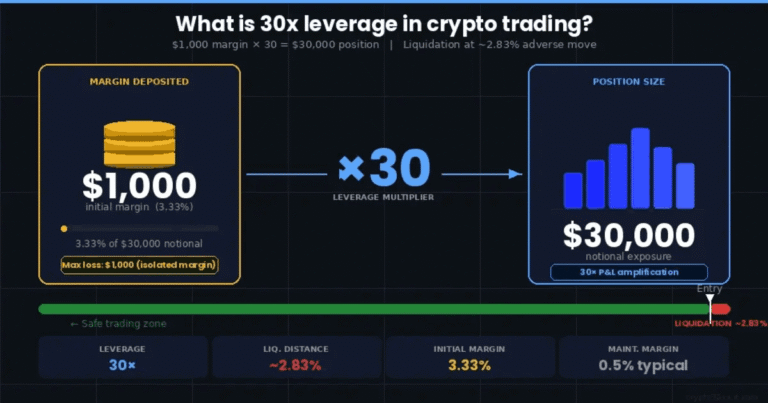
The math is direct. At 10% initial margin, controlling a $10,000 position requires a $1,000 deposit. Maximum leverage is the inverse of the initial margin rate:
Maximum leverage = 1 ÷ initial margin rate
- At 10% initial margin: 1 ÷ 0.10 = 10× leverage
- At 5% initial margin: 1 ÷ 0.05 = 20× leverage
- At 1% initial margin: 1 ÷ 0.01 = 100× leverage
The deposited collateral remains locked for the duration of the position. Unrealized profits may count toward account equity depending on the platform’s margin accounting rules.
How initial margin requirements vary
Initial margin is not uniform across assets or platforms. Traditional regulated futures markets rely on clearinghouses that publish standardized margin tables calibrated to each asset’s volatility profile. Crypto derivatives exchanges set their own rates and most use tiered margin structures where larger positions carry higher requirements. A small position might face a 5% initial margin rate, while a large position on the same exchange might face 15%, reflecting the greater counterparty risk that concentrated size creates for the clearinghouse.
What is maintenance margin?
Maintenance margin is the minimum equity level that must remain in a margin account at all times to keep an open position active. It is always set lower than initial margin, and that separation is intentional. Initial margin determines whether a position can open; maintenance margin determines whether it can keep running.
Once account equity falls to or below the maintenance threshold, the exchange takes action: a margin call requiring additional funds, or automatic liquidation of the position.
How maintenance margin is set
Maintenance margin, like initial margin, is expressed as a percentage of total notional position value. The exchange or clearinghouse sets this rate; traders cannot negotiate it. A common structural relationship places maintenance margin at roughly 40–60% of the initial margin rate, though exact figures vary by platform and asset. If initial margin is 10%, maintenance margin might sit at 5–6%.
Some platforms display a real-time margin ratio showing account equity relative to notional value. When that ratio falls below the maintenance rate, the liquidation engine activates.
Maintenance margin in perpetual futures
Perpetual futures are the dominant derivative in crypto markets. Because they carry no expiration date, open positions can persist indefinitely, and so can the maintenance margin check. Exchanges calculate the mark price, a fair value derived from the spot market and a reference index, against the position’s unrealized losses. When those losses erode account equity to the maintenance level, forced closure follows regardless of the trader’s intentions.
How maintenance margin vs initial margin compare
Initial margin and maintenance margin serve distinct functions at distinct moments in a position’s life. Initial margin is a one-time gate at entry. Maintenance margin is a continuous floor the account must stay above until the position is closed. Both thresholds protect the exchange from counterparty default, but they operate at different stages and trigger different consequences when breached.
| Feature | Initial margin | Maintenance margin |
|---|---|---|
| When it applies | At position opening | Throughout position lifetime |
| Primary function | Entry gate | Ongoing floor; liquidation trigger |
| Typical level | Higher (e.g., 10% of notional) | Lower (e.g., 5% of notional) |
| Set by | Exchange or clearinghouse | Exchange or clearinghouse |
| Consequence if not met | Position cannot open | Margin call or forced liquidation |
| Adjustable by trader? | Collateral can exceed minimum | Fixed by exchange; not adjustable |
| Continuous monitoring? | No (fixed at entry) | Yes (evaluated in real time) |
The margin buffer
The gap between initial margin and maintenance margin is the position’s buffer against forced liquidation. A trader who deposits exactly the initial margin minimum holds the smallest possible buffer: only the difference between the two threshold percentages. Depositing above the minimum widens that buffer proportionally, allowing the position to absorb larger adverse moves before the maintenance floor is reached.
What happens when equity falls below maintenance margin?
When a leveraged account’s equity falls to or below the maintenance margin threshold, the exchange takes action. The exact response depends on the platform and market type, but two paths are possible: a margin call requiring additional collateral, or immediate liquidation of the position. Both serve the same purpose: protecting the exchange from losses it would absorb if account equity went negative.
Margin calls explained
A margin call is a notification that account equity has reached or passed the maintenance margin floor. In traditional futures markets, the trader typically receives a window of time to deposit additional collateral. The account must be restored to at least the initial margin level, not merely to the maintenance level. Adding funds only to the maintenance threshold does not fully resolve the call on most platforms.
In crypto markets, the notification-and-wait model is frequently absent. Many exchanges liquidate positions automatically the moment maintenance margin is breached, without waiting for a trader response. This reflects the speed at which crypto prices can move and the operational reality of continuous 24-hour markets.
Liquidation mechanics in crypto
When a crypto exchange liquidates a position, the platform closes the trade and uses the remaining collateral to cover the loss. Liquidation occurs at the liquidation price: the asset price at which unrealized losses have consumed enough equity to bring the account to exactly the maintenance margin amount.
For a long position, the formula is:
Liquidation price (long) = Entry price × (1 − initial margin rate + maintenance margin rate)
With a $1,000 entry price, 10% initial margin, and 5% maintenance margin:
Liquidation price = $1,000 × (1 − 0.10 + 0.05) = $1,000 × 0.95 = $950
The position closes if the asset price falls to $950. The deposited collateral is consumed. Any shortfall beyond the collateral, meaning losses that exceed the initial deposit, is typically absorbed by the exchange’s insurance fund.
Practical examples with illustrative math
The following examples use round numbers to show how maintenance margin and initial margin interact across common scenarios. These figures are for illustration only; actual margin rates, leverage tiers, and liquidation mechanics vary by platform and asset.
Example 1: Minimum deposit vs extra collateral
A trader opens a long position with a $10,000 notional value using 10× leverage.
- Initial margin deposited: 10% × $10,000 = $1,000
- Maintenance margin floor: 5% × $10,000 = $500
- Maximum loss before liquidation: $1,000 − $500 = $500
The same trader now deposits $1,500 instead of the minimum:
- Deposited collateral: $1,500
- Maintenance margin floor: $500 (unchanged)
- Maximum loss before liquidation: $1,500 − $500 = $1,000
Depositing an extra $500 above the minimum doubles the loss the position can absorb before liquidation triggers. Capital efficiency falls, since the same notional exposure now requires a larger deposit, but the probability of forced closure during a volatile period drops significantly.
Example 2: Isolated margin vs cross margin
Most crypto platforms offer two collateral allocation modes, each of which changes how maintenance margin functions in practice.
Isolated margin: The collateral assigned to a specific position is ring-fenced. Only that allocated amount supports the maintenance margin calculation for that trade. If the position is liquidated, the maximum loss is capped at the assigned collateral. Risk stays contained, but the position cannot draw on other account funds to survive adverse moves.
Cross margin: The full account balance serves as collateral across all open positions. Unrealized profits on a winning trade count toward the maintenance margin of a losing trade, which can delay liquidation. A severe drawdown on one position can drain the entire account balance, however, affecting every other open position simultaneously.
Common misconceptions about margin thresholds
Several misunderstandings about initial and maintenance margin appear consistently among traders who are new to leveraged products. Each creates a measurable gap between how a trader expects a position to behave and how the exchange actually operates. Three specific misconceptions are worth examining in detail because each carries direct risk implications.
Breaching initial margin does not trigger liquidation
A position can fall below initial margin levels while remaining open. Liquidation triggers only when account equity drops to or below the maintenance margin threshold. The range between the two percentages represents normal operating territory for a leveraged position under adverse market pressure, not an emergency zone.
Depositing the exact minimum provides minimal protection
Opening a position at the minimum initial margin deposit creates the smallest possible buffer above the maintenance floor. Any adverse price move immediately begins consuming that buffer. From the moment the position opens at minimum margin, it is already close to its liquidation price.
Stop-loss orders and maintenance margin are independent systems
A stop-loss instructs the platform to close a position at a specified price. Maintenance margin is an equity threshold that the exchange monitors independently, in parallel. In fast-moving or low-liquidity markets, price can gap through a stop-loss level without triggering execution at the intended price. When that happens, maintenance margin liquidation functions as a backstop, not a substitute for stop-loss discipline.
FAQs
What is the difference between initial margin and maintenance margin? Initial margin is the collateral required to open a leveraged position. Maintenance margin is the minimum balance required to keep it open. Initial margin is always higher than maintenance margin. When account equity falls to or below the maintenance level, the exchange issues a margin call or liquidates the position automatically.
Why is maintenance margin always lower than initial margin? The gap between the two creates a buffer that absorbs routine price fluctuations. If both thresholds were equal, any loss, however small, would immediately trigger liquidation. The separation between them gives positions room to move through normal market volatility without automatic forced closure at every small adverse tick.
What happens if a margin call is not met in time? If additional funds are not deposited in response to a margin call, the exchange closes the position, partially or fully, to bring the account into compliance. In crypto markets, many platforms liquidate automatically the moment the maintenance threshold is breached, without issuing a formal margin call or waiting for any trader response.
Can maintenance margin rates change while a position is open? Exchanges set maintenance margin rates and can update their margin schedules. Changes typically apply to new positions rather than existing ones. Traders should review the platform’s margin table for their specific asset and position size before opening any leveraged trade, and periodically afterward for any platform-wide adjustments.
How does tiered margin affect initial and maintenance margin? Tiered margin systems increase both initial and maintenance margin rates as position size grows. A small position might require 5% initial margin and 2.5% maintenance margin, while a large position on the same platform might face 15% and 7.5%. This protects exchanges from the concentrated counterparty risk that large positions carry relative to available liquidity.
Is the liquidation price the same as the maintenance margin threshold? No. Maintenance margin is a percentage-based equity threshold. The liquidation price is the specific asset price at which unrealized losses reduce account equity to exactly the maintenance margin amount. The threshold determines when liquidation is triggered; the liquidation price is where that event appears on the price chart.
Do initial margin and maintenance margin apply to spot trading? No. Both thresholds apply only to margin accounts and derivatives products such as futures contracts and perpetual swaps. Spot trading involves direct asset ownership with no leverage, so neither threshold applies.
Disclaimer
This article is written for educational and informational purposes only. Nothing in this content constitutes financial, investment, or trading advice. Margin trading and leveraged derivatives carry significant risk of loss, including the total loss of all deposited collateral. Readers should conduct independent research and consult a qualified financial professional before making any trading or investment decisions.
The relationship between maintenance margin vs initial margin is the structural backbone of every leveraged position. Initial margin sets the cost of entry. Maintenance margin sets the floor below which the exchange will not allow a position to remain open. The buffer between these two figures is the maximum adverse move a position can absorb before forced intervention. For any trader or analyst examining how leveraged markets function, these two thresholds, and the arithmetic that connects them, are the starting point for understanding liquidation risk.
Return to what matters most by spending quiet time inside our soft sanctuary made just for you.