What is impermanent loss in DeFi: a complete guide
Impermanent loss is the reduction in value that a liquidity provider experiences when the price ratio of two tokens in an automated market maker pool diverges from the ratio at deposit. The loss is called “impermanent” because it reverses fully if prices return to their original ratio before withdrawal. If a provider exits while prices remain diverged, the loss becomes permanent. Understanding this mechanic is essential for anyone evaluating liquidity provision as a strategy in decentralized finance.
What is impermanent loss in DeFi?
Impermanent loss in DeFi describes the opportunity cost a liquidity provider faces when the tokens they deposited into an automated market maker pool change in relative value. Instead of simply holding both assets in a wallet, the liquidity provider ends up with a portfolio worth less than what holding would have produced. The gap between those two outcomes is the impermanent loss.
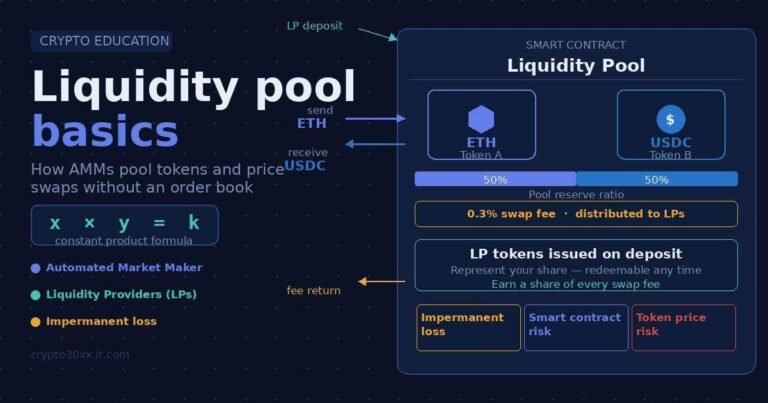
The concept applies specifically to constant-function market makers — the AMM design popularized by Uniswap’s x * y = k formula. Platforms such as Uniswap, Curve, Balancer, and SushiSwap all generate impermanent loss for liquidity providers in varying degrees, depending on their specific curve design.
This is not a bug in DeFi protocol design. It is a structural consequence of how AMMs rebalance pools automatically in response to price changes, without any centralized order book.
Why liquidity providers face this mechanic
When a liquidity provider deposits into a pool, they supply equal value of two tokens — for example, ETH and USDC in a 50/50 ratio. The AMM’s pricing formula then continuously adjusts the quantity of each token to maintain the mathematical invariant.
When external market prices shift, arbitrageurs step in and trade against the pool until its internal price reflects the new market price. Every arbitrage trade changes the quantity of each token in the pool. The result: the provider’s share of the pool now holds more of the token that fell in price and less of the one that rose. That composition shift is what produces impermanent loss.
How AMMs create impermanent loss: the mechanics
The constant product formula
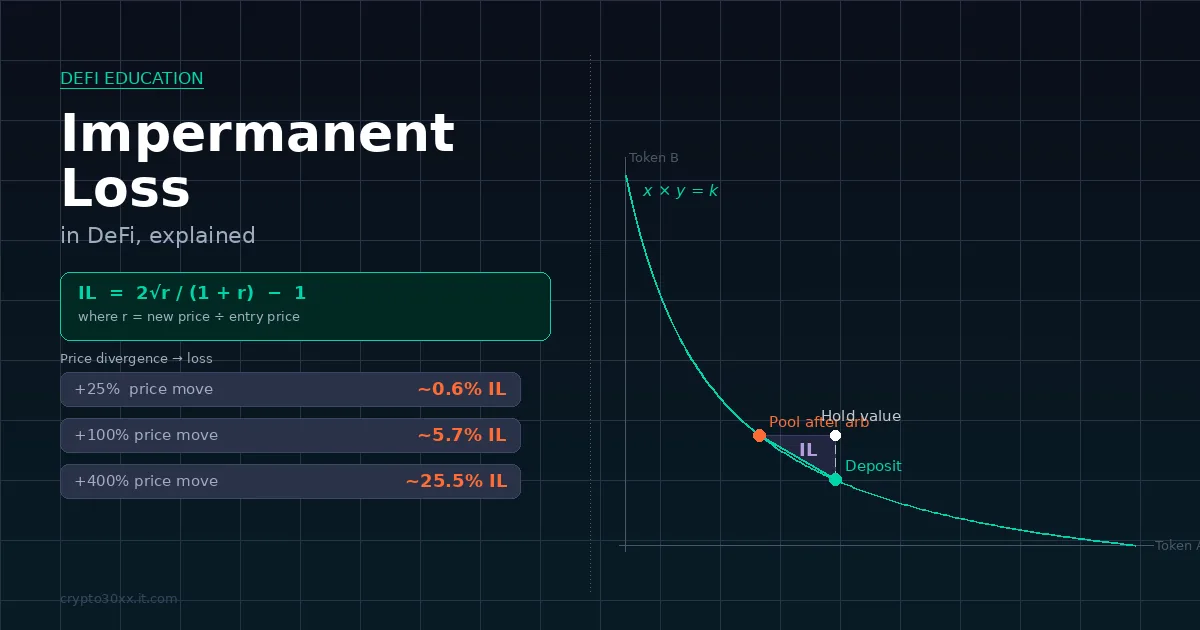
The x * y = k formula underpins most standard liquidity pools. In it, x is the quantity of token A, y is the quantity of token B, and k is a constant. Any trade must keep the product of the two reserves unchanged.
When someone buys token A from the pool, x decreases and y must increase to maintain k. The price of token A, expressed in the pool, is y / x. As x falls, y / x rises — token A becomes more expensive inside the pool. This is automatic, and it is what allows the pool to function without a central exchange.
What arbitrageurs do to pools
Suppose ETH is worth 2,000 USDC on external markets, and the pool reflects that price. Now ETH rises to 2,400 USDC externally. Arbitrageurs will buy ETH from the pool (which still prices it lower) until the pool’s internal price reaches 2,400 USDC. Each of those arbitrage purchases removes ETH from the pool and adds USDC.
After arbitrage settles, the provider’s share contains less ETH and more USDC than it did at deposit. Had the provider simply held both tokens, they would have kept the original ETH amount — which is now worth more. The difference between holding and providing liquidity is the impermanent loss.
The divergence loss formula
The relationship between price ratio change and loss follows a deterministic mathematical formula. Let r be the price ratio change (new price divided by original price):
Impermanent Loss = 2 × √r / (1 + r) − 1
This formula applies to a standard 50/50 pool. The key relationship it describes:
| Price change (one asset) | Impermanent loss |
|---|---|
| +25% | ~0.6% |
| +50% | ~2.0% |
| +100% (2×) | ~5.7% |
| +200% (3×) | ~13.4% |
| +400% (5×) | ~25.5% |
| −50% | ~5.7% |
| −75% | ~25.5% |
Two observations matter here. First, IL is symmetric: a 2× price increase produces the same loss as a −50% price decrease. Second, loss accelerates non-linearly as divergence increases.
A worked example of impermanent loss
Starting position
A provider deposits $5,000 in ETH and $5,000 in USDC into a 50/50 pool when ETH trades at $2,000. The deposit consists of 2.5 ETH and 5,000 USDC. The total portfolio value at entry: $10,000.
Price moves to $3,000
ETH rises to $3,000 externally. Arbitrageurs rebalance the pool until its internal price reflects $3,000. Using the constant product formula:
- At entry: x = 2.5, y = 5,000, k = 12,500
- At $3,000: new ETH quantity = √(k / 3,000) = √(12,500 / 3,000) ≈ 2.041 ETH
- New USDC quantity = k / 2.041 ≈ 6,124 USDC
The provider’s pool share now holds 2.041 ETH (worth $6,124) and 6,124 USDC. Total value: $12,247.
Had the provider simply held 2.5 ETH and 5,000 USDC: 2.5 × $3,000 + $5,000 = $12,500.
Impermanent loss: $12,500 − $12,247 = $253, or approximately 2.0% of the hold value. This matches the formula output for a 1.5× price ratio change.
What happens if prices return to $2,000
If ETH returns to its original $2,000 price before the provider exits, the pool rebalances back to 2.5 ETH and 5,000 USDC. The provider reclaims $10,000 — exactly what they would have held. The loss was impermanent.
When impermanent loss becomes permanent
The “impermanent” label is technically accurate but can mislead. The loss only reverses if the price ratio returns to the exact ratio at deposit before the provider withdraws.
Three common situations make the loss permanent in practice:
Withdrawal while prices are diverged
The most common scenario. A provider deposits during a period of low volatility, prices diverge significantly over months, and the provider exits to rebalance or exit DeFi entirely. Whatever IL exists at withdrawal is locked in.
Depeg or token collapse
In pairs involving algorithmic stablecoins, new tokens, or assets with low liquidity on the other leg, one side of the pair can approach zero. The constant product formula responds by draining the pool of the surviving asset. By the time the collapse is apparent, the pool may hold almost entirely the worthless token. This is the extreme end of impermanent loss — effectively total loss of the stronger asset.
Pool migration or protocol shutdown
If a liquidity protocol migrates to a new version or shuts down, providers must withdraw at whatever price ratio exists at that moment. There is no option to wait for price recovery.
How impermanent loss varies by pool type
Not all AMM designs produce the same level of IL. Pool architecture shapes loss exposure significantly.
Standard 50/50 pools
The highest IL exposure. Both the worked example and the formula table above reflect this design. When one token moves significantly against the other, loss accelerates. Standard pools are most suitable for assets that tend to move together or for providers who want maximum fee income from a high-volume pair.
Stablecoin pools (Curve-style)
Curve Finance’s StableSwap invariant concentrates liquidity near a 1:1 peg, which dramatically reduces IL for stablecoin pairs like USDC/DAI/USDT. The trade-off: the pool works efficiently only within a narrow price band. If a stablecoin depegs materially, losses can spike sharply because the pool’s construction is not designed for that scenario.
Weighted pools (Balancer-style)
Balancer allows pools with non-50/50 weightings — for example, an 80/20 split between a volatile token and a stablecoin. A heavier weighting toward the more stable asset reduces IL because the formula requires smaller rebalancing trades to maintain the invariant. The trade-off: lower fee capture per unit of volume.
Concentrated liquidity pools (Uniswap v3-style)
Uniswap v3 introduced concentrated liquidity, where providers specify a price range for their capital. Within that range, capital efficiency is far higher, generating more fee revenue per dollar deposited. Outside that range, the position earns nothing and is composed entirely of the weaker-performing token. IL in concentrated liquidity is generally higher than in standard pools because the capital is more exposed within the active range, and providers face total single-asset exposure outside it.
| Pool type | IL exposure | Best suited for |
|---|---|---|
| Standard 50/50 | High | Volatile, high-volume pairs |
| Stablecoin (Curve) | Low within peg | USD stablecoin pairs, pegged assets |
| Weighted (80/20) | Moderate | Projects holding a large native token |
| Concentrated (v3) | Variable/high | Active managers, tight-range pairs |
Fees, incentives, and the net return calculation
Impermanent loss does not determine the outcome of liquidity provision alone. Fee income offsets IL. The question is whether accumulated fees exceed the loss from price divergence.
Trading fee revenue
Every swap through an AMM pays a fee — typically between 0.01% and 1% depending on the pool tier — that distributes to liquidity providers proportionally. A pool with high daily volume may generate enough fees to compensate for significant IL. A pool with low volume may not compensate for even modest IL.
Liquidity mining incentives
Many protocols distribute additional governance or protocol tokens to liquidity providers as an incentive. These rewards can substantially improve total returns. They also introduce a second layer of risk: if the reward token depreciates sharply, the net return calculation changes.
The net return formula
A simplified framework for evaluating a liquidity position:
Net return = Fee income + incentive rewards − impermanent loss − gas costs
Fee income depends on pool volume and the provider’s share. IL depends on price divergence. The relationship between the two is not linear — high-volume pairs tend to produce both high fees and high IL because price movement drives both volume and rebalancing.
Strategies for managing impermanent loss
Pair selection by correlation
IL is lowest when the two assets in a pair maintain a stable price relationship. Pairing two assets that tend to move together reduces the probability of large divergence. WBTC/ETH is a common example cited because Bitcoin and Ethereum have historically shown periods of high correlation. Stablecoin pairs carry the lowest structural IL risk.
Time horizon matching
Providers who expect to exit in a short time frame are more exposed than those with longer horizons, because they have less time to accumulate fees and less probability of price mean reversion. IL is path-dependent: temporary spikes in one direction that reverse before exit produce no permanent loss.
Position sizing relative to total portfolio
Because IL can be material in high-volatility environments, many practitioners size liquidity positions as a defined fraction of a broader portfolio rather than concentrating capital in a single pool.
Active management in concentrated liquidity
In Uniswap v3-style pools, providers can update their price range as market conditions shift. Moving the active range to track current prices maintains fee earning capacity and reduces out-of-range single-asset exposure — at the cost of higher gas fees and the operational overhead of active monitoring.
Understanding what cannot be hedged easily
Impermanent loss is a function of relative price change between two assets in a pool. Straightforward spot hedges on individual tokens do not fully offset IL because IL is driven by the ratio, not the absolute price level. Structured products and options strategies exist to hedge IL more precisely, but they add complexity and cost that can outweigh the benefit for smaller positions.
Common misconceptions about impermanent loss
“Impermanent” means recoverable
Technically, yes — but in practice, most liquidity positions are not held until the price ratio recovers. Providers exit for various reasons: rebalancing, capital needs, protocol concerns. Once they withdraw, whatever divergence existed becomes a permanent outcome. The term describes the mathematical property of the loss, not a promise of recovery.
Small price moves mean small risk
The formula shows IL accelerates non-linearly. A 100% price move produces roughly 5.7% IL, but a 400% move produces 25.5% IL. In markets where tokens can move 10× or more, IL can represent a substantial fraction of the deposited value.
Fees always compensate for IL
This is pool-specific and time-period-specific. During low-volume periods, or in newly launched pools with thin trading activity, fees may be insufficient to offset even modest IL. There is no general guarantee that fee income covers IL.
IL only applies to volatile pairs
Stablecoin depeg events demonstrate that even nominally stable pairs carry IL risk. When a stablecoin loses its peg, the pool’s composition shifts dramatically toward the depegging token, exposing the other side of the pair to concentrated exposure at exactly the wrong moment.
FAQs
What is impermanent loss in simple terms? Impermanent loss is the difference between the value of tokens you deposited into a DeFi liquidity pool and the value you would have had if you had simply held those tokens in a wallet. When the price ratio between the two tokens changes, the pool automatically rebalances, leaving you with a worse outcome than holding.
Can impermanent loss be negative — meaning can it work in a provider’s favor? No. The divergence loss formula always produces a value of zero or negative for the provider relative to holding. A provider can end up better off than holding only when fee income and incentive rewards exceed the impermanent loss, not because IL itself turns positive.
How is impermanent loss different from a regular trading loss? A trading loss occurs when you sell an asset at a lower price than you paid. Impermanent loss is an opportunity cost — you have not sold the underlying assets, but the pool’s automatic rebalancing has left you holding a different quantity of each asset than you deposited, which is worth less than what holding both would have produced.
Do all DeFi protocols generate impermanent loss? Not all. Protocols that allow single-sided liquidity provision, order-book-based DEXs, or certain structured vaults do not produce the classic AMM impermanent loss. However, most major DeFi liquidity protocols — Uniswap, SushiSwap, Curve, Balancer — do use AMM designs that generate it.
Does impermanent loss apply to stablecoin pairs? Under normal conditions, stablecoin-to-stablecoin pairs produce very little IL because the price ratio remains close to 1:1. However, depeg events can produce sudden and severe IL, as the pool rebalances toward the depegging token at the expense of the stable one.
Can fee income fully offset impermanent loss? In high-volume pools over sufficient time, fee income can and often does offset IL. This is not guaranteed. The relationship depends on how much trading activity passes through the pool and how far prices diverge during the holding period.
What happens to impermanent loss if a token goes to zero? This is the worst case. As one token approaches zero, the constant product formula requires the pool to drain almost entirely of the other token to maintain the invariant. Providers effectively exchange all of their stronger asset for an ever-increasing quantity of the failing token. The result is near-total loss of the viable asset.
Is impermanent loss tax-deductible? Tax treatment of DeFi activity varies by jurisdiction and evolves as regulators develop guidance. This is not a tax or legal matter this article can address. A qualified tax professional familiar with digital assets is the appropriate resource.
Disclaimer
This article is written for educational and research purposes only. It does not constitute financial, investment, or legal advice. Liquidity provision in decentralized finance carries material risks, including but not limited to impermanent loss, smart contract vulnerabilities, token price volatility, and protocol failure. Readers should conduct independent research and consult qualified professionals before making any financial decisions.
Impermanent loss is one of the more precisely defined risk mechanics in DeFi — a mathematical outcome of how constant-function market makers respond to price changes. The loss is real, measurable, and non-trivial in high-volatility environments. Understanding the formula, the pool types that amplify or reduce it, and the role of fees in the net return calculation gives any researcher or learner a more complete picture of what liquidity provision actually involves. The word “impermanent” describes a mathematical property, not a safety guarantee.
Small reads, big impact—our micro-learning expert posts pack a serious punch.