How flash loans work in DeFi: the complete guide
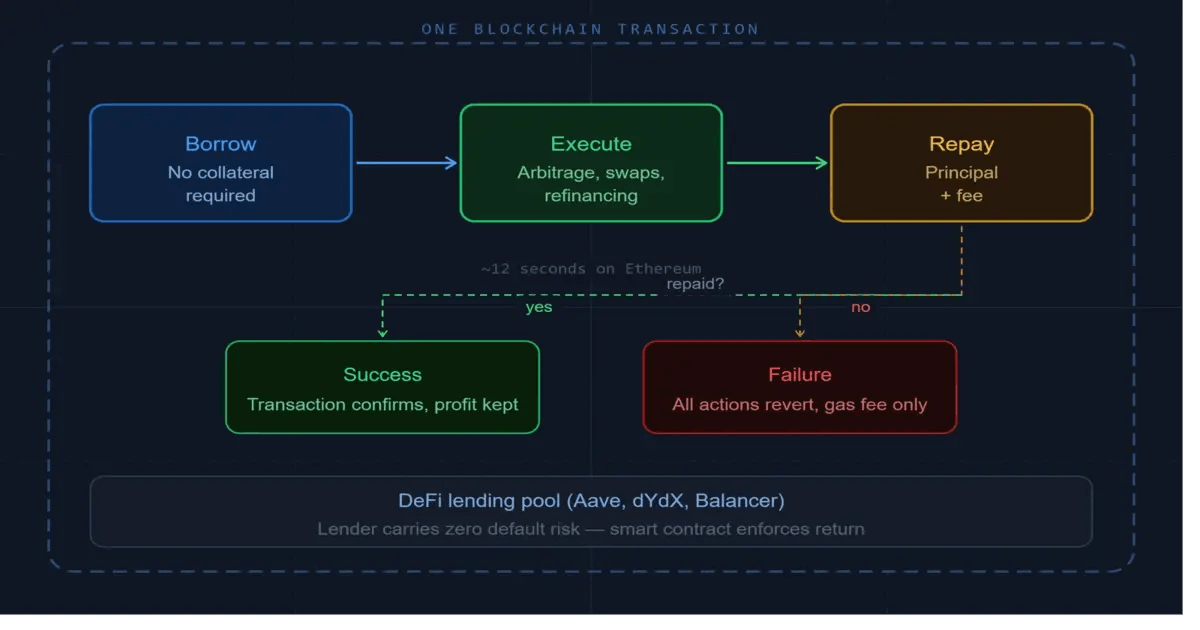
Featured Image Alt Text: A diagram showing the three-step flash loan cycle — borrow, execute, repay — inside a single blockchain transaction block, with success and failure outcome paths. Featured Image File Name: how-flash-loans-work-defi.webp Featured Image Title: How flash loans work in DeFi Featured Image Caption: Flash loans borrow, execute, and repay within one blockchain transaction. If repayment fails, every action reverts automatically.
Flash loans are uncollateralized loans in DeFi that must be borrowed and fully repaid within a single blockchain transaction. If repayment fails before the transaction closes, a smart contract automatically reverts every action, returning all funds to the lender as if the loan never occurred. This atomic design removes default risk entirely, letting anyone access millions in liquidity without posting collateral, a credit history, or waiting for approval.
That single paragraph describes something with no real precedent in traditional finance. A bank cannot roll back a loan. A blockchain can.
What is a flash loan in DeFi?
A flash loan is a DeFi borrowing instrument that operates entirely within a single on-chain transaction. The borrower receives funds, executes whatever logic they want — arbitrage, debt restructuring, collateral swaps — and returns the principal plus a protocol fee before that transaction block finalizes. Every step is governed by smart contract code, not a human credit officer.
The key mechanism here is atomicity. In blockchain terms, an atomic transaction either completes in full or fails completely. There is no partial state. A flash loan exploits this property: the smart contract releases funds under the condition that the same transaction also returns them. If that condition is not met, the entire block of actions reverts. Balances snap back to their starting values. The loan, from the protocol’s perspective, never happened.
This is why the lender carries zero default risk. They do not need the borrower to be creditworthy. They need the blockchain to enforce the rules — which it always does.
How flash loans differ from standard crypto loans
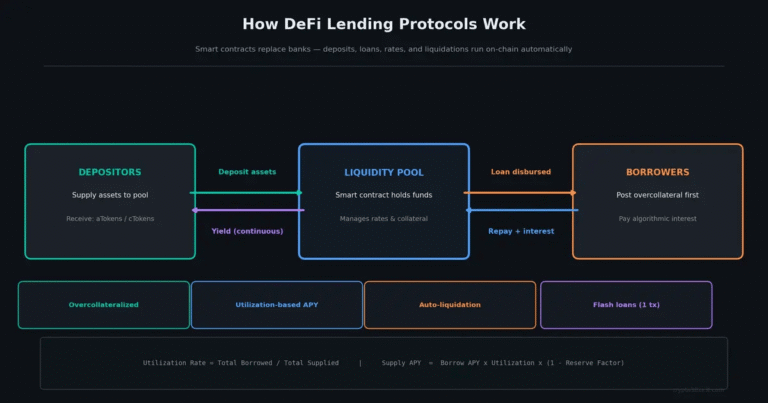
Standard DeFi lending, such as on Compound or Aave’s regular borrowing facility, requires overcollateralization. A borrower who wants $10,000 in stablecoins typically has to deposit $15,000 or more in ETH or other accepted assets. The collateral protects the protocol if the borrower defaults or disappears.
Flash loans eliminate that requirement, but they replace it with a structural constraint: the entire loan must be repaid in the same transaction. The security model shifts from collateral to code.
Traditional bank loans are even further removed: they require income verification, credit history, legal agreements, and scheduled repayments over months or years. A flash loan repays itself in roughly 12 seconds on Ethereum — the average time it takes for one block to be mined.
How flash loans work: the mechanics step by step
Understanding the transaction lifecycle is the clearest way to see why flash loans behave the way they do.
- Request: The borrower deploys a smart contract that calls a flash loan function on a lending protocol such as Aave or dYdX. The request specifies the asset and amount.
- Release: The protocol temporarily transfers funds from its liquidity pool to the borrower’s smart contract. No collateral check occurs at this stage.
- Execute: The borrower’s smart contract runs whatever on-chain logic has been programmed into it. This could be a series of token swaps across decentralized exchanges, a collateral swap on a lending platform, or any other series of smart contract calls.
- Repay: Before the transaction block closes, the borrower’s contract must return the original principal plus a protocol fee. Aave charges 0.09% on the borrowed amount; other platforms have different structures, and some charge nominally.
- Finalize or revert: If the repayment condition is satisfied, the transaction confirms and the borrower keeps any profit. If it is not satisfied, the entire transaction reverts. Every swap, every transfer, every action within that transaction is undone.
The role of the smart contract
A flash loan cannot be executed through a standard wallet interface. The borrower has to write or use a smart contract that encodes the full sequence: borrow, execute, repay. The smart contract is the intermediary that handles every step in one atomic bundle.
This is why flash loans remain largely a tool for developers and technically proficient traders rather than casual users. Writing a flash loan contract requires familiarity with Solidity or similar languages, an understanding of how DeFi protocols expose their APIs, and careful testing, because a bug in the logic means the transaction reverts and the borrower loses only the gas fee, but the strategy fails.
What “atomic” actually means
Atomicity is borrowed from database theory. A database transaction that transfers money from Account A to Account B is atomic if the full transfer either succeeds or is never recorded — the funds cannot vanish from A without arriving at B. Blockchains enforce this at the protocol level.
Flash loans use this guarantee in reverse: funds can leave the lending pool only if the transaction also guarantees their return. The protocol does not trust the borrower. It trusts the rules encoded in the contract.
What are flash loans used for?
Most flash loan volume is legitimate. A small fraction involves attacks. Understanding both is essential.
Arbitrage
Price differences for the same asset across different decentralized exchanges (DEXs) create arbitrage opportunities. When one DEX prices a token at $0.98 and another prices it at $1.02, a trader can borrow a large sum via flash loan, buy the cheaper token, sell it on the more expensive platform, repay the loan, and keep the spread. All within one transaction.
This type of arbitrage serves a genuine market function: it compresses price discrepancies across exchanges, making DeFi markets more accurate. Without it, price gaps could persist much longer than they do.
Collateral swaps
A borrower on Aave might have an outstanding loan backed by ETH as collateral. If they want to swap that collateral to a different asset without closing the position, a manual approach requires repaying the debt first, which requires having the repayment funds. A flash loan provides that capital temporarily. The sequence is: borrow stablecoins via flash loan, repay the ETH-backed loan, withdraw the freed ETH, post a new collateral asset, re-borrow the original sum, repay the flash loan.
The entire position restructure happens in one transaction with no intermediate exposure.
Self-liquidation
When a borrower’s collateral value drops toward the liquidation threshold, third-party liquidators typically step in and claim a liquidation bonus at the borrower’s expense. A borrower can pre-empt this by using a flash loan to repay their own debt, reclaim their collateral before liquidation triggers, sell enough to cover the flash loan, and keep the remainder. The outcome is the same — the debt is cleared — but the borrower avoids the liquidation penalty.
Debt refinancing
A borrower paying 12% APY on a lending protocol can use a flash loan to pay off that debt instantly, move to a different protocol offering 7% APY, and repay the flash loan in one transaction. What would otherwise require multiple manual steps and temporary capital becomes a single atomic operation.
Flash loan comparison: platforms and structure
| Protocol | Fee structure | Supported networks | Notable feature |
|---|---|---|---|
| Aave V3 | 0.05–0.09% on principal | Ethereum, Arbitrum, Polygon, Optimism, Avalanche and others | Largest liquidity, developer documentation |
| dYdX | Minimal or zero fee (historically) | Ethereum (original) | Early adopter, tighter asset selection |
| Uniswap V3 (flash swaps) | 0.3% swap fee | Ethereum and L2s | Flash swaps rather than loans; slightly different model |
| Balancer | 0% protocol fee | Ethereum and L2s | Pool-based, good for multi-asset strategies |
Fee structures evolve as protocols update their governance. The figures above reflect historically documented ranges and may change through on-chain governance votes.
Flash loan attacks: how protocols are exploited
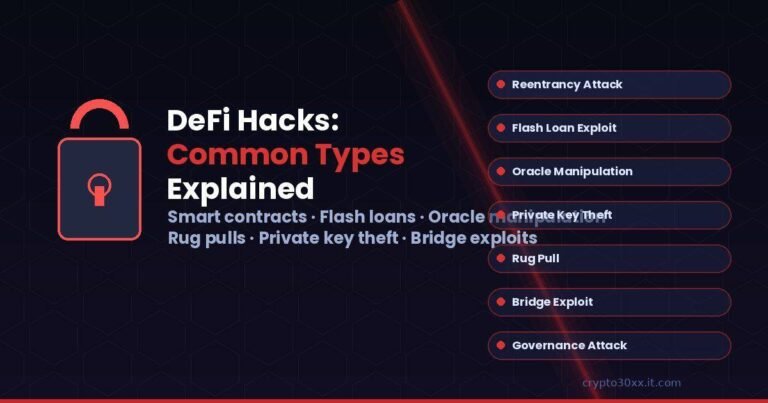
Flash loans themselves do not contain a vulnerability. The attacks that use them exploit weaknesses in other protocols, typically price oracles that can be manipulated within a single transaction.
How oracle manipulation works
Many DeFi protocols calculate asset values by reading the spot price from a single DEX. A flash loan provides enough capital to drastically skew that spot price within one transaction. The attack sequence:
- Borrow a large amount of Token A via flash loan.
- Dump Token A into a DEX liquidity pool, crashing its spot price on that exchange.
- Call a victim protocol that reads that DEX as its price oracle — the protocol now believes Token A is worth far less than it actually is.
- Exploit the mispriced valuation to borrow more than the collateral is worth, drain funds, or trigger incorrect liquidations.
- Swap the stolen funds back, repay the flash loan plus fee, keep the profit.
If the transaction fails at any point, the entire thing reverts. The attacker risks only the gas fee on a failed attempt.
Why the flash loan is not the root problem
The flash loan provides capital. The exploit requires a separately vulnerable protocol — specifically one that uses manipulable price data. Well-designed protocols use time-weighted average prices (TWAPs) calculated across many blocks, which cannot be manipulated within a single transaction, or rely on decentralized oracle networks that aggregate prices from many sources.
The bZx attacks in early 2020 were among the first to bring flash loan exploits to wide attention. An attacker used a flash loan from dYdX to manipulate the price of sUSD on Kyber Network, then borrowed a disproportionate amount of ETH from bZx against the manipulated price. The first attack extracted roughly $350,000. A second attack days later took approximately $600,000.
Since then, multiple other protocols have suffered similar exploits, collectively resulting in hundreds of millions of dollars in losses across DeFi. The consistent factor is not the flash loan mechanism. It is protocols relying on price sources that can be moved within a single block.
Risks for DeFi users: what matters
Flash loans introduce no direct risk to ordinary DeFi users who are not actively attempting to use them. However, the protocols where users deposit assets carry indirect exposure.
| Risk type | Who it affects | Severity |
|---|---|---|
| Oracle manipulation via flash loan | Protocols with manipulable price feeds | High |
| Smart contract bugs in flash loan logic | Borrowers executing flash loan strategies | Medium (failed tx, gas lost) |
| Protocol liquidity drain | Depositors in exploited protocols | High (historic losses) |
| Transaction failure | Flash loan borrower | Low (gas fee only) |
| Systemic contagion | Broader DeFi ecosystem | Context-dependent |
For ordinary depositors, the most relevant risk is protocol-level security. Depositing into a protocol with weak oracle design exposes funds to flash loan-enabled attacks, even if the depositor never interacts with a flash loan directly.
Security improvements in response to attacks
Several protocol design changes reduce flash loan attack surfaces:
- TWAP oracles: Time-weighted average prices smooth out manipulation attempts that only last one block.
- Multi-source price aggregation: Using Chainlink or similar oracle networks draws prices from many off-chain sources, making single-block manipulation impossible.
- Reentrancy guards: Smart contract safeguards that prevent a contract from calling back into itself during execution.
- Audits and formal verification: Third-party code reviews catch logical vulnerabilities before deployment.
These measures do not make flash loans less useful for legitimate purposes. They make protocols harder to exploit through any mechanism, not just flash loans.
Historical context: origin and growth
The concept originated with Marble Protocol in 2018. Marble described itself as a “smart contract bank” on Ethereum and introduced flash lending as a way for anyone to borrow assets and execute arbitrage without using their own capital, as long as funds were returned within the same transaction. The project did not gain significant traction.
The mechanism reached mainstream DeFi with Aave’s launch in January 2020. Aave built flash loans into its lending protocol with full documentation and developer support, charging 0.09% on each transaction. Within months, Aave was processing over $100 million in flash loan volume per day.
The bZx attacks in February 2020 — occurring just weeks after Aave’s launch — brought flash loans to the attention of the broader crypto community, and not favorably. The coverage focused on the attack angle. The legitimate use cases took longer to gain recognition.
Since that period, flash loans have become standard infrastructure in DeFi. Arbitrage bots, liquidation engines, and position management tools routinely use them. Their existence accelerates price discovery across DEXs and makes capital more efficient across the entire DeFi stack.
FAQs
Do you need collateral for a flash loan? No. Flash loans are uncollateralized by design. The security mechanism is the atomic transaction itself — funds must be returned before the transaction closes or the entire sequence reverts. The borrower’s creditworthiness is irrelevant.
How long does a flash loan last? The duration of a single blockchain block. On Ethereum, that is roughly 12 seconds. The entire sequence of borrowing, executing, and repaying must fit within that window.
Can anyone take out a flash loan? Technically yes, but practically it requires writing or using a smart contract. There is no user-friendly interface for flash loans equivalent to a bank loan application. The borrower must be comfortable with smart contract development or use a pre-built tool that abstracts the contract layer.
What fee does Aave charge for flash loans? Aave has charged between 0.05% and 0.09% on the borrowed principal, depending on the version and pool. On a $1 million flash loan at 0.09%, the protocol fee is $900. Borrowers also pay Ethereum gas fees separately.
Are flash loans legal? Flash loans are a neutral technical mechanism. Using them for arbitrage or collateral management is generally considered legal in most jurisdictions, subject to the regulatory environment around DeFi activity. Using them to exploit protocol vulnerabilities through price manipulation is a different matter and has attracted law enforcement attention in specific cases.
Can a flash loan fail? Yes. If the strategy does not produce enough profit to cover the loan and fee, or if any step in the transaction chain fails, the entire transaction reverts. The borrower loses the gas fee for the failed attempt but does not owe the principal.
What is the difference between a flash loan and a flash swap? Flash swaps, used by Uniswap, allow a user to withdraw assets from a liquidity pool and either return the same assets or pay for them with a different token, all within one transaction. The structure is similar to a flash loan but integrated specifically into the swap mechanism rather than a separate lending facility.
Which DeFi protocols offer flash loans? Aave is the most widely used. dYdX, Uniswap (through flash swaps), Balancer, and several others offer comparable functionality with different fee structures and supported assets.
Disclaimer
This article is written for educational and research purposes by the independent editorial team at crypto30xx.it.com. Nothing in this guide constitutes financial, investment, or legal advice. Flash loans and DeFi protocols carry significant financial and technical risks. Readers should conduct independent research and consult qualified professionals before making any financial decisions. Past behavior of DeFi protocols does not predict future security or performance.
Flash loans are one of the clearest examples of what smart contracts make possible that traditional financial infrastructure cannot replicate. Atomic, uncollateralized borrowing — where the lender’s risk is structurally zero — does not exist in banks or brokerage systems. It exists because blockchains enforce transaction-level guarantees that no legal agreement can match.
The mechanism is neutral. The outcomes depend entirely on what borrowers do with temporary access to large capital. Most of it is mundane: arbitrage bots closing price gaps, borrowers restructuring positions. A smaller portion has been weaponized against protocols with exploitable design choices. Both realities belong in any honest account of how flash loans work.
Take your knowledge game to the next level with our level-up article collection.