What is DeFi in simple words: a clear guide to decentralized finance
What is DeFi in simple words: DeFi, short for decentralized finance, is a system of financial services — lending, borrowing, trading, and earning interest — built directly on public blockchains, where software code replaces the banks, brokers, and clearinghouses that normally sit in the middle of every transaction. Instead of a company holding your funds and deciding what you can do with them, a set of self-executing programs called smart contracts enforces the rules automatically, around the clock, for anyone with a crypto wallet and an internet connection. No application forms. No credit checks. No business hours.
What does DeFi actually mean?
DeFi is short for decentralized finance. The “finance” part refers to the services themselves — lending, borrowing, trading, saving. The “decentralized” part refers to how those services run: not on servers owned by one company, but across a distributed network of computers where no single party controls the outcome.
Think about what happens when you wire money through a bank. The bank verifies your identity, checks your account balance, processes the transaction, takes a fee, and logs the event in its own private database. You trust the bank to do all of this correctly. DeFi replaces that chain of trust with code. The rules are written into a smart contract, published on a public blockchain, and executed automatically whenever the specified conditions are met. No one at a desk approves or denies anything.
The term itself entered common use in 2018 among Ethereum developers and builders looking for a label that distinguished protocol-level financial tools from ordinary cryptocurrency trading. Since then, it has grown into an umbrella covering dozens of distinct services and hundreds of individual protocols.
How does DeFi work?
The role of blockchains
Every DeFi service runs on top of a blockchain — a distributed database maintained by thousands of independent computers, all of which hold the same copy of the transaction record. Because no single computer can alter that record unilaterally, the system is resistant to tampering in a way that a single company’s database is not.
Most DeFi protocols were built on Ethereum first, which introduced programmable smart contracts in 2015. Other blockchains — including those built as faster or cheaper alternatives to Ethereum — have since attracted their own DeFi activity.
What smart contracts actually do
A smart contract is a program stored on a blockchain. It runs automatically when predefined conditions are met, and once deployed, its code cannot be altered by the team that wrote it (in most cases). That immutability is what makes it trustworthy: both parties to a transaction know the rules will not change mid-way.
A simple example: a lending smart contract might say, “If a user deposits 1.5 ETH as collateral, release 1,000 USDC to their wallet. If the ETH value drops below 1.2× the loan value, liquidate the collateral automatically.” No human needs to monitor this or make a judgment call. The contract executes whenever those conditions occur.
Liquidity pools and how they replace order books
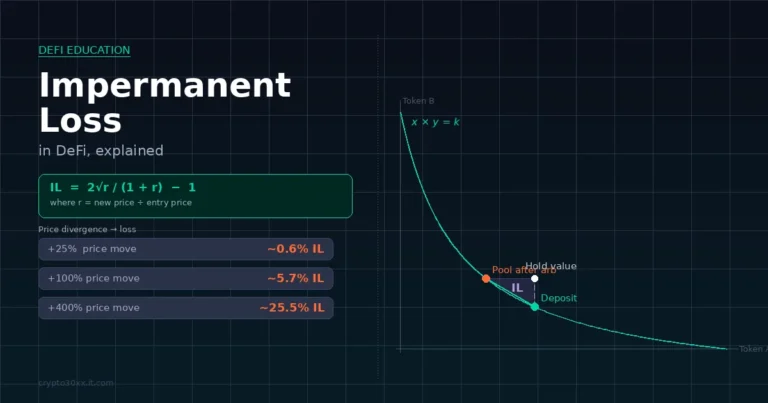
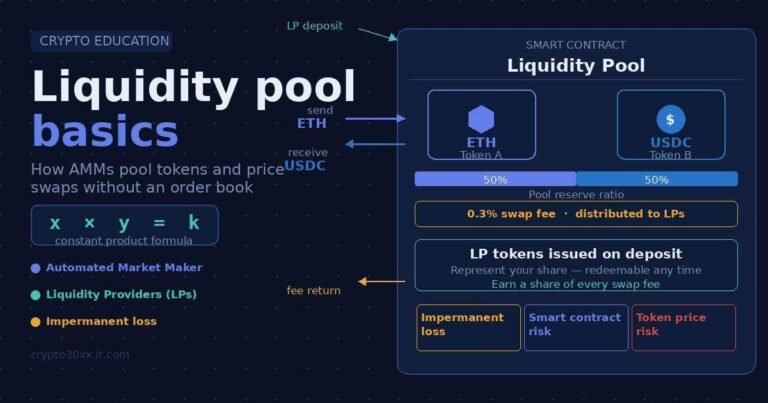
Traditional exchanges match a buyer to a seller. DeFi exchanges — called decentralized exchanges (DEXs) — typically work differently. Users deposit pairs of tokens into a shared pool. A pricing algorithm adjusts the exchange rate based on the ratio of tokens in the pool. When someone trades, they swap one token for another directly against the pool, not against another person’s specific order.
These pools are supplied by liquidity providers, who deposit tokens in exchange for a share of the trading fees generated by that pool. This model keeps markets liquid even when there is no matching counterpart waiting on the other side.
What can you do in DeFi?
The services available in DeFi map closely to what exists in traditional finance, though the mechanics differ substantially.
| DeFi Service | What it does | Traditional equivalent |
|---|---|---|
| Lending protocol | Deposit crypto assets and earn interest | Savings account |
| Borrowing protocol | Take a loan against collateral | Secured loan |
| Decentralized exchange (DEX) | Swap tokens without a central operator | Stock or currency exchange |
| Stablecoins | Hold a token pegged to a fiat currency | Cash or money market fund |
| Yield farming | Provide liquidity and earn fee income | Dividend investing |
| Flash loans | Borrow without collateral within a single block | No direct equivalent |
Lending and borrowing
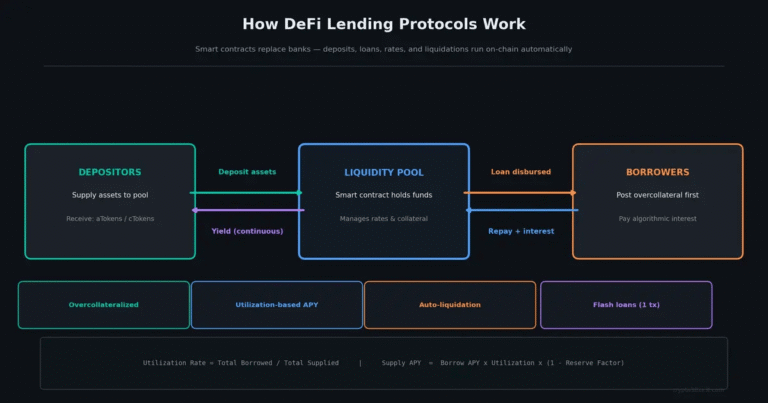
Lending in DeFi works through pooled smart contracts. A user deposits an asset — say, a stablecoin — into a protocol’s liquidity pool. Borrowers can then draw from that pool by posting crypto collateral worth more than the loan amount. This overcollateralization compensates for the fact that DeFi lenders cannot check a borrower’s credit history or employment. If collateral value falls below the required ratio, the smart contract liquidates it automatically to protect the lender’s funds.
Interest rates on DeFi lending platforms are typically algorithmic: when demand for borrowing a particular asset rises, the interest rate rises with it. When demand falls, rates compress. No committee meets to set a rate.
Stablecoins in DeFi
Many DeFi users want exposure to the financial mechanics of the system without holding assets that can swing 20% in a day. Stablecoins — tokens designed to track the value of a fiat currency, most often the US dollar — fill that role. Some stablecoins are backed by fiat reserves held by a centralized issuer. Others are generated algorithmically by DeFi protocols themselves, created when users lock up collateral and minted in proportion to what that collateral can back.
Flash loans: a DeFi-native instrument
Flash loans have no equivalent in traditional finance. A user borrows any amount of a token from a protocol, executes a series of transactions (arbitrage between two prices, for example), and repays the loan — all within a single blockchain transaction block, which takes seconds. If repayment does not occur within that same block, the entire transaction reverts as if it never happened. The lender bears no risk because the loan cannot persist if it is not repaid.
Flash loans are used legitimately for arbitrage and collateral swaps. They have also been used in attacks, which the risks section covers.
DeFi vs. traditional finance: a direct comparison
Understanding what DeFi changes — and what it does not — requires looking at the structural differences side by side.
| Feature | Traditional finance (CeFi) | DeFi |
|---|---|---|
| Who controls the rules | Banks, regulators, company policies | Smart contract code |
| Custody of funds | Institution holds funds | User retains custody (typically) |
| Access requirements | ID, credit history, approval | Crypto wallet and internet connection |
| Operating hours | Business hours, settlement delays | 24 hours a day, every day |
| Transparency | Private ledgers | Public, verifiable on-chain |
| Reversibility | Chargebacks, dispute resolution | Transactions generally irreversible |
| Regulatory protection | Deposit insurance, consumer protections | None in most cases |
| Interest rates | Set by institution | Algorithmic, market-driven |
The table makes DeFi sound like a clear upgrade. In practice, every advantage in the left column comes with a corresponding risk in the right one. User-held custody means users who lose their private keys lose everything. Code-set rules mean a bug in that code can drain a protocol before anyone notices.
What are the risks of DeFi?
This is not a section to skim. DeFi carries risks that differ fundamentally from those in traditional finance, and several of them have produced material losses for users.
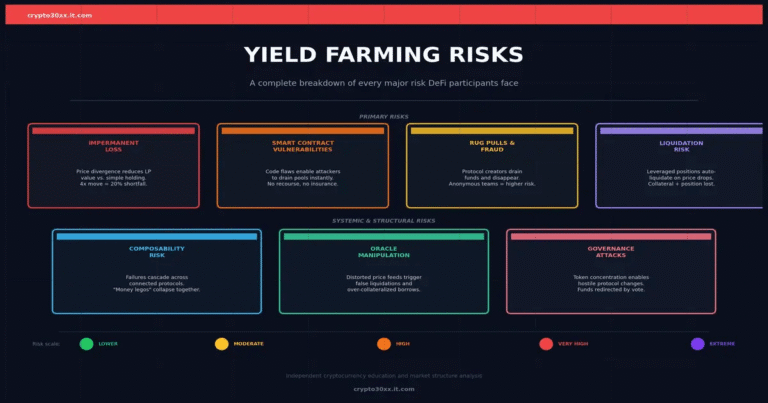
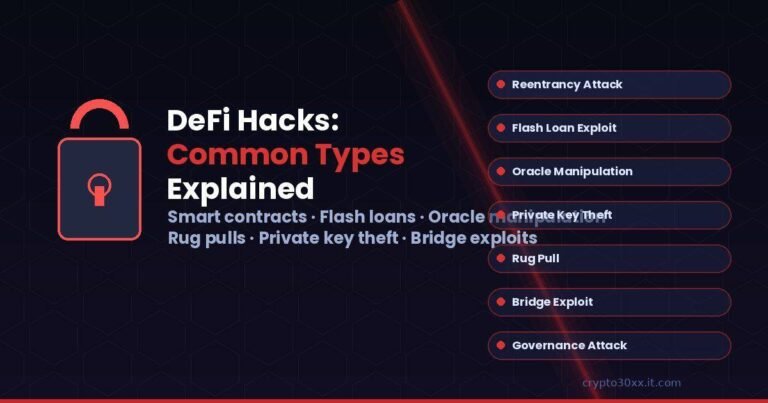
Smart contract vulnerabilities
DeFi protocols are programs. Programs have bugs. A vulnerability in a single line of code can allow an attacker to drain the entire pool the contract controls. Because smart contracts are generally immutable once deployed — a feature meant to prevent unauthorized changes — fixing a discovered bug often requires migrating to a new contract, a process that depends on users trusting the team’s response quickly enough.
The open-source nature of most DeFi code means anyone can read it, which aids security audits, but also allows attackers to study it for weaknesses.
Flash loan attacks
Flash loans, described above as legitimate instruments, have also enabled a category of exploit. An attacker borrows a large sum without collateral, uses it to manipulate a price feed or drain a liquidity pool, repays the loan, and exits with a profit — all within one transaction. The attacked protocol has no recourse. Flash loan attacks have drained protocols of tens of millions of dollars in a matter of seconds.
Oracle manipulation
DeFi protocols often need real-world price data — for example, the current USD price of ETH — to determine when to liquidate a position. This data is fed in by oracles, external services that bridge on-chain and off-chain information. An oracle that can be manipulated gives an attacker the ability to trigger liquidations artificially or borrow against inflated collateral values. Several high-profile exploits have used oracle manipulation as their primary method.
Rug pulls and exit scams
Not all DeFi protocols are what they appear. In a rug pull, developers create a token or protocol, attract users to deposit funds, and then withdraw all liquidity — leaving depositors with assets worth nothing. Because DeFi protocols can launch without regulatory review or identity disclosure, these schemes are common. Rug pulls represented a large share of total cryptocurrency losses in the years when DeFi activity surged.
Liquidation risk for borrowers
A user who borrows against crypto collateral faces forced liquidation if that collateral falls in value too quickly. Crypto assets are volatile. A borrower who calibrates their position safely during a stable period may find their collateral automatically sold off during a sharp market move before they have a chance to add more.
Regulatory uncertainty
DeFi occupies contested regulatory ground in most countries. The classification of DeFi tokens, protocols, and yields as securities, commodities, or something else entirely differs by jurisdiction and has changed as governments have moved to address the sector. A protocol that operates freely in one environment may face restrictions in another.
How DeFi differs from CeFi (centralized crypto finance)
Not all crypto-based financial services are DeFi. Centralized finance — often called CeFi — covers platforms that use cryptocurrencies but operate with traditional corporate structures: a company that controls user funds, verifies identities, and handles operations through internal systems rather than on-chain smart contracts.
The line between CeFi and DeFi is not always clean. Some protocols present as decentralized but retain admin keys that allow the deploying team to change contract parameters or pause the system. Meaningful decentralization requires more than deploying a smart contract — it requires removing the ability of any individual or group to override the rules the contract enforces.
When evaluating any DeFi protocol, researchers and analysts look at: whether the contract code is verified and publicly audited; whether the admin keys have been renounced or placed under multi-signature control requiring many parties to agree; and whether governance decisions are made on-chain by token holders rather than behind closed doors.
DeFi and blockchain infrastructure: what makes it possible
DeFi’s existence depends on several technical components working together.
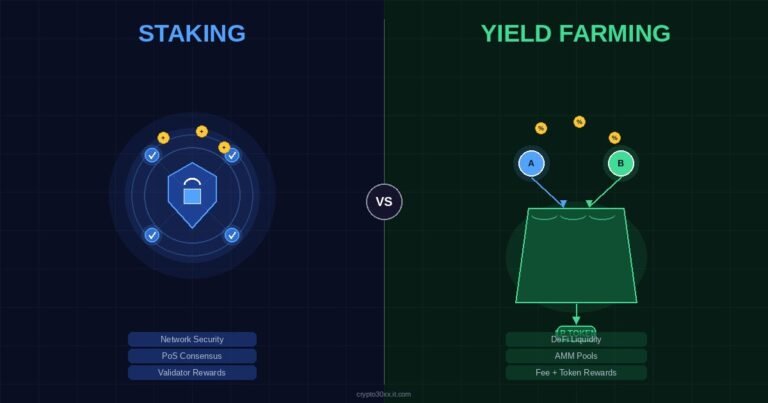
Proof-of-stake consensus: The Ethereum network, where most DeFi value has historically concentrated, switched from proof-of-work to proof-of-stake consensus in September 2022, an event referred to as the Merge. Validators lock ETH as collateral to earn the right to confirm transactions. This change affected energy consumption and the economics of transaction validation without altering the basic mechanics of how DeFi protocols function.
Layer 2 networks: Gas fees — the cost of executing transactions on a blockchain — can be prohibitively high on the Ethereum base layer during periods of high demand. Layer 2 networks process transactions off the main chain and post compressed proofs to it, reducing costs substantially. Many DeFi users now interact with the same protocols through Layer 2 deployments rather than directly on Ethereum.
Wrapped tokens and bridges: DeFi protocols on one blockchain cannot natively access assets from another. Bridge protocols allow users to lock an asset on one chain and receive a wrapped version on another. Bridges have been among the most frequently exploited points in DeFi infrastructure, making them a particular focus of security research.
FAQs
Do I need to know how to code to use DeFi? No. Most DeFi protocols offer web interfaces that let users connect a wallet and interact through a browser. That said, understanding what a transaction does before signing it is important — DeFi applications do not have customer service departments, and errors are typically irreversible.
Is DeFi the same as crypto? Not exactly. Crypto refers broadly to digital assets and the blockchain networks they run on. DeFi refers specifically to financial services — lending, trading, yield — built on those networks. All DeFi uses crypto, but most crypto activity is not DeFi.
What is the difference between a DeFi protocol and a crypto exchange? A crypto exchange — in the centralized sense — is a company that holds your funds and matches your orders against other users. A DeFi protocol is a set of smart contracts that executes trades, loans, or other functions automatically, without a company in the middle. You retain custody of your assets throughout a DeFi interaction (until you choose to move them elsewhere).
Is DeFi safe? DeFi carries real risks that do not exist in traditional finance: smart contract bugs, protocol exploits, oracle manipulation, rug pulls, and market volatility affecting collateral positions. Engaging with DeFi means accepting these risks without the safety nets that regulated financial institutions provide. Security audits, time-tested protocols, and careful position sizing reduce — but do not eliminate — exposure.
Can anyone use DeFi? Anyone with a compatible crypto wallet and access to the internet can technically interact with DeFi protocols. In practice, regulatory frameworks in some countries restrict or complicate this access, and front-end interfaces (the websites through which users interact with protocols) may block certain jurisdictions. The smart contracts themselves, however, are permissionless at the protocol level.
What is TVL in DeFi? TVL stands for total value locked. It is a common metric used to measure the scale of a DeFi protocol or the DeFi sector overall — it represents the aggregate market value of all assets currently deposited in smart contracts. TVL rises and falls with both the price of deposited assets and the number of participants.
What are governance tokens? Many DeFi protocols issue governance tokens that give holders the ability to vote on proposed changes to the protocol — fee structures, new asset listings, collateral ratios, upgrades. Governance token holders effectively act as a decentralized board of directors. How much practical influence individual token holders have depends on how concentrated the token distribution is.
What is yield farming? Yield farming means deploying crypto assets across DeFi protocols in a way designed to maximize the return from interest rates, trading fees, and governance token distributions. Users often move assets between protocols as rates shift. The term describes an activity that carries compounding risks — the more protocols involved, the more points of failure.
Disclaimer
This article is written for educational purposes by an independent research and information resource. Nothing in this article constitutes financial advice, investment advice, or a recommendation to buy, sell, or hold any digital asset. DeFi protocols involve significant risks, including total loss of funds. Readers should conduct their own research and, where appropriate, consult a qualified financial professional before making any decisions.
The core idea behind DeFi is structurally simple: move financial services onto public, programmable blockchains so that access does not depend on institutional approval and rules cannot be changed by a single party. The implementation is considerably more complex — and the gap between the idea and the reality is where most of the risk lives.
For researchers, analysts, and learners examining this space, that gap is precisely where the interesting questions are.
Built by experts, written for everyone—our accessible knowledge content hits different.