DeFi hacks common types: a complete breakdown
DeFi hacks common types: Decentralized finance protocols hold billions of dollars in on-chain assets secured entirely by code and cryptographic keys — no customer service line, no chargebacks, no insurance. That structure makes DeFi hacks uniquely damaging. When an attacker drains a protocol, funds are typically gone within a single block. This guide explains the most common types of DeFi hacks, how each one works at a technical level, and what distinguishes them from one another — giving researchers, learners, and protocol observers a clear framework for understanding why losses in this space accumulate so quickly.
What makes DeFi protocols vulnerable to hacks?
DeFi protocols are attractive targets for several structural reasons. Smart contract code is public by default, which means anyone can read it for bugs. Protocols are composable — they call each other’s functions — so a flaw in one contract can cascade through several. Development cycles are often fast, and security reviews are sometimes abbreviated or skipped. Collectively, these properties create a large, visible attack surface on top of significant liquidity.
<cite index=”2-1″>There are two broad categories of attacks: on-chain hacks that exploit vulnerabilities in smart contracts, and off-chain hacks that exploit front-end weaknesses, compromised credentials, or human error.</cite>
The split matters because defenses differ entirely. On-chain vulnerabilities require secure code and formal audits. Off-chain vulnerabilities require operational security, key management hygiene, and phishing awareness. Many major losses involve both.
Why open-source code cuts both ways
Every DeFi protocol publishes its source code. That transparency allows independent security researchers to find and report bugs before they are exploited — but it also hands attackers a complete blueprint. <cite index=”6-1″>The open-source nature of DeFi protocols allows attackers to view the smart contract code and identify glitches for exploitation.</cite>
The composability problem
DeFi’s strength is that protocols can be stacked. A single transaction can borrow from a lending protocol, swap on a DEX, deposit into a yield vault, and repay the loan — all atomically. The weakness is that every integration introduces new trust assumptions. A flaw in any layer can compromise the entire stack.
Smart contract vulnerabilities: the foundational attack class
Smart contract vulnerabilities are the oldest and best-documented category of DeFi hacks. <cite index=”4-1″>Smart contract vulnerabilities account for 47% of the top 50 attacks, with logic bugs making up 26% of all smart contract hacks and failed input validation accounting for 23%.</cite>
Reentrancy attacks
A reentrancy attack exploits a specific sequencing flaw. When a smart contract sends ETH or calls an external contract, it temporarily hands over execution control. If the vulnerable contract hasn’t updated its internal state before making that external call, an attacker’s contract can call back into the original function — repeatedly — before the first execution completes.
<cite index=”32-1″>The DAO hack of 2016 is the defining example. The DAO was a decentralized, community-controlled investment fund that raised $150 million worth of ether. A reentrancy flaw in its withdrawal function allowed an attacker to recursively drain approximately $60 million by calling the withdraw function before balances were updated.</cite>
The fix is mechanical: update state before making external calls. The pattern is now known as “checks-effects-interactions” and is a standard Solidity best practice. Despite this, reentrancy bugs reappear, often in novel contract architectures that reuse audited building blocks in unanticipated combinations.
<cite index=”30-1″>The DAO hack resulted in Ethereum issuing a critical update to roll back the attack, and the controversy over that rollback led directly to the fork that created Ethereum Classic.</cite>
Logic bugs and flawed access controls
Logic bugs are exactly what the name implies: the code executes as written, but what it was written to do is wrong. A miscalculation in collateral ratios, an incorrect condition in a liquidation function, or an unintended public function that exposes administrative controls — all fall into this category.
Access control failures are particularly damaging. <cite index=”9-1″>If attackers gain access to admin wallets, validator keys, or upgrade permissions, entire protocols can be drained within minutes.</cite> These aren’t bugs in the cryptography. They’re bugs in who is allowed to call which function, and under what conditions.
Integer overflows and precision errors
Solidity historically lacked built-in overflow protection, leading to cases where arithmetic operations wrapped around to unexpected values. Modern Solidity versions handle this, but precision errors — particularly in protocols dealing with fractional token amounts and rounding — remain a live risk. <cite index=”15-1″>A rounding error in Bunni’s withdrawal logic, amplified by temporary capital from a flash loan, resulted in approximately $8.4 million in losses in a single attack.</cite>
Flash loan attacks: using protocol mechanics as a weapon
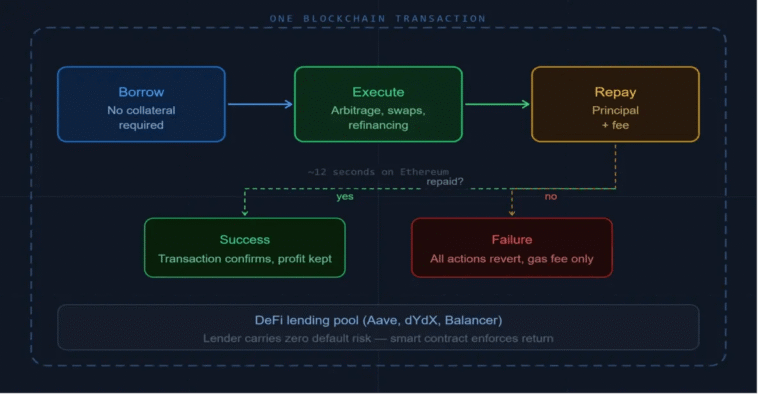
Flash loans are not a vulnerability in themselves. They are a legitimate DeFi primitive: <cite index=”11-1″>flash loan attacks exploit the ability to borrow large sums of funds without collateral within a single transaction, leveraging the atomic nature of blockchain transactions where all operations must succeed or fail together.</cite>
That atomicity is the key. If an attacker can’t complete the exploit and repay the loan within one transaction, the entire transaction reverts. No repayment, no exploit. But when the exploit does work, the attacker needs zero starting capital and can borrow tens or hundreds of millions of dollars in a single block.
How a flash loan attack is structured
The basic structure:
- Borrow a large amount from a flash loan provider (Aave, dYdX, or directly from a liquidity pool).
- Use the borrowed capital to trigger a vulnerability — most commonly oracle manipulation, reentrancy, or a logic flaw.
- Extract profit from the exploit.
- Repay the flash loan within the same transaction.
- Keep the difference.
The attacker’s cost is typically gas fees and the flash loan fee (often 0.05–0.09% of the borrowed amount). The return, in successful exploits, can be orders of magnitude larger.
Flash loans as amplifiers, not causes
An important distinction: flash loans don’t create vulnerabilities. They amplify the financial impact of vulnerabilities that already exist. A protocol with a flawed price oracle might be only marginally exploitable if the attacker has to deploy $10,000 of real capital. With a flash loan providing $10 million, the same flaw becomes catastrophic.
<cite index=”13-1″>Flash loan amplification turns minor flaws into catastrophic losses by providing attackers with massive temporary capital.</cite>
Oracle manipulation: corrupting the data that protocols trust
DeFi protocols are closed systems. A lending protocol doesn’t know the current market price of an asset unless something tells it. That something is an oracle — a mechanism for importing external data into the blockchain. <cite index=”6-1″>Oracle price manipulation is a common DeFi hack where attackers manipulate an oracle smart contract, leading to system failure, theft, and damages. Oracles provide real-world data to blockchains, with price feeds being the most exploited data type.</cite>
Spot price vs. time-weighted average price (TWAP)
The critical design decision is which price source a protocol uses.
| Price Source | How It Works | Manipulation Risk |
|---|---|---|
| Spot price (DEX pool) | Uses current pool reserves ratio | High — can be moved in one transaction |
| TWAP (time-weighted average) | Averages price over a time window | Lower — requires sustained manipulation |
| Decentralized oracle network | Aggregates data from multiple off-chain sources | Lower — requires compromising multiple data feeds |
Protocols that use a single DEX pool’s spot price as their oracle are particularly exposed. An attacker with a large flash loan can move the pool price dramatically within one transaction, trigger the protocol’s pricing logic at the distorted price, extract profit, and let the pool price normalize when the loan is repaid.
The Mango Markets case
<cite index=”17-1″>The Mango Markets hack involved attackers manipulating pricing to borrow overvalued assets, draining $117 million from the protocol. Attackers used flash loans to artificially inflate token prices in low-liquidity pools or faulty oracle systems.</cite>
This attack didn’t require breaking any code. The protocol functioned as designed. The problem was that its oracle could be moved, and its lending logic trusted that price unconditionally.
Private key compromise: the off-chain threat
Smart contract bugs dominated early DeFi exploits. The threat distribution has shifted substantially. <cite index=”28-1″>By 2024 and 2025, off-chain attack vectors had overtaken on-chain exploits in total value stolen. Compromised private keys and wallet infrastructure accounted for more than half of all incidents in 2024 and were responsible for approximately 80% of stolen funds that year.</cite>
Private key compromise means an attacker obtains the cryptographic key that controls a privileged wallet — an admin address, a treasury multisig, or a protocol deployer. Once they have the key, no smart contract audit matters. The attacker simply calls the protocol’s administrative functions legitimately.
How keys are stolen
Attack vectors include:
- Phishing campaigns targeting team members or infrastructure providers
- Malware on developer machines
- Social engineering attacks against third-party custodians
- Insider threats
- Compromised signing interfaces (attackers manipulate what the signer sees vs. what they’re actually signing)
<cite index=”23-1″>One illustrative case involved an attacker exploiting a compromised private key to perform a malicious smart contract upgrade and drain funds using an admin function — a form of attack that standard smart contract audits cannot prevent.</cite>
Multisig wallets and their limits
Multi-signature wallets require multiple keyholders to approve a transaction before it executes. This is a meaningful improvement over single-key control, but it’s not a complete solution. If enough signers are compromised simultaneously, or if the signing interface itself is manipulated to display a false transaction summary, multisig protection can be bypassed.
Rug pulls and exit scams: when the threat is the team itself
Not every DeFi loss is a hack in the technical sense. Rug pulls are deliberate thefts committed by the protocol’s own developers. The playbook: launch a protocol, attract user deposits, then drain the treasury and disappear.
Rug pulls take several forms:
- Liquidity removal: Developers hold liquidity provider tokens and withdraw all underlying assets at once, leaving other holders with worthless tokens.
- Mint function abuse: A hidden or undisclosed function allows the deployer to mint unlimited tokens, which they sell into the market.
- Upgrade key abuse: A protocol with upgradeable contracts has an admin key that can rewrite the contract’s logic. A malicious deployer upgrades the contract to steal funds.
- Soft rug / slow drain: Developers gradually siphon fees or inflate their own token allocations before abandoning the project.
The distinction between a rug pull and a hack matters legally and conceptually. A hack involves unauthorized access. A rug pull involves authorized access used for unauthorized purposes. Both leave users with losses that are typically unrecoverable.
Bridge exploits: cross-chain infrastructure as a target
Cross-chain bridges allow assets to move between separate blockchains — Ethereum to Solana, or Polygon to Arbitrum, for example. Bridges have become the largest single category of loss in DeFi history by total value.
The technical reason is structural. <cite index=”27-1″>Bridge vulnerabilities typically involve compromise of validator or multisig private keys, logic errors in bridge operations, and message spoofing or oracle data manipulation.</cite> A bridge must maintain synchronized state across two chains that cannot directly communicate. That synchronization problem creates multiple attack surfaces: the contracts on each chain, the validators or relayers in between, and the messaging protocols that connect them.
Bridge exploits are disproportionately large because bridges aggregate liquidity from many users. The Ronin Network breach and the Wormhole exploit are among the most-cited examples of single events draining hundreds of millions of dollars.
Governance attacks: exploiting on-chain voting
Many DeFi protocols are controlled by decentralized governance — token holders vote on proposals that change protocol parameters or spend treasury funds. Governance mechanisms introduce their own attack surface.
Flash loan governance exploits
<cite index=”16-1″>In decentralized governance, decision-making power often correlates with token ownership. Attackers use flash loans to acquire large amounts of governance tokens temporarily, influencing decisions in their favor — for example, proposing and passing malicious changes to the protocol’s rules.</cite>
The fix is snapshot-based voting: a protocol records token balances at a specific block height before a vote begins, then uses those historical balances to weight votes. Tokens borrowed after the snapshot have no voting power.
Vote-locking and time delays
Some protocols require governance tokens to be locked for a minimum period before they can vote. This makes flash loan governance attacks impractical, since the loan must be repaid within one transaction but the lock persists for days or weeks.
Comparing DeFi hack types
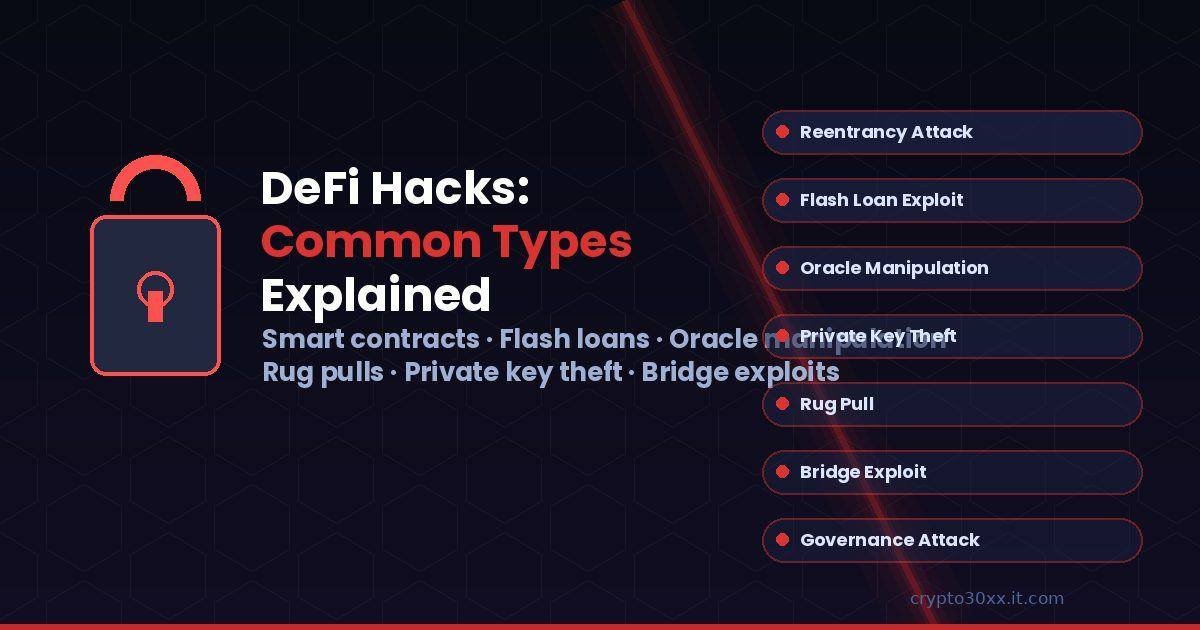
| Attack Type | Root Cause | Requires Code Bug? | Requires Capital? | Historical Loss Scale |
|---|---|---|---|---|
| Reentrancy | State update sequencing flaw | Yes | No | Moderate–Large |
| Logic bug | Flawed contract logic | Yes | Sometimes | Moderate–Catastrophic |
| Flash loan exploit | Protocol vulnerability amplified by borrowed capital | Usually | No (borrowed) | Large–Catastrophic |
| Oracle manipulation | Untrusted or single-source price feed | Partial | Yes (to move price) | Large |
| Private key compromise | Off-chain key management failure | No | No | Often Catastrophic |
| Rug pull | Malicious team with privileged access | No | No | Variable |
| Bridge exploit | Cross-chain infrastructure flaw | Sometimes | Sometimes | Often Catastrophic |
| Governance attack | Flash loan + snapshot timing flaw | Partial | Yes (borrowed) | Moderate–Large |
FAQs
What is the most common type of DeFi hack? Smart contract vulnerabilities historically account for the largest share of on-chain exploits, with logic bugs and access control failures making up the majority. However, private key compromise has overtaken smart contract exploits in total value stolen in more recent years, as protocols have improved their on-chain code quality while operational security has lagged.
Can a DeFi hack be reversed? In most cases, no. Blockchain transactions are final. Funds can occasionally be recovered if the attacker returns them voluntarily, or through legal action in jurisdictions that have obtained court orders. In rare cases, a blockchain’s community may vote to hard fork and reverse a specific transaction — as Ethereum did following the DAO hack in 2016 — but this is exceptional and highly controversial.
How do flash loans make DeFi hacks worse? Flash loans give attackers access to very large amounts of capital within a single transaction, at minimal cost. They don’t create vulnerabilities, but they amplify the financial impact of vulnerabilities that already exist. A flaw that might yield a few thousand dollars against a small attacker can yield tens of millions when an unlimited flash loan is available.
What is a rug pull and how does it differ from a hack? A rug pull is an exit scam by the protocol’s own developers. A hack involves an external attacker exploiting a vulnerability. The outcome for users is similar — funds are lost — but the mechanism differs. Rug pulls exploit trusted access. Hacks exploit code flaws or key theft.
What is oracle manipulation in DeFi? Oracle manipulation involves corrupting the external price data that a DeFi protocol uses to value assets and calculate collateral. If a protocol relies on a single DEX pool as its price source, an attacker can move that pool’s price using borrowed capital, trigger the protocol at the distorted price, extract profit, and repay the loan — all within one transaction.
Why are cross-chain bridges hacked so frequently? Bridges must maintain synchronized state across two independent blockchains using validators, relayers, and messaging protocols. Each of those components introduces a potential attack surface. The concentration of user liquidity in bridge contracts makes them high-value targets. A single exploit in the bridge infrastructure can drain assets locked by many separate users at once.
How can protocol users reduce their exposure to DeFi hacks? Users can research whether a protocol has completed multiple independent security audits, whether the team has verified identities, whether contract upgrades are timelocked, and whether the protocol uses well-designed decentralized oracle networks rather than single-source price feeds. No measure eliminates risk entirely. Protocols with long track records, meaningful bug bounty programs, and open security disclosures carry structurally lower (though never zero) risk profiles.
Disclaimer
This article is written for educational and research purposes only. It does not constitute financial advice, investment recommendations, or endorsement of any protocol, token, or platform. DeFi protocols carry significant risk of total loss of funds. Readers should conduct independent research before interacting with any decentralized finance application. crypto30xx.it.com is an independent educational blog and has no affiliation with any protocol, exchange, or token issuer mentioned in this article.
The common thread across every DeFi hack category is this: the same properties that make DeFi open and permissionless also make it unusually easy for attackers to probe, exploit, and extract. Smart contract bugs, oracle design choices, private key management, bridge architecture, and governance mechanics each present distinct vulnerabilities. Understanding which type of attack a given incident represents is the first step toward assessing whether a protocol has addressed the underlying structural issue — or whether the same flaw could resurface in a different form.
Find your competitive advantage inside our edge-giving curated content.