DEX vs CEX difference explained: how each exchange works
DEX vs CEX difference explained: A decentralized exchange (DEX) and a centralized exchange (CEX) are two structurally different systems for trading cryptocurrency. A CEX is operated by a company that holds user funds, verifies identities, and matches trades through an internal order book. A DEX runs on blockchain smart contracts, lets users trade without a company intermediary, and requires no account. Understanding the DEX vs CEX difference matters because the choice between them determines who controls your assets, what fees you pay, what information you disclose, and what category of risk you accept. This guide explains how each exchange type works from first principles, compares them across eight practical dimensions, and covers the real risks each model introduces — without framing one as categorically better than the other.
What are CEXs and DEXs?
A CEX is a company-run trading platform that takes custody of user funds and uses an internal order book to match trades. A DEX is a set of smart contracts on a blockchain that lets users trade directly from their own wallets, with no company intermediary and no account required. Both systems enable crypto trading but achieve it through structurally opposite approaches.
CEXs mirror how traditional financial intermediaries operate: a central authority holds assets, enforces access rules, and settles transactions internally. DEXs mirror the peer-to-peer design of public blockchains: code replaces the central authority, and every transaction settles on-chain with no company involvement.
Both types process significant trading volume. The distinction between them is not about scale; it is about architecture and the question of who ultimately holds control.
How a centralized exchange works
When a user deposits cryptocurrency onto a CEX, those assets move from the user’s personal wallet into wallets controlled by the exchange. The user’s on-platform balance is an internal credit: a database record showing what the exchange owes that user, not an on-chain position the user independently controls.
Trades execute through an order book: a live registry of open buy and sell orders. When a buy order and a sell order match on price, the exchange’s matching engine settles the trade instantly and updates both users’ internal balances. This process runs entirely on the exchange’s servers, which is why CEX trades confirm in milliseconds regardless of blockchain congestion.
To gain full access, users typically complete a Know Your Customer (KYC) process, submitting government-issued identification so the platform can satisfy regulatory requirements in its operating jurisdictions.
How a decentralized exchange works
A DEX operates through smart contracts deployed on a public blockchain. Ethereum, BNB Chain, Avalanche, and Solana each host their own DEX protocols. No company controls those contracts once deployed; they execute autonomously based on programmed logic.
Users connect a self-custody wallet to the DEX interface. The wallet is never transferred to platform accounts. It authorizes specific smart contract interactions for individual trades, and once a swap completes, output tokens appear directly in the user’s wallet.
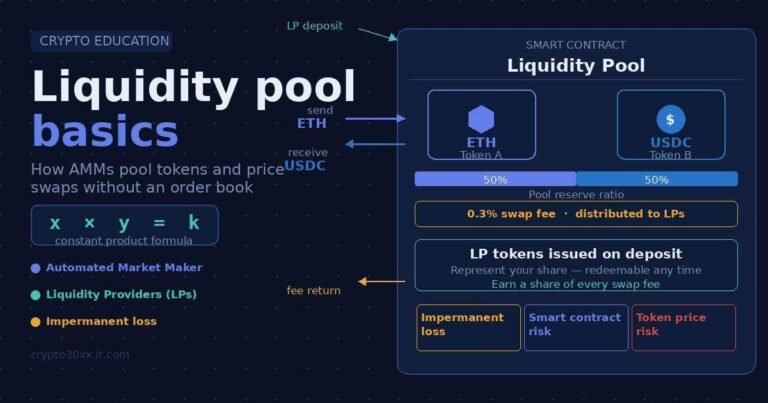
Most DEXs use an automated market maker (AMM) model rather than an order book. AMMs price assets using a mathematical formula applied to pooled token reserves maintained by liquidity providers. The constant product formula (x × y = k) is the most widely used: x and y are the token quantities in the pool, k is a fixed constant, and any trade shifts the ratio, automatically repricing the asset in response.
How the mechanics differ between a CEX and a DEX
The core mechanical difference is where trades are priced and settled. A CEX matches buyers and sellers through an order book and confirms trades on private servers in milliseconds. A DEX prices trades algorithmically against pooled reserves and settles every transaction on-chain within one blockchain block, which takes several seconds to minutes depending on the network and its congestion level.
Order books vs automated market makers
On a CEX, price discovery is continuous and competitive. Traders place limit orders at specified prices; market orders fill immediately against the best available counterpart. Tight bid-ask spreads on liquid pairs allow most trades to execute close to the mid-market price.
On a DEX, there is no waiting counterpart. A user swaps tokens directly against a pool. If a pool contains 100 ETH and 200,000 USDC (implying a price of $2,000 per ETH), a buyer of ETH adds USDC and removes ETH, shifting the pool ratio and pushing the implied price slightly higher. For small trades relative to pool size, the price impact is negligible. For larger trades, the effect, called slippage, can be material.
CEX slippage on liquid pairs is usually minimal; DEX slippage is predictable and calculable from pool depth before the trade executes.
Custody and wallet control
On a CEX, the exchange holds the private keys to the wallets storing user funds. Users with platform balances have no independent on-chain claim to those assets; they depend on the exchange to honor its obligations at all times. This is the structural condition that gave rise to the phrase “not your keys, not your coins,” which became shorthand in the Bitcoin community for the risk of holding funds on a third-party platform.
On a DEX, the user’s wallet retains its private key throughout every trade. The smart contract interacts with the wallet only during the swap itself, and no custody transfer occurs at any point.
This difference becomes most visible during platform failures. If a CEX becomes insolvent or suffers a hack, funds held in exchange wallets are at risk. If a DEX protocol is attacked, funds sitting in users’ wallets remain untouched; only the smart contracts are vulnerable.
Identity verification and access
Most CEXs require account creation and identity verification before enabling withdrawals or full trading access. This compliance requirement reflects anti-money laundering regulations imposed across most major jurisdictions.
DEXs require no account and no identity documents. A wallet address is the only credential. Any user with a compatible wallet and internet access can interact with a DEX, without geographic restriction or approval process.
The privacy consequence follows directly. CEX activity links to verified identities and is reportable to financial authorities. DEX activity is pseudonymous, connected to wallet addresses rather than personal information, though blockchain analysis can sometimes establish connections between addresses and identities.
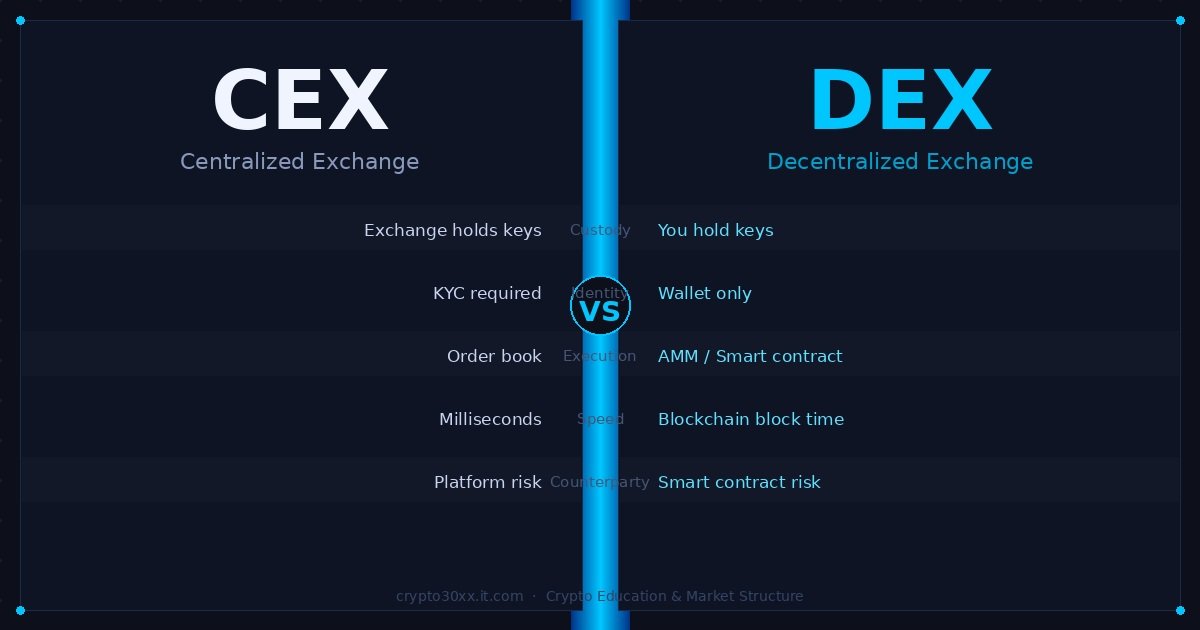
DEX vs CEX: a side-by-side comparison
The eight dimensions below cover the most consequential structural differences between DEX and CEX trading. No single factor determines which type is better; the relevant question is always which trade-offs align with a specific user’s priorities, risk tolerance, and level of technical comfort.
| Dimension | CEX | DEX |
|---|---|---|
| Custody | Exchange holds private keys | User retains private keys |
| Identity requirement | KYC typically required | Wallet address only |
| Trade mechanism | Order book | Automated market maker (typically) |
| Asset availability | Listed tokens only | Any token with a liquidity pool |
| Trade speed | Milliseconds (off-chain) | Blockchain block time |
| Fee structure | Trading fee (maker/taker model) | Swap fee + network gas fee |
| Slippage | Minimal on liquid pairs | Varies with pool depth |
| Counterparty risk | Exchange solvency and security | Smart contract code integrity |
Fees and cost structure
CEX fees follow a maker-taker model. Makers place limit orders that add liquidity to the book and pay lower fees. Takers execute against existing orders and pay higher fees. Trading fees on established CEXs typically range between 0.05% and 0.5% per trade, with reductions available for high-volume users or holders of the platform’s native token.
DEX fees carry two separate components. The swap fee, distributed to liquidity providers, commonly sits between 0.05% and 1% depending on pool tier. The network fee (gas), paid to blockchain validators, is variable and can spike sharply during periods of high activity. On congested networks, gas alone can make small DEX transactions significantly more expensive than an equivalent CEX trade, which makes CEXs more cost-efficient for low-value swaps in high-demand conditions.
Speed and execution
Off-chain CEX execution completes in milliseconds. For traders who require precise timing on entries or exits, this represents a structural advantage that no current on-chain system matches.
On-chain DEX trades confirm when the blockchain produces its next block. Ethereum produces a block roughly every 12 seconds under normal conditions; higher-throughput chains operate in sub-second ranges. During periods of heavy network activity, transactions can queue and wait for multiple blocks, increasing both confirmation time and uncertainty around the final execution price.
Risks, limitations, and common misconceptions
CEXs and DEXs both carry real risks that differ in kind and location. CEX risk concentrates on the platform itself: solvency, security practices, and regulatory exposure. DEX risk distributes across smart contract code integrity and individual user security practices. Recognizing this distinction prevents the common error of treating either model as unconditionally safer than the other.
Risks specific to CEXs
Counterparty risk is the defining vulnerability of any CEX. Users with funds on a platform hold an unsecured claim against it. If the exchange fails through a hack, mismanagement, or insolvency, users can lose access to their funds and may have limited legal recourse beyond bankruptcy proceedings.
Exchange hacks are a separate concern. A large CEX represents a concentrated high-value target: significant assets held across a relatively small number of controlled wallets. A successful breach can result in immediate, irreversible loss across all accounts on the platform.
Withdrawal restrictions introduce a subtler risk. During periods of financial stress, some exchanges have suspended withdrawals, imposed daily limits, or halted transfers entirely, leaving users unable to access funds at precisely the moments when access mattered most.
Risks specific to DEXs
Smart contract risk is the structural vulnerability of any DEX. If the code contains an exploit, an attacker can drain a liquidity pool in a single transaction. Multiple DEX protocols have suffered exactly this outcome, and in most cases no recovery mechanism exists.
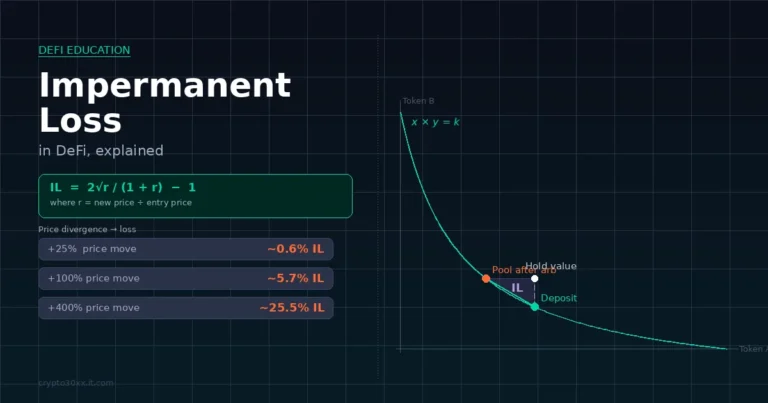
Liquidity providers face impermanent loss. When the price of one token in a pool diverges from its price at the time of deposit, the pool’s automatic rebalancing creates a position worth less than simply holding the tokens in a wallet would have been. The loss becomes permanent if prices do not return to the original deposit ratio.
MEV (Maximal Extractable Value) attacks present a practical concern for AMM users. Bots monitor pending transactions in the network’s public mempool and can insert trades ahead of a user’s swap to extract value through arbitrage. This is commonly called front-running and affects users on congested networks, particularly those making larger trades against shallow pools.
Why “DEXs are always safer” is a misconception
Self-custody removes counterparty risk from an exchange. It does not remove risk from the user’s situation.
A user who loses their seed phrase loses access to all funds permanently, with no recovery path and no entity to appeal to. A user who approves a malicious smart contract can have their wallet drained in one transaction. Fraudulent tokens designed to trap buyers circulate freely on permissionless DEX platforms, with no listing standard to filter them.
The architecture shifts the risk profile rather than reducing aggregate risk. CEXs concentrate custody risk on one entity. DEXs distribute it across individual users’ security practices and the integrity of smart contract code. Each model requires competence in a different set of areas.
Hybrid models and aggregators
A third category of exchange sits between CEXs and DEXs: hybrid platforms and DEX aggregators. Some hybrid platforms match orders off-chain using a traditional order book but settle trades on-chain, preserving user self-custody while delivering faster price discovery. The on-chain settlement step adds gas cost and confirmation latency relative to a pure CEX but removes the custody dependency.
DEX aggregators route trades across multiple liquidity pools simultaneously, finding the combination that delivers the best net output for a given input. They hold no funds and take no custody. Protocols in this category function as a pricing and routing layer built on top of existing DEX infrastructure, rather than as exchanges themselves.
The boundary between CEX and DEX has grown less rigid over time. Hybrid approaches continue to develop, and the architectural categories that defined the original split are evolving as the broader market matures and regulatory clarity develops across different jurisdictions.
FAQs
What is the main DEX vs CEX difference? The core difference is custody. A CEX holds user funds in exchange-controlled wallets and requires account creation and identity verification. A DEX executes trades through smart contracts without ever taking custody of funds. Users retain their private keys throughout and interact with the protocol directly through a connected wallet.
Is a DEX safer than a CEX? Neither is unconditionally safer. CEXs carry counterparty risk tied to the exchange’s solvency and security. DEXs carry smart contract risk and place full responsibility for key management on the user. The relevant question is which risks a specific user is better positioned to manage, given their assets, technical capability, and activity type.
Do DEXs require KYC or identity verification? Most DEXs require no KYC and no account. A wallet address is the only credential needed to trade. This makes DEX access permissionless and global, but it also means there is no support team, no account recovery mechanism, and no dispute resolution pathway if something goes wrong.
Why can DEX fees be higher than CEX fees? DEX transactions involve two separate costs: a swap fee paid to liquidity providers, and a network gas fee paid to blockchain validators. During periods of high network demand, gas fees alone can significantly exceed the cost of a comparable CEX trade, particularly for smaller transaction sizes where the gas cost is disproportionate to the trade value.
Can any token be traded on a DEX? A DEX can support any token that has an active liquidity pool on the same blockchain, including newly launched or low-profile tokens not listed on any CEX. The trade-off is that DEX listings carry no vetting standard, and fraudulent or malicious tokens are common on permissionless platforms.
What is an AMM and why do DEXs use it? An automated market maker (AMM) prices trades using a mathematical formula applied to pooled token reserves, rather than matching individual buyers and sellers through an order book. DEXs use AMMs because a pool is always available to accept the other side of a swap without requiring an active counterpart to be present at the same time.
What happens to funds on a CEX if it becomes insolvent? Users with funds on an insolvent CEX typically become unsecured creditors of the company. Recovery depends on jurisdiction, the exchange’s remaining assets, and whether any insurance or reserve fund exists. Most exchanges do not carry comprehensive insurance coverage of user balances, and recovery processes through bankruptcy can be lengthy and partial.
What is impermanent loss on a DEX? Impermanent loss is the value difference between providing liquidity to a DEX pool versus holding the same tokens in a wallet. When one token’s price shifts relative to the other, the pool’s rebalancing mechanism adjusts the token ratio. This may leave liquidity providers with less total value than direct holding would have yielded. The loss is only impermanent if prices return to the ratio at the time of deposit.
Disclaimer
This article is written for educational and informational purposes only. It does not constitute financial, investment, or legal advice. Cryptocurrency markets carry significant risk, including the total loss of capital. Readers should conduct independent research and consult qualified professionals before making any financial decisions.
The DEX vs CEX difference ultimately comes down to a single structural question: who holds the assets? Centralized exchanges provide speed, familiarity, and regulatory structure in exchange for custody of user funds. Decentralized exchanges provide permissionless access and self-custody in exchange for greater complexity, variable gas costs, and user-side responsibility for security. Understanding both architectures in structural terms (before interacting with either) is the more durable starting point.
From questions to answers in one click—try our quick-answer knowledge posts.