Staking vs yield farming: the complete difference explained
Staking and yield farming are two distinct methods for putting idle crypto assets to work, but they operate through entirely different mechanisms with different risk profiles, reward structures, and levels of complexity. Staking locks tokens into a proof-of-stake blockchain to support network security and transaction validation, earning newly minted tokens or fee revenue in return. Yield farming deposits assets into decentralized finance liquidity pools, earning a share of trading fees and protocol incentives in exchange for providing tradeable liquidity. Understanding the staking vs yield farming difference comes down to one core question: are you securing a network, or supplying a market?
What is staking in crypto?
Staking is the process of locking cryptocurrency into a proof-of-stake (PoS) blockchain protocol to participate in network consensus. A staker commits their tokens as economic collateral, which the protocol uses to select validators — the nodes responsible for proposing and confirming new blocks.
The foundational logic is economic accountability. A validator’s staked tokens are held at risk: honest behavior earns rewards, while dishonest behavior results in automatic penalties. This collateral model is what makes PoS blockchains function without the energy expenditure of proof-of-work mining.
How proof-of-stake consensus works
In a PoS system, the protocol selects validators from a pool of stakers using weighted random selection. A validator with a larger stake has a proportionally higher chance of being chosen to propose or attest to the next block. When selected, the validator:
- Proposes a block of transactions to the network.
- Other validators attest that the proposed block follows consensus rules.
- Once a supermajority of attestations is reached, the block is finalized.
- Rewards are distributed to participating validators and, on many networks, to delegators who staked behind them.
The reward source varies by network design. Some chains distribute newly minted tokens (a form of controlled inflation). Others distribute a portion of transaction fees. Many combine both. The annualized rate a staker receives reflects the total reward pool divided by total staked supply — as more tokens get staked, the rate per token generally declines.
Slashing: the risk specific to staking
Slashing is the penalty mechanism that gives staking its security properties. When a validator acts dishonestly — such as signing two conflicting blocks simultaneously (double signing) or staying offline long enough to impair consensus — the protocol automatically confiscates a portion of their staked balance.
The logic is structural. Without a credible economic penalty, a validator could endorse multiple competing versions of a blockchain at no cost, a flaw known as the “nothing-at-stake” problem. Slashing resolves this by making dishonesty expensive.
On networks where delegated staking is supported, slashing risk can extend to token holders who stake behind a misbehaving validator. The degree to which delegators share this exposure varies by protocol design — some networks protect delegators entirely, others do not.
Lock-up periods and liquidity constraints
Staking typically involves a lock-up period during which tokens cannot be transferred or sold. On Ethereum, for example, the unstaking exit queue can take anywhere from days to weeks depending on the volume of validators attempting to exit at the same time. Other PoS chains have their own unbonding windows ranging from a few days to several weeks.
This illiquidity is a design feature, not a limitation. Lock-up periods prevent validators from abandoning the network during stress events. From a risk management perspective, a staker must be willing to forgo the ability to sell during the lock-up window, which introduces exposure to price movements in assets they cannot immediately exit.
What is yield farming in DeFi?
Yield farming is the practice of depositing crypto assets into decentralized finance (DeFi) protocols — primarily decentralized exchanges (DEXs) and lending platforms — in order to earn rewards from trading fees, interest, or protocol-issued token incentives. A yield farmer acts as a liquidity provider, not a network validator.
The core function served is market liquidity. Decentralized exchanges require pooled assets to execute trades between users. Without liquidity providers supplying those pools, the exchange cannot function. In exchange for supplying this capital, providers earn a proportional share of the fees generated by trades routed through the pool.
How liquidity pools and AMMs work
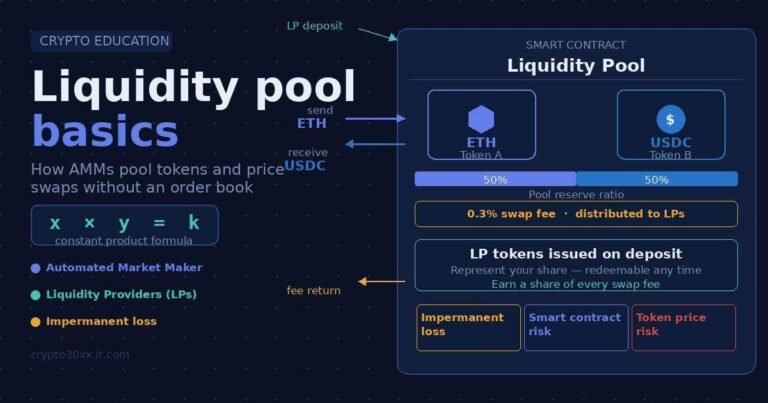
Most DeFi exchanges use an automated market maker (AMM) model instead of an order book. An AMM maintains a pool of two tokens and prices them algorithmically using a constant product formula:
x × y = k
Where x and y are the quantities of the two tokens in the pool, and k is a constant that must remain unchanged after each trade. When a trader swaps one token for the other, they change the ratio of x to y, which shifts the price. The pool rebalances continuously as trades occur.
A liquidity provider deposits tokens into this pool at the prevailing ratio — typically 50% of each token by value. In return, they receive LP (liquidity provider) tokens representing their proportional share of the pool. When they withdraw, they receive back their share of the pool’s current composition plus accumulated fees.
Reward structures in yield farming
Yield farming rewards come from several sources:
- Trading fees: A fixed percentage (often 0.3% on standard AMM pools, but variable across protocols) of each swap is distributed to liquidity providers in proportion to their pool share.
- Protocol token incentives: Many DeFi protocols distribute their own governance tokens to attract and retain liquidity. These incentives can significantly boost effective yields but fluctuate with token prices.
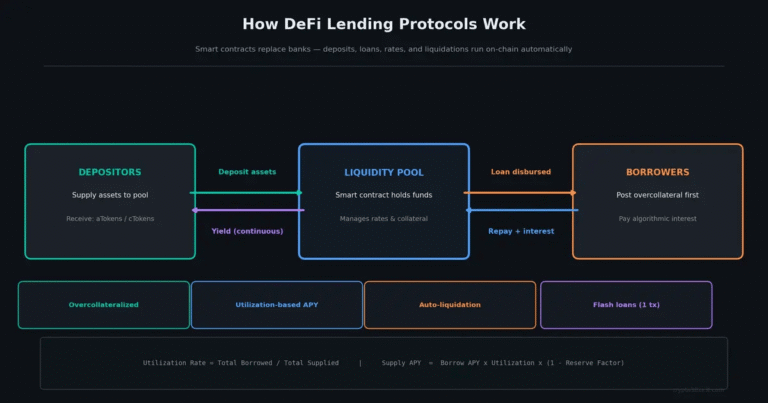
- Lending interest: On DeFi lending platforms, yield farmers supply assets that borrowers pay interest to access. The interest rate adjusts algorithmically based on pool utilization.
Total yield in farming is typically quoted as APY (annual percentage yield) or APR (annual percentage rate), though both figures are highly variable and reflect conditions at a specific moment rather than a guaranteed forward rate.
The staking vs yield farming difference: a direct comparison
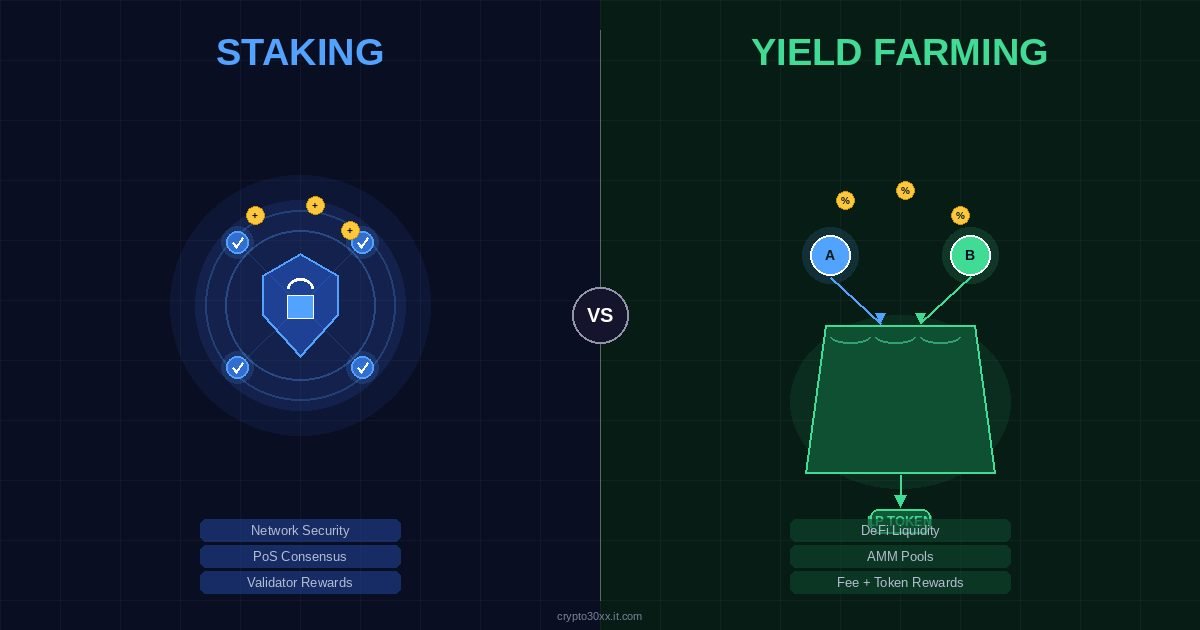
The core staking vs yield farming difference lies in what participants actually provide. Staking provides security to a blockchain network. Yield farming provides liquidity to a financial market.
| Dimension | Staking | Yield Farming |
|---|---|---|
| Primary function | Network security / consensus | Market liquidity provision |
| Protocol type | Proof-of-stake blockchain | DeFi exchange / lending protocol |
| Asset requirement | Single token (the network’s native asset) | Token pair (often two assets at 50/50 value) |
| Reward source | New token issuance + transaction fees | Trading fees + protocol incentives |
| Reward variability | Moderate (tied to staking rate changes) | High (tied to trading volume and token prices) |
| Typical complexity | Lower (select validator, commit stake) | Higher (choose protocol, pair, pool, manage risk) |
| Key risk | Slashing, lock-up illiquidity | Impermanent loss, smart contract exploits |
| Lock-up | Yes — unbonding period required | Generally no — withdrawals often available anytime |
| Skill requirement | Low to moderate | Moderate to high |
Reward potential and why it differs
Staking rewards tend to be more predictable. The protocol distributes a defined reward pool among all stakers, so an individual staker’s return is roughly known in advance — the main variables are the total staked supply (which affects dilution) and any changes the protocol governance makes to the reward rate.
Yield farming rewards can be substantially higher in nominal terms, particularly when a protocol is distributing large governance token incentives to attract liquidity. But those higher figures carry more uncertainty: trading volume determines fee income, token prices determine the real value of incentive rewards, and impermanent loss (covered below) can reduce net returns significantly.
Lock-up differences
This is one of the more practically significant contrasts. Yield farming typically allows liquidity providers to withdraw their assets at any time — the smart contract enforces no lock-up. A yield farmer maintains more control over their capital.
Staking operates differently. Most PoS networks impose an unbonding or “unstaking” period during which the staker’s tokens are inert — not yet free but no longer earning rewards either. The purpose is to prevent rapid validator exit during network stress. For risk management, this means a staker’s exposure to the staked token’s price cannot be closed immediately.
Impermanent loss: yield farming’s defining risk
Impermanent loss is the most important concept for anyone evaluating yield farming. It does not exist in staking. Understanding it is necessary to evaluate whether farming’s higher nominal yields actually produce higher real returns.
How impermanent loss occurs
When a liquidity provider deposits a 50/50 token pair, the AMM continuously rebalances the pool as prices change. If one token appreciates relative to the other, the AMM sells the appreciating token and buys more of the depreciating one — in effect, the pool always rebalances toward the lower-performing asset.
Consider a simple illustration with round numbers:
- A provider deposits $500 of Token A and $500 of Token B into a pool (total: $1,000).
- Token A doubles in price while Token B stays flat.
- The AMM rebalances the pool composition. The provider’s share is now worth roughly $1,414 at withdrawal.
- But if they had simply held the original $500 of Token A and $500 of Token B outside the pool, those same assets would be worth $1,500 (Token A doubled, Token B unchanged).
- The $86 gap — approximately 5.7% — is the impermanent loss.
The loss is called “impermanent” because if Token A’s price returns to its original level, the divergence disappears and no loss is realized. The loss becomes permanent only if the provider withdraws while prices remain diverged.
As the price divergence increases, the impermanent loss scales non-linearly. A 5x price move between the two tokens produces a loss of approximately 25% relative to simply holding. For token pairs with high correlation (for example, two stablecoins, or ETH and a liquid ETH staking token), impermanent loss is much smaller because their prices move together.
When fees offset impermanent loss — and when they don’t
Impermanent loss is not automatically a net loss. Trading fees and protocol incentives can offset it. The critical variable is trading volume relative to price volatility. High-volume, low-volatility pools (such as stablecoin pairs) often generate enough fee income to remain profitable even accounting for impermanent loss. High-volatility pairs with low volume can produce net losses even when quoted yields appear attractive.
This trade-off explains why sophisticated yield farmers analyze not just quoted APY but the underlying fee volume, the token pair’s volatility history, and current protocol incentive levels before committing capital.
Smart contract risk: yield farming’s additional exposure
Yield farming introduces a category of risk that staking does not: smart contract vulnerability.
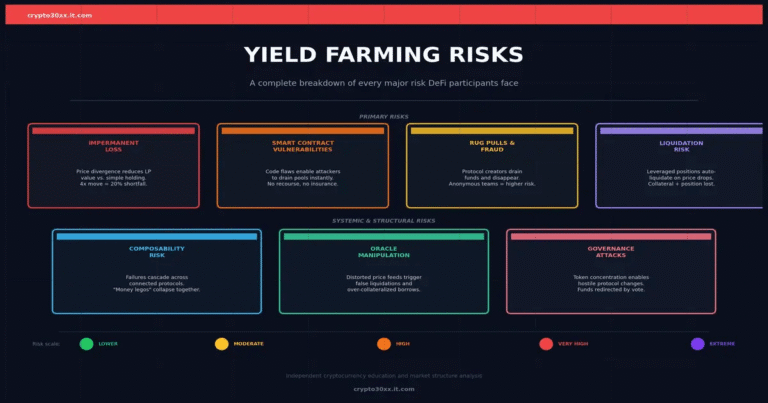
Every DeFi protocol is governed by code deployed on-chain. If that code contains a bug, a logical flaw, or an economic design vulnerability, an attacker may be able to drain the liquidity pool. Losses from such exploits are typically unrecoverable because there is no central authority to reverse transactions on a decentralized network.
Common attack vectors include:
- Re-entrancy attacks: An attacker repeatedly calls a withdrawal function before the contract updates balances.
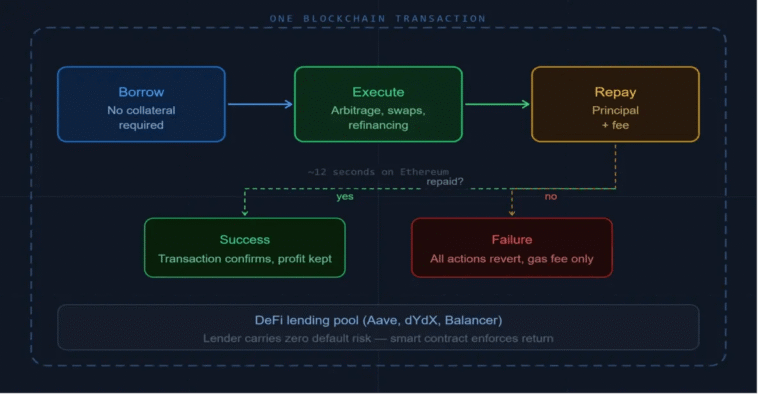
- Flash loan attacks: Large uncollateralized loans taken and repaid in a single transaction are used to manipulate pool prices.
- Rug pulls: Protocol developers (or malicious actors with admin key access) drain the pool and abandon the project.
Staking on established PoS chains is not free of protocol risk — bugs in consensus clients can cause network issues — but the attack surface is generally smaller, and major PoS chains have undergone extensive formal security review.
Risks and considerations for each method
Risks specific to staking
- Slashing: Validator misconduct (including accidental misconfiguration) can result in automatic loss of a portion of staked funds.
- Lock-up illiquidity: Tokens cannot be sold during the unbonding period, creating price exposure that cannot be immediately closed.
- Network risk: If the underlying blockchain suffers a consensus failure, staked assets may be affected.
- Concentration risk for delegated stakers: Staking behind a single large validator creates dependency on that validator’s operational reliability.
Risks specific to yield farming
- Impermanent loss: Price divergence between paired tokens reduces real returns relative to holding.
- Smart contract exploits: Protocol bugs can result in total loss of deposited funds.
- Reward token volatility: When protocol incentives are paid in governance tokens, a drop in the token’s price compresses real yield.
- Gas fees and transaction costs: On high-fee networks, the cost of entering, managing, and exiting positions can erode returns, especially for smaller capital amounts.
- Protocol insolvency or liquidity crises: Sudden withdrawal demand can drain a pool faster than fees replenish it.
Shared misconceptions about staking and yield farming
“Yield farming and staking are both just passive income”
Staking is largely passive after the initial setup. Yield farming is more active. Effective yield farmers monitor reward rates, manage impermanent loss exposure, and migrate capital between protocols as conditions change. Treating it as fully passive can lead to worse outcomes than simply holding.
“Higher APY means higher real returns”
Quoted APY in yield farming reflects the annualized rate at a specific moment. It does not account for impermanent loss, declining incentive token prices, or fee compression when more liquidity enters a high-APY pool (which it typically does, rapidly reducing the rate). Comparing raw APY figures between staking and yield farming without adjusting for these factors is misleading.
“Staking is risk-free”
Staking carries slashing risk, lock-up risk, and network risk. On most major PoS chains, slashing events are rare and the penalties are bounded, but the risk exists. Lock-up periods can expose stakers to significant price moves in the underlying asset during an unbonding window. Neither method is risk-free.
Which protocol types support each method?
Staking operates on PoS blockchains. Examples of chains that use proof-of-stake or delegated proof-of-stake consensus include Ethereum (after its transition in September 2022), Solana, Avalanche, Cardano, Cosmos, and Polkadot, among others. Bitcoin uses proof-of-work and does not support native staking.
Yield farming operates on DeFi protocols typically built on programmable blockchains. The largest concentration of DeFi activity sits on Ethereum and its layer-2 networks, though significant DeFi ecosystems also exist on Solana, BNB Chain, Avalanche, and others. The specific protocol determines the token pairs available, the fee structure, and the incentive design.
Some networks support both activities simultaneously — a user could stake the network’s native token for consensus rewards while also providing liquidity on a DeFi protocol built on the same chain.
FAQs
Is staking the same as yield farming? No. Staking locks tokens into a proof-of-stake blockchain’s consensus mechanism to validate transactions and earn network rewards. Yield farming deposits tokens into DeFi liquidity pools to earn trading fees and protocol incentives. The mechanisms, risks, and reward structures are fundamentally different.
Which is safer: staking or yield farming? Staking is generally considered lower risk for established PoS networks, primarily because the risk surface is narrower — slashing requires active validator misconduct, lock-up periods are predictable, and the protocol is typically well-audited. Yield farming introduces impermanent loss and smart contract vulnerability, which can produce larger and less predictable losses.
Can you lose money staking? Yes. Stakers face slashing risk if the validator they use misbehaves (including through misconfiguration), and lock-up periods expose them to asset price movements they cannot immediately exit. Returns also decline if total staked supply increases significantly.
What causes impermanent loss in yield farming? Impermanent loss occurs when the price ratio between the two tokens in a liquidity pool changes from the ratio at the time of deposit. The AMM rebalances the pool continuously, which means a liquidity provider ends up holding less of the token that appreciated and more of the token that declined. If prices do not revert, the loss relative to simply holding is realized on withdrawal.
Do you need a minimum amount to stake or yield farm? This depends on the specific protocol. On Ethereum, running a direct validator node requires 32 ETH. Most networks offer delegated or pooled staking options with much lower minimums. Yield farming has no universal minimum, though gas fees on some networks make very small positions economically inefficient.
Can staking and yield farming be done on the same blockchain? Yes. A blockchain that supports smart contracts and uses proof-of-stake consensus can host both activities. A user might stake the native asset for consensus rewards while separately providing liquidity to a DeFi protocol built on the same chain.
What is a liquidity provider token (LP token)? An LP token is a receipt issued to a yield farmer when they deposit assets into a liquidity pool. It represents their proportional ownership share of the pool. When the farmer withdraws, they return the LP token to the protocol and receive back their share of the pool’s current assets plus any accumulated fees.
Is yield farming the same as liquidity mining? The terms are often used interchangeably, but they have a technical distinction. Yield farming refers broadly to earning returns by supplying liquidity to DeFi protocols. Liquidity mining specifically refers to earning a protocol’s native governance tokens as an additional reward on top of fee income. Liquidity mining is a subset of yield farming strategies.
Disclaimer
This article is written for educational and informational purposes only by crypto30xx.it.com, an independent cryptocurrency education and research blog. It does not constitute financial advice, investment advice, or any recommendation to buy, sell, or hold any digital asset. Cryptocurrency markets carry significant risk, including the potential for total loss of capital. Readers should conduct their own research and consult a qualified financial professional before making any financial decisions.
The staking vs yield farming difference ultimately comes down to function and risk architecture. Staking is participation in network consensus — a relatively bounded, moderately passive activity with predictable reward mechanics and a limited but real set of risks. Yield farming is participation in market liquidity — a more dynamic activity with higher nominal yield potential but meaningfully more complex risk, including impermanent loss and smart contract exposure. Neither method is categorically superior. Each suits a different capital strategy, technical comfort level, and approach to risk.
Stay sharp, stay hungry—our intellectually stimulating blog articles keep you both.