Small cap altcoin risks explained: a complete guide
Small cap altcoin risks explained: Small cap altcoin risks are the specific structural and market vulnerabilities that affect cryptocurrencies with low total market capitalization , typically those below $300 million to $1 billion, though definitions vary by source. These assets behave differently from large-cap tokens not just in degree but in kind: the mechanisms driving their price, the participants trading them, and the events that can erase their value are structurally distinct from what affects Bitcoin or Ethereum. This guide examines each risk category with enough mechanical detail to understand what actually happens when things go wrong: covering liquidity gaps, token supply events, fraud structures, information deficits, and how these assets perform when broad market conditions deteriorate. It is written for learners and researchers who want to evaluate this category accurately, not for anyone seeking trading guidance.
What counts as a small cap altcoin?
A small cap altcoin is any cryptocurrency, other than Bitcoin and Ethereum, with a total market capitalization below a commonly cited threshold. Most frameworks place that threshold between $50 million and $300 million, though some extend the upper bound toward $1 billion. Market capitalization equals the token’s price multiplied by its circulating supply.
Market cap tiers in crypto
The crypto market is generally divided into three capitalization tiers:
- Large cap: Typically above $10 billion. Includes Bitcoin, Ethereum, and a small number of established tokens with deep liquidity, institutional coverage, and years of on-chain history.
- Mid cap: Roughly $1 billion to $10 billion. Larger altcoin ecosystems with moderate liquidity and more developed track records than the tier below.
- Small cap: Generally below $300 million to $1 billion, with assets below $50 million sometimes labeled “micro cap” in research frameworks.
These boundaries are not standardized. Different data platforms, research firms, and educational resources draw the lines differently. The exact threshold matters less than the behavioral consequence: smaller market capitalizations translate directly into lower trading volumes, thinner order books, and fewer participants holding the asset at any given time.
Why the threshold matters for risk
Market cap functions as a rough proxy for how much capital it takes to move a price. A token with a $10 million market cap can see its price shift 10% from a single $1 million trade. A token with a $10 billion market cap absorbs that same trade with minimal visible impact. This sensitivity to individual transactions is the root mechanism behind nearly every small cap altcoin risk category that follows.
Why small cap altcoins carry amplified risk
Small cap altcoins carry amplified risk because their market structure (shallow order books, low daily trading volume, and concentrated token ownership) makes price formation fragile and reversals rapid. The mechanisms that dampen volatility in large-cap assets, from institutional market makers to deep arbitrage pools to ETF mechanics, either operate at far smaller scale in low-capitalization tokens or are absent entirely.
Low liquidity and price slippage
Liquidity describes how easily an asset can be bought or sold without materially changing its price. In small cap tokens, liquidity is structurally thin. Order books may hold only a few thousand dollars on each side, meaning that a market order of $10,000 to $50,000 can move the price several percentage points in a single execution.
This produces slippage: the gap between the displayed price and the price actually received. On decentralized exchanges using automated market maker (AMM) protocols, slippage is mathematically tied to pool size. In a liquidity pool with $500,000 in total value locked, a $50,000 trade can generate slippage above 5%. Larger orders in thinner pools can push slippage above 20%.
The problem compounds under adverse conditions. When prices are falling and selling pressure is elevated, slippage and price impact move in the same direction. The assets that are hardest to exit quickly are also the most painful to exit under stress, a structural disadvantage that plays out precisely when it matters most.
Volatility without structural support
In large-cap markets, multiple actors absorb volatility: institutional market makers quote continuous two-sided prices, arbitrage desks correct pricing inefficiencies across exchanges, and derivatives markets allow hedging against spot exposure. None of these stabilizing mechanisms operates with the same depth in small cap tokens.
Single-wallet transactions, social media mentions, or minor exchange listings can shift small cap prices by 30%, 50%, or more within hours. The same absence of depth that enables sharp upward moves creates equivalent, or larger, downward ones. Price recovery after a sharp drop depends on renewed speculative interest arriving faster than selling pressure continues. That renewed demand is not structurally guaranteed.
Concentrated ownership and thin volume
Small cap tokens frequently have a high percentage of supply held by a small number of wallets, often the founding team, early investors, or one or two major market participants. When a single wallet holds 10% or more of the circulating supply, its selling decision can constitute a meaningful fraction of typical daily volume.
Thin daily volume also means that reported prices may not reflect genuine market-clearing rates. A token trading $50,000 per day can display a stable price on charts, then gap sharply when volume spikes, in either direction. On-chain analytics tools allow researchers to inspect wallet concentration before evaluating any specific asset.
Structural risks unique to small caps
Structural risks in small cap altcoins are embedded in how projects are created, funded, and distributed. These are not market risks that can be managed by watching price action; they are project-level vulnerabilities that can drive a token to near-zero value regardless of whether the broader crypto market is rising, because the failure mechanism is internal to the project itself.
Rug pulls and exit scams
A rug pull occurs when a project’s founders attract outside capital through a token launch, presale, or liquidity pool, then withdraw that capital and abandon the project. On decentralized exchanges, the mechanism is direct: create a liquidity pool, attract buyers, then drain the pool’s liquidity in a single programmatic transaction, leaving token holders with an asset they cannot sell because there is no longer a counterparty on the other side.
Rug pulls concentrate in small caps for structural reasons:
- Lower market capitalizations attract less scrutiny from journalists, research firms, and regulatory bodies
- Token contract code can include hidden withdrawal functions that only an independent audit would reveal
- Anonymous founding teams carry no professional accountability in most jurisdictions
- The entire operation, from token launch to liquidity drain, can execute in under 24 hours
The distinguishing characteristic of a rug pull is speed. Unlike a gradual project failure, value destruction is often total before most holders can exit.
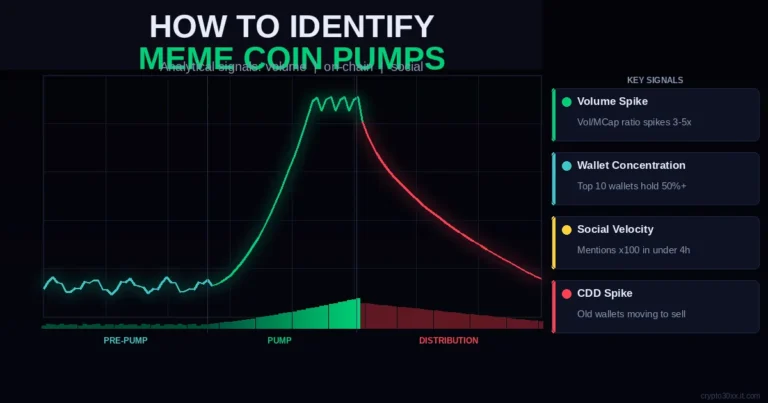
Pump and dump schemes
A pump and dump involves coordinated buying to drive a token’s price upward, followed by selling into the resulting demand. The thin volume and shallow order books of small cap tokens make this relatively inexpensive to execute. A coordinated group spending $100,000 to $500,000 into a low-volume token can generate price action that attracts momentum-driven retail participants, who then provide the exit liquidity the coordinating group needs.
In many jurisdictions, crypto assets fall outside the securities regulations that govern this behavior in traditional markets. The practical result: small cap participants carry exposure to price action driven by coordination that would face legal consequences in equity or commodity markets.
Token unlock schedules and vesting cliffs
Most altcoin projects retain a significant portion of total token supply for the founding team, early investors, and ecosystem development funds. These allocations are subject to vesting schedules; tokens unlock in stages over months or years. When a vesting cliff arrives, a large quantity of tokens becomes available for sale simultaneously.
A concrete illustration: if a token has a $50 million market cap and a vesting event releases $15 million worth of tokens held by early backers who entered at a fraction of the current price, those holders have a direct financial incentive to sell. That sell pressure enters the market on a fixed calendar date, regardless of project operational status or broader market sentiment.
Token unlock schedules are typically disclosed in project documentation and tracked by third-party analytics tools. Failing to account for them before evaluating a small cap position is one of the more avoidable structural risks in this category.
Smart contract vulnerabilities
Most small cap altcoins operate through smart contracts: self-executing code deployed on a blockchain. If that code contains an exploitable flaw, an attacker can drain the protocol’s funds in a single transaction. This risk is not exclusive to small caps, but it is amplified by two structural factors: smaller projects are less likely to have commissioned independent security audits from recognized firms, and they attract fewer white-hat security researchers who might surface vulnerabilities before malicious actors do.
Documented attack categories include re-entrancy exploits, integer overflow errors, flawed access control logic, and oracle price manipulation. Funds lost through a smart contract exploit are typically unrecoverable. No insurance mechanism, regulatory body, or technical process reverses a confirmed blockchain transaction.
Information and transparency risks
Information gaps are a defining feature of small cap altcoin markets, not an exception. The majority of small cap projects receive minimal or no coverage from credible research firms, financial analysts, or on-chain analytics services; evaluating these assets typically requires working with partial, unverified, or simply absent data. This condition creates systematic advantages for insiders relative to outside researchers.
Anonymous teams and absent audits
Large-cap projects generally have named founding teams with professional histories, published smart contract audits from recognized security firms, and active governance processes. Many small cap projects have none of these. Anonymous founding teams remove the accountability layer that constrains exit scam behavior. Absent audits leave contract code unexamined. Short operating histories provide no track record for evaluating how teams behave under market stress.
Pseudonymity is a legitimate design choice in certain protocol architectures. From a risk-assessment standpoint, however, anonymous teams in low-liquidity projects with no audit history represent a combination of factors that has historically preceded a disproportionate share of fraud events in the space.
Limited coverage and data gaps
On-chain analytics platforms provide less granular data for illiquid tokens. Trading history may be thin, interpolated, or influenced by wash trading. Developer activity metrics (commit frequency, active contributors, code review volume) can be gamed or absent entirely. Social media followings can be purchased. Governance participation may be centralized in practice regardless of what project documentation states.
This information environment favors participants with direct insider access, early-entry cost basis advantages, or active influence over supply-demand dynamics. Researchers working from publicly available data face a structural disadvantage relative to each of these groups, and that disadvantage has no straightforward workaround.
Risk comparison by market cap tier
Risk levels differ structurally across crypto market cap tiers. Small cap assets face a distinct combination of liquidity, transparency, and manipulation vulnerabilities that mid-cap and large-cap assets generally do not face at the same intensity. The table below maps the most common small cap altcoin risk factors across all three tiers as structural tendencies. Individual assets deviate from these patterns, but the distribution holds at a population level.
| Risk Factor | Large Cap | Mid Cap | Small Cap |
|---|---|---|---|
| Price slippage on moderate trade | Very low | Low to moderate | High to very high |
| Susceptibility to price manipulation | Low | Moderate | High |
| Rug pull / exit scam probability | Very low | Low | High |
| Smart contract audit coverage | Common | Variable | Rare |
| Founding team transparency | Usually public | Variable | Often anonymous |
| Regulatory and compliance scrutiny | High | Moderate | Low to minimal |
| Historical survival rate across cycles | High | Moderate | Low |
| Exchange delisting probability | Very low | Low to moderate | High |
No category label predicts outcomes for individual assets. The table reflects structural tendencies across asset populations, not guarantees about any specific project.
How small caps perform during market downturns
Small cap altcoins tend to fall faster and further than large caps during market downturns, and they recover more slowly — if they recover at all. The combination of thin liquidity, concentrated ownership, and absent institutional support creates a structural disadvantage that becomes most visible when broad selling pressure enters the crypto market.
Beta amplification in bear markets
Beta measures how much an asset moves relative to a reference index. In crypto, that reference is typically Bitcoin. Small cap altcoins historically exhibit beta values substantially above 1.0: a 10% Bitcoin decline often corresponds to declines of 20%, 30%, or greater in small caps. The mechanism is direct: when market sentiment deteriorates, participants exit the highest-risk positions first, and shallow order books amplify the price impact of that selling through the slippage effect described earlier in this guide.
In extended downturns, the pattern compounds. Small caps that survive a bear market may hold only a fraction of their previous peak valuations for prolonged periods, because the speculative momentum that originally drove prices upward does not return on the same timeline.
Delisting risk and project abandonment
Exchanges periodically review listed assets and remove those that fail minimum volume thresholds, regulatory compliance requirements, or project activity criteria. Small cap altcoins face delisting far more frequently than large caps. A delisting announcement typically triggers an immediate price decline as holders exit before trading access narrows or ends entirely.
Beyond delistings, entire projects shut down. Developers stop committing code, official channels go quiet, and communities dissolve. Historical analysis across prior market cycles shows that a substantial proportion of small cap altcoins present near a market peak are no longer actively traded by the following peak. This creates survivorship bias in any contemporaneous survey of the market: what is visible at any given moment is not representative of the full population of projects that launched during the prior cycle.
FAQs
The questions below address the most common points of confusion about small cap altcoin risks, drawing on the structural and market mechanics covered throughout this guide. Understanding these distinctions provides a more precise foundation for evaluating the smallest segment of the crypto market.
What is considered a small cap altcoin? A small cap altcoin is generally any cryptocurrency (excluding Bitcoin and Ethereum) with a total market capitalization below approximately $300 million to $1 billion, depending on the framework used. Assets below $50 million are sometimes labeled micro cap. Market cap is calculated as price multiplied by circulating supply, and the threshold varies by data source.
Are small cap altcoins always riskier than large caps? As a category, yes: they carry structurally higher risk because of thin liquidity, concentrated ownership, limited auditing, and lower regulatory scrutiny. Individual exceptions exist: some small cap projects have rigorous audits and fully transparent teams. The category label is a starting point for risk evaluation, not a conclusion about any specific asset. Each project requires independent assessment.
What is a rug pull and why does it concentrate in small caps? A rug pull occurs when project founders drain liquidity or dump token allocations after attracting outside capital, leaving other holders unable to sell at any meaningful price. It concentrates in small caps because lower market capitalizations receive less scrutiny, anonymous teams face minimal accountability, and the mechanics, especially on decentralized exchanges, allow the entire event to execute in minutes.
How do token unlock schedules create sell pressure? When vesting periods end, team members and early investors gain access to previously locked tokens. If those allocations are large relative to daily trading volume, and if early holders have a cost basis well below current prices, the unlock creates a window of predictable selling pressure. This pressure arrives on a fixed calendar date regardless of whether the project is performing well operationally or whether broader market conditions are favorable.
What does slippage mean in small cap token trading? Slippage is the gap between the expected price of a trade and the price that actually executes. In tokens with shallow order books or thin liquidity pools, even moderate-sized orders shift the price during execution, resulting in an average fill price worse than the displayed quote. On automated market maker protocols, slippage is a direct mathematical function of trade size relative to total pool liquidity.
Is smart contract risk greater for small cap altcoins? Generally, yes. Smaller projects are less likely to have undergone independent security audits from recognized firms, and they attract fewer external security researchers who might surface vulnerabilities before attackers do. Contract vulnerabilities (including re-entrancy bugs, access control flaws, and oracle manipulation weaknesses) have caused total loss of funds across numerous small and micro cap DeFi protocols. Losses through contract exploits are typically unrecoverable.
Can small cap altcoins survive a full market cycle? Some do. Historical patterns across prior market cycles indicate that a substantial proportion of small cap altcoins present near a market peak are no longer actively traded by the following cycle. Survival correlates with genuine utility, developer continuity, maintained exchange listings, and active community governance. The survival rate for small caps across bear cycles is substantially lower than for large caps at a population level.
Disclaimer
This article is published by crypto30xx.it.com as an independent educational resource for learners, analysts, and researchers. Nothing in this guide constitutes financial advice, investment advice, or a recommendation to buy, sell, or hold any digital asset. Cryptocurrency markets involve substantial risk, including the risk of total loss of capital. Readers should conduct independent research and consult a qualified financial professional before making any financial decisions.
Small cap altcoin risks are not a single problem but a cluster of overlapping structural conditions that reinforce each other. Thin liquidity makes prices fragile. Fragile prices attract manipulation. Anonymous teams reduce accountability. Missing audits leave vulnerabilities hidden. Concentrated ownership means that one large holder’s selling decision can move the entire market. And shallow depth means that exits are painful precisely when they are most urgent. Understanding each mechanism individually, and how they interact under pressure, is the analytical baseline for evaluating this segment of the crypto market with accuracy.
Turn scrolling into something meaningful with our purpose-driven content picks.