Yield farming risks explained: complete guide for learners
Yield farming risks explained: Yield farming risks are the financial, technical, and structural dangers that arise when participants deposit digital assets into decentralized finance (DeFi) protocols to earn rewards. While yield farming can generate returns through trading fees, governance tokens, and protocol incentives, it exposes participants to a category of risk that differs fundamentally from holding assets in a centralized account. Understanding these risks is the first step any informed participant must take before committing funds to any farming strategy, and this guide explains each one clearly, without hype or oversimplification.
What is yield farming and how does it generate returns?
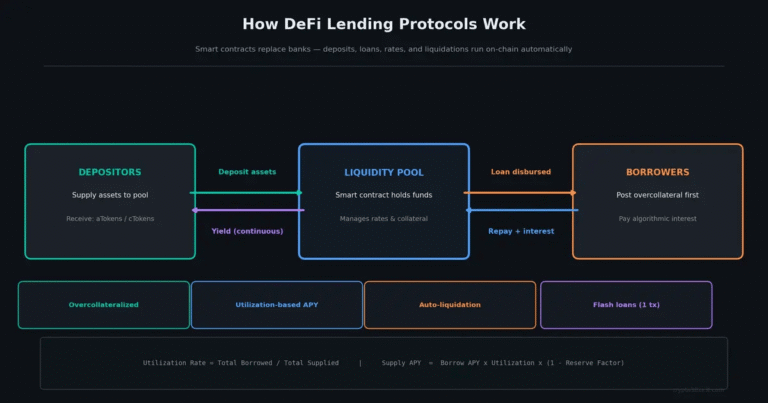
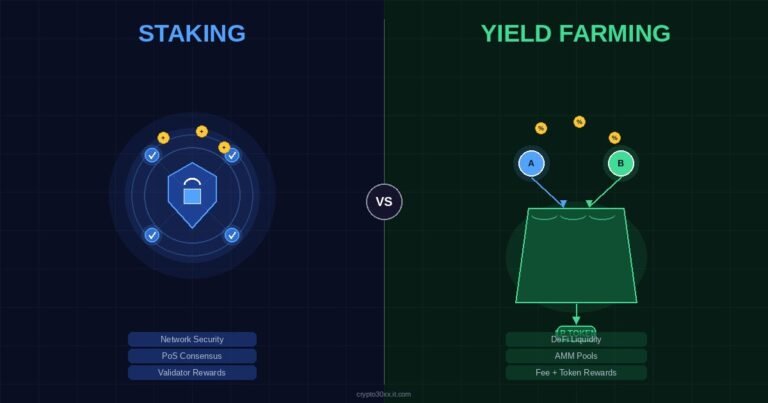
Yield farming is a DeFi strategy in which participants supply liquidity or assets to a protocol and receive rewards in return. Those rewards can come from trading fees, newly issued governance tokens, or interest paid by borrowers. The term “farming” reflects the practice of moving funds between protocols to pursue higher reward rates.
How liquidity pools work
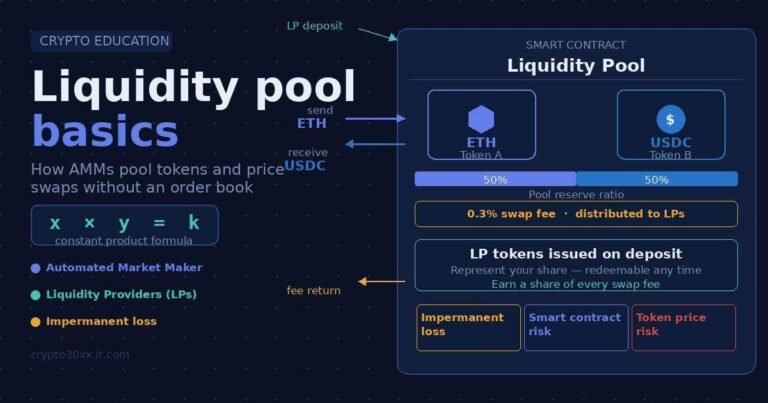
A liquidity pool is a smart contract holding two or more tokens in a defined ratio. When traders swap one token for another on a decentralized exchange (DEX), they interact with that pool rather than a counterparty. Liquidity providers (LPs) deposit tokens into the pool and receive a proportional share of the trading fees generated with each swap.
The most common structure pairs two assets at a 50/50 value ratio — for example, ETH and USDC. An automated market maker (AMM) algorithm maintains the pool balance mechanically, adjusting prices as the token ratio shifts.
Where the yield actually comes from
Yield in farming protocols comes from three main sources: trading fees paid by swappers, interest paid by borrowers in lending protocols, and token emissions distributed to LPs as an incentive to provide liquidity. The third source is critical to understand, because it layers token price volatility and potential value decay on top of all other risks. High headline APYs almost always reflect heavy token emission rewards, and those rewards are worth only as much as sustained demand for the emitted token can support.
What are the primary risks of yield farming?
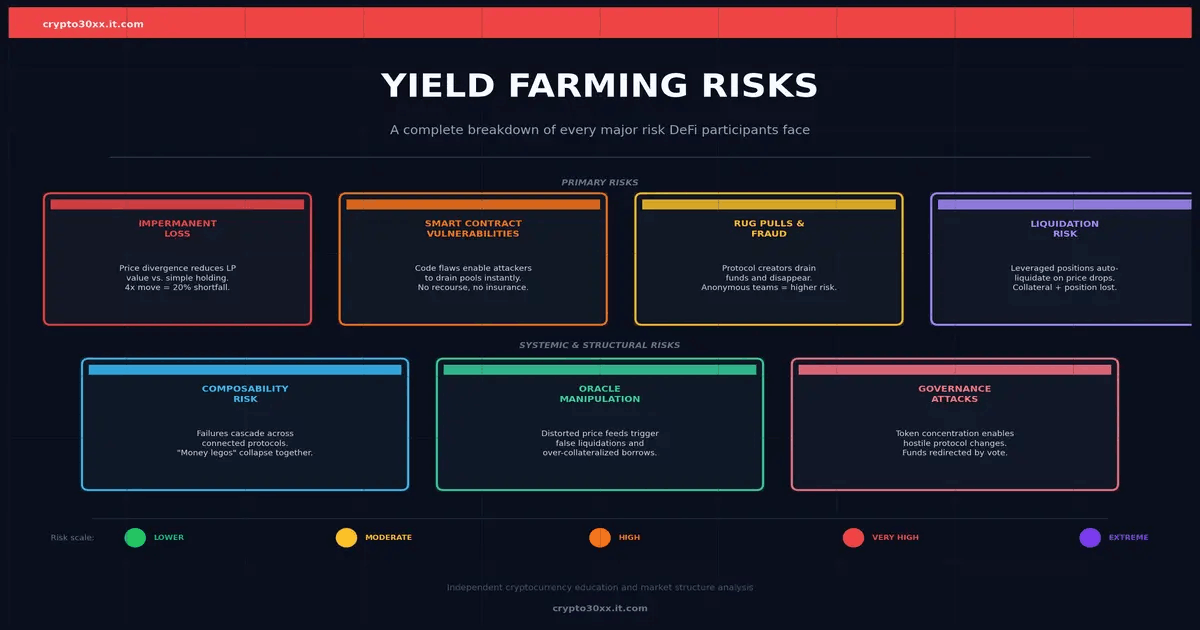
Yield farming risks span technical, financial, and behavioral categories. For any participant considering a farming strategy, these are the exposures that will appear first and carry the most direct impact on their position, regardless of which protocol, chain, or asset pair they choose.
Impermanent loss: the risk most participants underestimate
Impermanent loss (IL) is the difference between the value an LP holds inside a pool and the value they would hold by keeping both tokens in a wallet. It emerges because an AMM constantly rebalances the pool ratio as prices shift, leaving an LP holding more of the depreciating asset and less of the appreciating one compared to a straight hold position.
The math is precise. An LP deposits 1 ETH (priced at $1,000) and 1,000 USDC into an ETH/USDC pool, a $2,000 position split 50/50 by value. If ETH rises to $4,000, arbitrageurs rebalance the pool until it holds 0.5 ETH and 2,000 USDC, a total pool value of $4,000. A holder of the same original assets — 1 ETH and 1,000 USDC — now holds $5,000. The LP has lost $1,000 relative to holding, a 20% shortfall.
The label “impermanent” applies because prices could return to their original ratio, closing the gap entirely. In practice, many token pairs do not return, especially after large, directional price moves.
| Price change of volatile asset | Impermanent loss vs. holding |
|---|---|
| 25% increase | ~0.6% |
| 50% increase | ~2.0% |
| 100% increase (2×) | ~5.7% |
| 300% increase (4×) | ~20.0% |
| 400% increase (5×) | ~25.5% |
| 900% increase (10×) | ~42.5% |
Trading fees can offset impermanent loss when volume is consistently high relative to price divergence. That offset is difficult to calculate in advance and is not guaranteed by any protocol.
Smart contract vulnerabilities
Every yield farming position is held inside a smart contract — code deployed on a blockchain that executes automatically, without human intermediaries. If that code contains a flaw, an attacker can drain the pool entirely. Unlike a bank deposit, no insurance covers these losses, no authority can reverse the transaction, and no appeals process exists.
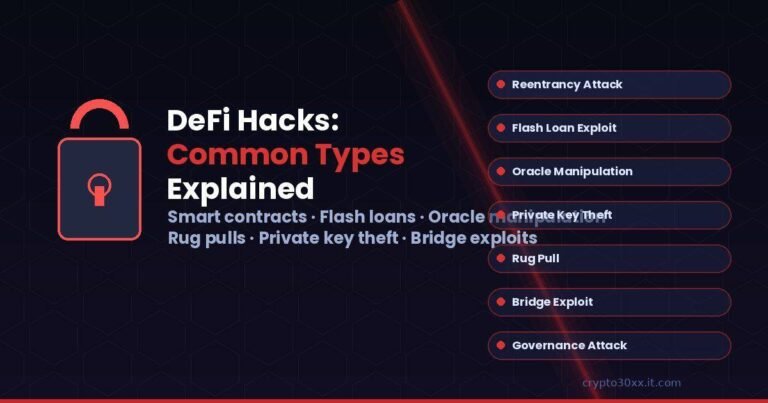
Smart contract exploits in DeFi have produced cumulative losses in the billions of dollars, with individual incidents draining hundreds of millions from single protocols. Common attack vectors include reentrancy attacks, flash loan manipulations that distort internal accounting, and logic errors in reward calculation functions. Protocols that have not undergone independent security audits, or whose audits predated significant code changes, carry measurably higher exposure.
Even audited protocols are not immune. An audit reflects the code at a point in time. Protocol upgrades, new integrations, and changes in connected infrastructure introduced after the audit create fresh risk surfaces that the original review never examined.
Rug pulls and protocol fraud
A rug pull is an intentional fraud in which protocol creators drain the liquidity they control and disappear, leaving participants with worthless tokens. This attack type is concentrated in newly launched protocols offering unusually high APYs designed to attract rapid capital inflows before the exit.
Common warning patterns include: anonymous founding teams with no verifiable history, contracts that have not been audited by a recognized firm, token distribution structures that concentrate large allocations in developer wallets, and reward rates with no identifiable fee revenue model behind them. No single indicator confirms intent, but their combination should be treated as a serious signal.
“Soft rugs” — where developers gradually extract value through inflated protocol fees, minting privileges, or hidden admin key functions — can destroy participant positions without triggering any obvious event.
Liquidation risk in leveraged yield strategies
Some yield farming approaches involve borrowing assets against collateral to amplify position size. When the value of that collateral falls below a protocol-defined liquidation threshold, the protocol automatically liquidates the position to repay the outstanding loan. A participant can lose their collateral and their farmed position in a single price movement.
Volatile market conditions compress the available response time. Network congestion can spike gas fees precisely when a participant most needs to add collateral or reduce exposure, turning a manageable drawdown into an unavoidable liquidation.
What are the less visible but equally serious yield farming risks?
Beyond the most discussed dangers, several structural risks in yield farming can cause substantial damage with far less advance warning. These risks operate at the system level rather than the protocol level, which makes them harder to evaluate and easier to overlook when assessing any single farming opportunity.
Composability and systemic risk
DeFi protocols are built to connect — a position in one protocol can serve as collateral in another, which can feed liquidity into a third. This interconnection, often called the “money legos” property, creates composability risk: a failure in any one layer can cascade through every connected layer. A participant farming through a protocol that depends on three upstream components accepts the collapse risk of all three, not just the one they directly interact with.
When a large protocol fails, liquidity typically exits connected protocols simultaneously. That simultaneous exit triggers additional liquidation events, de-pegging in related tokens, and further price collapses in assets used as collateral throughout the chain.
Oracle manipulation
Many DeFi protocols rely on price oracles — external data feeds — to assess the value of assets held as collateral or inside pools. If an attacker briefly distorts the oracle price (often using a flash loan to move a thinly traded market), the protocol responds as if that distorted price is real. This can trigger false liquidations, allow the attacker to borrow beyond the genuine value of their collateral, or manipulate pool accounting in their favor.
Protocols using decentralized, time-weighted average prices (TWAPs) from multiple independent sources carry measurably lower oracle risk than those depending on a single spot price from a single source.
Governance attacks
Governance tokens — the reward many farming protocols distribute — grant holders voting rights over protocol parameters. If one actor or a coordinated group accumulates enough governance tokens, they can pass proposals that redirect protocol funds, alter fee structures, change collateral requirements, or dilute other participants’ positions.
This attack type is most likely in protocols with heavily concentrated token distributions or chronically low governance participation, where a small number of large holders can determine outcomes for the entire protocol.
How do yield farming risk levels compare across strategies?
Yield farming strategies differ widely in their risk exposure. Understanding where a specific strategy sits on the risk spectrum is a prerequisite for any meaningful position sizing decision, and the categories below reflect the structural differences between the most common approaches.
| Strategy | Core activity | Primary risks | Risk level |
|---|---|---|---|
| Stablecoin LP | Provide liquidity between stablecoins | Smart contract, stablecoin depeg | Lower |
| Volatile asset LP | Provide liquidity between volatile tokens | Impermanent loss, smart contract, fraud | Moderate–High |
| Single-sided lending | Lend one asset to borrowers | Smart contract, oracle, liquidity mismatch | Moderate |
| Leveraged yield farming | Borrow to amplify farming position | Liquidation, smart contract, compounded IL | High |
| New protocol farming | Early entry into a recently launched protocol | Rug pull, audit gaps, token inflation | Very High |
Stablecoin liquidity provision reduces impermanent loss because both assets track the same value. It does not eliminate smart contract risk. And it does not protect against a stablecoin depegging event, a failure mode that has caused severe and permanent losses in pools that included algorithmic or poorly collateralized stablecoins.
How can a participant evaluate and manage yield farming risk?
Yield farming risk cannot be eliminated, but it can be understood, measured, and managed with a consistent approach. The steps below reflect practices used by experienced DeFi participants who assess risk deliberately before committing capital to any protocol — presented here strictly for educational purposes, not as personal financial advice.
- Verify the security audit: Confirm that a reputable, independent security firm audited the specific contract version you are using, not an earlier version. Audit reports should be public, dated, and specific to the deployed code.
- Evaluate team accountability: Pseudonymous teams are not automatically fraudulent. Look for consistent public communication, transparent governance activity, and verifiable on-chain history as signals of legitimate intent over time.
- Trace the source of the yield: Identify what fee or demand mechanism produces the reward. Yields that depend primarily on continued token issuance, with no independent fee revenue behind them, are inherently circular and fragile by design.
- Model impermanent loss before entering: Use publicly available IL calculators to simulate your LP position under several price scenarios. Identify the fee rate required to break even under a realistic range of outcomes before depositing.
- Size positions to the risk level: A position in a new, unaudited protocol should represent a fraction of what you might commit to a protocol with a multi-year operational record and multiple independent audits. Risk sizing deserves as much attention as protocol selection.
- Monitor governance activity: Protocols with on-chain governance allow participants to track proposal submissions. Unusual proposals with short voting windows and large treasury implications can be early signals of governance risk materializing.
What regulatory risks does yield farming carry?
Yield farming operates in a regulatory environment that varies significantly by jurisdiction and continues to evolve. Regulatory agencies across multiple regions have examined whether certain DeFi activities, including liquidity provision, token distribution, and governance participation, fall under existing securities, tax, or money transmission frameworks.
Rewards earned from yield farming are classified as taxable income in most jurisdictions with established crypto tax frameworks. The specific treatment depends on local tax authority classification of the tokens received and the timing of receipt relative to disposal. Participants who later become involved in protocols that face enforcement actions may encounter legal exposure they did not anticipate at the time of deposit.
DeFi protocols do not generate the standardized documentation — trade confirmations, account statements, year-end tax forms — that traditional financial products produce. Participants are responsible for maintaining accurate records of all transactions, rewards received, and their associated values at the time of receipt.
FAQs
Is yield farming profitable after accounting for impermanent loss? Profitability depends on the specific pool, the fee rate generated, and the price behavior of the deposited assets. In high-volume pools with relatively stable price ratios, fee income can outpace impermanent loss. In low-volume pools with large price divergences, impermanent loss typically exceeds fee revenue by a significant margin.
What is the least risky type of yield farming? No yield farming strategy is free of risk. Stablecoin liquidity pools carry lower impermanent loss exposure because both assets track the same value, but they remain exposed to smart contract vulnerabilities, protocol failure, and stablecoin depegging. Established protocols with long audited operational histories present lower — not zero — risk compared to newer deployments.
Can a smart contract audit guarantee that funds are safe? No. An audit reduces the probability of known vulnerability types but cannot guarantee the absence of all flaws. Audits assess code at a specific point in time. Protocol upgrades, new integrations, or changes in connected protocols introduced afterward can create new risk that the original audit did not cover.
How do I identify a potential rug pull before it happens? No set of indicators guarantees detection, but patterns that elevate the probability include: teams with no verifiable history, contracts without a public audit from a recognized firm, short lock periods on developer token allocations, and reward rates with no identifiable fee revenue source. The combination of multiple warning signals warrants serious caution.
What happens to funds if a DeFi protocol is exploited? In most cases, funds lost in a DeFi exploit are not recoverable. Some protocols offer optional coverage through decentralized insurance platforms, but coverage is partial and requires active setup before an event occurs. No equivalent to government-backed deposit insurance exists in DeFi.
Does impermanent loss disappear if prices return to their original ratio? Yes. If the price ratio between two deposited assets returns exactly to its original level, impermanent loss is eliminated. In practice, this return does not occur reliably, particularly after large directional price movements in volatile token pairs over extended farming periods.
Are yield farming rewards taxable? In most jurisdictions with established crypto tax frameworks, yield farming rewards are treated as ordinary income at the time of receipt, and any subsequent sale of reward tokens may trigger a separate capital gains event. Tax treatment varies significantly by country and asset classification. Consulting a qualified tax professional familiar with local crypto regulations is advisable before participating.
Disclaimer
This article is written for educational and informational purposes only and does not constitute financial advice, investment advice, or a recommendation to participate in yield farming or any DeFi protocol. Yield farming involves significant risk of loss, including the potential to lose all deposited funds. Readers should conduct independent research and consult qualified financial, legal, and tax advisors before making any financial decisions.
Yield farming risks are multi-layered, compounding, and frequently more severe than headline APY figures suggest. Impermanent loss erodes LP positions when prices diverge. Smart contract flaws concentrate years of pooled capital into single exploitable vulnerabilities. Rug pulls eliminate positions without warning. Composability and governance risks extend exposure well beyond the boundaries of any single protocol. For participants approaching DeFi as learners and researchers, the most durable insight is this: every return in yield farming represents compensation for bearing risk, and the magnitude of the return usually reflects the magnitude of the risk being borne.
Your potential is waiting to be unlocked—open it with our key insight articles.