How DeFi lending protocols work: the complete guide
DeFi lending protocols are smart contract systems that allow users to borrow and lend crypto assets without a bank, credit check, or intermediary. Understanding how DeFi lending protocols work starts with one structural reality: all deposit and borrow activity flows through shared on-chain pools, governed entirely by code, with no human approval at any stage. This guide covers every layer — how liquidity pools form and distribute yield, how interest rates self-adjust using utilization data, how liquidations are triggered and executed, and what risks these systems carry for both depositors and borrowers. Whether you are studying blockchain finance for the first time or deepening an existing understanding, this article covers the structural logic precisely.
What are DeFi lending protocols?
DeFi lending protocols are blockchain-based platforms that use smart contracts to match lenders and borrowers automatically, without a central authority managing the process. Users deposit assets into shared pools and earn interest; other users borrow from those same pools by locking up collateral. The entire process runs on-chain, with no intermediary approving transactions or holding user funds at any point.
Smart contracts as the foundation
A smart contract is self-executing code stored on a blockchain. In lending protocols, smart contracts replace every function a bank would handle manually: holding deposits, calculating interest, releasing loans, monitoring collateral ratios, and triggering liquidations.
Because the contract logic is embedded in the blockchain, its behavior is auditable before any user interacts with it. Any participant can read the code and verify the rules before depositing a single asset. This on-chain transparency is a defining structural feature of the model — and a sharp departure from traditional financial infrastructure.
The role of liquidity pools
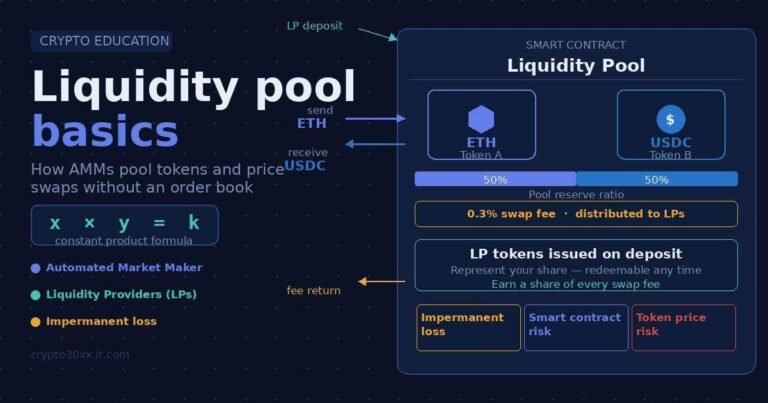
Liquidity pools are the shared reserves that borrowers draw from. When a lender deposits ETH into a protocol, that ETH does not go to a specific counterpart. It joins a collective pool, and the protocol tracks each lender’s share, distributing interest proportionally as borrowers pay it.
This pooled model removes peer-to-peer matching delays. A borrower can draw from the pool the moment a transaction confirms, provided sufficient liquidity exists. No waiting for a matched lender on the other side.
How DeFi lending protocols work: core mechanics
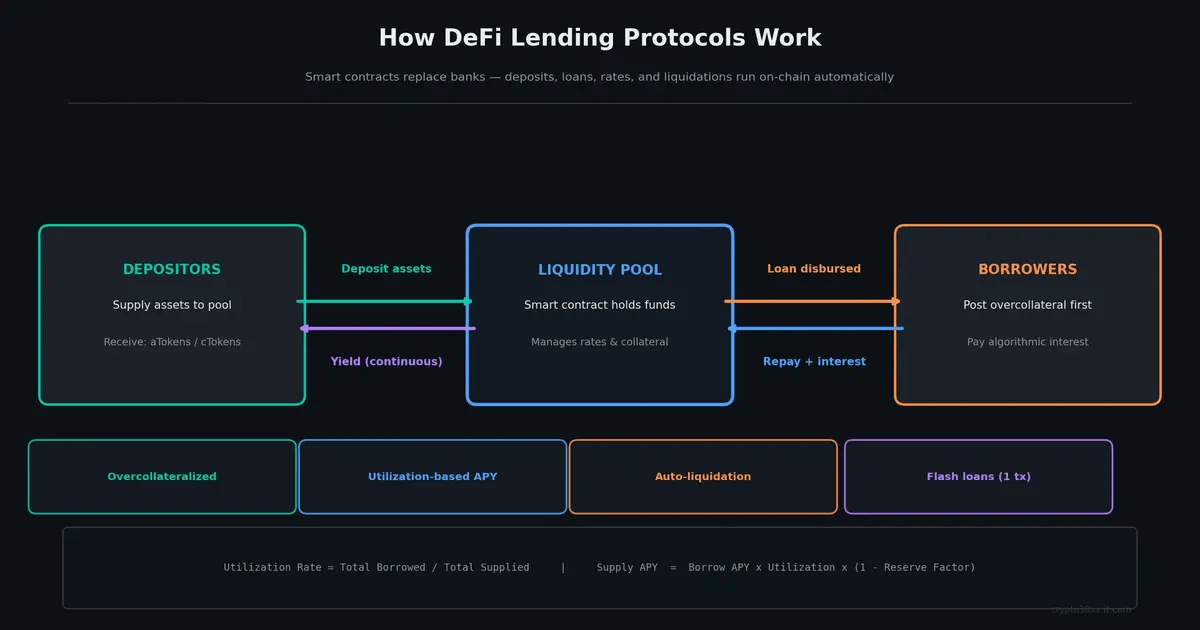
How DeFi lending protocols work follows three sequential actions: a lender deposits assets, a borrower locks collateral and draws a loan, and the smart contract monitors the collateral ratio continuously. Each action executes on-chain with no intermediary approval — the contract enforces the rules automatically for every participant in the system.
Depositing assets and earning yield
When a user deposits crypto assets, they receive an interest-bearing token in return. Protocols such as Aave issue aTokens; Compound issues cTokens. These tokens represent the depositor’s share of the pool and grow in value automatically as interest accrues.
Interest compounds continuously at the protocol level. A depositor’s balance increases in real time as borrowers generate interest on their outstanding loans — no manual claiming or reinvestment required.
Borrowing against collateral
To borrow, a user deposits assets as collateral first. The protocol assigns each accepted asset a loan-to-value (LTV) ratio — the percentage of the collateral’s market value that can be borrowed.
Example: If ETH carries an LTV of 75%, a user who deposits $1,000 of ETH can borrow up to $750 of another asset. Interest accrues on the borrowed amount continuously. A position that opens safely can drift toward liquidation if the collateral’s value falls or if interest compounds unchecked over time.
How overcollateralization protects the system
DeFi lending protocols require overcollateralization: the deposited collateral must always exceed the outstanding loan in value. This differs sharply from most traditional lending, where income and credit history determine how much can be borrowed.
Overcollateralization exists because there is no identity layer or legal mechanism to pursue a non-paying borrower. The collateral is the only enforcement tool. So the protocol requires it to exceed the debt at all times, by design.
How interest rates are set algorithmically
Interest rates in DeFi lending are not set by a committee — they adjust automatically based on supply and demand inside each liquidity pool. The core variable driving the calculation is the utilization rate: the ratio of what has been borrowed to what has been supplied across any given pool at a specific point in time.
The utilization rate model
Utilization rate formula: Total Borrowed ÷ Total Supplied
If a USDC pool holds $10 million in deposits and $7 million is borrowed, the utilization rate is 70%.
Protocols use a tiered rate curve. At low utilization, borrow rates stay modest to attract borrowers. As utilization climbs toward 100%, rates rise sharply — often accelerating beyond a target threshold near 80%, in what protocol designers call a kink model. The kink is a deliberate inflection point, not a linear scale.
How rates self-correct
High utilization signals pool stress. When most of a pool is borrowed, depositors cannot withdraw freely — a structural risk that the rate model is built to resolve.
Sharply rising borrow rates at high utilization push borrowers to repay and attract new deposits, pulling the system back toward equilibrium without any human intervention. The supply rate (what depositors earn) always sits below the borrow rate:
Supply rate formula: Borrow rate × Utilization rate × (1 − Reserve factor)
The reserve factor represents the percentage of interest revenue the protocol retains as a security buffer.
DeFi lending vs traditional lending: key differences
DeFi lending differs from traditional bank lending most sharply in its collateral requirements, approval process, and rate-setting mechanism. Mapping these differences shows why the two systems serve different use cases, rather than one simply replacing the other.
| Feature | Traditional lending | DeFi lending protocol |
|---|---|---|
| Approval process | Credit check, identity, income verification | Collateral only; no identity required |
| Collateral requirement | Often below 100%; unsecured loans common | Always above 100% (overcollateralized) |
| Interest rate setting | Set by lender or central bank policy | Algorithmic, based on utilization rate |
| Settlement speed | Days to weeks | Seconds to minutes |
| Custody of funds | Bank holds funds | Smart contract holds funds |
| Liquidation mechanism | Court order, repossession | Automated, on-chain, incentivized |
| Accessibility | Requires bank account | Requires wallet and collateral |
| Transparency | Internal, opaque processes | Fully auditable on-chain code |
Neither model is categorically superior. Each operates on different assumptions about trust, identity, and enforcement. The comparison is structural — not a recommendation for either approach.
Liquidation: the safety mechanism behind every loan
Liquidation is the automated process by which a borrower’s collateral is sold to repay outstanding debt when the position’s collateral ratio falls below the protocol’s minimum threshold. Without this mechanism, a protocol holding undercollateralized loans would put depositors’ funds at immediate risk.
Understanding the health factor
Protocols express position safety as a health factor (used by Aave) or a collateral ratio (used by Compound and others). When the health factor drops below 1.0, the position becomes eligible for liquidation.
Three inputs determine the health factor: the current market value of the collateral, the protocol’s liquidation threshold for that asset (a percentage set above the initial LTV), and the total outstanding debt including accrued interest.
Worked example: A user deposits $1,000 of ETH. The liquidation threshold is 80%. They borrow $650 of USDC. The health factor starts above 1.0. If ETH’s price falls until the collateral is worth approximately $812 — 80% of which equals exactly $650, matching the outstanding debt — the health factor reaches 1.0 and liquidation becomes possible.
How liquidators work
Liquidation is not executed by the protocol itself. Any external address can call the liquidation function when a position qualifies. In return, the liquidator repays part of the borrower’s debt and receives a portion of the borrower’s collateral at a discount.
That discount — called the liquidation bonus, typically between 5% and 15% depending on the protocol and asset — compensates liquidators for gas costs and execution timing risk. Automated bots monitor positions and compete to liquidate eligible accounts. The system runs without any central operator because competition among liquidators keeps it functioning.
Flash loans and advanced protocol mechanics
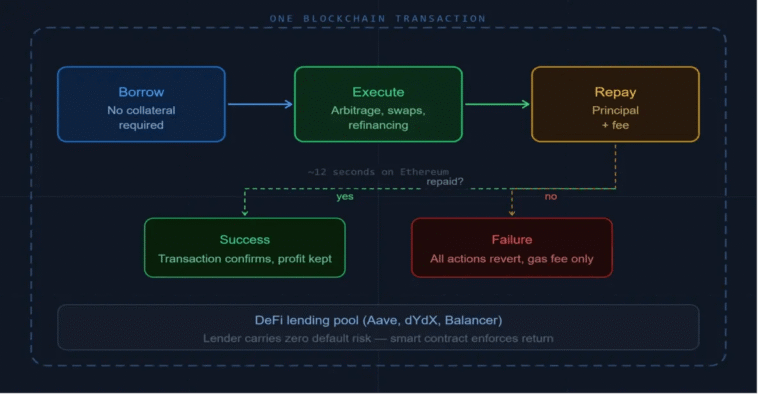
Flash loans are uncollateralized loans that exist entirely within a single blockchain transaction: borrowed, used, and repaid before the transaction closes. They require no collateral because the blockchain’s atomicity guarantees repayment — if the funds are not returned within the same transaction, the entire sequence reverts and no transfer ever settles.
Flash loans have no equivalent in traditional finance. They are used for strategies including arbitrage between decentralized exchanges, collateral swaps without closing a position, and self-liquidation of an account before external bots can do it first. Because the loan exists for milliseconds and leaves no open position, the protocol carries no credit exposure.
They also illustrate something structural about how DeFi lending protocols work at the execution level: rules are enforced by cryptographic finality, not by legal agreements or credit relationships. Enforcement is mathematical, not institutional.
Risks of DeFi lending protocols
DeFi lending protocols carry specific risks that differ meaningfully from traditional credit risk. Some arise from the technology layer: smart contract vulnerabilities and oracle failures. Others emerge from market dynamics, such as sharp price drops that outpace the liquidation system’s capacity to respond in time.
Smart contract risk
The protocol is only as secure as its code. A vulnerability in the smart contract can allow an attacker to drain the liquidity pool. There is no deposit insurance, no authority to freeze withdrawals, and often no legal recourse after the fact.
Even audited contracts can harbor vulnerabilities in edge cases or in interactions with other protocols. DeFi’s composable architecture — where protocols interact with one another in multi-step on-chain actions — means a bug in one system can propagate to others in the same transaction.
Oracle risk
Lending protocols rely on price oracles to assess collateral values in real time. Manipulated or incorrect oracle prices distort health factor calculations, enabling undercollateralized borrowing or triggering incorrect liquidations across the pool.
Oracle attacks have been used to exploit lending pools by temporarily moving the price of a collateral asset. Protocols mitigate this through decentralized oracle networks and time-weighted average price (TWAP) calculations, though the exposure is never fully eliminated.
Liquidation risk
Sudden, sharp market moves can push many positions to liquidation simultaneously. During periods of blockchain congestion, liquidation bots may fail to execute in time, leaving the protocol with undercollateralized debt that cannot be recovered.
When this happens, losses are sometimes socialized across depositors or covered from reserve funds. Depositors are not fully shielded from extreme market events, even in a structurally well-designed protocol.
Governance and regulatory risk
Most major lending protocols are governed by token holders who vote on parameters: supported collateral types, LTV ratios, interest rate curves, and reserve factors. Governance can be influenced by large holders acting in their own interest rather than the protocol’s long-term stability.
On the regulatory side, the classification of DeFi lending activity varies by jurisdiction and remains actively contested. Participants are responsible for understanding the legal context where they operate.
FAQs
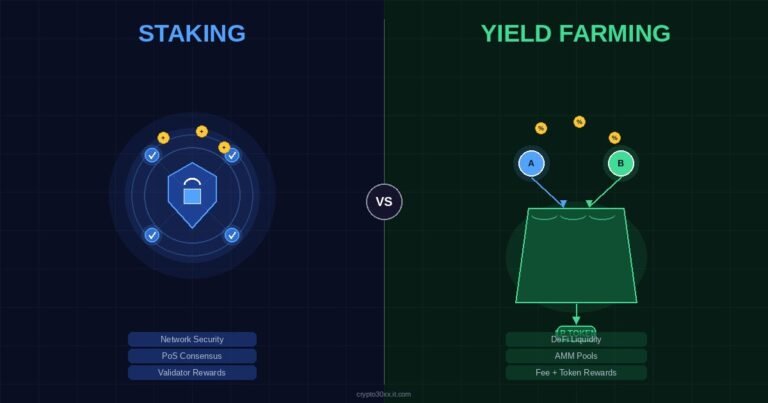
What is the difference between DeFi lending and DeFi staking? Staking involves locking tokens to participate in a blockchain’s consensus mechanism in exchange for network rewards. DeFi lending involves depositing assets into a shared pool and earning interest from borrowers. Both generate yield on crypto assets, but through structurally different mechanisms with different underlying risk profiles.
Do you need to verify your identity to use a DeFi lending protocol? Most DeFi lending protocols are permissionless at the contract level — only a compatible wallet and sufficient collateral are required. No credit check or identity verification is typically needed. Front-end interfaces may restrict access based on location, but the underlying smart contract is generally reachable by any wallet address.
Can depositors lose funds in a DeFi lending protocol? Yes. Deposited funds carry smart contract risk, oracle risk, and in extreme scenarios, exposure to protocol bad debt that may be distributed across the depositor pool. DeFi deposits are not insured and carry a real possibility of partial or total loss.
What assets are accepted as collateral? Each protocol maintains its own list of supported collateral assets, typically including major cryptocurrencies and stablecoins. Assets with higher volatility or lower liquidity either carry reduced LTV ratios or are not supported at all. Protocol governance determines which assets qualify and under what terms.
How is interest paid to depositors? Interest accrues automatically through the rising value of the depositor’s tokens — such as aTokens or cTokens — which increase as borrowers pay interest into the pool. No manual claiming is required. The balance grows continuously as long as borrowing activity generates revenue.
What is a liquidation bonus? When a liquidator repays part of a borrower’s overdue debt, they receive a share of the borrower’s collateral at a discount. That discount — typically 5% to 15% depending on the protocol and asset — is the liquidation bonus. It compensates for gas costs and the timing risk of executing the transaction before another liquidator does.
Are flash loans risky for the lending protocol? Flash loans carry no direct credit risk because repayment is enforced within the same atomic transaction. Indirectly, flash loans have been used to amplify oracle manipulation attacks on some protocols, making them relevant to broader security analysis even though the loans themselves are self-clearing.
What does composability mean in DeFi lending? Composability means that DeFi lending protocols can interact with other on-chain systems within the same transaction. A user might borrow from one protocol and immediately supply those funds to another, all in a single on-chain action. This enables complex multi-step strategies but also means vulnerabilities in one system can affect connected protocols in the same transaction.
Disclaimer
This article is written for educational and informational purposes only and does not constitute financial, investment, or legal advice. DeFi lending protocols carry significant risks, including the potential for total loss of deposited funds. Always conduct independent research and consult a qualified professional before making any financial decisions.
DeFi lending protocols work by replacing human intermediaries with smart contracts that manage deposits, loans, interest rates, and liquidations automatically on public blockchains. The result is a credit system that requires no identity, operates without business hours, and is transparent to anyone who can read on-chain data.
The structural trade-off is direct: removing the intermediary also removes the protections intermediaries provide. Smart contract vulnerabilities, oracle failures, and liquidation cascades are risks absorbed by participants, not insured away. Understanding the mechanics — how pools form and distribute yield, how utilization drives rates, and how the liquidation system maintains solvency — is the foundation for evaluating any protocol with real analytical precision.
For the ones who never stop improving—our relentless growth articles are for you.