NFT gas fees explained: complete guide to blockchain costs
NFT gas fees explained: NFT gas fees are the transaction costs paid to a blockchain network for processing any NFT-related action: minting, buying, transferring, or listing. They are not collected by NFT marketplaces. They go directly to the validators or miners who maintain the network and verify each recorded transaction. Gas fees exist because every on-chain action consumes real computational resources, and those resources must be compensated. Understanding how gas fees work, and why they can shift from negligible to expensive within hours, is foundational knowledge for anyone participating in NFT markets.
What are NFT gas fees?
Gas fees are payments made to a blockchain network in exchange for processing a transaction. Every action that changes data on a blockchain, whether minting an NFT, transferring ownership, or completing a purchase, requires computation. Validators or miners perform that computation and receive gas fees as direct compensation for their work.
The term “gas” originated with Ethereum, the blockchain where most NFT activity first developed. Gas is a unit of measurement for the computational effort required to execute a specific operation. A simple token transfer consumes a fixed, relatively small amount of gas; minting a complex NFT with on-chain attributes and metadata may consume several times more.
Gas fees also serve a second function: spam prevention. Making every transaction carry a cost, even a small one, makes flooding the network with worthless data economically impractical.
Gas fees vs. marketplace fees: a critical distinction
Two separate costs appear when using NFT platforms, and confusing them is a common error. Gas fees are paid to the blockchain network and flow to validators. Marketplace fees are paid to the platform itself; creator royalties, charged separately, flow to the original artist when their work is resold.
A reliable rule applies: gas fees reach the network, not any company. Marketplace and creator fees reach the platform or creator. Each is charged independently, and gas fees apply regardless of which marketplace initiates the transaction.
How are gas fees calculated?
Calculating a gas fee requires two values: the amount of computational work the transaction needs, measured in gas units, and the price per unit of gas at the time of submission, denominated in gwei. Multiply these together and the result is the total fee expressed in the blockchain’s native token. For Ethereum, that native token is ETH.
The core formula: Gas fee = Gas units × Gas price
Gas units and the gas limit
Gas units measure how much computational work a specific transaction requires. A standard ETH transfer consumes a fixed 21,000 gas units. Minting an NFT through a complex smart contract often requires 100,000 to more than 200,000 gas units, depending on how much data the contract writes to the chain.
Before submitting a transaction, the sender sets a gas limit: the maximum units authorized for that operation. If actual computation costs less, the unused gas is automatically refunded. If the transaction exhausts its limit before completing, it fails, and the gas already spent is not returned.
Gas price: base fee and priority fee
Ethereum restructured its fee model with EIP-1559. Instead of a single competitive bid, the system now uses two components.
Base fee: Set algorithmically by the protocol based on how full the previous block was. This amount is burned, permanently removed from circulation. It does not go to validators.
Priority fee (tip): An optional amount the sender adds to incentivize validators to include their transaction sooner. Higher tips push transactions toward the front of the queue.
Both components are denominated in gwei.
What is gwei?
Gwei is one billionth of one ether: 1 ETH equals 1,000,000,000 gwei. Because gas prices per unit are tiny fractions of ETH, gwei makes the numbers practical. A gas price of 50 gwei means each gas unit costs 0.00000005 ETH.
A concrete example: a minting transaction costs 150,000 gas units, the network’s base fee is 30 gwei, and the sender adds a 5 gwei priority tip. Total = 150,000 × 35 gwei = 5,250,000 gwei = 0.00525 ETH. The base portion (4,500,000 gwei) is burned; the tip (750,000 gwei) goes to the validator.
Why do NFT gas fees fluctuate?
NFT gas fees rise and fall with demand for blockchain block space. Each block can hold a limited number of transactions. When more users want confirmations than blocks can accommodate, competition for inclusion drives fees upward. When network activity is light, fees drop. The mechanism operates as an auction: those who pay more get processed first.
Network congestion and block space competition
Each Ethereum block has a target size and a hard maximum. When demand consistently exceeds the target, the base fee increases; when blocks run below target, it decreases. This feedback mechanism adjusts fee levels automatically but cannot prevent sharp spikes when sudden surges outpace the adjustment speed.
When a backlog of pending transactions builds in the mempool, users who need faster confirmation raise their priority tips. Validators include the highest-paying transactions first. Users willing to wait can leave their tips minimal; those with time-sensitive needs pay more.
NFT drops and gas wars
Major NFT collection launches create concentrated demand. When thousands of buyers attempt to mint simultaneously during a limited-supply event, enormous transaction volume compresses into a short window. Every participant raises their priority fee to secure a spot in the next block. This phenomenon is called a gas war.
Gas wars drive network-wide fee levels to extremes that affect all users, not only NFT participants. Participants who set insufficient gas limits may find transactions stuck in the mempool for extended periods, or failed outright after consuming whatever gas was spent before the failure.
Other contributors to fee variability
Gas prices reflect all network activity, not only NFT transactions. DeFi protocol interactions, stablecoin movements, and arbitrage bots all compete for the same block space. Time-of-day patterns also play a role. Network activity follows global usage cycles, and periods of lower global activity tend to produce measurably lower base fees.
Which NFT actions require gas fees?
Not all NFT activity triggers gas fees; only on-chain state changes do. Browsing a marketplace or viewing collection data costs nothing. Actions that write new data to the blockchain, such as minting, buying, transferring, or canceling a listing, each require a fee paid to the network for recording that change permanently.
| Action | Gas required? | Who pays? | Notes |
|---|---|---|---|
| Minting an NFT | Yes | Minter | Most computationally intensive NFT action |
| Buying from a listing | Yes | Buyer | Includes contract settlement logic |
| Accepting an offer | Yes | Seller | Smart contract call required |
| Listing for sale (on-chain) | Yes | Lister | Off-chain signature listings avoid this cost |
| Canceling an on-chain listing | Yes | Lister | Writes to chain; gas applies |
| Transferring to another wallet | Yes | Sender | Similar to a standard token transfer |
| Lazy-minted NFT first purchase | Yes | Buyer | Creator deferred gas cost to sale moment |
| Browsing or viewing NFTs | No | None | Read-only; no chain write occurs |
Why minting costs the most
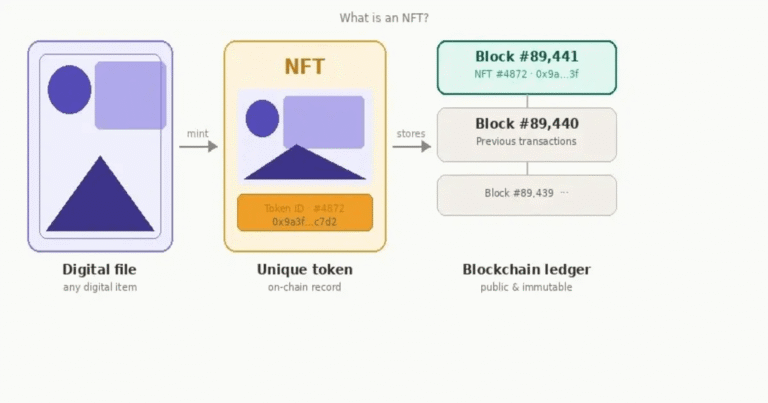
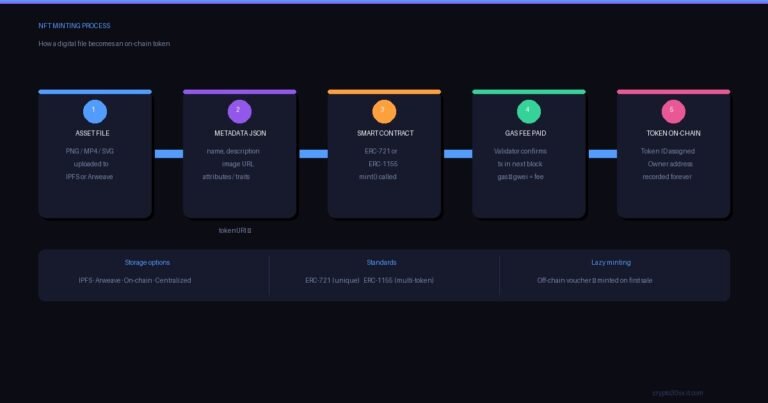
Minting creates an NFT on-chain by executing a smart contract that writes token identifiers, ownership data, and metadata references to permanent blockchain storage. Writing to storage is computationally expensive relative to reading it, which is why minting consistently demands more gas than transferring an already-existing asset.
Transfers and secondary purchases
Sending an NFT from one wallet to another requires a contract call that updates the ownership record. Secondary market purchases bundle this update with order settlement logic. Both are structurally simpler than a mint but still trigger fees because they change on-chain state.
Failed transactions and the cost of failure
A failed transaction does not reverse the gas already consumed. If a minting attempt runs out of gas mid-execution, or if the contract reverts because the collection sold out before the transaction confirmed, the validator still receives compensation for computation performed up to that point. The sender loses the gas fee and receives no NFT.
Setting a gas limit slightly above the contract’s estimated requirement reduces this risk. During competitive drops, even an adequate gas limit provides no guarantee of success if the supply is exhausted before the transaction confirms.
How do gas fees compare across blockchains?
Gas fee structures differ substantially between blockchains. Ethereum’s mainnet offers the most established NFT market but has historically charged the highest fees. Other blockchains, including those designed for speed and low cost, offer cheaper transactions with trade-offs in market size, security model, and secondary market depth.
| Blockchain | Fee currency | Relative cost | Notable NFT context |
|---|---|---|---|
| Ethereum (Layer 1) | ETH (gwei) | High; demand-driven | Largest established NFT trading market |
| Polygon | MATIC | Very low | Major platform integrations; widely supported |
| Solana | SOL | Very low | High-volume; different consensus architecture |
| Flow | FLOW | Low | Designed for consumer collectibles |
| Immutable X | None for users | Zero user fees | ZK-rollup; costs absorbed by protocol |
| Arbitrum / Optimism | ETH (L2 rates) | Much lower than L1 | Inherits Ethereum security via rollup |
Layer 2 networks and reduced gas costs
Layer 2 networks process transactions off Ethereum’s main chain in batches, then submit compressed proofs or data summaries to Layer 1 for final settlement. Because many transactions share a single L1 submission, the per-transaction cost of mainnet security drops sharply.
Several Layer 2 networks have built NFT activity because of this cost structure:
- Polygon processes transactions with its own validator set; fees paid in MATIC are typically fractions of a cent
- Arbitrum and Optimism use optimistic rollup technology and inherit Ethereum’s security at reduced per-transaction cost
- Immutable X uses ZK-rollup architecture designed for NFTs, routing the computational cost away from individual users
- StarkNet applies ZK-proof compression to batch large transaction volumes efficiently
The trade-off is meaningful. Layer 2 networks often carry less secondary market liquidity and fewer active buyers than Ethereum mainnet, and bridging assets between networks takes time and sometimes costs fees. Resale market depth on most Layer 2 networks is significantly smaller.
How to reduce NFT gas fees
No technique eliminates gas fees on Ethereum’s main network, but several practical approaches reduce what users pay per transaction. The core principle is simple: gas prices reflect demand for block space. Transacting when demand is low, choosing efficient transaction types, and using cost-optimized networks all reduce the total fee paid.
- Track gas prices before transacting. Gas tracker tools display fee levels across different times of day. Patterns are consistent: activity tends to be lower during certain hours, which typically produces lower base fees. Tools that display historical fee data help identify those windows.
- Set a manual gas limit and priority fee. Most wallets allow custom gas settings. A gas limit slightly above the contract’s estimated requirement avoids mid-execution failure without meaningfully overpaying. A minimal priority tip saves cost when speed is not critical.
- Use lazy minting for NFT creation. Some platforms defer the minting transaction to the first sale. The gas cost shifts to the buyer at the moment of purchase. Creators using this model list work without paying any upfront gas.
- Avoid initial-drop competition. Gas wars during hyped launches are avoidable by purchasing on the secondary market after the mint wave, when competition for block space has subsided.
- Consider Layer 2 or alternative networks. For lower-value NFT activity, the fee difference between Ethereum mainnet and a Layer 2 is substantial. The decision requires weighing lower fees against smaller buyer pools and bridge complexity.
- Batch operations where platforms allow. Some tools consolidate multiple actions into a single transaction. Fewer on-chain writes mean fewer separate gas charges.
Common misconceptions about NFT gas fees
Several misunderstandings about NFT gas fees persist among new and experienced participants alike. The most costly ones involve where fees go, what happens when transactions fail, and whether paying more always secures a spot in the next block. Clearing up these points helps users transact more deliberately and avoid unnecessary losses.
Misconception: gas fees go to the marketplace
Gas fees go to blockchain validators. The NFT marketplace earns a separate platform fee, typically a percentage of the sale price. These two charges are routed to completely different recipients and calculated independently. The platform has no claim on gas fees.
Misconception: a higher gas price guarantees faster confirmation
A higher priority tip increases the probability of faster inclusion in the next block. It does not guarantee it. During extreme congestion, even high-fee transactions can queue behind others offering more. Confirmation is probabilistic, and during major drops, no individual fee level is a certain guarantee.
Misconception: failed transactions cost nothing
Failed transactions consume gas up to the point of failure. If a minting contract reverts because supply sold out, or if the transaction runs out of gas mid-execution, the validator still receives compensation for computation already performed. The sender pays without receiving the asset.
Misconception: gas fees vary by marketplace
On Ethereum Layer 1, gas fees for a given transaction type are set by the network. The same smart contract interaction costs the same gas whether submitted through one platform or another. Differences between platforms arise only when different contract designs require different amounts of computation for equivalent actions.
FAQs
What are NFT gas fees in simple terms? Gas fees are the cost of using a blockchain network to record a transaction. They function as processing fees paid not to any company, but to the decentralized network of validators that verify and permanently record on-chain data. Any NFT action that changes on-chain state, including minting, buying, or transferring, triggers a gas fee.
Why are Ethereum gas fees so high sometimes? Ethereum processes a fixed number of transactions per block. When demand exceeds that capacity, whether during popular NFT launches, DeFi activity, or periods of high market volume, users compete for limited block space by raising their priority fees. This competition pushes gas prices sharply higher. Fees fall when demand eases.
Do I always pay gas fees when buying an NFT? On Ethereum Layer 1, any on-chain transaction triggers gas fees. On Layer 2 networks such as Immutable X, costs are structured differently and users often pay minimal or no gas from their end. The underlying computational costs are absorbed or redistributed by the protocol’s design rather than passed directly to the buyer.
Can gas fees be refunded? Unused gas, the difference between your gas limit and the actual gas consumed, is refunded automatically at the end of a successful transaction. Gas consumed by a failed transaction is not refunded. Base fees are burned by the protocol permanently and are not recoverable under any circumstance.
What is a gas war in NFTs? A gas war occurs when large numbers of buyers simultaneously attempt to mint or purchase NFTs during a limited-supply launch. All participants raise their priority fees to secure inclusion in the next block, driving network-wide gas prices to extreme levels. Participants who set the highest tips get processed first; others face delays, failed transactions, or extended waits.
Is there a way to avoid NFT gas fees entirely? On Ethereum’s main chain, gas fees cannot be avoided. Alternatives include blockchains with different fee models such as Solana or Flow, Ethereum Layer 2 networks with lower costs, and platforms that support lazy minting to defer fees. Each alternative involves trade-offs in market size, liquidity, and security model.
What does the gas limit mean for an NFT transaction? The gas limit is the maximum amount of gas units the sender authorizes a transaction to consume. Setting it too low causes the transaction to fail mid-execution while still consuming the gas already used. Setting it above the estimated requirement is safe: any unused gas below the limit is automatically returned after the transaction completes.
How did EIP-1559 change NFT gas fees? EIP-1559 restructured Ethereum’s fee market by splitting the gas price into a protocol-set base fee and a user-chosen priority tip. Before this change, users bid a single price with no predictability. After the change, the base fee adjusts algorithmically to manage congestion. Demand spikes during NFT events still produce volatility, but routine fee levels are more predictable than the prior system.
Disclaimer
This article is written for educational and research purposes only. Nothing in this content constitutes financial, investment, or legal advice. Gas fees, blockchain protocols, and NFT market structures evolve as networks upgrade and user activity changes. Readers should verify all information independently and consult qualified professionals before making financial decisions.
NFT gas fees are a direct expression of how public blockchains function: finite block space, distributed validation, and market-driven pricing. The fees are not arbitrary; they reflect the real computational cost of recording data on a permanent, decentralized network.
Understanding the mechanics behind gas calculation, the distinction between network fees and platform fees, and the practical strategies available for reducing costs gives any participant a complete picture of what they pay and why.
Wisdom from the best, written for the rest—our expert-voice articles bridge the gap.