Utility NFTs vs profile picture NFTs: key differences
Utility NFTs vs profile picture NFTs represent two distinct philosophies of digital ownership. A profile picture NFT (PFP) derives most of its value from identity signaling: the holder displays it publicly as a social marker tied to community membership. A utility NFT derives value from an embedded function, whether access rights, in-game mechanics, or a revenue claim, that the token activates on-chain or through a connected platform. The distinction determines how each type is priced, who holds it, how it loses value, and what due diligence looks like. This guide examines both categories in structural terms, written for learners and researchers who want an honest framework for understanding NFT value.
What are profile picture NFTs?
Profile picture NFTs are tokens from generative art collections where each item is a unique image produced by combining randomly selected visual traits. Holders display these tokens as social identity markers across social media and community platforms. Value rests almost entirely on community perception, brand recognition, and trait rarity, not on any on-chain function the token activates or any service it grants access to.
How PFP collections are built
A standard PFP collection follows a repeatable production model:
- An artist or team designs a base character and a set of visual trait layers: backgrounds, clothing, accessories, and expressions
- An algorithm combines those traits to generate thousands of unique images, each with a distinct rarity profile
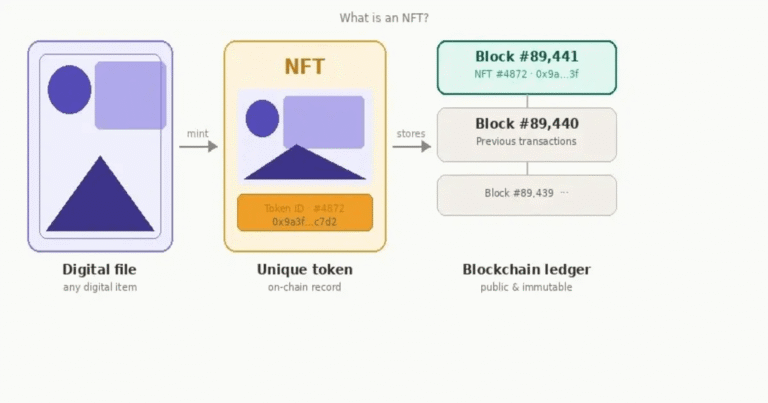
- Each image is minted as a separate NFT on a blockchain, with rarity metadata encoded alongside the token
- A secondary market forms where tokens trade based on floor price, trait rarity, and community signals
CryptoPunks established this model in 2017. The Bored Ape Yacht Club refined it by building a membership brand around the collection, adding community events and a distinctive aesthetic that drove cultural recognition. Both collections built secondary markets on perceived status rather than any on-chain function.
The social signaling function
The primary use case of a PFP NFT is display. Setting a collection token as a public avatar signals membership in a specific community and, in many cases, communicates financial standing. When a collection gains high-profile holders or sustained media coverage, demand typically rises independent of any technical change to the token itself.
This creates a reflexive pricing dynamic: the token’s value depends partly on how many others believe it is worth holding. That belief can compound during periods of strong market sentiment. It can collapse just as fast when sentiment reverses.
What are utility NFTs?
Utility NFTs are tokens designed to activate a specific function, grant access to a service, or confer a defined right, independent of any collectible or display value the token might carry. The utility is embedded in smart contract logic, off-chain system integrations, or both, and it is what the token does that constitutes its primary value proposition.
Types of utility NFTs
Access and membership: An NFT can function as a transferable or non-transferable membership pass, granting holders entry to gated platforms, communities, or events. The token’s value tracks the ongoing desirability of that access.
In-game assets: Blockchain games issue NFTs to represent items with defined mechanical properties: weapons, characters, land plots, and vehicles. The token’s value derives from the item’s role within the game economy and from the size of the active player base.
Revenue and royalty mechanisms: Some projects embed royalty distribution logic in the contract so that holders receive a fraction of protocol revenue. The NFT functions as a claim on earnings rather than as a collectible.
Credentials and proof of participation: Event tickets, certifications, and attendance badges can be issued as NFTs that verify a holder’s participation or completion. After the original event, they function as on-chain credentials. The POAP (Proof of Attendance Protocol) model is one structured example.
Domain and identity tokens: Ethereum Name Service (ENS) domain tokens grant holders control over a human-readable blockchain address. The utility is the address resolution function itself, not any aesthetic quality of the token.
How utility is encoded in a token
Utility in an NFT reaches the holder through one of three delivery mechanisms:
- On-chain logic: The smart contract itself enforces the function through staking rules, royalty splits, or access controls coded into the contract and auditable by anyone
- Off-chain system integration: A platform reads the holder’s wallet, detects the NFT, and grants access through its own servers accordingly
- Hybrid: Both mechanisms work in combination, with the contract managing ownership records and the platform delivering the user experience
The second and third models are most common in gaming and membership applications. They also carry the most significant platform dependency risk, covered in the risk section below.
Utility NFTs vs profile picture NFTs: core structural differences
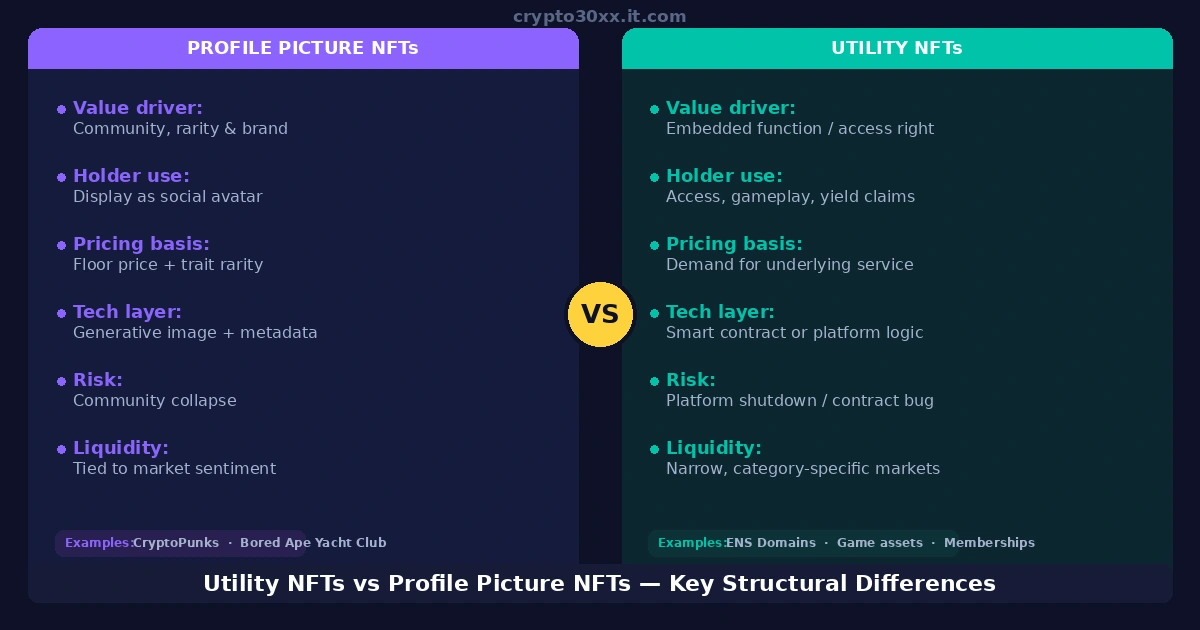
Utility NFTs vs profile picture NFTs differ across five structural dimensions: value source, holder experience, technical mechanics, market behavior, and risk profile. These dimensions are not cosmetic distinctions. They determine how a token is priced, how it loses value, and what a holder can realistically do with it when market conditions shift.
| Dimension | Profile picture NFTs | Utility NFTs |
|---|---|---|
| Primary value driver | Community perception, rarity, brand | Embedded function or access right |
| Holder experience | Display and identity signaling | Using the function: access, gameplay, yield |
| Technical foundation | Generative image and metadata | Smart contract logic or platform integration |
| Market pricing basis | Floor price, trait rarity, social signals | Demand for the underlying service or function |
| Value without active community | Collapses significantly | Depends on whether function is self-sustaining |
| Creator dependency | High | High to very high, especially off-chain |
Value source: community perception vs. embedded function
The critical structural divide is what makes the token worth holding over time. A PFP NFT is worth what the market collectively decides it is worth. That decision reflects cultural momentum, and when momentum fades, floor prices in PFP collections have historically dropped sharply because no underlying function sustains demand.
A utility NFT should, in theory, retain value as long as the function it provides remains in demand. A gaming asset retains value if the game retains players. A membership pass retains value if the membership continues delivering access to something the holder wants.
The practical caveat is significant: many utility NFTs are tied to platforms that shut down or lose users, eliminating the function the token was built to provide.
Holder experience and interaction model
PFP holders interact with their token primarily through community spaces: Discord servers, social media feeds, secondary markets, and brand events. The token rarely executes any technical function. It represents membership in a social group, and the holder’s relationship with it is almost entirely mediated by community dynamics.
Utility NFT holders interact with their token as a functional object. They stake it, use it to enter a game, claim yields from it, or present it as an access credential. The holder experience is defined by what the token enables rather than what it represents.
Market behavior and liquidity patterns
PFP collection markets tend to concentrate activity around floor price tracking and trait-based premium pricing. Trading volume spikes during cultural relevance events and contracts sharply when interest fades. Liquidity in lower-tier collections disappears quickly, making fair exits difficult.
Utility NFT markets behave differently by category. Gaming asset markets are often narrow, driven by active player demand rather than broader collector interest. Membership NFT markets reflect the perceived value of the underlying platform. Neither category guarantees liquidity.
When the two categories overlap
Not every NFT fits cleanly into one category. Many successful collections began as PFP projects and later added utility layers: event access, staking rewards, and token airdrops. Others launched as utility-first tokens but developed collector communities around the visual design of each token. This overlap zone is where many of the most actively traded collections operate.
Hybrid collections and their market dynamics
The Bored Ape Yacht Club began as a PFP collection and later added member events, companion NFT drops, and an associated token. The PFP identity remained the brand anchor, but utility features were layered on to sustain engagement and justify ongoing floor prices. The market priced both the cultural status and the utility features together.
Gaming projects have moved in the opposite direction, issuing visually distinctive character tokens that function both as playable assets and as identity tokens holders display publicly. These tokens carry dual pricing logic, where part of the price reflects in-game function and part reflects collector demand for rare visual traits.
How to identify which value driver dominates
For any NFT claiming hybrid status, one analytical question clarifies the dominant driver: if the founding team dissolved tomorrow, would the token retain its core function? If yes, the utility holds without team dependency. If the answer is “probably not, because the function depends on the team maintaining a server,” the true value driver is organizational trust, not structural utility.
This question does not always have a clean answer. Many projects operate in a functionally mixed state, where community perception sustains a floor price that would otherwise be lower, and utility features provide a secondary demand driver. Understanding that mix is part of proper project-level analysis.
Risk analysis: what can go wrong with each type
Both PFP NFTs and utility NFTs carry substantial downside risk, but the mechanisms behind that risk differ. Understanding those mechanisms before engaging with a collection is what separates structured analysis from guesswork. The risks below apply to each category specifically, followed by a set that affects both.
PFP-specific risks
Community collapse: PFP value is self-referential. When holders lose interest and community activity declines, floor prices typically drop and liquidity dries up. No underlying function sustains demand during a sentiment shift.
Historical data from multiple collection cycles shows this pattern repeated across high-profile projects that once commanded significant floor prices.
Volume inflation: Secondary market volume in some PFP collections has shown patterns consistent with wash trading, where the same wallets conduct buy-sell transactions to inflate reported activity. Artificially inflated volume can mislead buyers about actual demand levels.
Intellectual property ambiguity: The rights a PFP NFT holder actually receives over the underlying artwork vary significantly by project. Some projects grant broad commercial rights; others grant nothing beyond token ownership. The legal frameworks governing NFT intellectual property remain unsettled in most jurisdictions.
Utility NFT-specific risks
Platform dependency: When utility is delivered through an off-chain system, the token becomes non-functional if the platform shuts down. Unlike a PFP, which retains its image regardless of team activity, a utility NFT tied to a defunct platform loses its primary value driver entirely.
Smart contract vulnerabilities: On-chain utility requires trusting the smart contract code. Bugs, design flaws, or deliberately deceptive contract structures can expose holders to unauthorized rule changes, fund loss, or loss of access. Audited contracts reduce this risk but do not eliminate it.
Overstated utility claims: Projects routinely market tokens as utility NFTs when the utility is minimal, conditional, or subject to unilateral change by the team. Verifying real utility requires examining contract code or relying on independent audits, not marketing materials.
Shared risks across both categories
- Illiquidity: NFT markets are far less liquid than fungible token markets. Exiting at a fair price can be difficult, particularly in collections with low daily trading volume
- Smart contract dependency: Both categories rely on blockchain infrastructure and contract code that carry execution and upgrade risk
- Regulatory uncertainty: The classification of NFTs as securities, property, or another asset type remains unresolved in most jurisdictions and varies by country
- Total loss risk: NFTs can and have dropped to floor prices near zero across both PFP and utility collections, resulting in a complete loss of the original purchase price
How to evaluate a utility NFT claim
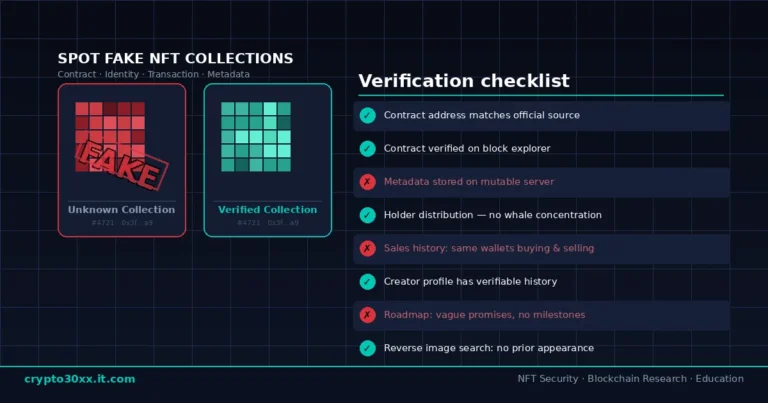
Genuine utility in an NFT should be independently verifiable through smart contract code, platform architecture, and technical documentation, not solely through marketing materials. Any team can describe a feature as utility. The meaningful test is whether that utility survives without the team’s active cooperation. Five questions help apply that test to any project.
Five questions to test genuine utility
- Is the utility enforced by the smart contract, or does it depend on a company’s ongoing decision to honor it through an off-chain system?
- Does the underlying service or platform have measurable usage that is independent of the NFT’s secondary market activity?
- If the founding team dissolved tomorrow, would the token’s core function continue to operate?
- Are the terms of the utility fixed on-chain, or can a centralized party modify them without holder consent?
- Does the token’s market price reflect the value of the underlying function, or is it priced primarily on speculation about future community growth?
None of these questions can be answered without examining contract code, platform architecture, and project documentation. That research is the minimum analytical baseline for any holder considering a token primarily on the basis of its claimed utility.
FAQs
What is the main difference between utility NFTs and profile picture NFTs? Utility NFTs derive their primary value from an embedded function, whether access rights, in-game mechanics, or a revenue claim. Profile picture NFTs derive value from identity display and community perception. The core distinction is what the token does versus what it represents.
Can a PFP NFT also have utility? Yes. Many collections began as pure PFP projects and later added utility features such as event access, staking rewards, or companion token drops. The analytical question is which value driver dominates: a verifiable on-chain function or community perception and organizational trust.
Which type holds value better over time? Neither category guarantees value retention. PFP collections depend on sustained community relevance, which historical patterns show is difficult to maintain across full market cycles. Utility NFTs depend on the underlying platform remaining active and useful. Both carry high risk of significant value decline.
Are utility NFTs safer than PFP NFTs? The risk profiles are different, not definitively lesser for either category. Utility NFTs carry platform-dependency risk and smart contract risk on top of standard market risk. PFP NFTs carry community collapse risk and liquidity risk. Neither type provides structural downside protection.
What are common examples of utility NFT categories? Documented categories include in-game assets such as weapons, characters, and land plots; membership passes for gated platforms or events; blockchain domain tokens such as ENS names; protocol revenue-sharing NFTs; and proof-of-attendance credentials. Each category has a distinct demand driver and risk profile.
How is floor price determined in a PFP collection? Floor price reflects the lowest listed token in the collection on a given secondary marketplace. Tokens with statistically rare trait combinations typically command prices above the floor. Social signals, including high-profile holders and media coverage, also drive price movement independent of trait rarity.
Do utility NFTs require on-chain transactions to use? Not always. Some utility is delivered when a platform reads the holder’s wallet balance off-chain and grants access accordingly. Others require explicit on-chain actions such as staking or claiming. The interaction model depends on how the utility was designed and which delivery mechanism the project uses.
Disclaimer
This article is written for educational and research purposes only and does not constitute financial, investment, legal, or tax advice. NFTs carry substantial risk of loss, including total loss of value. Readers should conduct independent research and consult qualified professionals before making any decisions involving digital assets.
The distinction between utility NFTs vs profile picture NFTs is structural, not cosmetic. PFPs build value through identity and community, a mechanism that scales quickly but collapses when cultural momentum fades. Utility NFTs build value through function, which is theoretically more durable but practically contingent on platform survival and verifiable utility design.
Understanding which model a project follows, and whether the project actually delivers on that model, is the analytical starting point for evaluating any NFT on its own terms.
Stay plugged into what matters with our priority-filtered article updates.