Energy usage bitcoin mining facts: a complete guide
Energy usage bitcoin mining facts: Bitcoin mining energy usage refers to the electricity consumed by the global network of computers competing to validate transactions and add blocks to the Bitcoin blockchain. This consumption is a structural feature of Proof of Work, Bitcoin’s consensus mechanism, which requires real computational effort to secure the network against manipulation. The energy expended is the economic cost that makes altering the blockchain’s history prohibitively expensive. Estimates of Bitcoin’s annual electricity draw have historically placed it in a range comparable to mid-sized industrialized nations, with significant variation depending on methodology, hardware assumptions, and the period measured. This article examines the mechanics behind that demand, the data on its scale and composition, and the most common analytical errors that distort public understanding of the topic.
What is bitcoin mining energy usage and why does it exist?
Bitcoin mining consumes electricity because validating the blockchain requires measurable, costly computation. Proof of Work requires real energy by design: without it, a bad actor could cheaply rewrite transaction history. The energy expenditure creates the economic barrier that makes altering the blockchain’s history prohibitively expensive as total network participation grows. Understanding this structural purpose is the starting point for interpreting any data about bitcoin mining energy usage.
Why Proof of Work requires energy by design
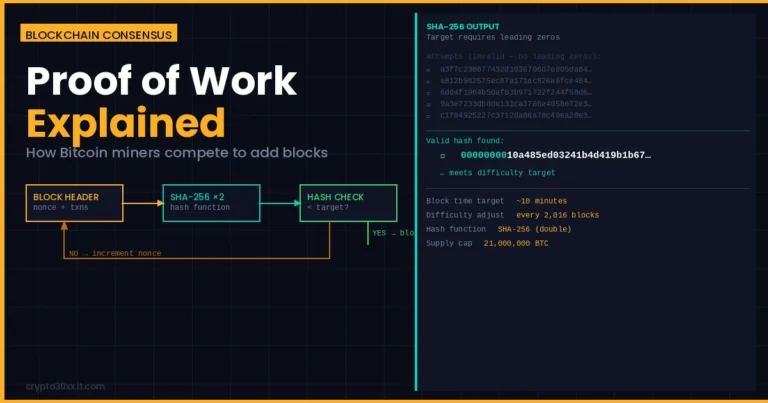
Bitcoin uses the SHA-256 hashing algorithm. To produce a valid block, a miner’s hardware must repeatedly compute SHA-256 hash outputs until one falls below a target value set by the protocol. There is no mathematical shortcut. The process is deliberately asymmetric: finding a valid hash is computationally expensive, but verifying that a found hash meets the target takes milliseconds.
The protocol adjusts its difficulty target every 2,016 blocks (roughly every two weeks) to maintain an average block interval of ten minutes. If more total hashrate joins the network, difficulty rises. If miners leave, difficulty falls. The block production rate stays approximately constant regardless of how many machines compete.
Adding more miners does not accelerate block production. It raises difficulty, and in doing so, increases the total energy the network expends to produce the same number of blocks per unit of time. This is not a design flaw; it is the mechanism by which the network maintains consistent security regardless of how much computational power participates.
The role of hashrate in energy demand
Hashrate is the aggregate computational throughput of all active miners on the network at any moment, measured in hashes per second. Higher hashrate means more machines running, and more electricity consumed.
The Cambridge Centre for Alternative Finance (CCAF), which maintains the Cambridge Bitcoin Electricity Consumption Index (CBECI), estimates Bitcoin’s electricity consumption by combining observable hashrate data with assumptions about the efficiency of the hardware mix likely in use. Because miners do not publicly disclose their equipment inventories or power contracts, every published figure is an estimate within a range — not a precise measurement.
The CBECI has become the reference point for academic papers, journalism, and policy discussions on Bitcoin’s energy consumption. The CCAF itself acknowledges that its estimates are models built on observable proxies, not direct measurements of a centrally reported system.
How much energy does bitcoin mining actually consume?
Estimating Bitcoin’s total electricity consumption is structurally difficult: no central reporting exists, hardware mixes are not disclosed, and facilities are geographically dispersed across dozens of jurisdictions. Researchers infer consumption from observable hashrate data and published ASIC efficiency specifications. Different assumptions about the hardware mix in active use produce materially different estimates.
Estimating consumption: the methodology problem
The CBECI approach uses three estimates: a lower bound (assuming all active miners use the most efficient hardware available), an upper bound (assuming the least efficient hardware still plausibly in use), and a central estimate applying weighted assumptions about real-world hardware deployment.
Different research groups have produced estimates that diverge by a factor of two or more for the same time period. The Digiconomist Bitcoin Energy Consumption Index, another widely cited model, uses different input assumptions than the CBECI and consistently produces different outputs. Neither is wrong in a simple sense; each reflects its embedded assumptions. Published figures should be read as ranges with stated methodological constraints, not as measurements.
Key benchmark comparisons
For scale, researchers frequently compare Bitcoin’s estimated annual electricity consumption to other industries and systems. The comparisons below reflect figures appearing across the published literature. They are approximations and carry methodological caveats; they should not be treated as precisely comparable without reviewing the underlying study scope.
| System or activity | Estimated annual electricity | Notes |
|---|---|---|
| Bitcoin network (CBECI central estimate) | ~100–150 TWh historically | Varies with hashrate and hardware mix |
| Global gold mining | ~100–130 TWh | Includes extraction, processing, transport |
| Traditional banking system | ~250–300 TWh | Data centers, branches, ATMs, card networks |
| Bitcoin (CBECI upper bound) | Up to ~200+ TWh | Assumes less efficient hardware mix |
| US residential always-on devices | ~400+ TWh | EPA estimates for idle and standby electronics |
Approximate historical ranges drawn from CBECI and referenced literature. Figures fluctuate with network hashrate, hardware generations, and energy prices.
The country comparisons that appear frequently in media coverage, placing Bitcoin’s consumption alongside specific nations, use the same CBECI methodology applied to national electricity statistics. These comparisons are useful for conveying scale to a general audience but can obscure the high degree of uncertainty embedded in the Bitcoin figure itself.
What powers bitcoin mining operations?
Bitcoin miners have a direct financial incentive to minimize electricity costs, since power is their largest operating expense after hardware capital. This pushes mining activity toward the cheapest available power sources, which vary substantially by region, policy environment, and infrastructure availability. The result is a geographically distributed industry with a heterogeneous energy mix that has shifted considerably as regulatory environments in major jurisdictions have changed over the years.
The renewable energy question
Multiple industry surveys, most prominently from the Bitcoin Mining Council (BMC), report that a significant share of member electricity consumption comes from sustainable sources. These self-reported surveys consistently show sustainable energy comprising a majority of surveyed capacity.
Independent researchers have noted limitations in this data: BMC membership is voluntary, the survey represents only participating firms, and formal audit mechanisms are limited. Published estimates from independent institutions have placed the renewable share across the full global mining industry at a wide range. Precise verification is not possible given available data. The carbon intensity of Bitcoin mining depends not just on how much electricity it uses but on the source of that electricity. A facility powered by run-of-river hydroelectricity carries a very different carbon profile than one powered by a coal-heavy regional grid.
What is documentable: regions with abundant, low-cost hydroelectric generation, including parts of Scandinavia, Iceland, and western North America, have attracted significant mining activity due to low electricity costs. The geographic distribution of mining has shifted substantially following policy changes in major jurisdictions, altering the aggregate energy mix in ways that are difficult to track precisely in real time.
Stranded and wasted energy sources
A subset of mining operations uses energy that would otherwise be unmonetized or destroyed:
- Flared natural gas: Oil extraction sites routinely burn off associated natural gas that is uneconomical to capture and transport to market. Some mining operations co-locate with these sites, using the gas for on-site power generation and converting methane that would otherwise be burned unproductively into a mining input.
- Surplus hydroelectric generation: Dams in high-rainfall periods sometimes produce more power than the local grid can absorb. Mining operations at these sites act as flexible load, monetizing otherwise-curtailed generation that would simply be wasted.
- Landfill gas capture: Decomposing organic waste produces methane. Small-scale mining operations have used captured landfill gas as a power source, reducing methane emissions relative to unmanaged venting.
These use cases do not resolve the broader energy debate, but they demonstrate that Bitcoin mining’s relationship to the energy system is more complex than a simple waste characterization suggests. Mining’s ability to operate as interruptible load in locations with stranded energy is a structural feature, not an edge case.
Hardware efficiency and the mining arms race
Bitcoin mining hardware has improved dramatically in energy efficiency since the network’s earliest years. Each hardware generation delivered orders-of-magnitude better performance per watt than its predecessor. Understanding this trajectory matters for interpreting historical consumption data and for explaining why efficiency improvements have not reduced total network energy consumption.
From CPUs to ASICs: the efficiency curve
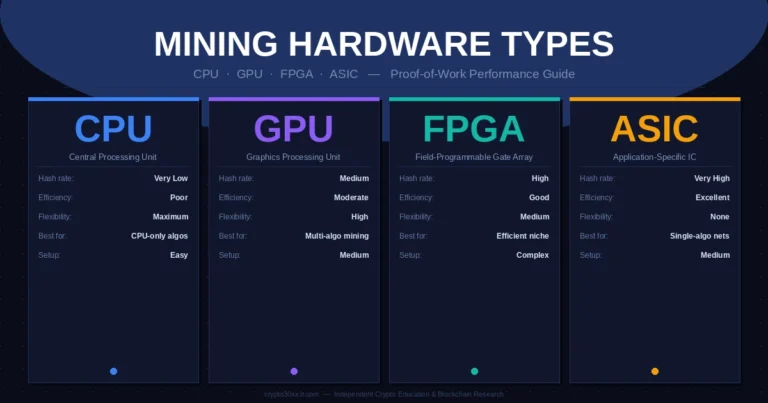
Bitcoin mining has progressed through four hardware generations, each representing a step-change in computational efficiency:
- CPU mining: Standard processor chips designed for general computation. Extremely inefficient for SHA-256 hashing by modern standards.
- GPU mining: Graphics processors, which perform parallel calculations efficiently. They offered large hash-rate-per-watt improvements over CPUs and were the dominant hardware for several years.
- FPGA mining: Field-programmable gate arrays, purpose-configurable chips that bridged the performance gap between GPUs and dedicated ASICs.
- ASIC mining: Application-specific integrated circuits designed exclusively for SHA-256 computation. Modern ASICs operate at efficiencies measured in joules per terahash (J/TH), many orders of magnitude better than first-generation hardware.
Leading modern ASICs operate below 20 J/TH. Early hardware generations operated at thousands of J/TH or more. The improvement across hardware generations is among the most dramatic in the history of consumer computing, driven by the economic incentives of mining competition.
How efficiency gains affect total consumption
More efficient hardware does not automatically reduce the network’s total power draw. Lower cost-per-hash attracts additional miners and capital. This raises total hashrate and difficulty, absorbing the efficiency gains in greater aggregate computation.
In environmental economics, this pattern is called the Jevons paradox: efficiency improvements increase total resource consumption rather than reducing it, because they make the activity more economically attractive at the margin. Historical Bitcoin data reflects this dynamic consistently. Major ASIC efficiency improvements have accompanied increases, not decreases, in total network electricity consumption during periods of sustained mining profitability. Efficiency is necessary but not sufficient for reducing absolute energy consumption.
Common misconceptions about bitcoin mining energy usage
Several frequently repeated claims about bitcoin mining energy usage facts contain structural analytical errors. The three most prevalent are the per-transaction energy metric, the wasted energy characterization, and direct comparisons to the traditional financial system applied without methodological alignment. Each deserves careful examination.
The per-transaction energy argument
A widely cited criticism expresses Bitcoin’s energy use as kilowatt-hours per on-chain transaction (kWh/tx). This metric is analytically weak for two distinct reasons.
First, Bitcoin’s electricity consumption is determined by global hashrate and hardware economics, not by transaction volume. The network would consume approximately the same power whether it settled 200,000 or 2,000,000 transactions in a given period. Transaction throughput and energy draw are structurally decoupled; the denominator of the metric has no causal relationship to the numerator.
Second, the metric misstates economic activity per transaction. A single on-chain Bitcoin transaction can represent the settlement of millions of Lightning Network micropayments, the net position of thousands of exchange-internal transfers, or a batched consolidation of hundreds of individual sends. Treating each on-chain transaction as equivalent to a single consumer card swipe conflates settlement and activity in a way that produces a meaningless comparison.
The “wasted energy” framing
Critics often describe Bitcoin mining electricity as wasted because it produces no physical commodity. This framing ignores what the energy actually purchases: decentralized, censorship-resistant transaction finality in a system that operates without a central authority, trusted intermediary, or shut-off switch.
Whether that output justifies the energy cost is a values question, not a technical one. The energy is not wasted in any mechanical sense; it is converted into heat, computational work, and network security. Some operations have begun capturing waste heat for secondary productive uses, including greenhouse heating, aquaculture, and district heating, at small-to-medium scale. The output of mining hardware is not limited to block production.
Comparison to the traditional financial system
Comparing Bitcoin’s energy consumption to global banking is legitimate as a framing exercise but requires methodological care. Studies that scope the full banking system, including data centers, branch operations, ATMs, card networks, central bank infrastructure, and embedded fintech layers, against Bitcoin’s on-chain settlement layer alone are not equivalent comparisons.
A methodologically sound comparison would either scope both systems at the settlement layer or include Bitcoin’s full second-layer ecosystem alongside banking’s equivalent infrastructure. The research literature does not produce a single agreed figure; it produces a range of estimates, each valid only within its stated scope. The most honest conclusion from the available studies is that Bitcoin’s energy consumption sits in a range comparable to other large industrial sectors, with a net environmental impact that depends heavily on its regional energy sources.
FAQs
Is bitcoin’s energy consumption growing over time? Bitcoin’s total electricity consumption has generally trended upward across multi-year periods as global hashrate increases. Short-term fluctuations occur with mining profitability cycles, regulatory changes, and energy price shifts. Hardware efficiency improvements moderate but have not reversed the long-term growth in aggregate energy draw during periods of rising hashrate and sustained miner revenue.
What percentage of bitcoin mining uses renewable energy? Published estimates vary widely, from roughly one-quarter to nearly three-quarters of total mining electricity, depending on the source and methodology. Industry self-reporting suggests a high renewable share among surveyed participants; independent academic estimates are more conservative. Precise global verification is not possible given the decentralized and non-reporting nature of the industry.
How does bitcoin mining compare to gold mining in energy use? Published research places both industries in a broadly similar energy range, roughly 100–130 TWh per year, though the comparison requires methodological care. Gold’s footprint includes physical extraction, ore processing, chemical refining, and logistics. Bitcoin’s is primarily electrical computation. Different scoping assumptions produce different relative results, and neither figure should be taken as a precise measurement.
Why doesn’t bitcoin switch to Proof of Stake? Bitcoin’s consensus mechanism is fixed at Proof of Work by protocol design and community governance. Changing it would require broad agreement among node operators, developers, and miners. That shift has no meaningful consensus support in the Bitcoin development community. Other blockchains, including Ethereum, have made this transition, which dramatically reduces their electricity demand. Bitcoin’s design philosophy treats the energy cost as a core property of its security model.
Does more bitcoin usage increase energy consumption? Not directly. Transaction volume does not drive Bitcoin’s electricity consumption. The primary drivers are hashrate, which follows miner revenue expectations, and hardware efficiency. Network usage and energy draw are structurally decoupled; adding users or transaction volume without changing miner economics has negligible effect on power consumption.
What is the Cambridge Bitcoin Electricity Consumption Index? The CBECI, produced by the Cambridge Centre for Alternative Finance at the University of Cambridge, is the most widely cited academic model for estimating Bitcoin’s electricity consumption. It uses publicly observable hashrate data combined with hardware efficiency assumptions to generate lower bound, upper bound, and central estimates of annual electricity use. It is updated regularly and is freely available for reference.
Can bitcoin mining use otherwise-wasted energy? Yes, in practice. Some operations co-locate with natural gas flaring sites, converting methane that would otherwise be burned unproductively into mining power. Others operate on surplus hydroelectric or curtailed renewable generation. These applications represent a subset of global mining capacity and do not account for the full industry picture, but they demonstrate that mining can function as a flexible load consumer of otherwise-stranded energy.
Is per-transaction energy a valid measure of bitcoin’s environmental impact? No. Per-transaction energy is a structurally flawed metric because Bitcoin’s electricity consumption is independent of transaction volume. The network’s total energy draw is determined by hashrate and hardware economics, not by how many transactions settle on-chain. A more analytically sound approach compares total network energy to the total economic value or settlement throughput secured, with explicit methodological disclosure about what is being compared.
Disclaimer
This article is produced for educational and research purposes by crypto30xx.it.com, an independent cryptocurrency education and market analysis blog. Nothing here constitutes financial, investment, environmental, or legal advice. Energy consumption estimates carry significant methodological uncertainty and change over time as hashrate, hardware generations, and energy markets evolve. Readers seeking current data should consult primary sources, including the Cambridge Bitcoin Electricity Consumption Index (cbeci.org).
Energy usage bitcoin mining facts resist simple summary, and that resistance is itself a key finding. Consumption estimates are modeled ranges, not measured totals. The energy mix is heterogeneous, partially renewable, and geographically variable. Hardware efficiency has improved dramatically while total consumption has grown, because economic incentives absorb efficiency gains into greater aggregate computation. The per-transaction metric is analytically unsound; the comparison to traditional finance requires careful scope alignment to be meaningful. What remains is a clear structural fact: Proof of Work secures Bitcoin by making honest computation expensive, and that security mechanism carries a real, significant, and legitimately debated energy cost. The depth of that debate reflects both the importance of the question and the genuine complexity of answering it rigorously.
New topics, new skills, new you—start exploring our discovery-focused content.