How bitcoin mining works: a complete guide for learners
How bitcoin mining works: Bitcoin mining is the process by which new bitcoins enter circulation and transactions get permanently recorded on the blockchain. Miners use specialized computers to compete in solving a cryptographic puzzle — the first to find a valid solution adds the next block of transactions to the chain and earns a reward. This mechanism, called proof of work, removes the need for any bank or central authority to approve payments. Instead, economic incentives keep a global network of independent operators honest. Understanding how that system fits together is the starting point for understanding Bitcoin itself.
What is bitcoin mining, and why does it exist?
Bitcoin mining is the method Bitcoin uses to confirm transactions and issue new coins simultaneously — two problems solved with one mechanism. Without it, there would be no agreed-upon record of who owns what, and nothing stopping someone from spending the same bitcoin twice.
Traditional payment systems solve this with a trusted central party: a bank keeps the ledger and approves each transaction. Bitcoin replaces that trusted party with a competition. Anyone willing to run the right hardware can compete, and the protocol itself enforces the rules.
The double-spend problem
Digital data can be copied. A photo sent to one person can be sent to ten others without losing the original. If bitcoin were simply a file, the same coin could theoretically be spent in two places at once. Mining solves this by requiring public, tamper-evident proof that a transaction happened in a specific order, at a specific time.
Decentralization as the design goal
Satoshi Nakamoto’s original 2008 whitepaper described a peer-to-peer payment system that needed no trusted third party. Mining is how that goal is implemented mechanically. Any node on the network can independently verify the entire transaction history by checking the chain of proofs miners have produced.
How does proof of work actually function?
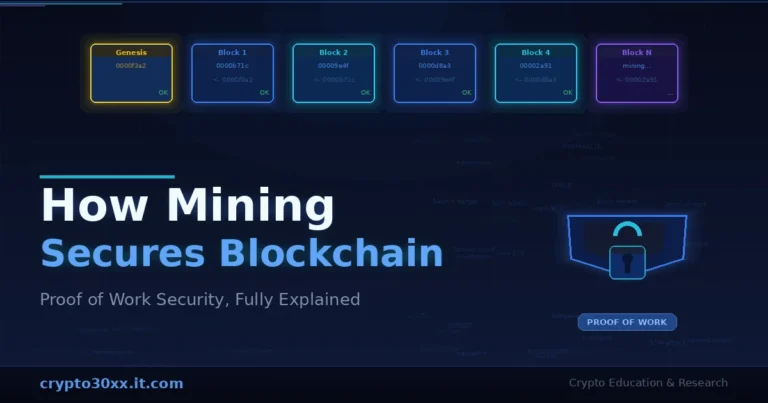
Proof of work is a cryptographic method that requires computational effort to produce a result, but makes verifying that result trivially easy. Think of it as a lock that takes thousands of attempts to open but takes one second to confirm is open.
In Bitcoin’s case, miners compete to produce a number called a hash that meets a specific criterion set by the network.
What is a hash?
A hash is a fixed-length string of letters and numbers produced by running data through a mathematical function. Bitcoin uses SHA-256 (Secure Hash Algorithm, 256-bit). Feed any input into SHA-256 — one word, one sentence, the entire contents of a book — and you get a 64-character hexadecimal output that looks like this:
Two properties make SHA-256 useful for mining. First, changing even one character in the input produces a completely different output — there is no pattern to predict. Second, the function runs in one direction only: given a hash, you cannot reverse-engineer the input.
The nonce and the target
Each new block contains a variable called a nonce (a number used once). Miners repeatedly change this nonce and re-run SHA-256 on the block’s data until the resulting hash falls below a number set by the network called the target. A lower target means fewer valid hashes exist and the puzzle is harder.
Because SHA-256 outputs are unpredictable, the only method is brute force: try one nonce, check the hash, try the next nonce, repeat — billions of times per second.
The first miner to find a valid hash broadcasts it to the network. Every other node can verify the solution in milliseconds by running SHA-256 once. This asymmetry — hard to find, easy to verify — is the core property that makes proof of work useful.
Step-by-step: what happens during one mining cycle
Each block follows a predictable cycle from transaction broadcast to confirmed entry in the chain.
- Transactions enter the mempool. When someone sends bitcoin, the transaction is broadcast to the network and held in a waiting area called the memory pool (mempool). It is unconfirmed at this stage.
- Miners select transactions. A miner picks a set of transactions from the mempool to include in the next block. Miners prioritize transactions that carry higher fees, since fees are part of their reward.
- A block is assembled. The chosen transactions are bundled into a candidate block alongside a header containing the hash of the previous block, a timestamp, and an empty nonce field.
- Hashing begins. The miner’s hardware starts cycling through nonce values, running SHA-256 on the block header each time. Modern mining machines (ASICs) perform trillions of these calculations per second.
- A valid hash is found. One miner’s machine happens to produce a hash below the current target. The miner broadcasts this solution to the network along with the complete block.
- The network verifies. Other nodes check the solution in under a second. If valid, they add the block to their copy of the chain and begin working on the next block.
- The reward is credited. The winning miner receives two types of compensation: the block subsidy (newly created bitcoin) and all the transaction fees from the transactions in that block. These arrive in a special first transaction called the coinbase transaction.
The entire cycle averages ten minutes, a target the protocol maintains through automatic adjustments.
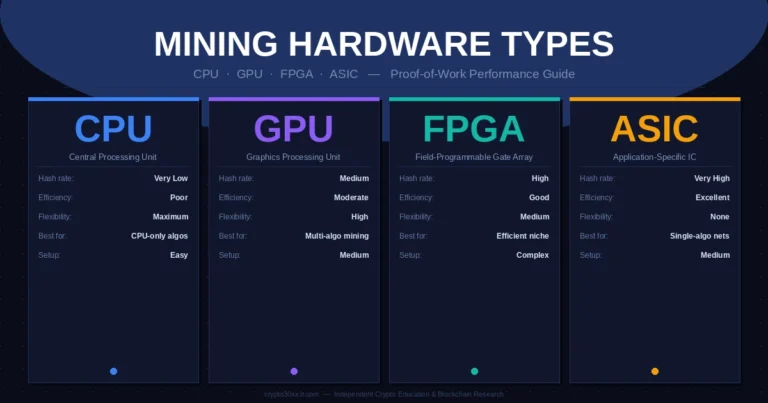
Mining hardware: from CPUs to ASICs
The physical machines doing this work have changed dramatically since Bitcoin’s early days. Understanding the progression explains why mining today is an industrial operation, not a hobby.
| Hardware type | Era | Relative efficiency | Status |
|---|---|---|---|
| CPU (laptop/desktop) | 2009–2010 | Baseline | Obsolete for BTC |
| GPU (graphics card) | 2010–2013 | ~50× CPU | Obsolete for BTC |
| FPGA (programmable chip) | 2011–2013 | ~5× GPU | Obsolete for BTC |
| ASIC (application-specific circuit) | 2013–present | 10,000× CPU or more | Industry standard |
What makes an ASIC different?
An ASIC (Application-Specific Integrated Circuit) is a chip designed to do one thing: run SHA-256 as fast as possible, using as little electricity as possible. It cannot browse the web, play a game, or run any other software. That single-purpose design allows manufacturers to optimize every transistor on the chip for hashing.
Modern ASICs produce tens of terahashes per second — tens of trillions of hash calculations every second — from a machine roughly the size of a shoebox. Each generation of hardware raises the bar, making older machines less competitive.
Hash rate and what it measures
Hash rate is the number of SHA-256 calculations a machine (or the entire network) performs per second. Higher hash rate means more attempts per second and a higher probability of finding the next valid block.
The units scale rapidly:
- TH/s — terahashes per second (trillions)
- EH/s — exahashes per second (quintillions)
- ZH/s — zettahashes per second (sextillions)
The total Bitcoin network hash rate fluctuates but has grown consistently over Bitcoin’s history as more and more powerful hardware has come online.
Difficulty adjustment: how the network self-regulates
Bitcoin’s design targets one new block every ten minutes on average. But the number of miners on the network changes constantly — machines come online, electricity prices shift, regions experience outages. Without correction, blocks would arrive in seconds when hash rate surges and in hours when it drops.
The protocol solves this with a built-in self-correction called the difficulty adjustment.
How the adjustment works
Every 2,016 blocks (approximately two weeks), the network looks back at how long those 2,016 blocks actually took. If they came in faster than the 20,160-minute target (14 days × 24 hours × 60 minutes), difficulty rises, making the target hash harder to hit. If blocks came in slower, difficulty falls.
The adjustment is capped at a factor of four in either direction per period, preventing catastrophic swings. In practice, most adjustments are small single-digit percentage changes.
Why this matters structurally
The difficulty adjustment is what makes Bitcoin’s issuance schedule predictable. It does not matter how many machines join the network or how powerful they become — the system recalibrates to keep block times near ten minutes. This means the rate at which new bitcoin enters circulation stays on its predetermined schedule regardless of how competitive mining becomes.
Block rewards and the halving
Miners earn two things per block: newly issued bitcoin (the block subsidy) and the accumulated transaction fees from the transactions they included. The subsidy is the dominant portion during Bitcoin’s early decades.
The halving schedule
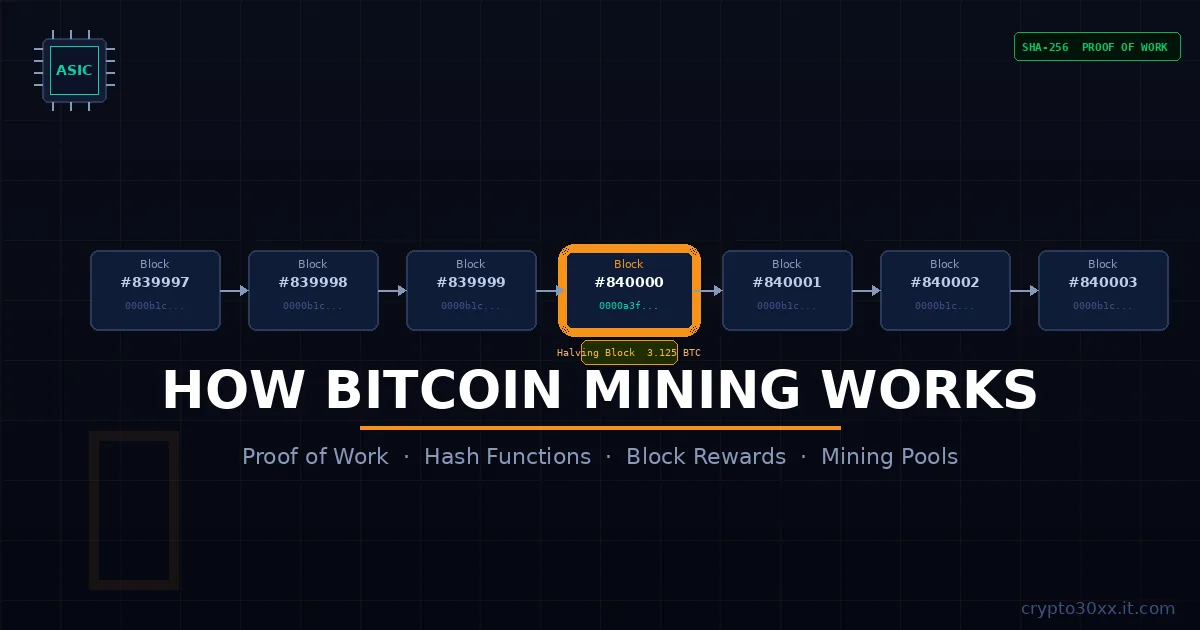
Bitcoin’s supply is capped at 21 million coins. To ensure they are not all issued immediately, Satoshi encoded a rule: every 210,000 blocks, the block subsidy drops by 50%. This event is called the halving.
The progression of subsidies:
| Period | Block subsidy |
|---|---|
| 2009–2012 (blocks 0–209,999) | 50 BTC |
| 2012–2016 (blocks 210,000–419,999) | 25 BTC |
| 2016–2020 (blocks 420,000–629,999) | 12.5 BTC |
| 2020–2024 (blocks 630,000–839,999) | 6.25 BTC |
| 2024–present (blocks 840,000+) | 3.125 BTC |
The April 2024 halving, at block 840,000, reduced the subsidy from 6.25 BTC to 3.125 BTC per block. With roughly 144 blocks mined per day, approximately 450 new BTC enter circulation daily under the current schedule.
Transaction fees as long-term revenue
As the block subsidy declines through successive halvings, transaction fees become a progressively larger share of miner income. The protocol has no end date for fees — miners will continue earning them as long as transactions occur on the network, even after all 21 million bitcoin have been issued, which the issuance schedule projects for around the year 2140.
Mining pools: why solo mining rarely works
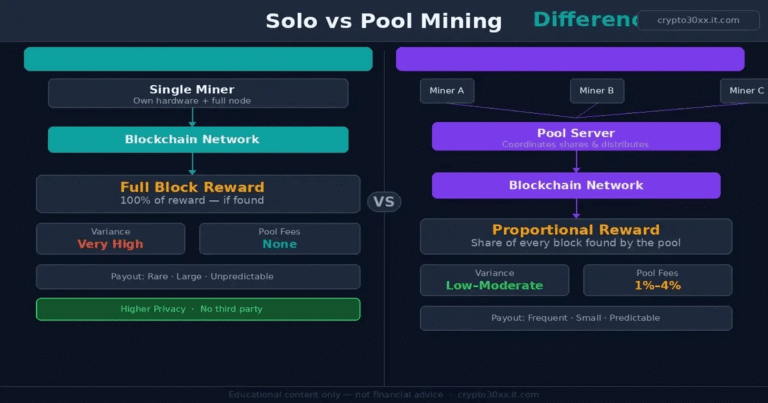
A single mining machine, however powerful, represents a tiny fraction of the global hash rate. The probability of solo-mining a block is so low that a miner could operate for years without a single reward. Mining pools exist to solve this statistical problem.
How pools function
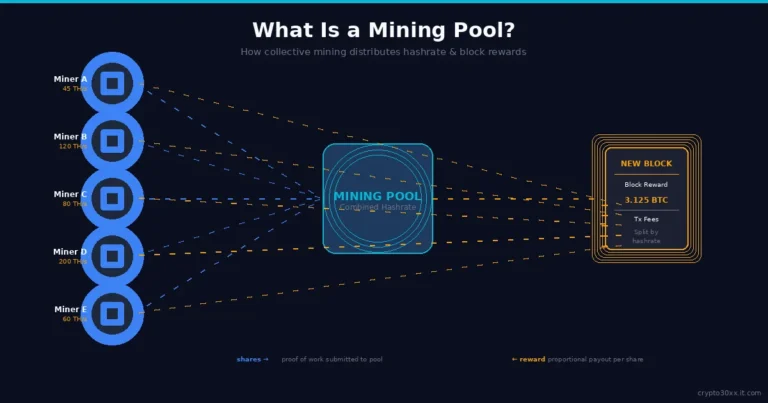
A mining pool is a group of miners who combine their hash rate and share rewards proportionally. Instead of each miner racing independently, the pool submits work collectively and distributes winnings according to each participant’s contribution.
Individual miners send the pool “shares” — hash results that meet a lower difficulty threshold than the network requires. These shares prove the miner is working without requiring the network-level solution. When the pool finds a valid block, the reward is divided among all contributors based on the shares they submitted.
Pool fees and payout structures
Pools typically charge a fee of 1–4% of mining revenue. Payout structures vary:
- PPS (Pay Per Share): Miners receive a fixed payment per valid share, regardless of whether the pool finds a block. Predictable income, higher fee.
- PPLNS (Pay Per Last N Shares): Rewards are distributed from actual blocks found, weighted toward recent shares. Less predictable, lower fee, rewards loyal miners.
- FPPS (Full Pay Per Share): Like PPS but also includes a proportional share of transaction fees.
Risks and limitations of bitcoin mining
Understanding the economics and risks is as important as understanding the mechanism.
Capital intensity and hardware depreciation
Mining hardware is expensive, depreciates fast, and becomes obsolete in a matter of years. Each new ASIC generation raises the network hash rate, which forces up the difficulty, which strands older machines below break-even. A machine bought today is generally competitive for roughly two to four years at prevailing electricity rates, after which newer hardware prices it out.
Electricity cost as the primary variable
Energy is the ongoing cost that determines profitability. Mining is energy-intensive by design — that energy expenditure is what makes the blockchain expensive to rewrite. Miners with access to cheap electricity (stranded hydro, excess grid capacity, industrial rates) hold a structural advantage over those paying retail rates.
Revenue uncertainty
Mining revenue depends on three factors that can all move independently: bitcoin’s price, network difficulty, and transaction fee levels. A halving cuts the subsidy in half overnight. Difficulty can rise sharply if large mining operations come online. None of these variables is predictable with precision.
Centralization pressure
Despite Bitcoin’s decentralized design, mining has consolidated around large industrial operations and a relatively small number of pools. The top pools have historically controlled significant portions of global hash rate, which is worth monitoring as a structural concern for the network.
Environmental considerations
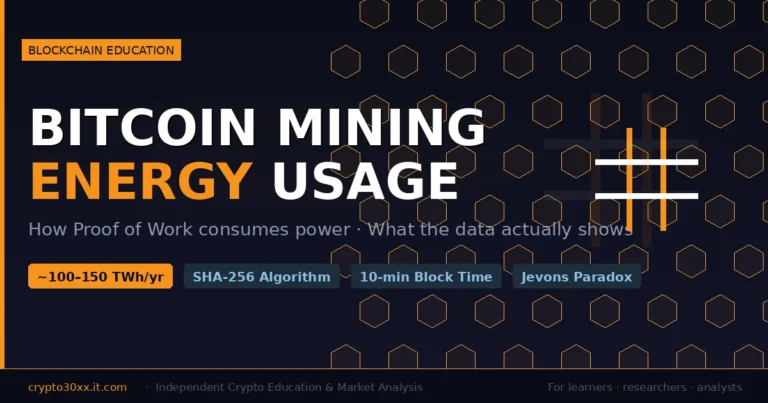
Bitcoin mining uses substantial amounts of electricity. The industry has increasingly moved toward renewable and stranded energy sources — hydro, wind, solar, and flared natural gas — but the energy consumption debate is genuine and ongoing. Researchers and regulators continue to examine the net environmental impact, and the answer varies substantially depending on the energy mix each mining operation uses.
FAQs
Can anyone mine bitcoin? Technically yes — the protocol is open. Practically, solo mining on consumer hardware is economically ineffective given today’s network hash rate. Joining a mining pool reduces variance, but profitability still depends heavily on electricity cost, hardware efficiency, and network conditions.
What happens when all 21 million bitcoin are mined? Block subsidies will eventually reach zero after all 210,000-block halvings complete, projected around 2140. Miners would then earn only transaction fees. Whether fees alone provide sufficient incentive to secure the network is a debated long-term question in Bitcoin research.
How long does it take to mine one bitcoin? Bitcoin is not mined coin by coin — it is issued per block. At the current subsidy of 3.125 BTC per block and a ten-minute block time, one block takes ten minutes on average. How much of that reward any individual miner earns depends entirely on their share of total network hash rate.
What is the SHA-256 algorithm? SHA-256 (Secure Hash Algorithm 256-bit) is a cryptographic hash function developed by the US National Security Agency and published as a public standard. It takes any input and produces a 256-bit (64-character hexadecimal) output. Bitcoin uses it twice in sequence (SHA-256d) for its proof-of-work puzzle.
Is bitcoin mining profitable? Profitability depends on electricity cost, hardware efficiency, bitcoin’s price, and current network difficulty. These four variables interact in ways that make a universal answer impossible. Operations with very low electricity costs and modern hardware can remain profitable across wide ranges of market conditions; those with high costs may not.
What is a mining rig? A mining rig is the physical hardware setup used to mine cryptocurrency. For Bitcoin, this is almost always one or more ASIC machines, along with the cooling, power supply, and network infrastructure needed to run them.
What does “hash rate” mean? Hash rate is the number of SHA-256 calculations a miner or the entire network performs per second. It is measured in terahashes (TH/s), exahashes (EH/s), or zettahashes (ZH/s). Higher hash rate means more chances per second to find the valid block hash.
Why does Bitcoin target ten-minute blocks? Ten minutes was a deliberate design choice in Satoshi’s original protocol. It allows enough time for a found block to propagate across the global network before the next one is found, reducing the probability of two valid blocks appearing simultaneously (called a fork). Shorter block times increase fork risk; longer times slow transaction confirmation.
Disclaimer
This article is produced for educational and research purposes by crypto30xx.it.com, an independent cryptocurrency education blog. It does not constitute financial advice, investment advice, or any recommendation to buy, sell, or hold any asset. Cryptocurrency mining involves significant financial risk, including loss of capital. Readers should conduct their own research and, where appropriate, consult a qualified financial professional before making any decisions.
Mining is not a metaphor. It is the literal mechanism by which Bitcoin keeps time, issues supply, and maintains a ledger no single party controls. Every ten minutes, somewhere on the network, a machine finds the right hash — and one more block gets written. That process, running continuously since the genesis block in January 2009, is what makes Bitcoin function without a bank. The elegance is in how one competitive mechanism solves three separate problems at once: issuance, transaction settlement, and network security. That is worth understanding regardless of what you think about cryptocurrency as an investment
Curiosity meets clarity inside our well-researched featured blog posts.