NFT minting process explained: how digital assets go on-chain
NFT minting process explained: Minting an NFT is the act of writing a new token record to a blockchain. It converts a digital file — image, audio, video, document — into a permanent, verifiable entry on a public ledger, assigning it a unique token ID and an owner address. Unlike uploading a file to a server, minting produces a chain state that no single party can alter or delete. This guide explains exactly how that process works: what happens technically, what it costs, where files are actually stored, and what the common sticking points are for people encountering NFT minting for the first time.
What does “minting” mean in the NFT context?
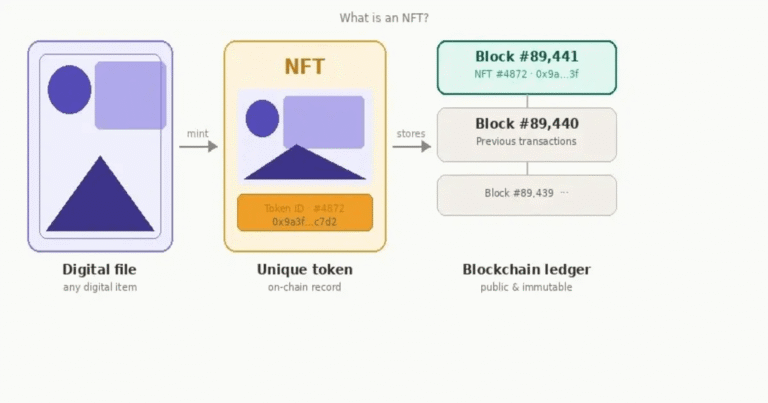
Minting, in blockchain terminology, is the creation of a new token. The word is borrowed from currency production: just as a mint manufactures physical coins and introduces them into circulation, NFT minting creates a new token unit and records it on-chain. The result is a non-fungible token — a unique record that cannot be replicated or swapped one-for-one with another token of the same type.
The minting transaction is the moment a smart contract assigns a token ID, records the creator’s address as the original owner, and anchors the token’s metadata. Before this transaction is confirmed, the NFT does not exist as a blockchain object; after confirmation, it is permanent and publicly verifiable.
How minting differs from uploading
Uploading a file to a website stores it on a private server. The file can be deleted, moved, or modified by whoever controls that server.
Minting ties a cryptographic reference to that file to a blockchain record. The record itself — the token ID, owner address, and contract address — is immutable once confirmed. The file it points to may or may not be equally permanent, depending on where it is stored (more on that below).
Fungible vs non-fungible: the distinction that matters
A fungible token is interchangeable. One unit of ETH is worth exactly one other unit of ETH; they are mathematically equivalent. A non-fungible token carries a unique token ID within its contract. Token #1 and Token #2 from the same collection are not equivalent, even if their visual content looks similar. This uniqueness is what gives NFTs their provenance properties.
How the NFT minting process works, step by step
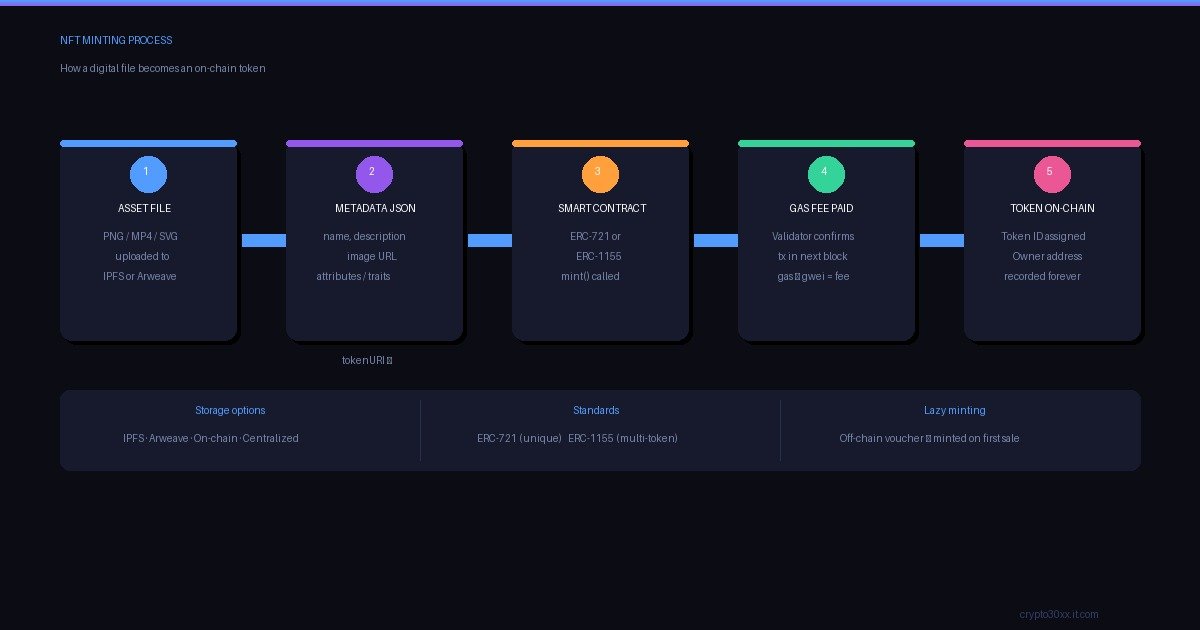
The minting process involves four distinct technical phases: preparing the asset and metadata, deploying or interacting with a smart contract, paying the gas fee to confirm the transaction, and receiving the token in a wallet. Each phase has components worth understanding separately.
Phase 1: asset preparation and metadata assembly
Before anything goes on-chain, the creator prepares two things: the asset file itself, and a metadata file that describes it.
The asset file is the actual content — a PNG, MP4, FLAC, PDF, or any supported format. This file is typically not stored on the blockchain directly. Block space is expensive, and most networks cannot practically hold large binary files in their state. Instead, the file is uploaded to an off-chain or decentralized storage system, and the resulting URL or content-addressed hash is embedded in the metadata.
The metadata file is almost always a JSON document. It typically contains:
name— the token’s titledescription— a text descriptionimage— the URL pointing to the asset fileattributes— an array of trait key-value pairs (used in generative collections)external_url— optional link to a project website
The metadata JSON is also stored off-chain, and the URL pointing to it becomes the token’s tokenURI — the on-chain reference that wallets and marketplaces query to display the NFT.
Phase 2: smart contract interaction
NFTs live inside smart contracts. The two dominant standards on Ethereum-compatible chains are ERC-721 and ERC-1155.
ERC-721: Each token is unique. Minting calls the contract’s mint() or safeMint() function, which increments the token ID counter and records the new owner. This is the standard for 1-of-1 artworks and unique collectibles.
ERC-1155: A single contract can hold multiple token types, some fungible and some non-fungible. Minting calls mintBatch() or equivalent. This is common in gaming assets where a player might own 200 identical swords (fungible) and one unique legendary weapon (non-fungible) under the same contract.
A creator can deploy a fresh contract for full control, or call a pre-deployed shared contract through a platform like OpenSea, Manifold, or Zora. Platforms that use shared contracts let creators mint without writing or deploying code — the platform’s contract handles the logic, and the creator’s wallet signs the mint transaction.
Phase 3: the gas transaction
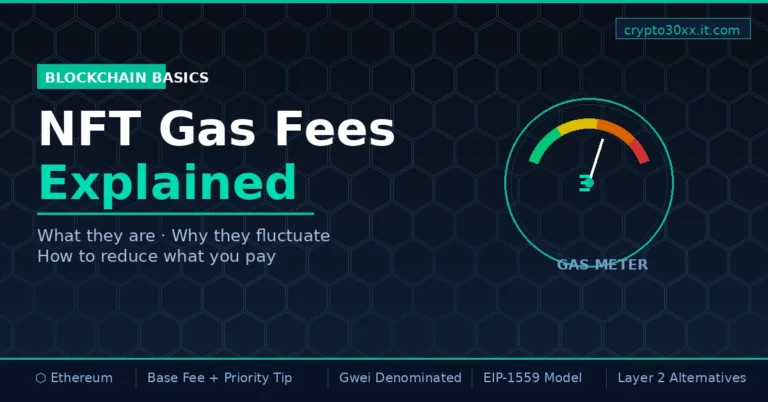
Gas is the fee paid to network validators (or miners, on proof-of-work chains) to process and confirm a transaction. The cost is determined by:
- Gas limit: the maximum computational units the transaction may consume. A standard ERC-721 mint typically consumes between 50,000 and 150,000 gas units, depending on contract complexity.
- Gas price: the amount paid per unit, denominated in gwei (one gwei equals 0.000000001 ETH). Gas price fluctuates with network demand.
- Total fee = gas units × gas price. At 50 gwei and a 100,000-unit mint, the fee would be 0.005 ETH.
The creator signs the transaction with their private key using a wallet like MetaMask. The signed transaction is broadcast to the network, picked up by validators, included in a block, and confirmed. Confirmation depth (the number of blocks added after the one containing the transaction) determines how final the transaction is considered.
On congested networks, transactions with low gas prices may sit in the mempool for extended periods. Most wallets allow users to set a priority fee to accelerate confirmation.
Phase 4: token receipt and on-chain state
Once the block is confirmed, the contract’s state reflects the new token. The minter’s wallet address is recorded as the owner of the new token ID. Any marketplace or wallet that reads that contract will display the NFT by querying the tokenURI, fetching the metadata JSON, and rendering the asset file.
The minting transaction is visible on-chain in perpetuity — block explorers like Etherscan display the contract address, token ID, timestamp, creator address, and gas paid.
Where NFT files are actually stored
This is the part of the NFT minting process that causes the most confusion, and where the most risk accumulates for buyers.
Centralized storage
Some platforms store asset and metadata files on their own servers. An NFT minted this way points to a URL like https://platform.com/metadata/12345. If the platform shuts down or changes the file at that path, the NFT’s displayed content changes or disappears — even though the on-chain token record remains. The token still exists; it just points to nothing useful.
IPFS (InterPlanetary File System)
IPFS is a content-addressed, peer-to-peer storage protocol. Files are identified by their content hash (a CID, or Content Identifier), not by a server location. An IPFS URL looks like ipfs://QmXyz.... As long as at least one node on the IPFS network pins the file, it remains retrievable and verifiable — anyone can confirm the file matches the hash recorded in the metadata.
IPFS is not inherently permanent. If all nodes that pin a file stop pinning it, the file becomes unretrievable. Pinning services like Pinata and NFT.Storage (powered by Filecoin) provide paid or subsidized guarantees of continued availability.
Arweave
Arweave is a decentralized storage protocol designed for permanent storage. Files are stored with a one-time payment that funds retrieval in perpetuity through an endowment model. Arweave is increasingly used for high-durability NFT storage, particularly in collections intended to persist for decades.
Fully on-chain storage
A small category of NFTs stores both the metadata and the asset directly in the smart contract, typically as SVG graphics or compact generative code. These NFTs are the most durable — they have no external dependency. The Nouns project and Art Blocks (for on-chain outputs) are documented examples. Fully on-chain storage is expensive and limits file complexity, which is why it remains uncommon for media-heavy collections.
| Storage type | Permanence | File size flexibility | Dependency risk |
|---|---|---|---|
| Centralized server | Low | High | Platform failure |
| IPFS (unpinned) | Medium | High | Node unpinning |
| IPFS + pinning service | Medium-high | High | Pinning service continuity |
| Arweave | High | Medium | Network survival |
| Fully on-chain | Very high | Very low | None |
Lazy minting: deferred on-chain writing
Many platforms offer lazy minting — a mechanism where the NFT is not written to the blockchain at the moment of creation. Instead, the creator signs a voucher (a cryptographic proof of intent) that is stored off-chain. The actual minting transaction happens only when a buyer purchases the token, at which point the buyer typically pays the gas fee.
Lazy minting reduces the upfront cost barrier for creators, since no gas is spent until a sale occurs. The trade-off is that the token has no on-chain existence until purchase, which means it cannot be verified by block explorers or transferred between wallets before that point.
OpenSea’s early lazy minting system and Manifold’s claim-based minting both operate on this principle, with minor implementation differences.
Gas fees and cost variables
Gas costs for NFT minting vary across chains and conditions. Ethereum mainnet has historically been the most expensive network for minting, with fees ranging from a few dollars in quiet periods to over $200 during peak congestion events. Layer 2 networks (Polygon, Arbitrum, Base, Optimism, zkSync) reduce gas costs by orders of magnitude — often to fractions of a cent — by batching transactions and settling compressed proofs to Ethereum.
Solana uses a different fee model: a flat lamport fee per transaction, plus a rent-exempt deposit that is returned if the account is closed. Minting a single NFT on Solana has historically cost well under $0.01 in fees (excluding marketplace listing fees), though the deposit for account creation adds a small one-time cost.
Cost factors that affect minting on Ethereum-compatible chains:
- Contract complexity: more logic means more gas consumed per mint
- Network congestion at the time of minting: higher demand raises gas price
- Whether the creator deploys a new contract or uses a shared one
- Batch minting: minting multiple tokens in a single transaction reduces per-token cost
Risks and common misconceptions in NFT minting
Misconception: the NFT is the file
The NFT is a token record on a blockchain. The file it references may be stored anywhere — or nowhere durable. Buyers who do not verify where the file is stored may find their NFT pointing to a dead link. Due diligence on storage method matters more than most marketplace UIs communicate.
Misconception: minting guarantees authenticity
Anyone can mint an NFT of any file, including files they did not create. The blockchain records that a particular address minted a particular token — it does not verify that the minter had the right to mint it. Authenticity in practice comes from the creator’s verified identity on a platform, contract address provenance, and social proof, not from the minting act itself.
Misconception: minting cannot be reversed
The on-chain record is permanent, but the token can be transferred or burned. Burning sends the token to an address from which it cannot be retrieved (a zero address or dedicated burn address), effectively removing it from circulation. The minting record still exists on-chain; only the current ownership changes.
Gas estimation failures and failed transactions
If a transaction is submitted with a gas limit too low to complete the contract’s execution, it fails. On Ethereum, failed transactions still consume gas up to the point of failure — the fee is spent even if the NFT is not minted. Wallets typically estimate gas limits automatically, but estimation errors can occur during high activity or on complex contracts.
Phishing and fake contract approvals
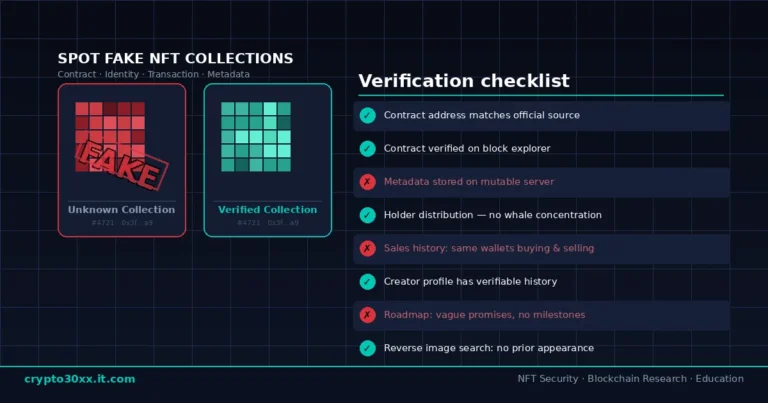
Minting interacts with smart contracts directly. Malicious sites can present transactions that appear to be minting but actually grant token spending approval to an attacker’s contract. Creators and buyers should verify contract addresses against official project sources before signing any transaction.
FAQs
What is the NFT minting process in simple terms? Minting an NFT means sending a transaction to a smart contract that creates a new token record on a blockchain. The contract assigns a unique token ID, records the minter as the owner, and links to a metadata file that describes the asset. Once the transaction confirms, the NFT exists permanently on-chain.
Do you need coding skills to mint an NFT? No. Platforms like OpenSea, Manifold, Zora, and Foundation handle the smart contract interaction through a web interface. The creator uploads their file, fills in metadata fields, and signs the transaction with a wallet. Deploying a custom contract requires coding knowledge, but using existing platform contracts does not.
What does “gas fee” mean in NFT minting? Gas is the fee paid to network validators to process a transaction. It varies with network congestion and contract complexity. On Ethereum mainnet, gas fees for a single mint can range from under $1 to over $100 depending on conditions. Layer 2 networks reduce this cost significantly.
What is lazy minting? Lazy minting defers the actual on-chain transaction until a buyer purchases the NFT. The creator signs a cryptographic voucher off-chain. When a sale occurs, the minting transaction is triggered and the buyer typically covers the gas fee. The NFT has no blockchain existence until that point.
What is ERC-721 vs ERC-1155? ERC-721 is the standard for unique, one-of-one tokens — each token ID maps to one owner. ERC-1155 is a multi-token standard that handles both fungible and non-fungible tokens in a single contract, useful for gaming items and editions. Both are widely supported across Ethereum-compatible chains.
Where is the actual image file stored in an NFT? Usually off-chain. The blockchain holds a reference (the tokenURI) pointing to a metadata JSON file, which in turn points to the image. Common storage options are IPFS, Arweave, or centralized servers. Only a small subset of NFTs store image data directly on-chain, typically as SVG or generative code.
Can an NFT be deleted or changed after minting? The on-chain token record is permanent and cannot be altered. However, if the metadata or asset files are stored on a mutable server, the content those files contain can change. The token still exists; only what it displays changes. On-chain or IPFS-pinned assets reduce this risk.
Can someone mint an NFT of a file they do not own? Technically yes — the blockchain does not verify intellectual property rights. The minting act itself creates no legal ownership of the underlying artwork. IP disputes in NFTs are resolved through legal channels, not blockchain logic. Buyers should verify creator identity before purchasing.
Disclaimer
This article is written for educational and research purposes only. It does not constitute financial, legal, or investment advice. NFTs involve significant risks, including loss of funds through gas fees, smart contract vulnerabilities, and loss of asset access due to storage failures. Readers should conduct independent research and consult qualified professionals before making any financial decisions involving digital assets.
The NFT minting process is, at its foundation, a database write — one that happens to be distributed, public, and append-only. What makes it meaningful is the combination of factors around it: where the referenced files live, which contract standard governs the token, what the gas cost implies about chain activity at that moment, and how the creator’s identity can be verified. Understanding those four variables gives a more complete picture than the surface-level framing of “creating digital art.” The on-chain record is the easy part. The infrastructure around it is where the durability — or fragility — actually sits.
Content so good you’ll share it—start with our shareable expert article picks.