What is an NFT: a simple explanation for beginners
An NFT, or non-fungible token, is a unique digital record stored on a blockchain that proves ownership of a specific item. No two NFTs are identical. Unlike standard cryptocurrencies where each unit is interchangeable with another, every NFT carries its own permanent identity embedded in the blockchain ledger. That core property — non-fungibility — is what separates NFTs from every other token type in digital finance. This guide explains the mechanics behind how NFTs work, what they represent, where they have found practical application, and what the genuine limitations of this technology are.
What is an NFT?
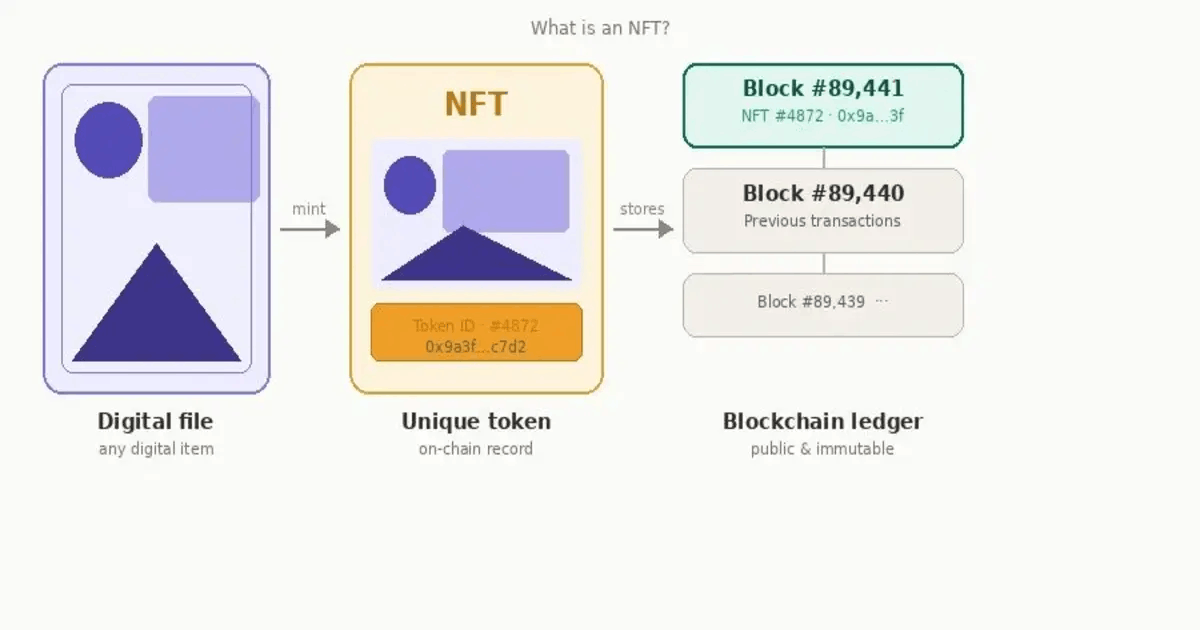
An NFT (non-fungible token) is a blockchain-based certificate that identifies ownership of a unique item. The token is not the item itself — it is the verifiable record that a specific wallet address holds rights to something specific. Because that record sits on a public, immutable blockchain, ownership can be confirmed by anyone without requiring a central authority or intermediary to maintain the database.
What “non-fungible” actually means
Fungibility is an economic property describing whether units of something are interchangeable. A $10 bill is fungible: any other $10 bill holds equal value and can be swapped without loss. One Bitcoin works the same way — each unit is identical in function and value to any other unit.
Non-fungibility works in reverse. A specific seat at a concert, an original signed manuscript, a serial-numbered limited-edition print — these items are not interchangeable with any other item. Swapping one for another produces something categorically different. NFTs encode this property into blockchain tokens: each token has a permanent, individual identity that cannot be merged with or substituted for any other.
What “token” means in this context
A token is a blockchain entry — a record confirmed by the network that tracks something of interest. Cryptocurrencies use tokens to track transferable balances. NFTs use the same basic infrastructure, but each token entry is structured to be unique: it carries a distinct token ID, a creator address, and metadata pointing to what the token represents. Two NFTs from the same collection share a smart contract address but hold different token IDs, making them separate assets with separate ownership histories.
How NFTs work on a blockchain
NFTs are minted — created for the first time — by sending a transaction to a smart contract on a blockchain network. Ethereum introduced the first widely adopted NFT standards, though several other networks have since developed their own implementations. Each minting transaction writes a permanent entry to the blockchain: who created the token, when, and what unique identifier was assigned to it.
The role of smart contracts
Smart contracts are the architecture that makes NFTs possible. A smart contract is a program stored directly on a blockchain that executes automatically when predefined conditions are met. For NFTs, the contract defines the rules of creation, transfer, and in some cases resale royalties. On Ethereum, two standards dominate: ERC-721, which creates fully unique one-per-token items, and ERC-1155, which supports limited-edition tokens where multiple copies of the same token ID can exist. These standards allow wallets, marketplaces, and applications to interact with NFTs consistently regardless of which project created them.
Ownership records and token metadata
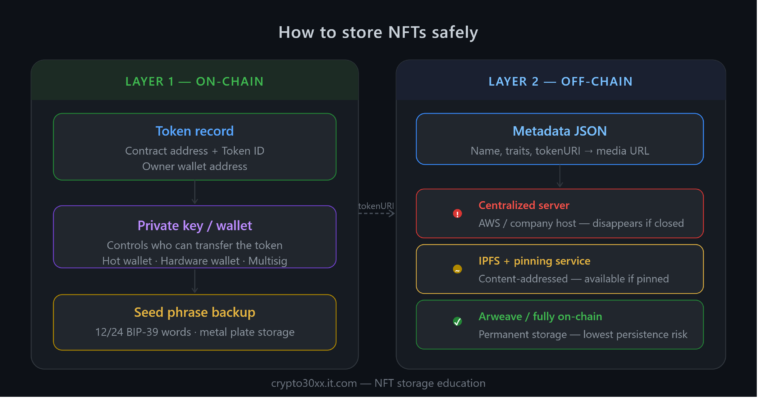
Each NFT carries metadata — a structured data file describing what the token represents. Typical metadata fields include a name, a description, a list of traits or attributes, and a link to the associated media file. On the blockchain itself, the core record is minimal: it logs the token ID, the current owner’s wallet address, and the contract governing it.
The token ID is what makes individual ownership traceable. When an NFT is sold or transferred, the on-chain ownership record updates in a single confirmed transaction. The previous owner’s address is replaced by the new owner’s, with the full history preserved.
Where the actual file is stored
The blockchain entry is small. It contains the token’s identity and a pointer — typically a URL or content hash — to the media file the NFT represents. The actual image, video, or audio lives elsewhere. Many projects store media files on IPFS (InterPlanetary File System), a decentralized storage protocol that identifies files by their content hash rather than a server location. This approach means the file’s address changes if the content changes, providing a useful form of tamper-evidence.
Other projects store the associated file on standard centralized servers. If those servers go offline, the link in the NFT metadata may break. The blockchain record remains, but the file it pointed to may no longer be accessible. This distinction is meaningful when evaluating the long-term integrity of any NFT.
NFTs vs. regular cryptocurrencies
NFTs and cryptocurrencies both live on blockchains, are stored in digital wallets, and can be transferred between users without an intermediary. Beyond those surface similarities, however, they are structured entirely differently. One is designed for interchangeable exchange; the other is designed to represent a specific, unique item that cannot be substituted for another.
| Feature | Cryptocurrency (e.g. BTC, ETH) | NFT |
|---|---|---|
| Fungibility | Fully fungible | Non-fungible |
| Divisibility | Divisible (e.g. 0.001 BTC) | Not divisible |
| Interchangeability | 1:1 swap possible | Each token is unique |
| Primary function | Medium of exchange or store of value | Proof of ownership of a unique item |
| Token standard (Ethereum) | ERC-20 | ERC-721 or ERC-1155 |
| Value determination | Market-set price identical across units | Individually negotiated per token |
What makes NFTs structurally different from Bitcoin or Ether
One ETH is identical in every respect to any other ETH. Holding 2 ETH from two different sources carries exactly the same value — origin is irrelevant. NFTs are the opposite by design. Each token has an individual history, a specific set of traits, and a separate market value even within the same collection. A common misunderstanding is that NFTs and crypto work the same way because both use blockchain. The token standard is what separates them architecturally.
What are NFTs used for?
NFTs address a real problem in digital environments: establishing verifiable original ownership of something that can otherwise be copied without friction. The technology has been applied across several distinct domains, with varying levels of practical adoption and documented results.
Digital art and collectibles
Digital artists have used NFTs to create a verifiable provenance record for original works. When a collector buys an NFT-backed artwork, the transaction is recorded permanently on-chain. Smart contracts can also encode a royalty percentage, so the original creator receives a share each time the NFT sells on a compatible marketplace. This addresses one of the core challenges of digital art: the ease of reproduction. The NFT does not prevent copying of the image file. It defines who holds the verifiable original ownership record.
Gaming and virtual items
Game studios have explored NFTs as a mechanism for representing in-game assets — characters, equipment, virtual land, and cosmetic items — on a blockchain rather than in proprietary databases controlled by the developer. The argument is that blockchain-based ownership allows players to transfer or sell items without platform permission. In practice, this works only when game infrastructure actually recognizes the on-chain data. Ownership of an in-game NFT without game-side support has no functional utility.
Music, video, and media
Musicians and content creators have used NFTs to sell limited-edition releases directly to audiences. Some have experimented with NFTs that grant access to exclusive content, backstage events, or ongoing royalty streams from a song’s revenue. Event organizers have tested ticket NFTs as a mechanism for controlling resale or encoding conditional access rules. The degree to which any of these use cases creates lasting value for buyers depends on how the issuing project sustains those commitments over time.
Real-world asset representation
An area of active experimentation involves using NFTs to represent ownership of physical assets — real estate, luxury goods, legal contracts. This is more complex than purely digital applications because it requires a functioning legal bridge between the on-chain record and enforceable off-chain rights. Different jurisdictions treat blockchain records differently in legal proceedings. A well-functioning real-world asset NFT depends on both the technical layer and the legal layer being aligned.
Risks and limitations of NFTs
NFTs carry documented risks that introductory coverage often minimizes or omits entirely. These are not edge cases — they are structural features of how NFT markets and technology actually work.
Market volatility and speculation
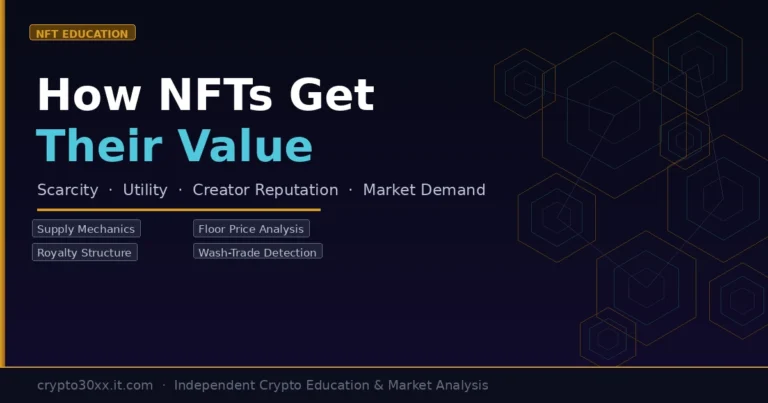
NFT values have historically shown extreme volatility. Prices depend entirely on what another buyer is willing to pay. There is no underlying asset generating cash flow, no yield, and no structural floor price. Collections that traded at high valuations have entered extended periods of near-zero trading activity. Illiquidity is common: finding a buyer at a desired price is not guaranteed, and in thin markets, it may be practically impossible within any reasonable timeframe.
Intellectual property misconceptions
Buying an NFT does not automatically transfer copyright or any intellectual property rights over the associated work. Unless a separate legal agreement explicitly transfers those rights, the buyer holds the on-chain record — not a license to reproduce or commercially exploit the work. The terms differ significantly across projects, and many buyers have incorrectly assumed standard IP transfer. Separately, minting an NFT using content one does not own is technically possible, which means the existence of an NFT is not proof of legitimate creation.
Technical risks
Access to an NFT depends entirely on controlling the private key for the wallet that holds it. A lost key means permanent, irreversible loss of access. A stolen key — through phishing attacks, malicious smart contract interactions, or social engineering — allows an attacker to transfer the NFT immediately and without recourse. Blockchain transactions cannot be reversed. Smart contract vulnerabilities present a further risk: exploitable bugs in poorly audited contracts have been used to drain NFTs from multiple wallets in documented incidents.
Environmental considerations
Criticism of NFTs has included concerns about energy consumption, particularly for networks using proof-of-work consensus, where miners compete computationally to confirm transactions. The energy footprint of any NFT transaction depends on which network it runs on and what consensus mechanism that network uses. Proof-of-stake networks, which validate transactions through staked capital rather than computational competition, use substantially less energy per transaction. This varies by chain and is worth examining for anyone who weighs environmental factors in their analysis.
How to read an NFT listing
When examining an NFT on a marketplace, several data fields appear consistently. Understanding what they mean allows for clearer evaluation, and every field below is independently verifiable using a block explorer.
- Contract address: The unique identifier for the smart contract governing the collection. Cross-reference this with the official project source to confirm legitimacy before any transaction.
- Token ID: The individual identifier within the collection. Two tokens sharing a contract address but carrying different token IDs are separate, distinct assets.
- Creator/minter address: The wallet that originally called the mint function. Useful for verifying whether the token was created by the expected address.
- Current owner: The wallet currently holding the token. This updates automatically with every confirmed transfer.
- Token standard: ERC-721 indicates a fully unique, one-of-a-kind token. ERC-1155 indicates a token that may exist in multiple copies under the same ID.
- Metadata: The name, description, and trait attributes associated with this token. Viewable on the marketplace and usually fetchable directly from the contract.
- Transaction history: The complete on-chain record of every sale, transfer, and listing. Fully public and verifiable.
- Storage type: Whether the metadata and media file link to IPFS or a centralized server matters for assessing whether the file remains accessible long-term.
FAQs
Do I actually own something when I buy an NFT? You own the on-chain record — the entry in the smart contract assigned to your wallet. Whether that translates to copyright, reproduction rights, or commercial rights depends on the specific terms of the project. Those terms vary significantly across collections, and they must be read separately from the transaction itself.
Can someone just screenshot my NFT and own it? Copying the image file is possible, but it does not replicate the on-chain ownership record. The NFT is the blockchain entry, not the image. Copying the file is analogous to printing a photograph of a painting — the copy exists, but the documented provenance and verified ownership record do not transfer.
What is “minting” an NFT? Minting is the act of writing a new token to the blockchain for the first time. The creator calls the mint function on a smart contract, which registers a new token ID to their wallet address. A network transaction fee (gas fee) is paid to the validators who confirm the transaction.
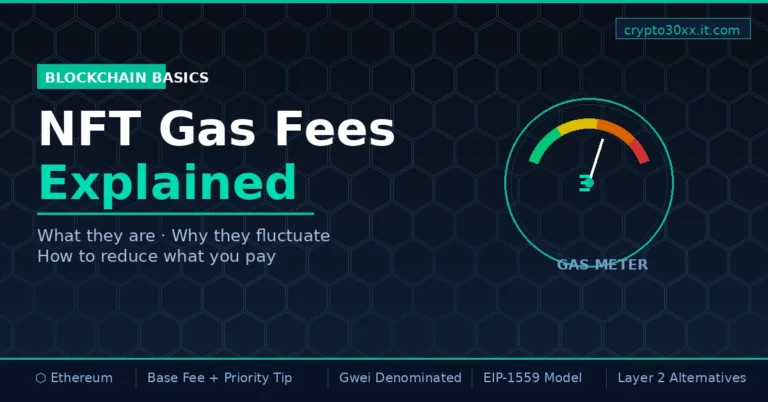
What is a gas fee? A gas fee is the cost paid to validators or miners who process and confirm a blockchain transaction. On Ethereum, gas fees fluctuate based on how much demand exists for block space at any given time. High-demand periods produce higher fees; quieter periods produce lower ones. Gas is denominated in gwei, a fractional unit of ETH.
Are NFTs the same as the digital files they represent? No. The NFT is a blockchain record that points to a file. The file and the record are separate objects. Anyone can copy the file. Only the holder of the wallet tied to the on-chain record holds the NFT.
What is an NFT collection? A collection is a set of NFTs deployed under a single smart contract, typically sharing a visual theme and trait system. Individual tokens within the collection differ in their specific trait combinations, which often affect perceived rarity and market value.
What happens to my NFT if the marketplace shuts down? The NFT remains on the blockchain, unaffected by any marketplace’s operational status. Marketplaces provide an interface for viewing and transacting with NFTs — they do not store them. The token stays in the wallet that holds it and is accessible through any compatible wallet application or block explorer.
Can NFTs be faked? The on-chain record itself cannot be falsified. What can be faked is the surrounding context: scammers create copycat collections that mimic legitimate projects using visually identical names or artwork. Verifying the contract address against the official project’s confirmed channels is the standard check for authenticity.
Disclaimer
This article is written for educational and research purposes only and does not constitute financial advice, investment advice, or any recommendation to buy, sell, or hold any digital asset. NFT markets involve significant risk, including the possibility of substantial or total financial loss. Readers should conduct independent research and, where appropriate, consult a qualified financial or legal professional before making any decisions.
The core technology behind an NFT is not complicated. A smart contract assigns a unique identity to a blockchain token, records who holds it, and updates that record automatically when ownership transfers. What makes this technology significant — and at times difficult to evaluate — is the range of assumptions, legal interpretations, and market behaviors layered on top of that simple mechanism.
Understanding what an NFT actually is: a blockchain record, not a file, not a legal contract, not a guarantee of value, gives a cleaner foundation for any further analysis. The mechanism answers the basic question. Everything else worth knowing follows from there.
Designed for lifelong learners—our continuous growth article series never stops.