Bitcoin block reward explained: how mining incentives work
Bitcoin block reward explained: The bitcoin block reward is the total amount of bitcoin a miner receives for successfully adding a new block to the blockchain. It combines two components: a fixed subsidy of newly created bitcoin and all transaction fees collected from transactions inside that block. This reward is the primary economic incentive that motivates miners to contribute computing power to the network, and it is the sole mechanism by which new bitcoin enters circulation. Understanding both components, and how they evolve over time, is fundamental to grasping Bitcoin’s monetary design.
What is the bitcoin block reward?
The bitcoin block reward is the total payment a miner receives for successfully adding a valid block to the blockchain. It consists of two parts: a newly minted coin subsidy and all transaction fees included in that block. Without it, miners have no economic reason to expend resources securing the network.
Block subsidy: newly minted bitcoin
The block subsidy is the fixed amount of new bitcoin the protocol creates with each valid block. It started at 50 BTC per block at Bitcoin’s launch and is programmed to halve roughly every 210,000 blocks — approximately every four years. The subsidy declines until it reaches zero, at which point the total supply is capped at just under 21 million coins.
Satoshi Nakamoto embedded this issuance schedule directly into Bitcoin’s protocol as a mechanism for controlled, predictable supply growth. The design parallels the declining extraction rate of a finite natural resource: abundant early, then progressively scarcer.
Transaction fees: the variable component
Transaction fees are amounts users attach to their transactions as payment for prioritizing inclusion in a block. Every transaction broadcast to the Bitcoin network competes for limited block space. Miners, acting rationally, select transactions that maximize total fee revenue, so higher fees generally result in faster confirmation.
In early Bitcoin history, fees were negligible compared to the subsidy. As the subsidy shrinks with each halving event, fees become an increasingly critical share of total miner revenue — and eventually the only source of it.
How does the bitcoin block reward work?
The bitcoin block reward is created and distributed through Bitcoin’s proof-of-work consensus mechanism. Each time a miner successfully solves a cryptographic puzzle and broadcasts a valid block to the network, the protocol automatically awards that miner the coin subsidy and all transaction fees from that block. This happens, on average, approximately every 10 minutes.
The mining process and proof of work
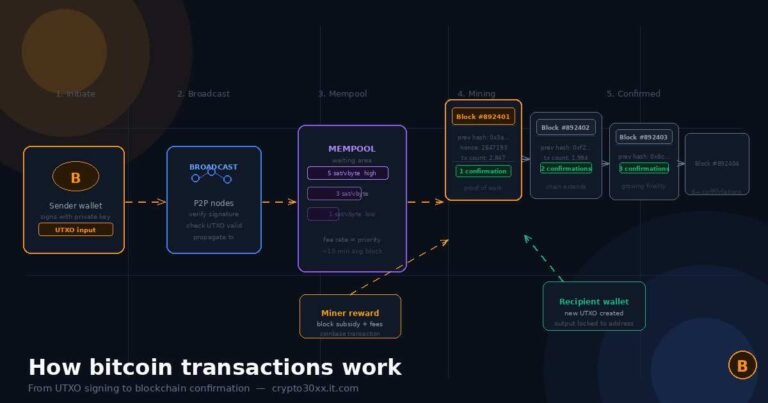
Miners gather pending transactions from the mempool (a waiting area for unconfirmed transactions) and group them into a candidate block. They then repeatedly hash the block header, adjusting a value called the nonce, until the resulting hash meets the network’s current difficulty target. A valid hash must begin with a required number of leading zeros, which makes it statistically rare to produce.
This computation is expensive by design. The difficulty target adjusts automatically every 2,016 blocks, roughly every two weeks, to maintain an average block time of 10 minutes regardless of how much total hashing power participates in the network.
Block validation and the coinbase transaction
Once a miner finds a valid hash, it broadcasts the completed block to the network. Other nodes independently verify that:
- The hash meets the current difficulty target
- All included transactions are valid with no double-spends or invalid signatures
- The coinbase transaction does not exceed the allowed subsidy plus total collected fees
The coinbase transaction is the mandatory first transaction in every Bitcoin block. It has no inputs and assigns the newly created bitcoin plus all fees to an address the miner controls. It predates the Coinbase exchange by years and serves as the protocol mechanism that allocates the entire block reward.
The 100-block maturity period
Newly created block rewards cannot be spent immediately. Bitcoin’s protocol enforces a mandatory 100-block maturity period before coinbase outputs become spendable. This rule protects against block orphaning: when two miners find valid blocks at the same height simultaneously, only one eventually becomes part of the longest chain. Maturity ensures a miner cannot spend coins from a block that could still be invalidated by the network.
The halving: how the block reward changes over time
The halving is the scheduled reduction in Bitcoin’s block subsidy that occurs every 210,000 blocks, roughly every four years. Each halving cuts the number of new BTC awarded per block exactly in half. This mechanism controls Bitcoin’s rate of issuance, ensuring the total supply approaches its fixed cap gradually over approximately 130 years from the genesis block.
The mathematics behind the 21 million cap
The total supply cap emerges from a geometric series. Starting from 50 BTC per block, the subsidy halves every 210,000 blocks. The total amount ever issued equals:
Total = 50 × 210,000 × (1 + 1/2 + 1/4 + 1/8 + …) = 50 × 210,000 × 2 = 21,000,000 BTC
The infinite series 1 + 1/2 + 1/4 + … converges exactly to 2. In practice, the total falls fractionally short of 21 million because the subsidy eventually rounds down to zero satoshis before reaching the mathematical limit precisely. One satoshi equals 0.00000001 BTC, the smallest indivisible unit of bitcoin.
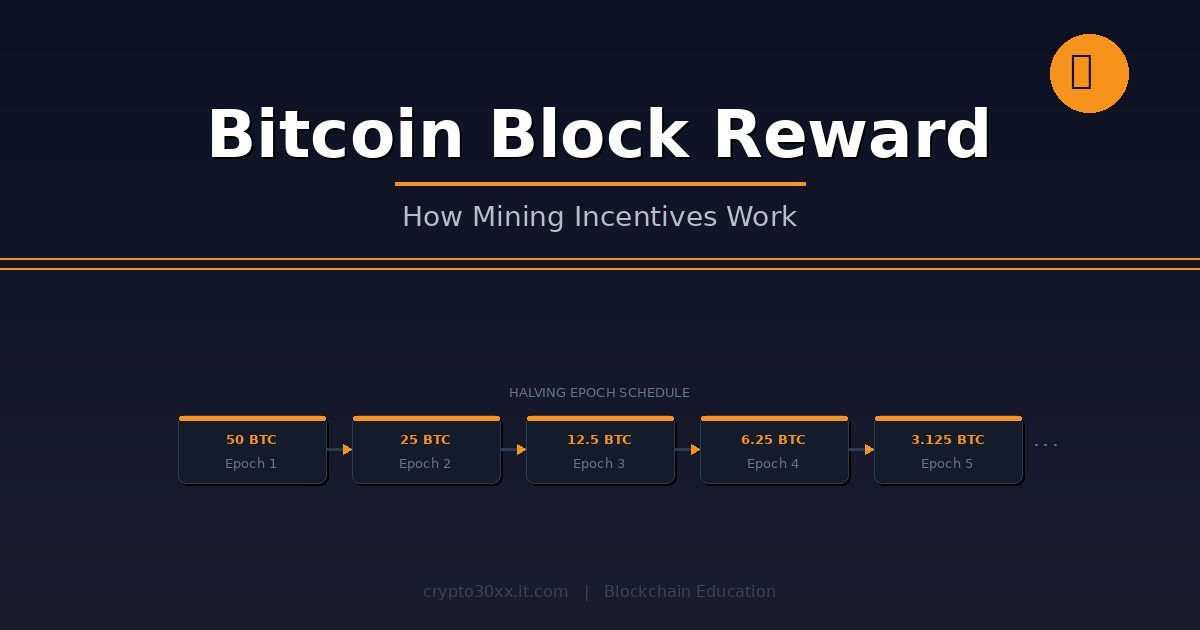
The halving epoch schedule
Bitcoin’s block subsidy has changed across each epoch as follows:
| Epoch | Block range | Subsidy per block | Approx. BTC issued |
|---|---|---|---|
| 1 | 0 – 209,999 | 50 BTC | ~10,500,000 |
| 2 | 210,000 – 419,999 | 25 BTC | ~5,250,000 |
| 3 | 420,000 – 629,999 | 12.5 BTC | ~2,625,000 |
| 4 | 630,000 – 839,999 | 6.25 BTC | ~1,312,500 |
| 5 | 840,000 – 1,049,999 | 3.125 BTC | ~656,250 |
| 6+ | 1,050,000+ | 1.5625 BTC, halving continues | Diminishing |
Each epoch issues precisely half as much new BTC as the one before it, regardless of bitcoin’s market price or total hash rate.
What happens after all bitcoin is mined?
After approximately 33 halvings, the subsidy rounds down to zero satoshis and new issuance ends permanently. From that point, miners will depend entirely on transaction fees for revenue. Bitcoin’s protocol assumes fee revenue will be sufficient to sustain adequate mining and network security. Whether that holds depends on future transaction demand, block space scarcity, and layer-2 adoption. None of those outcomes are predetermined by the protocol.
Block subsidy vs transaction fees: how the two components compare
As the block subsidy declines with each halving, transaction fees become a larger portion of total miner revenue. These two revenue streams operate under different rules, have different sources, and behave differently under market conditions. A direct comparison clarifies how Bitcoin’s incentive model is designed to evolve over time.
| Feature | Block subsidy | Transaction fees |
|---|---|---|
| Source | Protocol-issued new BTC | Users attached to pending transactions |
| Amount per block | Fixed within each epoch | Variable, driven by demand for block space |
| Predictability | High — set by protocol schedule | Low — fluctuates with network congestion |
| Long-term trend | Approaches zero across halvings | Expected to grow as block space demand increases |
| Effect on supply | Increases circulating BTC | No new BTC created |
| Miner influence | None — enforced by protocol | Indirect — miners select highest-fee transactions |
The shift from subsidy-dominated to fee-dominated miner income is one of the most consequential planned transitions in Bitcoin’s protocol design. No prior monetary system has navigated a comparable structural change.
Why the bitcoin block reward matters for network security
The block reward is the mechanism that funds Bitcoin’s security model. Every miner participates because the economic incentive justifies the operational cost. This creates a direct link between block reward value and the cost of attacking the network, making it one of the most structurally significant parameters in Bitcoin’s protocol.
Mining economics and the difficulty adjustment
Mining is a competitive industrial activity. Miners invest in application-specific integrated circuits (ASICs), consume substantial electricity, and operate at scale to remain competitive. For mining to be economically rational, the block reward must exceed operational costs — primarily electricity and hardware amortization.
After a halving cuts the subsidy by half, less efficient operations may exit, causing a temporary drop in network hash rate. The difficulty adjustment then recalibrates every 2,016 blocks, lowering the computational requirement until a new equilibrium forms. This self-correcting mechanism keeps block times near 10 minutes regardless of how much hash rate enters or leaves the network.
The security budget
Some Bitcoin researchers use the term “security budget” to describe total miner revenue: subsidy plus fees. The argument is that the cost of a 51% attack scales with total hash rate, which scales with miner profitability. A declining security budget could, in theory, translate to reduced hash rate and a more vulnerable network over the long term.
Critics argue that rational miners would not abandon a well-functioning network as subsidies decline, particularly if fee revenue grows alongside transaction demand. Proponents of the concern counter that fee revenue is inherently volatile and cannot be guaranteed. This remains one of the more substantive open debates in Bitcoin economics research.
Common misconceptions about block rewards
Several misunderstandings about the bitcoin block reward appear consistently across general writing and informal discussions:
- Miners can spend rewards immediately: Bitcoin’s protocol enforces a mandatory 100-block maturity window. Coinbase outputs cannot be spent before that threshold passes.
- Transaction fees go to a central party: Every fee in a block goes entirely to the miner who includes that block. No central entity receives or controls any portion of the fees.
- The halving causes an immediate price change: The halving alters the rate of new supply entering circulation, not price directly. Market responses depend on demand-side conditions that the protocol does not control.
- The 21 million cap is an arbitrary number: The cap emerges directly from the geometric series structure of the halving schedule. It is encoded in Bitcoin’s consensus rules and would require a protocol-level change, with broad network agreement, to modify.
FAQs
What exactly is the bitcoin block reward? The bitcoin block reward is the total compensation a miner earns for successfully adding a valid block to the blockchain. It consists of the protocol-defined block subsidy (newly created BTC) plus all transaction fees collected from transactions in that block. Both components go entirely to the winning miner.
How often does the block subsidy halve? The block subsidy halves every 210,000 blocks, which takes roughly four years given Bitcoin’s 10-minute average block time. This event is called the halving. It permanently reduces the rate of new BTC issuance by half and has occurred at regular intervals since Bitcoin’s genesis block in January 2009.
What is the block subsidy after the fourth halving? After the fourth halving at block height 840,000, the subsidy became 3.125 BTC per block. This subsidy remains in place until the fifth halving, scheduled for block height 1,050,000. Transaction fees add a variable amount on top, so the total per-block reward fluctuates with network demand.
Will miners stop mining when the block reward ends? Bitcoin’s design anticipates that transaction fees will replace the block subsidy as the primary source of miner revenue once all BTC is issued. Whether fee revenue can sustain sufficient mining and network security is actively debated. The outcome depends on transaction volume, block space demand, and protocol developments not predetermined by Bitcoin’s current rules.
Can the 21 million supply cap be changed? Any Bitcoin protocol rule can technically be changed if a broad supermajority of nodes, miners, and economic participants adopt a new version. The 21 million cap has strong consensus across the network and is considered one of Bitcoin’s most settled parameters. A proposal to raise it would face substantial resistance and is widely regarded as unlikely to achieve the required consensus.
What is the coinbase transaction? The coinbase transaction is the mandatory first transaction in every Bitcoin block. It has no inputs and is where the miner creates the block subsidy and collects fees, assigning them to an address the miner controls. All coinbase outputs are subject to a 100-block maturity period before they become spendable.
How do mining pools distribute block rewards? Mining pools collect all block rewards won by the pool and distribute proportional shares to participating miners based on submitted proof-of-work contributions, called “shares.” Common distribution structures include Pay Per Share (PPS), which offers a fixed payout per valid share regardless of whether the pool wins a block, and Proportional (PROP), where payouts depend on actual blocks found by the pool.
How does the block reward enforce bitcoin’s fixed supply? The block reward is the only channel through which new bitcoin enters circulation. Because the subsidy halves on a fixed, predictable schedule and eventually rounds to zero satoshis, the total amount of bitcoin that will ever exist is mathematically bounded at just under 21 million. The block reward structure is the direct mechanism behind Bitcoin’s programmatic scarcity.
Disclaimer
This article is produced by an independent cryptocurrency education and research blog. Nothing here constitutes financial advice, investment guidance, or a recommendation to buy, sell, or hold any digital asset. Cryptocurrency markets carry significant risk; readers should conduct independent research and consult qualified professionals before making any financial decisions.
Conclusion
The bitcoin block reward is the economic engine behind both network security and controlled supply issuance. Miners secure the blockchain because the reward makes it rational to do so. As the subsidy halves on a fixed schedule, Bitcoin’s incentive model gradually shifts toward transaction fees — a transition without clear precedent in monetary history. For anyone studying how Bitcoin actually functions, the block reward is the right place to start.
Our healing reflections bring you back to yourself whenever life pulls you far from our warm corner.