Bitcoin whitepaper summary: a complete beginner’s guide
Bitcoin whitepaper summary: The Bitcoin whitepaper is a nine-page technical document published on October 31, 2008, by a pseudonymous author — or group of authors — using the name Satoshi Nakamoto. Titled “Bitcoin: A Peer-to-Peer Electronic Cash System,” it proposed a method for sending digital payments directly between two parties without involving a bank or any other intermediary, solving a problem that had blocked digital currency for decades. This guide breaks down every major section of that document in plain language, so any reader — regardless of technical background — can understand what it argues, how it works, and why it matters.
What problem does the Bitcoin whitepaper actually solve?
Before Bitcoin, every attempt at purely digital money ran into the same wall: you can copy a digital file. Hand someone a dollar bill and it’s gone from your hand. Hand someone a digital token and, without a central record-keeper, you might copy it first and spend it twice. That vulnerability is called the double-spending problem, and for years the only practical fix was a trusted institution — a bank — that maintained the authoritative ledger and decided which transactions were valid.
The whitepaper’s opening argument is surgical: financial institutions cannot be fully trusted, all disputes require reversible transactions, and reversibility creates costs, fraud risk, and the need for intermediaries. Satoshi’s proposal was to replace institutional trust with cryptographic proof — a system where the math itself enforces the rules, leaving no single entity in control.
That single reframing is the intellectual foundation of the entire document.
Why “trustless” matters
A trustless system does not mean participants distrust each other in a social sense. It means the protocol does not require you to trust any particular participant for it to function correctly. No bank can freeze your funds; no government can alter your transaction history; no company can change the rules unilaterally. The validity of every payment is established by the network itself.
How the whitepaper defines a Bitcoin transaction
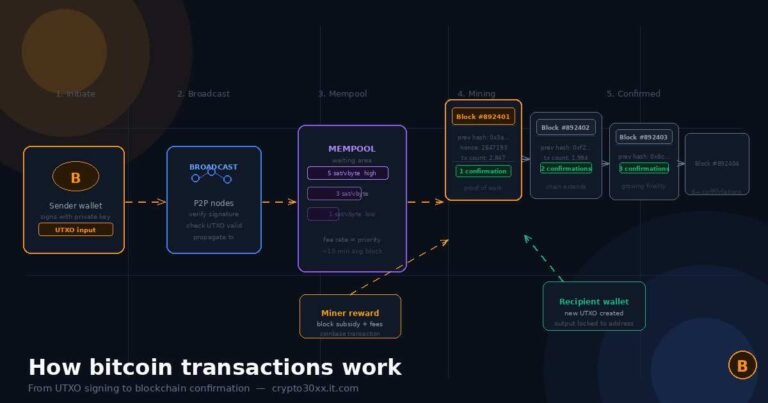
Nakamoto defines an electronic coin as a chain of digital signatures. Each time a coin is transferred, the current owner signs the previous transaction together with the public key of the next recipient. That signature is appended to the coin’s history. Anyone can verify the chain of ownership by checking the sequence of signatures — no central database required.
What a digital signature does
A digital signature proves that the sender controls a private key without revealing that key. Think of it as a wax seal you cannot forge: anyone can see it, but only the holder of the original stamp could have created it. In Bitcoin, your private key is the stamp, your public key is the seal impression, and the signature is what locks each outgoing transaction.
The remaining problem: double-spending
Even with signatures, a sender could theoretically broadcast the same coin to two different recipients simultaneously. Signatures prove ownership but cannot, by themselves, establish which of two conflicting transactions arrived first across a decentralized network. Solving this ordering problem is where the whitepaper’s most important technical innovation enters.
How the blockchain and timestamps work
The whitepaper’s solution to double-spending is a distributed timestamp server. Every batch of transactions is combined into a block, and that block is given a timestamp by including a cryptographic hash of all prior blocks. Each new block’s hash depends on everything that came before it. Change one old transaction and the hash of its block changes — which breaks the hash of every subsequent block. Forgery becomes computationally detectable.
This linked structure of blocks is what we now call the blockchain.
What a hash is
A hash is a fixed-length string of characters produced by running data through a mathematical function. The same input always produces the same output. Change even a single character of the input and the output changes entirely. This property makes hashes ideal for detecting tampering: if any transaction inside a block were altered, the block’s hash would immediately no longer match what the network expects.
How blocks form a chain
Each block header contains:
- A hash of the previous block (creating the chain)
- A timestamp
- A Merkle root (a single hash representing all transactions in the block)
- A proof-of-work value (explained in the next section)
The chain is append-only by design. Rewriting history requires recomputing every block that follows the altered one, faster than the rest of the network adds new blocks — a task that grows more expensive the deeper the target transaction is buried.
Proof of work: how miners secure the network
The blockchain structure alone is not enough. An attacker could still rewrite history if they had enough raw computing power. The whitepaper solves this with proof of work (PoW) — a mechanism that forces any participant who wants to add a block to demonstrate they have expended significant computational effort.
Miners search for a special number — called a nonce — that, when included in the block, causes the block’s hash to begin with a required number of zeroes. There is no shortcut: the only way to find this number is by trying billions of combinations until one works. This converts computing power into votes, making the “longest chain” also the chain with the most cumulative work invested in it.
Why this deters attacks
Rewriting a transaction buried six blocks deep means recalculating six blocks of proof of work before the rest of the network adds a seventh honest block. The whitepaper presents probability calculations showing that, as long as honest nodes collectively control more than 50% of the network’s total computing power (hashrate), the chance of a successful attacker catching up declines exponentially with each additional confirmation block.
The scenario where a single entity controls the majority of hashrate is called a 51% attack. At that point, an attacker could theoretically approve fraudulent transactions or reverse recent ones. But the whitepaper also notes a critical economic point: an entity with that much hardware is better off mining honestly and collecting block rewards than destroying the network that makes those rewards valuable.
Difficulty adjustment
The whitepaper specifies that difficulty should adjust automatically so that blocks are found at a roughly constant rate — one approximately every ten minutes in Bitcoin’s implementation. As more computing power joins the network, the target becomes harder; if power leaves, it becomes easier. This self-regulation keeps the block schedule stable regardless of network size.
The incentive structure and Bitcoin’s fixed supply
A decentralized network needs participants willing to run nodes and do the costly computational work of mining. Nakamoto’s answer is an elegantly self-funding incentive: the first miner to find a valid block earns the right to include one special transaction paying newly created coins to themselves. This is the block subsidy.
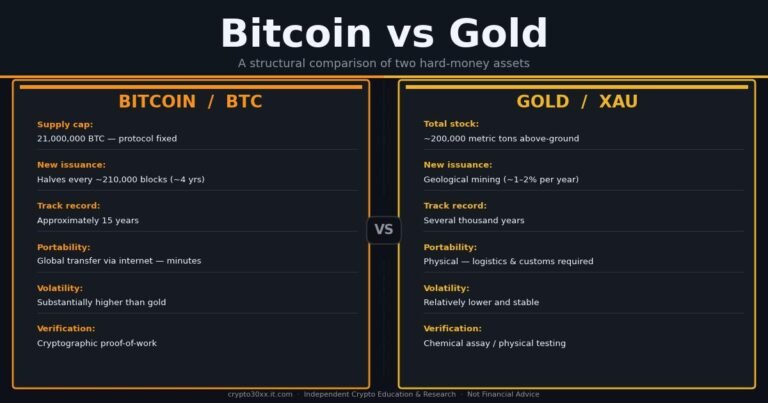
The whitepaper specifies that this subsidy provides a way to initially distribute coins into circulation without any central authority issuing them. It also specifies a hard supply limit — 21 million coins total — enforced by a halving schedule: the block subsidy is cut in half every 210,000 blocks, roughly every four years. The subsidy started at 50 BTC per block when the network launched in 2009 and halves on this fixed schedule until the supply cap is asymptotically approached and no new coins can be created.
Once the subsidy declines to near zero, the whitepaper anticipates that transaction fees paid by senders will carry the incentive forward — transitioning miners from monetary issuance to pure fee revenue.
Why the incentive also encourages honesty
Miners who cheat — who try to include fraudulent transactions — produce blocks that the honest majority will reject. Rejected blocks earn no reward. The honest strategy dominates the dishonest one, so rational participants mine honestly. This is not naive optimism; it is a deliberately engineered game-theoretic outcome.
Merkle trees: solving the storage problem
As the blockchain grows, storing every transaction indefinitely becomes impractical for most participants. The whitepaper addresses this with Merkle trees — a data structure named after computer scientist Ralph Merkle.
A Merkle tree hashes transactions in pairs, then hashes those hashes in pairs, continuing until a single hash remains: the Merkle root. This root is recorded in the block header. If any single transaction in the block is altered, the Merkle root changes, making the block invalid.
The practical benefit: a participant can verify whether a specific transaction is included in a block by checking only the relevant branch of the tree — a small subset of data — rather than downloading the entire block. The whitepaper calls this simplified payment verification (SPV).
| Structure | What it stores | Storage requirement |
|---|---|---|
| Full node | Every transaction in every block | High |
| SPV / lightweight node | Block headers + Merkle branch | Very low |
| Merkle root only | Summary hash of all transactions | Minimal |
This design allows ordinary users to verify payments on modest hardware without running a full archive node, which was an explicit design goal.
Privacy in the whitepaper’s model
Traditional banking privacy works by restricting access: only you and your bank see your transactions. Bitcoin’s model is different. All transactions are publicly announced. Privacy is preserved not by secrecy but by pseudonymity: addresses are not linked to real-world identities by default.
The whitepaper recommends generating a new key pair for each transaction to prevent linking payments to a common owner. It also draws a clear parallel to stock exchange data: the public can see that trades occurred at certain times in certain amounts, without knowing who the parties were.
This model has practical limits. Once an address is linked to an identity through an exchange or other means, the entire transaction history of that address becomes traceable. The whitepaper acknowledges this is an inherent trade-off in a system with a public ledger.
What the whitepaper does not address
Understanding what Nakamoto deliberately left out helps clarify the document’s scope:
- Smart contracts: The whitepaper describes simple value transfer. The programmable logic that characterizes Ethereum and later platforms is entirely absent.
- Scaling: The whitepaper does not propose a throughput solution for millions of transactions per second. Later developments — the Lightning Network, layer-2 protocols, other chains — emerged to address this gap.
- Governance: The whitepaper describes a protocol but not a formal process for changing it. Bitcoin’s governance has since evolved through community debate, BIP proposals, and software client adoption.
- Energy use: Proof of work is presented as a security mechanism, not analyzed from an energy-consumption perspective. This debate emerged much later as mining scaled.
These omissions are not oversights that weaken the document. The whitepaper solved one well-defined problem — trustless peer-to-peer digital cash — with precision. Everything beyond that scope it left to others.
The whitepaper’s lasting significance
The architecture described in those nine pages has since been replicated, modified, extended, and contested by thousands of projects. Every major public blockchain owes some structural debt to Nakamoto’s design: the chain of hashed blocks, the distributed consensus mechanism, the public ledger with pseudonymous participants, the protocol-enforced monetary policy.
The whitepaper also demonstrated something broader: that cryptography and game theory together can produce trustworthy coordination among anonymous participants at global scale. That proof-of-concept changed how engineers, economists, and policymakers think about monetary systems, institutional trust, and the architecture of the internet itself.
Reading the original document — which remains publicly available — is one of the more efficient ways to understand what Bitcoin actually is, as opposed to what it is often described as in popular media.
FAQs
How long is the Bitcoin whitepaper? The Bitcoin whitepaper is nine pages long and contains 12 sections, from the abstract through the conclusion. It was designed to be readable by a technically literate audience and remains one of the more concise foundational documents in the history of computing.
Who wrote the Bitcoin whitepaper? The whitepaper was published under the pseudonym Satoshi Nakamoto in October 2008. The real identity of the author or authors behind the name has never been confirmed. Several individuals have claimed or been claimed to be Nakamoto, but none has provided conclusive cryptographic proof of controlling the earliest Bitcoin wallets.
What does “peer-to-peer electronic cash” mean? It means digital value can be transferred directly from one party to another without any intermediary — no bank, payment processor, or clearing house. The network itself handles verification by maintaining a shared public ledger updated through distributed consensus.
What is the double-spending problem? Double-spending is the risk that a digital token could be copied and spent twice. Physical cash cannot be duplicated; digital data can. Solving double-spending without a central authority was the core technical challenge the whitepaper addressed through blockchain timestamps and proof of work.
What is proof of work in simple terms? Proof of work is a competition where computers race to solve a mathematical puzzle whose only practical solution method is trial and error. The winner earns the right to add the next block of transactions. The cost in computing power makes cheating economically irrational for any participant who does not control a majority of the network’s total hashrate.
What does the 21 million supply cap mean? The whitepaper defines a fixed maximum number of coins that can ever exist, enforced by a halving schedule that reduces the issuance rate of new coins every 210,000 blocks. No central authority can create additional supply. This constraint is encoded in the protocol itself and can only be changed through network-wide consensus.
Is the Bitcoin whitepaper a legally binding document? No. It is a technical proposal, not a legal instrument, a prospectus, or a contract. It describes how the system works, not who owns it, governs it, or is responsible for it. Bitcoin has no issuer, corporate entity, or legal guarantee behind it.
What happened after the whitepaper was published? Nakamoto released the Bitcoin software in January 2009 and mined the first block — the genesis block — on January 3, 2009. The embedded text in that block referenced a newspaper headline about bank bailouts, widely read as a commentary on the financial system the whitepaper proposed to circumvent. Development continued as an open-source project, and Nakamoto gradually withdrew from public communication around 2010–2011.
Disclaimer
This article is produced by crypto30xx.it.com for educational and research purposes only. It does not constitute financial, investment, or legal advice. Cryptocurrency markets carry substantial risk, including the potential loss of principal. Readers should conduct independent research and consult a qualified financial professional before making any financial decisions. The author has no affiliation with any protocol, exchange, or token issuer mentioned or implied in this article.
The Bitcoin whitepaper achieved something rare: a nine-page document that resolved a decades-old technical problem and, in doing so, established the architecture for an entirely new class of financial infrastructure. The core insight — that cryptographic proof and economic incentives, combined correctly, can substitute for institutional trust — has proven generative beyond anything its publication circumstances suggested. Any serious study of blockchain technology, digital assets, or decentralized systems still starts here.
Browse through our tender articles and feel your worries gently begin to soften and lift away.