How bitcoin ownership is proven on the blockchain
Bitcoin has no bank, no title registry, and no central body that records who owns what. Yet ownership works — reliably, globally, and without trust in any third party. How bitcoin ownership is proven comes down to three interlocking mechanisms: public-key cryptography, digital signatures, and the unspent transaction output (UTXO) model recorded on a public blockchain. Together, they replace the role that institutions play in traditional finance with pure mathematics.
This guide explains each mechanism in plain terms, how they work together, and what actually happens when someone “proves” they own bitcoin during a transaction.
What does owning bitcoin actually mean?
Owning bitcoin means possessing the private key that can authorize spending the coins assigned to a corresponding address. There is no account in the traditional sense, no username, and no database entry at a financial institution. Control of the private key is control of the coins. Lose the key, and the coins become permanently inaccessible.
This is different from how bank accounts work. A bank holds your money and maintains an internal record of your balance. You prove your identity to the bank, and the bank pays out. Bitcoin inverts that model entirely: the network holds a public record of unspent coin balances, and you prove control of those coins directly through cryptography, without identifying yourself to anyone.
Why the “ownership” framing can be misleading
In legal terms, ownership is a social construct enforced by institutions. Bitcoin has no native mechanism for courts or governments to adjudicate disputes over keys. In technical terms, the bitcoin protocol only recognizes one thing: a valid cryptographic proof that the person submitting a transaction controls the private key associated with a given address. The word “ownership” is useful shorthand. But the protocol itself deals only in mathematical proofs.
How public and private keys create a cryptographic identity
Bitcoin uses asymmetric cryptography, specifically the Elliptic Curve Digital Signature Algorithm (ECDSA) on the secp256k1 curve. Every wallet generates a private key — a 256-bit random number — and derives a corresponding public key from it.
The critical property: deriving a public key from a private key is computationally trivial. Going the other direction — working backward from a public key to recover the private key — is computationally infeasible with any known algorithm and any foreseeable hardware. This one-way relationship is the mathematical foundation of bitcoin’s security.
Private key
A private key is a 256-bit integer, effectively a number between 1 and approximately 10^77. It is generated randomly and must be kept secret. Anyone who obtains your private key can spend your coins. The private key is never broadcast to the network.
Public key
The public key is derived from the private key through elliptic curve point multiplication. It can be shared openly. In standard practice, the full public key is not exposed until the moment a user spends from an address — before that, only the hashed address is public.
Bitcoin address
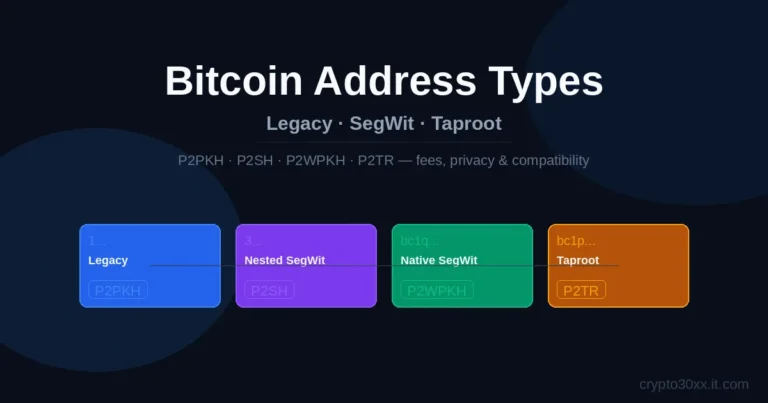
A bitcoin address is a hashed and encoded version of the public key. The transformation involves SHA-256, then RIPEMD-160 hashing, then Base58Check encoding. The resulting address (typically starting with 1 for legacy P2PKH, 3 for P2SH, or bc1 for native SegWit) is what gets shared with senders. It is a condensed, verifiable reference to the public key — not the key itself.
| Component | What it is | Who can see it |
|---|---|---|
| Private key | 256-bit secret number | Owner only |
| Public key | Derived from private key via ECDSA | Anyone, revealed at spend time |
| Bitcoin address | Hash of the public key | Anyone, shared publicly |
How digital signatures prove ownership at spend time
Knowing the address associated with some bitcoin is not enough to spend it. To move coins, a spender must produce a valid digital signature — a cryptographic proof that they know the private key corresponding to the address holding those coins, without ever revealing the private key itself.
This is how ownership is actually proven in every bitcoin transaction.
The signing process
When a user initiates a transaction, their wallet software performs these steps:
- Constructs the transaction data: inputs (which UTXOs are being spent), outputs (where the coins go), and the amounts.
- Hashes the transaction data to produce a fixed-length digest.
- Signs that digest using the sender’s private key via the ECDSA algorithm, producing a signature consisting of two values, conventionally labeled r and s.
- Includes the signature and the public key in the transaction’s input data.
- Broadcasts the transaction to the bitcoin network.
The verification process
This is the step where how bitcoin ownership is proven becomes concrete. Every node on the network independently verifies the transaction before accepting it:
- Takes the signature (r, s) and the public key from the transaction input.
- Takes the transaction data and hashes it identically to produce the same digest.
- Uses ECDSA verification math to confirm that the signature was produced by the private key corresponding to that public key, without needing to see the private key.
- Confirms that the public key hashes to the address holding the coins being spent.
- If all checks pass, the transaction is valid.
The mathematical elegance here: verification proves the signer knew the private key, while the private key is never transmitted, stored, or revealed to any party.
Why a signature cannot be reused or forged
Each ECDSA signature is unique to its transaction. The algorithm incorporates a random nonce into the signing process, meaning that signing the same transaction data twice produces two different signatures. More importantly, a valid signature for transaction A cannot be repurposed to authorize transaction B — the message digest changes, and the signature fails verification.
Forging a signature without the private key would require solving the elliptic curve discrete logarithm problem, which no known algorithm can do in practical time.
How the UTXO model tracks who holds what
Digital signatures prove authorization. But how does the network know how many coins a given address holds in the first place?
Bitcoin tracks balances through the Unspent Transaction Output (UTXO) model. There are no “accounts” with balances. Instead, the blockchain records a chain of transactions, each consuming previous outputs and creating new ones. At any moment, the UTXO set is the complete list of all coins in the system that have been received but not yet spent.
What a UTXO looks like
Every UTXO has two key components:
- Amount: the number of satoshis it contains.
- Locking script (scriptPubKey): a small program that specifies the conditions required to spend this output. For a standard pay-to-public-key-hash (P2PKH) transaction, the locking script demands a valid signature and public key that hashes to a specified address.
To spend a UTXO, a transaction must supply a corresponding unlocking script (scriptSig or witness data) that satisfies the locking conditions. The network’s Script interpreter runs both scripts together and accepts the transaction only if the result is valid.
How the UTXO set proves a balance
There is no single database entry saying “address X has 0.5 BTC.” Instead, the proof of a balance is: scan the UTXO set and find all unspent outputs whose locking scripts are satisfied by keys corresponding to a given address. Sum their amounts. That sum is the “balance.”
A full node maintains the entire UTXO set in memory. As of any given block, full nodes can confirm in milliseconds whether a proposed transaction is attempting to spend outputs that actually exist and have not already been spent.
The double-spend problem and how it is solved
One fundamental challenge in digital cash is the double-spend: what prevents someone from broadcasting the same coins to two different recipients simultaneously?
Bitcoin solves this through the combination of the UTXO model and the proof-of-work consensus mechanism. When two transactions both try to spend the same UTXO, miners include only one in a valid block. Once a transaction is confirmed in a block, the spent UTXO is removed from the UTXO set permanently. Any subsequent attempt to spend the same UTXO fails validation across every honest node.
The full proof chain: how bitcoin ownership is proven step by step
Putting these three mechanisms together, here is the complete chain of proof that makes bitcoin ownership meaningful:
- Key generation: A private key is generated randomly. A public key is derived. A bitcoin address is derived from the public key.
- Coins are assigned: A previous transaction places an output at that address — meaning it creates a UTXO with a locking script requiring the address’s private key.
- Ownership assertion: To move those coins, the owner constructs a new transaction referencing the UTXO as an input.
- Proof of control: The owner signs the transaction with their private key, producing a digital signature, and includes the public key.
- Network verification: Nodes verify the signature, confirm the public key matches the address, confirm the UTXO exists and is unspent, and check no other rules are violated.
- Consensus confirmation: Miners include the transaction in a block. Once the block is added to the chain and subsequent blocks are built on top of it, the transaction is considered final.
At no point does the network ask who the person behind the address is. It only asks: is the math correct?
Multisignature and other advanced proof structures
Standard bitcoin transactions require one signature from one private key. But the Script language supports more complex ownership proofs.
Multisig (M-of-N)
A multisig address requires M valid signatures from a set of N possible keys to authorize a spend. A 2-of-3 multisig, for example, means any two of three designated private keys must sign. This is used extensively in institutional custody, shared wallets, and escrow arrangements. Ownership in a multisig address is distributed — no single key holder can unilaterally move funds.
Pay-to-Script-Hash (P2SH) and Pay-to-Witness-Script-Hash (P2WSH)
These output types allow more complex spending conditions to be hidden behind a hash until spend time. The locking script commits only to a hash of the full redeem script. When spending, the spender reveals both the redeem script and the inputs satisfying it. This allows multisig and custom spending conditions without exposing the full logic in the output.
Taproot (P2TR)
Taproot is an upgrade to the Bitcoin scripting system that allows complex spending conditions to look like simple single-key spends when satisfied via the key path. It uses Schnorr signatures, which are mathematically cleaner than ECDSA and enable signature aggregation. A multisig arrangement using Taproot’s MuSig protocol can present to the network as a single signature from a single key, improving privacy and reducing transaction size.
What seed phrases and wallets actually do
Many users interact with bitcoin through wallets and seed phrases rather than raw private keys. Understanding what these tools do clarifies why the key is what matters, not the wallet software.
Hierarchical deterministic (HD) wallets
Modern wallets follow the BIP32/BIP44 standard for hierarchical deterministic key generation. A single seed — represented as a 12- or 24-word mnemonic phrase under BIP39 — generates a master private key, from which an unlimited number of child private keys (and corresponding addresses) can be derived deterministically.
The seed phrase is a human-readable encoding of the root key material. Anyone with the seed phrase can reconstruct every private key the wallet has ever generated and can therefore spend every coin associated with those keys. The wallet application itself is irrelevant — the keys are what control the coins.
Hot wallets vs. cold storage
| Feature | Hot wallet | Cold storage (hardware/paper) |
|---|---|---|
| Private key location | Software on internet-connected device | Offline hardware or physical medium |
| Signing location | Online device | Offline device or manual process |
| Convenience | High | Low |
| Exposure to network attacks | Higher | Lower |
| Appropriate for | Small, frequent amounts | Long-term or large holdings |
The distinction matters because proving ownership requires the private key to be available at signing time. Cold storage keeps the key offline, reducing the window in which it could be extracted by malware or a compromised device.
Common misconceptions about bitcoin ownership
“The blockchain holds my bitcoin”
The blockchain does not hold anything. It is a public record of transactions. What the blockchain records is the history of UTXO creation and consumption. The coins are, in a real sense, mathematical claims embedded in that record. But they only become spendable through possession of the correct private key.
“If I lose my password, I lose my bitcoin”
Password and private key are not the same thing. A wallet password typically encrypts access to the wallet file on a device. The private key itself — or the seed phrase — is separate. If a user has the seed phrase, they can restore their keys in any compatible wallet software, regardless of the original password. If they have only the encrypted wallet file and have lost the password, recovery depends on the encryption scheme and available computing resources. If they have neither, the coins are inaccessible.
“Bitcoin addresses are permanent identities”
Best practice is to use each address only once. Reusing an address degrades privacy: every transaction from that address links them publicly. After spending from an address, the public key is revealed on-chain, which reduces the margin of safety provided by the hash layer. Standard HD wallets generate a new address for each receive transaction automatically.
“Quantum computers will break bitcoin soon”
A sufficiently powerful quantum computer running Shor’s algorithm could theoretically derive a private key from an exposed public key. The exposure happens at spend time, when the public key is included in the transaction. Addresses from which coins have never been spent expose only the public key hash, not the key itself, providing an additional layer of separation. The bitcoin development community has been working on post-quantum cryptography proposals for years. No quantum computer close to the scale required exists, and practical timelines remain a matter of significant uncertainty in the research community.
FAQs
Does bitcoin ownership require any personal identification? No. The bitcoin protocol does not require or record any personal information. Ownership is proven purely through cryptographic means — specifically, the ability to produce a valid digital signature with the correct private key. No name, address, or government ID is involved at the protocol level.
Can someone steal bitcoin just by knowing my address? No. A bitcoin address is public information and safe to share. Spending coins from an address requires the corresponding private key. Knowing the address gives someone the ability to send coins to it and to monitor its transaction history — nothing more.
What happens if two people claim to own the same coins? The bitcoin network resolves this through the UTXO model and proof-of-work consensus. Only one transaction spending a given UTXO can be confirmed in the blockchain. If two conflicting transactions are broadcast simultaneously, miners will include one in a block and the other will be rejected by all honest nodes as an attempt to double-spend.
Is a bitcoin wallet the same as a bitcoin address? No. A wallet is software or hardware that manages one or more private keys. An address is a hashed, encoded version of a public key, used to receive coins. A single wallet typically manages hundreds or thousands of addresses, all derived from a single seed phrase.
What is the difference between a private key and a seed phrase? A private key controls one address. A seed phrase (12 or 24 words under BIP39) generates a master key from which all private keys in the wallet are derived. Backing up the seed phrase backs up every key the wallet will ever generate, past and future.
Can a lost bitcoin address be recovered by someone else? In theory, any private key is a valid key — the space of possible keys is so large (2^256) that randomly generating one already associated with coins is astronomically unlikely. The bitcoin address space is effectively infinite for practical purposes. Coins at a lost key are not recoverable by anyone; they remain in the UTXO set permanently, never to be spent.
Why does ownership proof not require revealing the private key? ECDSA and Schnorr signature schemes are designed so that a valid signature proves knowledge of the private key without transmitting it. The mathematics of elliptic curve cryptography allow verification of the proof while keeping the underlying secret hidden — this is the core of what makes public-key cryptography useful for systems like bitcoin.
Disclaimer
This article is written for educational and research purposes only. It explains how the bitcoin protocol works and does not constitute financial, investment, or legal advice. Bitcoin and other digital assets carry significant risk, including total loss of principal. Nothing in this article should be construed as a recommendation to buy, sell, or hold any asset. Readers should conduct their own research and consult qualified professionals before making any financial decisions.
Proving bitcoin ownership is a purely mathematical process. No central authority grants it, no institution can revoke it, and no identity document is required to assert it. The private key is the property right. The digital signature is the proof. The UTXO set and the blockchain record are the public ledger that makes the proof meaningful. Understanding these three components is the foundation for understanding how trustless digital property rights actually function.
Step inside our quiet space and let your mind settle into something truly worth thinking about.