Bitcoin vs gold comparison: key differences explained
Bitcoin and gold occupy a distinct category in monetary analysis: both are treated as hard money, both carry a scarcity narrative, and both attract analytical attention when concerns about currency debasement arise. The bitcoin vs gold comparison sits at the intersection of monetary theory and financial history, examining two assets that share structural properties yet differ sharply in their mechanics, risk profiles, and track records. This article is written for learners and researchers who want a systematic structural analysis — not a performance ranking or investment pitch. It covers supply mechanics, portability, volatility, counterparty risk, and the theoretical basis for each asset’s claim to the store-of-value role.
What makes Bitcoin and gold comparable assets?
Bitcoin and gold are frequently grouped together in analysis because both assets derive their perceived value from scarcity and resistance to arbitrary issuance — properties that contrast directly with fiat currencies, which central banks can expand without a fixed ceiling. Gold is a naturally occurring element with a documented monetary history spanning several millennia. Bitcoin is a decentralized digital protocol launched in 2009, whose issuance schedule is enforced by software consensus rather than geology. Both assets have been described, by their respective proponents, as non-sovereign stores of value whose supply no government decree can inflate.
Gold as a monetary commodity
Gold’s monetary role long predates formal financial institutions. Its physical properties — chemical stability, resistance to corrosion, high density relative to volume, and rarity compared to most other metals — made it a natural monetary base across independent civilizations and centuries. In the modern era, gold’s function shifted from direct monetary circulation to reserve holding. Central banks around the world hold gold as a reserve asset. Jewelry, electronics manufacturing, and medical applications create industrial demand that exists independently of any investment narrative.
Bitcoin as a protocol-defined asset
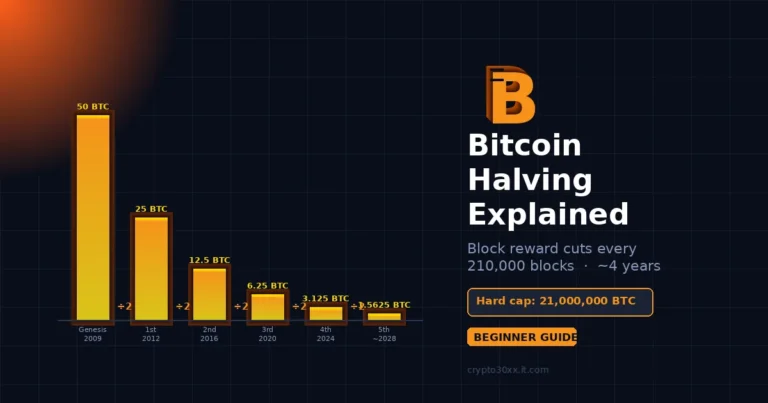
Bitcoin’s supply is governed not by geology but by software consensus. The protocol caps total issuance at 21 million BTC. New coins enter circulation as block rewards paid to miners who validate transactions. Every 210,000 blocks — approximately every four years — that reward halves in an event called the halving. Once all coins are mined, the protocol issues nothing further. This schedule is publicly auditable and would require extraordinary network consensus to alter. No single entity retains unilateral authority over Bitcoin’s monetary policy.
How scarcity works in each asset
Scarcity underpins the store-of-value argument for both gold and Bitcoin, but the two assets achieve it through entirely different mechanisms — one geological and probabilistic, the other mathematical and deterministic. Understanding this distinction is central to any serious comparison of the two assets.
Gold’s geological supply dynamics
Gold’s above-ground supply grows slowly because extraction requires physical capital, energy, and access to ore bodies of sufficient grade. New mining adds to the existing stock each year, but that rate is constrained by geology. Higher prices incentivize more extraction, which tends to moderate price spikes over time through a natural supply-response mechanism.
The World Gold Council has estimated total above-ground gold stocks at roughly 200,000 metric tons, with significant proportions distributed across central bank reserves, jewelry, and private investment holdings. The key structural characteristic: gold’s supply is empirically scarce, not mathematically bounded. More could theoretically be discovered or extracted as technology improves.
Bitcoin’s programmatic supply cap
Bitcoin’s scarcity is not empirical — it is definitional. The 21 million BTC ceiling is specified in the protocol code. The issuance schedule is fully predictable well in advance of each block being mined. With each halving, the annual emission rate drops by 50%, creating a known, declining supply curve.
In structural terms, Bitcoin’s issuance schedule represents an unusual property: the total future supply of a monetary asset can be calculated to the nearest unit, without geological surveys, sampling errors, or mining economics. This mathematical certainty is one of the properties its proponents cite most frequently when making the store-of-value case.
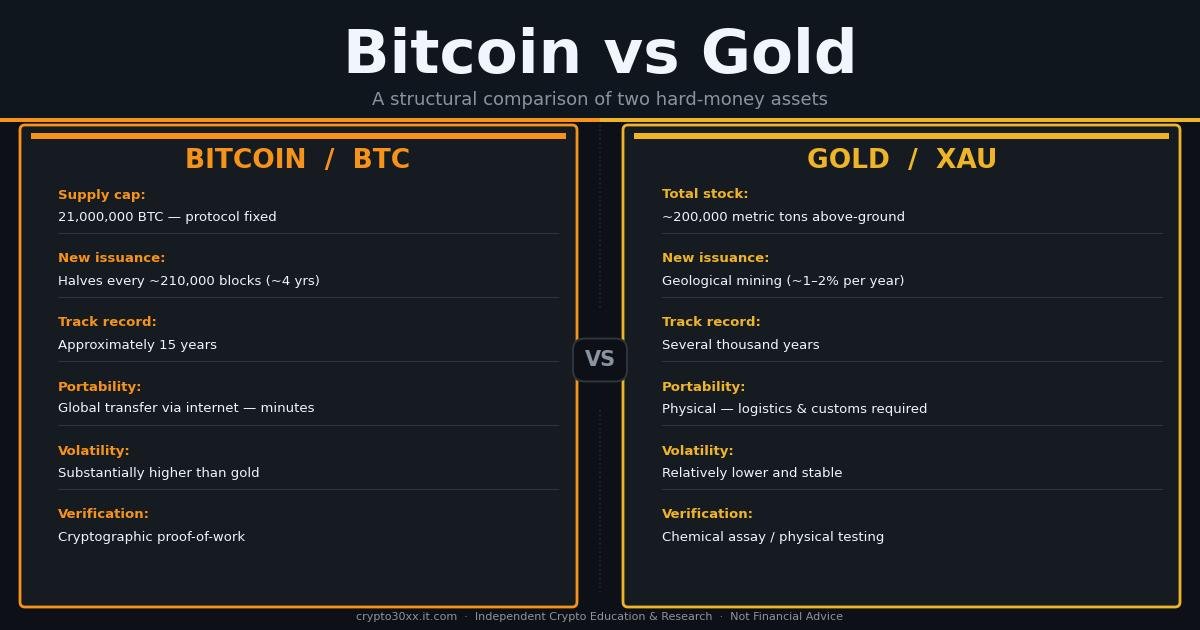
Bitcoin vs gold comparison: structural properties at a glance
Structural comparisons are useful because they separate mechanism from narrative. The table below describes what each asset is at the protocol or physical level — not what its proponents argue it will achieve. Each property carries distinct implications for how the asset functions under stress.
| Property | Gold | Bitcoin |
|---|---|---|
| Supply mechanism | Geological extraction | Protocol algorithm |
| Total supply ceiling | Empirically scarce; no fixed cap | Fixed: 21 million BTC maximum |
| Supply predictability | Low — depends on geology and prices | High — halving schedule known in advance |
| Physical existence | Tangible element | Ledger entries verified cryptographically |
| Portability | Low — heavy, logistics-dependent | High — transferable globally via internet |
| Divisibility | Limited in practice | Down to 0.00000001 BTC (one satoshi) |
| Verification method | Chemical assay or physical testing | Cryptographic proof-of-work consensus |
| Counterparty risk (self-held) | None — direct physical possession | None — if self-custodied via private key |
| Storage requirement | Physical vault or custodian | Hardware wallet, paper backup, or seed phrase |
| Monetary track record | Several thousand years | Approximately 15 years |
| Typical volatility level | Relatively lower | Substantially higher |
| Regulatory classification | Established in most jurisdictions | Variable — jurisdiction-dependent |
| Industrial demand | Yes — jewelry, electronics, medicine | Minimal |
Store of value mechanics: how Bitcoin and gold qualify
A store of value is an asset that preserves purchasing power across time. The preservation is never perfect, but the direction should prevent systematic debasement. Gold and Bitcoin are both positioned within this function, and the bitcoin vs gold comparison often centers on which asset performs the role more reliably. Defining the function’s requirements precisely is the most useful place to begin.
The three properties a store of value requires
Three properties are central to the store-of-value function: scarcity (limited supply prevents dilution), durability (the asset does not decay or degrade), and verifiability (market participants can confirm authenticity without prohibitive cost).
Gold satisfies all three physically. It does not corrode, its chemical identity is stable, and its weight and purity can be tested through established assay methods.
Bitcoin satisfies all three cryptographically. A valid private key controls the associated coins indefinitely, as long as the Bitcoin network operates. The proof-of-work consensus mechanism, enforced by thousands of independent nodes globally, makes fraud computationally prohibitive rather than physically impossible.
Where Bitcoin and gold diverge in practice
The most significant practical divergence is portability. A holder of substantial physical gold faces logistics, insurance, and regulatory friction when moving value across borders. Bitcoin transfers operate at the protocol level. Any quantity can be sent globally in minutes, with no third-party permission required.
That portability advantage carries a corresponding risk: a lost private key or compromised seed phrase causes permanent, unrecoverable loss. Gold, held physically, does not have a single cryptographic access point. The failure modes are structurally different — not simply larger or smaller in magnitude.
Volatility, liquidity, and price behavior
Volatility is one of the most consequential differences between Bitcoin and gold for anyone conducting risk analysis. The two assets are not comparable on this dimension, and treating them as substitutes on the basis of their shared scarcity narrative obscures a meaningful structural difference in price behavior.
Gold’s stability profile
Gold’s price moves within relatively narrow percentage ranges over most short-to-medium time windows compared to Bitcoin. This stability reflects gold’s large, established market depth, extensive institutional liquidity, and natural supply-response dynamics that limit extreme price swings. In periods of geopolitical stress, currency instability, or banking system strain, gold prices typically rise. The magnitude of those moves rarely approaches Bitcoin’s volatility profile. From a portfolio analysis standpoint, gold’s lower volatility makes it more tractable to model and hedge.
Bitcoin’s volatility characteristics
Bitcoin’s history includes multiple periods of drawdowns exceeding 70% from peak to trough, followed by recoveries that, historically, exceeded prior highs. The volatility reflects several converging factors. Bitcoin’s market capitalization remains substantially smaller than gold’s, meaning capital flows produce proportionally larger price impacts. Its valuation framework is actively contested. Retail sentiment plays a larger role in shorter-term price windows than institutional dynamics.
From a risk analysis standpoint, this volatility means Bitcoin cannot serve the same near-term stability function that gold has historically provided, even if both assets share a long-term scarcity narrative.
Correlation and macro behavior
One analytical question researchers examine is whether Bitcoin and gold move together during market stress. Historically, the correlation has been inconsistent. During some episodes, both assets declined simultaneously as investors raised cash — behavior more consistent with risk-off liquidity selling than safe-haven demand. During other periods, gold rose while Bitcoin fell, or the reverse. This inconsistency suggests the two assets, despite sharing structural similarities, are driven by partially distinct demand bases and investor cohorts. Treating them as interchangeable hedges on the basis of scarcity alone ignores that empirical pattern.
Risks and limitations: a side-by-side review
Both assets carry real risks. A balanced analysis requires examining those risks without weighting one asset’s downsides more heavily than the other’s. The question is not which asset is “safer” in the abstract, but what kind of risk each asset introduces.
Risks specific to gold
- Storage and insurance costs: Physical gold requires secure vaulting and insurance, both of which incur ongoing costs that reduce net returns over time.
- Illiquidity in size: Large gold positions may face spread costs or delays when converting to cash, particularly in illiquid market conditions.
- Paper gold counterparty risk: ETFs, futures, and other gold-linked products introduce custodian and counterparty risk. The holder owns a contractual claim, not the metal itself.
- Historical confiscation precedent: Historical examples of government gold seizure demonstrate that physical gold ownership has not always been legally protected. Legal environments vary significantly by jurisdiction and historical period.
Risks specific to Bitcoin
- Private key loss: No recovery mechanism exists for lost private keys or seed phrases. The associated Bitcoin is permanently inaccessible, with no recourse.
- Exchange and custodian failures: Bitcoin held on centralized platforms is subject to counterparty risk. Exchange insolvencies and security breaches have resulted in permanent fund losses in documented cases.
- Regulatory uncertainty: Bitcoin’s legal classification, tax treatment, and trading availability vary across jurisdictions and remain subject to legislative change.
- Protocol and code risk: Bitcoin has operated without a fundamental security breach since 2009. However, code-level vulnerabilities or large-scale consensus attacks, though considered unlikely at the current network scale, cannot be assigned zero probability.
- Volatility-driven timing risk: An investor who must liquidate during a severe drawdown may realize material losses regardless of any long-term price trajectory.
Common misconceptions in this comparison
“Gold has intrinsic value; Bitcoin does not.” Gold’s monetary value — distinct from its industrial applications — is socially determined. Civilizations assigned gold monetary status because others agreed to accept it. Bitcoin proponents make a structurally analogous argument about the protocol’s properties. Neither claim rests on value that is intrinsic in a strictly physical sense.
“Bitcoin will eventually replace gold.” These assets appeal to partially overlapping but distinct audiences. Gold carries institutional entrenchment and physical tangibility that Bitcoin does not replicate. Bitcoin offers portability, programmatic scarcity, and peer-to-peer transfer that gold cannot match. There is no structural necessity for one to displace the other.
“Scarcity alone determines value.” A fixed or declining supply is a necessary condition for store-of-value function, not a sufficient one. Demand must also exist and persist. An asset with zero demand retains no purchasing power regardless of supply constraints.
FAQs
Is Bitcoin actually digital gold? The comparison captures real structural parallels — fixed or declining supply, non-sovereign issuance, divisibility, and cryptographic verifiability. But Bitcoin lacks gold’s industrial demand, physical existence, and multi-millennia institutional track record. The framing is analytically useful but not definitionally precise.
Which asset has the stronger historical performance record? Bitcoin has produced larger percentage gains than gold over comparable multi-year windows in its approximately 15-year history. It has also experienced significantly larger drawdowns. Comparing performance without controlling for volatility, drawdown depth, and time-window selection produces incomplete conclusions.
Can gold or Bitcoin hedge against inflation? Gold has a documented, if imperfect, long-term relationship with purchasing power preservation during inflationary periods. Bitcoin’s correlation with inflation has varied considerably across different macroeconomic environments. Neither asset guarantees inflation protection in all conditions or across all time horizons.
Is one asset safer than the other? The answer depends on which risk dimension is being measured. Gold carries lower price volatility, longer institutional acceptance, and no cryptographic single-point-of-failure custody risk. Bitcoin carries higher volatility, regulatory uncertainty by jurisdiction, and technical custody requirements. “Safer” is not a single-variable comparison.
What is the stock-to-flow ratio, and how does it apply here? Stock-to-flow (S2F) measures existing supply against annual new supply. Gold has a high S2F ratio because annual mining adds little relative to the enormous above-ground stock. Bitcoin’s S2F ratio increases with each halving, as new issuance falls while total circulating supply grows. Some analysts use S2F as a scarcity metric; its predictive reliability for price behavior remains actively debated.
Why do some portfolio allocations include both gold and Bitcoin? Some analysts treat the two assets as complementary. Gold provides lower volatility and long institutional acceptance. Bitcoin provides different risk characteristics and higher potential asymmetry. Any allocation decision involving either asset should involve a qualified financial professional.
Does Bitcoin have industrial demand like gold? No. Gold generates demand from jewelry, electronics, and medical applications, creating a demand floor independent of investment sentiment. Bitcoin’s demand is almost entirely monetary and speculative in nature. This is a meaningful structural difference if investment demand for either asset contracts sharply.
How do custody requirements differ between the two assets? Gold requires physical storage — a vault or secure custodian — with associated costs and logistical complexity. Bitcoin can be held on a hardware wallet, paper backup, or memorized seed phrase. Both approaches carry distinct risks: physical theft or damage for gold, and permanent irreversible key loss for Bitcoin.
Disclaimer
This article is produced for educational and research purposes only. It does not constitute financial, investment, tax, or legal advice. Nothing in this article represents a recommendation to purchase, sell, or hold any asset. Readers should consult qualified financial and legal professionals before making any decisions involving financial assets.
The bitcoin vs gold comparison ultimately resolves into a structural question: what properties matter most for a given analytical framework? Gold offers several thousand years of institutional validation, lower volatility, and industrial demand that creates a baseline demand floor. Bitcoin offers mathematically enforced scarcity, superior portability, and a fully auditable supply schedule. Both assets carry distinct and meaningful risks that deserve equal weight in any analysis. Examining the mechanisms behind each asset — rather than short-term price movements or narrative claims — provides the most durable analytical foundation for understanding what each actually is.
Our quiet teachings offer grounded truth that never shouts to reach you in our tender space here.