How bitcoin was created: the complete history from whitepaper to network
How bitcoin was created? Bitcoin was created by a pseudonymous developer known as Satoshi Nakamoto, who published a nine-page whitepaper titled “Bitcoin: A Peer-to-Peer Electronic Cash System” on October 31, 2008, proposing the first decentralized digital currency system capable of processing transactions without banks or trusted intermediaries. The Bitcoin network launched on January 3, 2009, when Nakamoto mined the first block — known as the genesis block — establishing a public ledger secured by cryptographic proof rather than institutional authority. This article covers the full origin story: the intellectual lineage behind Bitcoin, how its core mechanisms work, and what made its design durable enough to operate continuously without a central administrator.
Why digital money needed a new solution
Before Bitcoin, every attempt at a purely digital currency ran into the same wall: without a central authority to verify transactions, nothing stopped users from spending the same digital coins twice. This is the double-spending problem, and it was the core technical barrier that made decentralized digital money theoretical rather than functional for decades.
Traditional payment systems sidestep this by design. When you pay with a bank card, your bank checks that the funds exist, deducts them, and records the change. The bank is the trusted third party. Its centralized ledger is the source of truth. That works — but it also means every digital transaction depends on an institution, which adds fees, excludes the unbanked, and creates a single point of failure or control.
Cypherpunks — a loose network of cryptographers, computer scientists, and privacy advocates active from the late 1980s onward — spent roughly twenty years trying to build a system that didn’t need that institution. Understanding their work is the only way to understand what Nakamoto actually invented.
The predecessor technologies Nakamoto built on
Satoshi Nakamoto did not start from scratch. The Bitcoin whitepaper explicitly cites earlier work, and the protocol borrows specific mechanisms from several prior projects.
- Hashcash (1997): Adam Back, a British cryptographer, designed a proof-of-work system to fight email spam. To send a message, the sender had to perform a small amount of computational work — enough to make mass spam expensive. Satoshi adopted this mechanism directly for Bitcoin’s mining process.
- B-money (1998): Wei Dai, a computer engineer and cypherpunk, proposed a peer-to-peer electronic cash system where participants maintained a shared distributed ledger and new money was created through proof-of-work computation. The Bitcoin whitepaper cites b-money in its references.
- Bit Gold (1998–2005): Nick Szabo designed a protocol for creating unforgeable digital tokens through chained proof-of-work puzzles. Bit Gold introduced the concept of cryptographically chaining computational work into a sequence — a structural ancestor of the blockchain.
- Reusable Proof of Work (2004): Hal Finney, one of the earliest Bitcoin adopters, improved on Hashcash by making proof-of-work tokens transferable, pushing the concept closer to functioning digital currency.
None of these projects fully solved the double-spending problem without a central server. Each required trusting some party or system at some point. That was the gap Nakamoto closed.
What the Bitcoin whitepaper actually proposed
The whitepaper Nakamoto distributed to the cryptography mailing list on October 31, 2008, was nine pages long. It made one central claim: that it was possible to solve the double-spending problem in a fully peer-to-peer way — no bank, no clearing house, no trusted third party at all.
The proposed solution combined three existing ideas into one coherent system.
The distributed timestamp server
Nakamoto described Bitcoin at its core as a “distributed timestamp server.” The problem with digital money is that digital data has no inherent time stamp — a file can be copied or replayed without any record of when the original transaction occurred. Nakamoto’s solution was to have the entire network, collectively, agree on the order of transactions by publishing them in time-stamped batches and chaining each batch to the one before it cryptographically.
Each batch of transactions is called a block. The chain of blocks is the blockchain.
Proof-of-work as consensus
To prevent any single participant from rewriting transaction history — and to make the cost of cheating prohibitively high — Nakamoto required that each block be sealed by a proof of computational work. Nodes on the network (called miners) compete to solve a mathematical puzzle. The puzzle requires finding a number that, when combined with the block’s data and processed through a hash function (Bitcoin uses SHA-256), produces an output below a target value.
Finding the right number requires billions of random guesses. Verifying that a correct number was found takes a fraction of a second. This asymmetry is what makes proof-of-work effective as a security mechanism.
The longest valid chain — the one representing the most accumulated computational work — is treated as the authoritative transaction history. An attacker trying to rewrite history would need to redo all the proof-of-work for the block they want to change and every block after it, while racing against the rest of the network continuing to add new blocks. At any realistic level of decentralization, that becomes computationally infeasible.
Solving double-spending without trust
Before Bitcoin, a digital coin was just data. Data can be copied. Sending a digital coin to one person did not prevent sending the same data — the same “coin” — to another person a moment later. The usual fix was a central database that tracked which coins had already been spent. Nakamoto’s fix was to make that database public, distributed, and append-only.
When a transaction is broadcast to the Bitcoin network, thousands of nodes independently verify it against the existing ledger. Miners include verified transactions in blocks. Once a transaction is confirmed inside a block — and several additional blocks are added afterward — reversing it becomes computationally impossible without controlling more than half the network’s total mining power.
This is how bitcoin became the first digital asset that could be proven, without any institution, to have been spent only once.
How the Bitcoin network launched
The genesis block: January 3, 2009
Nakamoto launched the Bitcoin network by mining the first block on January 3, 2009. This block — block zero, the genesis block — is the foundation from which every subsequent block in Bitcoin’s history chains back.
Embedded in the genesis block’s data is a message: “The Times 03/Jan/2009 Chancellor on brink of second bailout for banks.” This is a headline from that day’s edition of a British newspaper. The message serves two purposes. It provides an unambiguous timestamp for the block’s creation — anyone can verify that the block could not have been mined before that date. It also signals the context in which Bitcoin emerged: a global financial system in crisis, being propped up by public bailouts of institutions whose risky practices had nearly collapsed it.
The genesis block generated a reward of 50 BTC. Those 50 coins are unspendable by design — a technical quirk of how Nakamoto structured the first block’s data.
The first transaction: January 12, 2009
Hal Finney — the cryptographer who had developed the reusable proof-of-work system years earlier — was among the first people to download the Bitcoin software. On January 12, 2009, Nakamoto sent Finney 10 bitcoins, completing the first peer-to-peer Bitcoin transaction recorded on the network. This moment validated the system’s core function: value transferring between two parties, confirmed by a decentralized network, with no bank involved.
Nakamoto continued operating the network solo throughout most of 2009, mining blocks and communicating with early contributors via email and forum posts. By some estimates, the coins attributed to Nakamoto’s early mining represent approximately 1 million BTC — coins that have remained unspent in their original addresses since Nakamoto withdrew from the project around 2010.
The open-source release
Six days after the genesis block, on January 9, 2009, Nakamoto released the Bitcoin client software publicly on SourceForge, making the project open source. This decision was structurally important. Open-source code can be audited by anyone. No one had to trust Nakamoto’s claims about how the system worked — anyone with the technical ability could read the code and verify it.
The mechanisms that govern Bitcoin’s supply
Why 21 million?
Bitcoin’s total supply is capped at 21 million coins. This limit is not an arbitrary round number. It emerges mathematically from the halving schedule written into Bitcoin’s code.
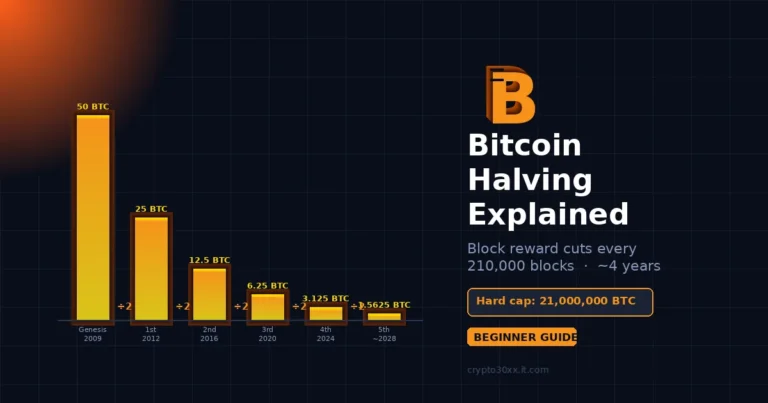
The block reward — the number of new bitcoins awarded to the miner who successfully adds a block — started at 50 BTC per block. Bitcoin’s protocol reduces this reward by 50% every 210,000 blocks, which at a target rate of one block per ten minutes, takes approximately four years. This reduction is called a halving.
The total supply is the sum of a geometric series: 50 × 210,000 + 25 × 210,000 + 12.5 × 210,000 + … converging toward approximately 21 million. There will be 33 halvings in total. After the final halving cycle, block rewards reach zero and the protocol stops issuing new coins. At that point, miners earn only from transaction fees.
How the supply cap is enforced
The 21 million cap is not a promise or a policy. It is enforced by consensus rules that every node on the network independently verifies. Any block that attempts to award miners more than the protocol allows is automatically rejected by nodes — the miner earns nothing, and the invalid block is discarded.
Changing the supply cap would require a hard fork: a fundamental alteration of Bitcoin’s consensus rules that every node operator, miner, and user would need to adopt. Given that the fixed supply is central to Bitcoin’s design and what many participants consider its core value proposition, no proposal to alter the cap has gained traction in the network’s history.
Block timing and mining difficulty
Bitcoin targets one new block every ten minutes on average. But the number of miners — and their total computational power — fluctuates constantly. To maintain the ten-minute target regardless of how much mining power is on the network, Bitcoin adjusts the difficulty of the proof-of-work puzzle every 2,016 blocks (roughly every two weeks). If blocks are being found too quickly, the puzzle gets harder. If too slowly, it gets easier.
This self-adjusting difficulty mechanism is what allows Bitcoin to maintain a predictable issuance schedule even as the network grows or contracts.
The identity question: who is Satoshi Nakamoto?
Nakamoto’s identity has never been confirmed. The name is a pseudonym. Analysis of the writing style, communication patterns, and technical knowledge visible in Nakamoto’s emails, forum posts, and code contributions has led researchers to various conclusions — but none has produced verifiable proof.
Several individuals have been proposed by journalists and researchers over the years. Some have denied involvement. One person publicly claimed to be Nakamoto but failed to provide cryptographic proof — which would be straightforward if the claim were true, since Nakamoto’s earliest addresses could sign a message only if the claimant actually controlled the private keys.
What is known about Nakamoto’s activity:
| Period | Activity |
|---|---|
| August 2008 | Registered bitcoin.org domain |
| October 31, 2008 | Published whitepaper to cryptography mailing list |
| January 3, 2009 | Mined genesis block, launched network |
| January 9, 2009 | Released open-source Bitcoin client |
| January 12, 2009 | Completed first peer-to-peer transaction (to Hal Finney) |
| 2009–2010 | Actively developed Bitcoin, communicated with contributors |
| April 2011 | Final known communication; told contributors they had “moved on to other things” |
Nakamoto’s departure left Bitcoin without a single leader or controlling figure. Development continued through contributors, and the project’s open-source governance model meant no one inherited central control. This was arguably intentional: a decentralized system governed by a named founder would still carry a point of authority and, by extension, a point of vulnerability.
What Bitcoin was built to address
Bitcoin’s technical design makes sense in historical context. The whitepaper opens by identifying a structural problem: internet commerce depends almost entirely on financial institutions serving as trusted third parties. That reliance creates real costs — transaction fees, account minimums, payment reversals, exclusion of participants without access to banking infrastructure.
Nakamoto proposed a system where two parties could transact directly, with the network itself providing the verification function that banks otherwise perform. The genesis block’s embedded headline underscored this framing. Bitcoin was not proposed as a speculative instrument. Its whitepaper describes it as an electronic cash system — a medium of exchange that transfers value peer-to-peer without requiring either party to trust an institution.
Whether Bitcoin functions better as a medium of exchange or a store of value has been debated extensively within the cryptocurrency community since the early years. That debate falls outside the scope of this article, which covers the history of Bitcoin’s creation and the mechanisms built into its original design.
Common misconceptions about Bitcoin’s origin
“Nakamoto invented blockchain”
The term “blockchain” does not appear in Bitcoin’s whitepaper. Nakamoto described the structure as a “chain of blocks” and a “distributed timestamp server.” The word “blockchain” entered common usage later, as the concept spread beyond Bitcoin. Nakamoto was the first to build a working system that used cryptographically chained blocks in a decentralized network — but the conceptual components (hash chains, distributed ledgers, proof of work) each predate Bitcoin.
“Bitcoin has no backing”
Bitcoin is not backed by a commodity or government guarantee. Its value, to the extent it has any, comes from its properties as a network: its decentralization, its fixed and auditable supply schedule, its security against double-spending, and its permissionless accessibility. Whether those properties constitute sufficient backing is a matter of ongoing debate. The relevant point here is that “no backing” as a criticism usually presupposes that backing by a government or commodity is necessary — a premise Bitcoin was explicitly designed to challenge.
“Bitcoin could be shut down”
Bitcoin runs on tens of thousands of nodes distributed across dozens of countries. There is no central server, no headquarters, and no administrator. Disabling the network would require simultaneously taking down all nodes worldwide — a coordination problem with no practical solution. Individual nodes can be targeted. Individual participants can be regulated. The network as a whole is structurally resistant to shutdown by any single actor, including state actors.
FAQs
When was Bitcoin created? The Bitcoin whitepaper was published on October 31, 2008. The network launched on January 3, 2009, when Nakamoto mined the genesis block. The open-source software was publicly released on January 9, 2009.
Who created Bitcoin? Bitcoin was created by a pseudonymous individual or group using the name Satoshi Nakamoto. Despite years of research and numerous theories, no verifiable evidence has confirmed the real identity behind the pseudonym.
Why does Bitcoin have a 21 million supply limit? The 21 million cap emerges from the mathematical structure of Bitcoin’s halving schedule. Block rewards started at 50 BTC and halve every 210,000 blocks. When the series of halvings converges, the sum of all rewards approaches but never exceeds approximately 21 million coins. The cap is enforced by consensus rules that every node independently validates.
What problem did Bitcoin solve? Bitcoin’s primary technical innovation was solving the double-spending problem for digital currency without relying on a trusted central authority. It achieved this through a distributed public ledger (the blockchain), proof-of-work consensus, and a network of independent nodes that each verify transactions against the same rules.
What is the genesis block? The genesis block is the first block in Bitcoin’s blockchain, mined by Nakamoto on January 3, 2009. It contains an embedded reference to a newspaper headline about a bank bailout and generated a 50 BTC reward that remains unspendable by design. Every subsequent Bitcoin block chains back to it.
Did Bitcoin exist before 2009? No. The whitepaper was published in late 2008, but the actual Bitcoin network — the live blockchain capable of processing transactions — did not exist until the genesis block was mined in January 2009. Earlier digital currency experiments like Hashcash and b-money predated Bitcoin but never launched as functional networks.
Why did Nakamoto remain anonymous? Nakamoto’s reasons for anonymity were never stated directly. Observers have noted that a named founder would create a central point of authority — contradicting Bitcoin’s decentralized design — and that the person or persons behind Nakamoto might have faced legal scrutiny given that Bitcoin was designed to function outside traditional financial infrastructure.
Is Nakamoto’s identity known? No. Numerous candidates have been proposed; none have provided cryptographic proof of identity by signing a message with keys from Nakamoto’s earliest Bitcoin addresses. That proof would be definitive. Its absence means no public claim to date has been substantiated.
Disclaimer
This article is written for educational and research purposes by an independent publication. Nothing here constitutes financial advice, investment guidance, or a recommendation to buy, sell, or hold any asset. Cryptocurrency markets carry substantial risk. Readers should conduct their own research and consult qualified professionals before making financial decisions.
The history of how bitcoin was created is, at its core, a story about a long-standing technical problem finally getting a working solution. Nakamoto did not invent every component of that solution — cryptographic hash functions, proof-of-work, and distributed ledger concepts all existed before 2008. The contribution was architectural: assembling those pieces into a system where decentralized consensus replaced institutional trust, and where the rules governing money supply were enforced by code rather than policy. Every mechanism described in this article — the genesis block, the proof-of-work, the halving schedule — was present from the network’s first day and continues to operate on the same terms Nakamoto defined.
Let our still waters hold the kind of truth that brings lasting peace to a restless mind.