What is bitcoin: a simple explanation for beginners
What is Bitcoin?: Bitcoin is a form of digital money that exists entirely on a computer network, with no physical coins, no central bank, and no single company controlling it. Created in 2009 by a pseudonymous figure known as Satoshi Nakamoto, it was the first cryptocurrency — a type of currency secured by mathematics rather than institutions. Unlike traditional bank transfers, a bitcoin transaction is recorded on a shared public ledger called the blockchain, where thousands of computers around the world verify and store each transaction permanently. There is no customer service line, no account manager, and no government guarantee. Understanding what bitcoin is starts with understanding what problem it was designed to solve.
What problem was bitcoin designed to solve?
Bitcoin was built to allow two parties to transfer value over the internet without trusting a bank, payment processor, or any other third party to manage the transaction. The core problem it addresses is the need for trust in digital payments. Traditionally, you need an intermediary (a bank, PayPal, a credit card network) to verify that a sender actually has the funds and hasn’t already spent them elsewhere. Bitcoin eliminates this requirement by replacing institutional trust with cryptographic proof and a decentralized network.
The double-spend problem
Digital files can be copied perfectly. An image, a document, a music file: all can exist in identical form on millions of devices simultaneously. This creates an obvious problem for digital money: what stops someone from sending the same digital coin to two different people at once?
Before bitcoin, the answer was always “a trusted third party keeps the definitive record.” A bank says what your balance is. PayPal says whether a payment has gone through.
Bitcoin solves this without any central authority. It uses a network of computers (called nodes) that collectively maintain one shared, tamper-resistant record of every transaction ever made. No single node controls the record. Altering it would require controlling the majority of the network’s computing power simultaneously, which is prohibitively expensive to attempt at scale.
The 2008 financial context
Satoshi Nakamoto published the bitcoin whitepaper in October 2008, immediately after the global financial crisis exposed deep structural failures in the banking system. The genesis block, the very first block of the bitcoin blockchain (mined in January 2009), contained an embedded text reference to a headline about a bank bailout. This was not accidental. Bitcoin was explicitly conceived as an alternative to a financial system that had just demonstrated the fragility of centralized institutional trust.
How does bitcoin actually work?
Bitcoin operates through three interlocking systems: a distributed ledger called the blockchain, a verification process called mining, and a cryptographic key system that controls ownership. Together, these components replace the role that banks and payment networks play in traditional finance.
The blockchain: a shared ledger no one owns
Every bitcoin transaction is recorded in a block. Each block contains a set of recent transactions, a timestamp, and a cryptographic reference (called a hash) linking it to the previous block. This chain of linked blocks going back to the genesis block is the blockchain.
The blockchain is stored identically on thousands of computers worldwide. When a new block is added, every node updates its copy. Because each block references the one before it, changing any historical record would require recalculating every subsequent block and then outpacing the rest of the network, a task that grows more computationally impossible as the chain lengthens.
The result is a public record of transactions that anyone can read, no one can secretly alter, and no single entity controls.
Mining: how new transactions get confirmed
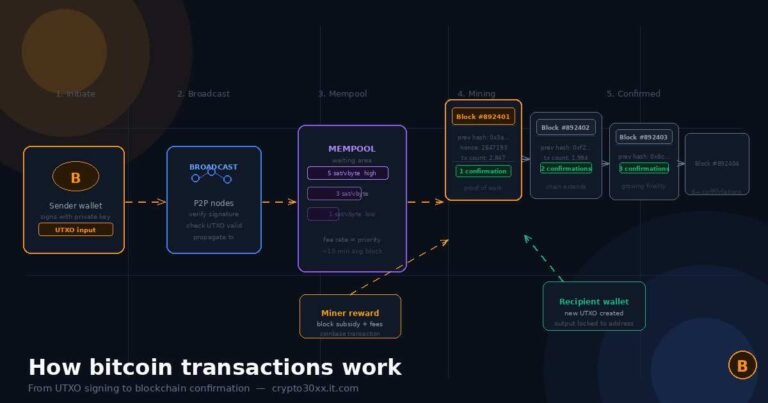
Bitcoin transactions don’t confirm instantly. They sit in a waiting pool called the mempool until a miner picks them up.
Miners are computers (or networks of computers) that compete to solve a computationally intensive mathematical puzzle. The puzzle requires finding a specific number (called a nonce) that, when included in the block data, produces a hash output meeting the network’s current difficulty target. This process is called Proof of Work.
The key aspects of mining:
- The puzzle is intentionally difficult, requiring enormous computational effort
- The solution is trivially easy for any other node to verify once found
- The first miner to find a valid solution broadcasts the new block to the network
- Other nodes verify the solution and add the block to their copies of the chain
- The winning miner receives a block reward, consisting of newly created bitcoin, plus any transaction fees included in the block
This process produces a new block approximately every 10 minutes. The difficulty of the puzzle adjusts automatically every 2,016 blocks (roughly every two weeks) to keep that 10-minute interval stable regardless of how many miners join or leave the network.
Public and private keys: how ownership works
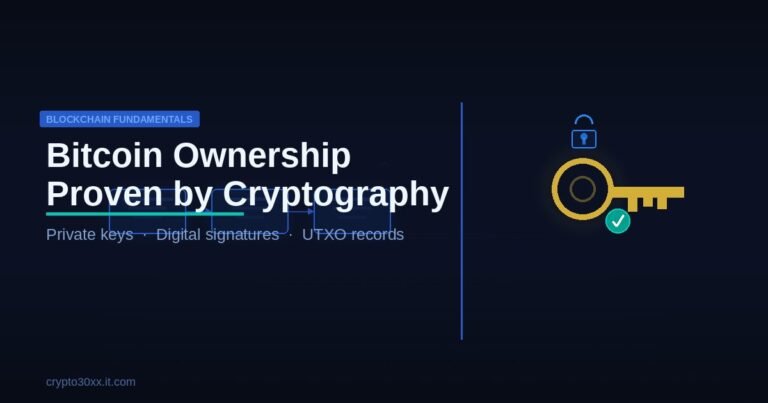
In traditional banking, your identity is tied to an account number controlled by your bank. In bitcoin, ownership is controlled by cryptographic keys.
Every bitcoin wallet contains:
- A private key: A secret number that allows the holder to authorize (sign) transactions. Anyone with this key can spend the associated bitcoin. It must never be shared.
- A public key: Derived mathematically from the private key. It generates a bitcoin address, the string of letters and numbers you share with others to receive payments.
The relationship is one-directional: the private key produces the public key, but the public key cannot reverse-engineer the private key. This is the foundation of bitcoin’s security model.
When you send bitcoin, you broadcast a transaction signed with your private key. The network verifies the signature against the corresponding public key without ever seeing the private key itself.
Bitcoin supply: why there will only ever be 21 million
Bitcoin has a fixed maximum supply of 21 million coins, hardcoded into the protocol. This is one of its most consequential design choices, and it differs fundamentally from government-issued currencies, which can be expanded by central bank policy.
The halving mechanism
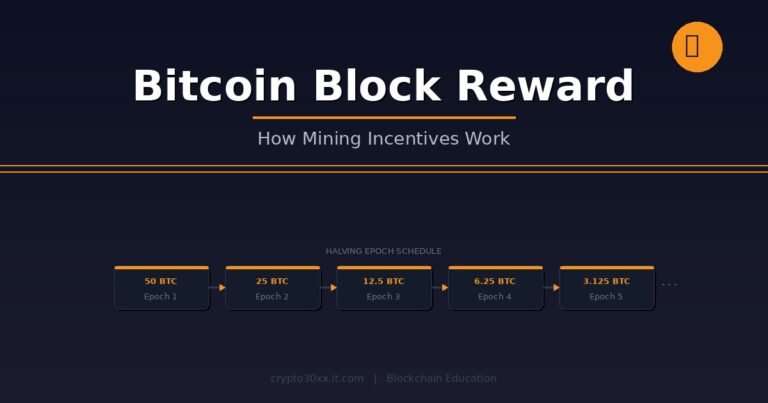
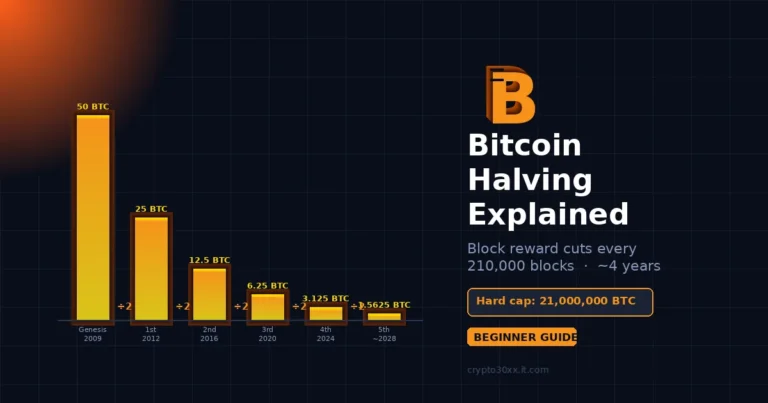
New bitcoin enters circulation exclusively through the block reward paid to miners. That reward started at 50 BTC per block in 2009. Built into the protocol is a halving event that occurs every 210,000 blocks (approximately every four years): the block reward is cut in half.
| Halving event | Block reward |
|---|---|
| Genesis (2009) | 50 BTC |
| First halving | 25 BTC |
| Second halving | 12.5 BTC |
| Third halving | 6.25 BTC |
| Fourth halving | 3.125 BTC |
This schedule continues until the block reward approaches zero, after which miners will be compensated entirely by transaction fees. The mathematics of this geometric series means that the total supply will asymptotically approach — but never exceed — 21 million BTC.
The halving also has a well-documented effect on the rate of new supply entering the market. Since demand does not automatically decrease when supply growth slows, halvings are structurally significant events in bitcoin’s economic model, though they do not guarantee any particular price outcome.
Lost bitcoin and circulating supply
Of the bitcoin that has been mined, a meaningful portion is estimated to be permanently inaccessible: sent to unusable addresses, held in wallets whose private keys are lost, or belonging to early miners whose coins have never moved. This reduces the effectively circulating supply below the total mined figure. No precise count is publicly verifiable, since the blockchain records addresses, not whether their keys still exist.
Bitcoin vs. traditional money: key differences
Understanding what bitcoin is becomes clearer through direct comparison with the financial infrastructure most people already use.
| Feature | Traditional bank account | Bitcoin |
|---|---|---|
| Issuer / controller | Central bank + commercial bank | No issuer; protocol-defined |
| Supply | Expandable by monetary policy | Fixed at 21 million |
| Transaction verification | Bank’s internal ledger | Decentralized network of nodes |
| Account reversals | Possible (chargeback, freeze) | Irreversible once confirmed |
| Custody | Bank holds funds on your behalf | Self-custody possible; holder controls private key |
| Access requirements | Government ID, credit history | Internet connection + wallet |
| Transaction hours | Business hours / settlement delays | 24/7, no geographic restrictions |
| Transaction fees | Set by institutions | Variable; determined by network demand |
| Transparency | Private (visible to bank only) | Public (any address visible on blockchain) |
| Anonymity | Identity-verified | Pseudonymous (addresses, not names) |
Neither model is strictly superior to the other. Each involves different trade-offs that suit different needs and risk tolerances.
Common misconceptions about bitcoin
“Bitcoin is anonymous”
Bitcoin is pseudonymous, not anonymous. Every transaction is permanently visible on the public blockchain. What’s recorded is not your name, but a bitcoin address. However, if any address is ever linked to a real-world identity (through an exchange’s identity verification process, a public disclosure, or blockchain analysis), the entire transaction history of that address becomes traceable. Several professional blockchain analytics firms specialize in exactly this kind of analysis.
“Bitcoin has no intrinsic value”
This argument is often made but imprecisely framed. Bitcoin’s value proposition rests on a combination of its network properties: verifiable scarcity, censorship resistance, decentralized settlement, and portability. Whether those properties constitute “value” is a philosophical and economic debate. The same critique applies to gold (valuable largely by convention) and to fiat currency (valuable partly by legal mandate, partly by institutional trust). Bitcoin’s value case is different from traditional assets, not categorically without basis.
“Bitcoin transactions are instant”
A broadcast bitcoin transaction appears on the network within seconds, but is not considered final until it has received several confirmations, typically six, each taking approximately 10 minutes. Full settlement therefore takes roughly an hour under normal conditions. For large transfers, waiting for multiple confirmations is standard practice precisely because the blockchain’s security model grows stronger with each additional block added after a transaction.
“Bitcoin is only used for illegal activity”
Blockchain analysis research consistently shows that the majority of bitcoin transactions by volume are associated with legal activity. Illicit use exists and is documented, but it is not the dominant use case. Cash, which is genuinely untraceable, has historically served as the primary medium for illegal transactions at scale.
What are the real risks of bitcoin?
Bitcoin carries risks that differ substantially from those of traditional financial instruments. Any serious explanation of what bitcoin is must address these directly.
Price volatility
Bitcoin’s price history includes drawdowns of 50–80% or more from peak values, sometimes occurring within a single market cycle. These are not anomalies. They are a recurring structural feature of a young, liquid, globally traded asset with no earnings floor and significant speculative participation. Anyone allocating funds to bitcoin must have a genuine tolerance for the possibility of substantial loss.
Custody risk
In traditional banking, deposits are often insured to a statutory limit. In self-custody bitcoin, there is no insurance, no recovery mechanism, and no customer service. If a private key is lost, the bitcoin it controls is permanently inaccessible. If it is stolen or disclosed, the bitcoin can be moved by anyone who holds it, with no recourse.
Using an exchange or third-party custodian transfers the custody risk from key loss to counterparty risk: the platform itself could be hacked, become insolvent, or restrict withdrawals. This is not theoretical; it has occurred at major exchanges more than once.
Regulatory risk
Bitcoin’s legal status varies significantly by country and has changed over time in multiple jurisdictions. Governments retain the ability to restrict trading, exchanges, or custody services within their territories. Tax treatment also varies and can be complex, particularly when bitcoin is used in transactions. Anyone operating in a regulated financial context should understand the applicable legal framework in their jurisdiction.
Technical risk
A mistake in a bitcoin transaction, such as sending to the wrong address or entering an incorrect amount, cannot be reversed. There is no dispute resolution process. Users bear full responsibility for the accuracy of their own transactions. This places a higher burden of care on individuals than most traditional financial systems.
FAQs
Who created bitcoin and is their identity known? Bitcoin was created by Satoshi Nakamoto, a name used by the person or group who authored the 2008 whitepaper and mined the genesis block in 2009. Nakamoto ceased public communications in 2010 and has never been reliably identified. The identity remains one of the most debated open questions in the history of technology.
Can bitcoin be shut down? Bitcoin operates on a peer-to-peer network with no central server. To fully disable it would require shutting down every node in every country simultaneously, which is practically infeasible for any single government or group of governments. Individual countries can restrict access to exchanges and ban use within their borders, but they cannot unilaterally destroy the network.
What is a bitcoin wallet? A bitcoin wallet is software (or hardware) that stores private keys and allows a user to send and receive bitcoin. It does not hold bitcoin itself. Bitcoin exists on the blockchain. The wallet simply manages the cryptographic keys that authorize transactions from your addresses.
How many bitcoin can ever exist? The protocol caps total supply at 21 million BTC. This limit is enforced by the code run by every node on the network. Changing it would require consensus among the overwhelming majority of network participants, and that consensus has never been achieved in any serious proposal.
Is bitcoin the same as blockchain? No. Blockchain is the underlying record-keeping technology bitcoin uses. Bitcoin is one application built on one specific blockchain. The term “blockchain” refers to a broader category of distributed ledger designs, many of which are used for purposes unrelated to digital currency.
What is the difference between bitcoin and other cryptocurrencies? Bitcoin was the first cryptocurrency and remains the largest by market capitalization and network security. Other cryptocurrencies (“altcoins”) use different protocols, consensus mechanisms, supply schedules, and design goals. Ethereum, for example, added a programmable layer for smart contracts. Most later cryptocurrencies modified or extended bitcoin’s original design in specific ways.
Do I need to buy a whole bitcoin? No. Bitcoin is divisible to eight decimal places. The smallest unit, 0.00000001 BTC, is called a satoshi. Any amount of bitcoin can be purchased or transferred, depending on what a given platform supports.
How long does a bitcoin transaction take? Most bitcoin transactions receive their first confirmation within 10–20 minutes. Six confirmations, considered standard for large-value transfers, take approximately one hour. During periods of high network demand, confirmation times can increase if a transaction’s fee is set too low to attract miners.
Disclaimer
This article is produced by crypto30xx.it.com as an independent educational resource. It is intended for learners and researchers seeking to understand how bitcoin works as a technology and economic system. Nothing in this article constitutes financial, investment, legal, or tax advice. Cryptocurrency markets involve substantial risk of loss, and past network behavior does not guarantee future outcomes.
Conclusion
Bitcoin is a decentralized digital currency secured by cryptography and maintained by a global network of computers. It solves the problem of transferring value without a trusted intermediary by replacing institutional trust with a transparent, tamper-resistant public ledger. Its fixed supply of 21 million coins, its open-source protocol, and its Proof of Work consensus mechanism distinguish it structurally from every form of money that preceded it.
Understanding bitcoin requires separating the mechanism from the speculation. The underlying system (the blockchain, the mining process, the key-based ownership model) operates according to mathematical rules that any technical reader can verify independently. What those rules produce in terms of economic outcomes remains uncertain, contested, and subject to substantial risk. That distinction is worth holding clearly.
Our compassionate content holds space for every question inside our gentle sanctuary built for you.