Blockchain in healthcare uses: a complete guide
Blockchain in healthcare uses a distributed, cryptographically linked ledger to solve problems that have frustrated healthcare systems for decades: fragmented patient records that don’t cross hospital boundaries, counterfeit drugs entering supply chains, clinical trial data that gets selectively reported, and insurance claims that are slow to verify and easy to manipulate. The core mechanism stays the same across all of these: once a record is written to the chain, altering it requires changing every subsequent block across every node simultaneously — a computational cost high enough to make tampering impractical. That property is why researchers, health systems, and regulators are examining the technology as infrastructure for medical data that demands a high degree of trust.
What properties make blockchain relevant to healthcare?
Healthcare data problems are, at base, trust problems. Multiple institutions hold fragments of the same patient’s history. Drug manufacturers hand off products to distributors who hand them to pharmacies, with no single actor able to verify the full chain of custody. Clinical researchers control their own data until they choose to publish it. Each of these scenarios involves parties who don’t fully trust one another but need to share information.
Blockchain addresses this through four structural properties:
- Immutability: Records appended to the chain cannot be retroactively modified without rewriting every subsequent block across every participating node. In practice, this creates a tamper-evident audit trail.
- Decentralization: No single institution controls the ledger. Each authorized node holds a copy, which eliminates single points of failure and removes the need for a trusted central administrator.
- Cryptographic access control: Public-private key pairs determine who can read or write specific records. Smart contracts can enforce conditional access — for example, allowing a specialist to view cardiology records but not psychiatry notes.
- Auditability: Every read and write event is time-stamped and permanently logged, which matters for regulatory compliance in an industry governed by strict data handling laws.
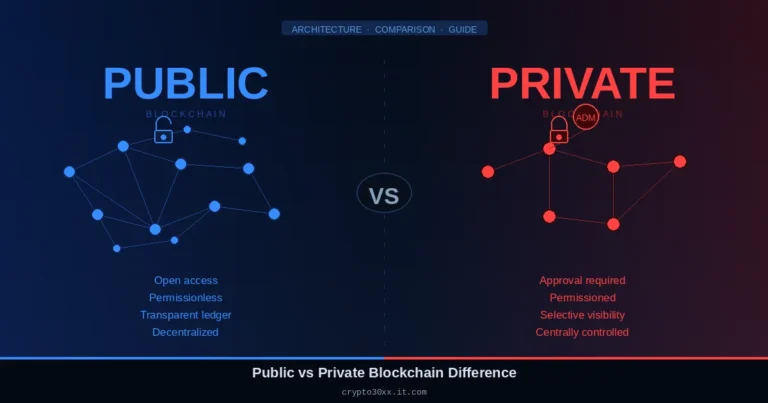
Healthcare implementations typically use permissioned blockchains rather than public ones. On a permissioned network, participation requires an identity credential issued by a governing body. Hyperledger Fabric is the platform most commonly cited in healthcare research; it was designed specifically for enterprise environments where data privacy and role-based access matter more than open participation. Ethereum appears in clinical trial research — particularly where smart contract automation is the primary goal — though its public architecture requires additional privacy layers to be compliant with regulations like HIPAA in the United States and GDPR in Europe.
How blockchain works in electronic health record management
The fragmentation problem in patient data
A patient who sees a primary care physician, a cardiologist, and an emergency department in three different health systems often has three separate records with no automatic way to reconcile them. When that patient arrives unconscious in a fourth hospital, clinicians work with incomplete information. This is not a minor inconvenience; medication interactions and allergies are the kind of information gaps that cause harm.
Interoperability between EHR systems is technically possible through standards like HL7 FHIR, but political and commercial barriers often prevent it. Health systems view patient data as a competitive asset. There is no shared infrastructure that institutions are obligated to use.
How a blockchain EHR architecture functions
In a blockchain-based health information exchange, the chain itself does not store the full medical record — that would be impractical at scale and raise serious privacy concerns, since blockchain data is visible to all nodes. Instead, the architecture works on a separation principle:
- The patient record is encrypted and stored in a secure off-chain database.
- A hash of that record, along with a pointer to its location, is written to the blockchain.
- Access permissions are encoded in a smart contract attached to that hash.
- When a clinician at a new institution requests access, the smart contract checks whether that clinician’s credential matches the access conditions. If it does, the contract releases the decryption key for that record.
- The access event is logged immutably on the chain.
The patient can theoretically hold their own private key, giving them control over who can read their records. This model, sometimes called patient-controlled or self-sovereign identity, is explored in frameworks using Decentralized Identifiers (DIDs) and Verifiable Credentials (VCs) on platforms like Hyperledger Indy. Research published in peer-reviewed journals has demonstrated proof-of-concept implementations where patients grant or revoke provider access through a smartphone application.
Limitations of blockchain EHR systems
The scoping review published in JAMIA Open found that security and interoperability were the most frequently cited compelling requirements, but also the areas with the most lingering challenges. Without a standard protocol that all health systems agree to implement, blockchain risks creating a new silo rather than dissolving existing ones. Patient-matching — connecting records to the correct individual across institutions — remains unsolved; blockchain records the transactions between identities, but the quality of that matching depends on the initial identity verification, which is a human process.
Pharmaceutical supply chain traceability
Why drug counterfeiting is a structural problem
Estimates from the World Health Organization suggest that counterfeit medicines represent a significant portion of pharmaceutical sales in markets with weak regulatory oversight, with consequences measured in lives rather than revenue. Even in well-regulated markets, drug diversion, tampering, and theft occur at multiple points in a supply chain that spans manufacturers, wholesalers, distributors, and pharmacies.
In the United States, the Drug Supply Chain Security Act (DSCSA), enacted in 2013, mandated the construction of an electronic, interoperable system to track prescription drugs at the package level from manufacturer to dispenser. The law set a phased compliance timeline, with full electronic interoperability as the end state. This regulatory requirement created a specific, time-bound problem that blockchain was proposed to solve.
How blockchain drug tracking works technically
Each unit of a drug product receives a unique serialized identifier — essentially a barcode that encodes the manufacturer, batch, expiry date, and a unique serial number. When ownership transfers from manufacturer to wholesaler, from wholesaler to distributor, and from distributor to pharmacy, that transaction is recorded on a shared blockchain.
Any party in the chain can query the full transaction history of any unit with a single scan. A pharmacy receiving a shipment can verify that the unit’s recorded history matches what the shipper claims, without needing a direct connection to every prior actor in the chain. An anomaly — a unit appearing at a pharmacy that was never recorded leaving the manufacturer — flags as a verification failure.
The technical advantage over traditional electronic data interchange (EDI) systems is the shared ledger. EDI requires each trading partner to maintain bilateral data connections with every other partner. A blockchain shared among all participants reduces that to a single connection to the network.
Cold chain integrity
Temperature-sensitive drugs — biologics, vaccines, certain oncology products — require continuous temperature monitoring from production through delivery. IoT sensors can write temperature readings directly to a blockchain at set intervals, creating a tamper-evident record of the cold chain. If a shipment was exposed to heat during transit, the record exists and cannot be retroactively altered. This matters for insurance claims, regulatory compliance, and patient safety.
Blockchain in clinical trials
The selective reporting problem
Clinical trials have a documented transparency problem. Regulatory frameworks in the United States and Europe require trial sponsors to register studies and publish results, but a substantial portion of completed trials have historically failed to meet those reporting requirements. When negative results are not published, the medical literature skews toward positive outcomes, which distorts clinical practice and regulatory decisions.
Blockchain addresses this at the protocol layer rather than the reporting layer. The core application is pre-registration of trial protocols with an immutable timestamp.
Smart contracts for trial data management
A smart contract written at the start of a clinical trial can encode the pre-specified analysis plan: which endpoints are primary, which statistical tests will be used, what constitutes the primary data set. Because the contract is written to the chain before any data collection begins, it cannot be modified retroactively to match the results that were actually observed. Any deviation from the pre-specified plan is immediately visible.
Smart contracts can also automate consent management. Informed consent is a legal and ethical requirement for trial participation. Managing consent across multi-site trials with thousands of participants is administratively complex, and consent withdrawal must be handled promptly and accurately. A blockchain-based consent system allows participants to grant or withdraw consent through a verified digital interface, with every action time-stamped and auditable by regulators without exposing personal data.
Researchers at multiple institutions have published proof-of-concept frameworks using Ethereum smart contracts for trial data management, with IPFS as the off-chain storage layer for large data files. The architecture follows the same separation principle as EHR systems: hashes on-chain, data off-chain, access controlled by the contract.
Health insurance claims and fraud prevention
How fraud enters the claims process
Healthcare insurance fraud takes several forms. Phantom billing submits claims for services never delivered. Upcoding bills for a more expensive service than was actually provided. Unbundling splits a procedure into multiple billing codes to collect more than the bundled rate would allow. These schemes are difficult to detect in centralized systems where each insurer sees only its own claims, and providers can exploit the informational asymmetry.
The FBI estimates healthcare fraud costs tens of billions of dollars annually in the United States alone. The precise figure is disputed, but the direction is not: fraud inflates premiums, reduces coverage for legitimate claims, and introduces perverse incentives into provider behavior.
How blockchain changes the claim verification structure
A consortium blockchain shared among multiple insurers, providers, and regulators creates a shared view of claim activity across the network. A provider who submits a duplicate claim to two insurers on a traditional system may not be caught because the insurers don’t communicate in real time. On a shared blockchain, both submissions are visible to network participants simultaneously.
Smart contracts can automate pre-authorization checks. A contract can verify that the claimed service matches the patient’s documented diagnosis, that the provider is credentialed for the procedure, and that the billing codes are internally consistent — before payment is released rather than after. This shifts fraud detection from a post-payment audit function to a pre-payment verification function, which is structurally more effective.
Research proposals in this space include multi-signature claim processing, where a claim requires cryptographic approval from both the provider and the patient before the smart contract releases payment. This makes phantom billing significantly harder: a fraudulent claim requires either forged patient credentials or patient cooperation.
Comparison: traditional vs. blockchain-based claim processing
| Dimension | Traditional system | Blockchain-based system |
|---|---|---|
| Claim ledger | Siloed per insurer | Shared across network participants |
| Fraud detection timing | Post-payment audit | Pre-payment smart contract verification |
| Duplicate claim detection | Manual cross-insurer reconciliation | Automatic via shared ledger |
| Audit trail | Reconstructed from internal logs | Immutable, time-stamped on-chain record |
| Patient verification | Administrative credential check | Cryptographic identity, multi-signature approval |
| Administrative overhead | High (manual reconciliation) | Lower (automated contract execution) |
Limitations and implementation challenges
The GDPR right-to-erasure conflict
Blockchain’s immutability is its primary security property. It is also the source of one of its most significant regulatory conflicts. GDPR Article 17 grants individuals in EU jurisdictions the right to request deletion of personal data when it is no longer necessary for processing. An immutable blockchain cannot honor that request for any data written on-chain.
The practical mitigation is to keep personal data off-chain and store only cryptographic hashes on-chain. If the off-chain data is deleted, the hash becomes a pointer to nothing. But this introduces a different problem: the hash itself may be considered personal data if it can be linked to an individual, which is a legal question without settled answers across all jurisdictions.
Scalability
Healthcare systems generate large transaction volumes. A large hospital network records tens of thousands of discrete interactions daily. Public blockchain architectures, with their requirement for network-wide consensus on every transaction, cannot handle that throughput at acceptable latency. Permissioned blockchains perform better — Hyperledger Fabric is designed to handle thousands of transactions per second — but still require careful architecture when scaled to national or international health information exchanges.
Implementation cost and legacy integration
Most healthcare institutions run EHR systems built over decades, with heterogeneous data formats, APIs, and governance structures. Integrating a blockchain layer requires either replacing or wrapping those systems. The development cost is substantial; the operational cost of maintaining cryptographic key infrastructure is ongoing; and the return on investment is difficult to quantify when the primary benefit is data integrity rather than revenue generation. Smaller healthcare organizations face greater barriers than large hospital networks with dedicated technology budgets.
Standardization gaps
Without common data standards, blockchain networks in healthcare risk replicating the silos they are designed to dissolve. HL7 FHIR provides a framework for data structure, but adoption is uneven across institutions and health systems. A blockchain that stores records in incompatible formats gains the security properties of the chain without the interoperability benefits that justify the investment.
How blockchain compares to other approaches for healthcare data problems
| Problem | Blockchain approach | Alternative approach | Blockchain advantage |
|---|---|---|---|
| EHR interoperability | Shared permissioned ledger with hash pointers | Centralized health information exchange (HIE) | No single controlling authority; tamper-evident audit trail |
| Drug traceability | Shared ledger across supply chain actors | Electronic data interchange (EDI) | Single shared record; no bilateral connections required |
| Clinical trial integrity | Pre-registered smart contract protocol | ClinicalTrials.gov registry | Protocol encoded in executable contract; deviation is automatic, not voluntary |
| Insurance fraud | Multi-insurer shared ledger, smart contract verification | Internal audit and post-payment recovery | Cross-insurer visibility; pre-payment verification |
| Patient identity | Decentralized identifiers, verifiable credentials | Centralized patient master index | Patient-controlled; no single identity authority to compromise |
FAQs
Does blockchain actually store patient health records? Storing full health records on-chain is generally impractical and conflicts with privacy regulations. Most architectures store only cryptographic hashes and access pointers on the chain, while the actual records remain in encrypted off-chain storage. The blockchain provides the access control layer and the tamper-evident audit trail.
What is a permissioned blockchain and why does healthcare use it? A permissioned blockchain requires participants to obtain a verified identity credential before joining the network. Unlike public blockchains where anyone can participate anonymously, permissioned networks give administrators control over who can read and write records. Healthcare institutions prefer this model because it allows compliance with data protection regulations and limits data exposure to authorized parties.
How does blockchain prevent counterfeit drugs from entering the supply chain? Each drug package receives a serialized unique identifier recorded at manufacture. Every ownership transfer — manufacturer to wholesaler, wholesaler to distributor, distributor to pharmacy — is recorded on the shared ledger. A pharmacy receiving a unit can verify its full provenance history with a single scan. A unit that cannot be traced to a legitimate manufacturing event fails verification and is flagged before dispensing.
Can blockchain fix the problem of selective reporting in clinical trials? It addresses the upstream problem, not the downstream one. Pre-registering a trial protocol as a smart contract on a blockchain creates an immutable record of the pre-specified analysis plan before data collection begins. Deviating from that plan becomes visible. But blockchain cannot force publication of results; it can only make protocol changes harder to conceal.
Does blockchain conflict with GDPR or HIPAA? Blockchain’s immutability conflicts with GDPR’s right to erasure. The standard mitigation is to store only hashes on-chain, keeping personal data off-chain where it can be deleted. HIPAA compliance depends on the implementation: data encryption, access controls, and audit trails are all achievable through blockchain architecture, but the technology itself does not automatically confer compliance.
What is the difference between Hyperledger Fabric and Ethereum for healthcare? Hyperledger Fabric is a permissioned blockchain framework designed for enterprise environments, with configurable consensus mechanisms and private data channels. Ethereum is a public blockchain with smart contract functionality. Healthcare implementations using Fabric prioritize access control and privacy; those using Ethereum typically prioritize smart contract automation and open auditability, often layering additional privacy mechanisms on top.
How do patients control access to their records in blockchain-based systems? In patient-controlled models, the patient holds a private key that controls a smart contract governing their health data. Granting a provider access involves signing a transaction with that key. Revoking access involves an additional transaction. Decentralized Identifier (DID) standards define how these digital identities are created and verified without relying on a central authority.
Is blockchain being actively used in healthcare today or is it still experimental? Both. Pharmaceutical supply chain traceability under the DSCSA framework has seen production deployments by large industry actors. Clinical trial data management and EHR interoperability remain largely in pilot or proof-of-concept stages. Insurance fraud prevention using blockchain is an active research area with several published architectures but limited production deployment at scale.
Disclaimer
This article is written for educational and research purposes. It describes how blockchain technology functions in healthcare contexts and does not constitute medical, legal, or financial advice. Readers should consult qualified professionals regarding specific implementation decisions, regulatory compliance, or data governance requirements in their jurisdiction.
The clearest conclusion from examining these use cases together is that blockchain functions well as trust infrastructure in healthcare: a way to let parties who don’t fully trust one another share data without delegating control to a single authority. The places where it works best are supply chain traceability — where a shared ledger of physical handoffs maps naturally to the technology’s architecture — and protocol integrity in clinical research, where immutability solves a specific manipulation problem. Patient data management and insurance claims processing are technically feasible but face harder adoption barriers: regulatory tension with the right to erasure, scalability constraints, integration costs, and the persistent absence of shared standards. Progress in those areas depends less on blockchain protocol development and more on governance agreements that no technology can substitute for.
Stay informed and ahead of the game—our top reflections give you light without the quiet glare.