Public vs private blockchain difference: full guide
The public vs private blockchain difference comes down to one structural question: who is allowed to participate? A public blockchain is an open, permissionless network where anyone can read the ledger, submit transactions, and join the consensus process without prior approval. A private blockchain restricts that access — only pre-approved entities can operate nodes, validate transactions, or view the data. Both architectures use distributed ledger design, cryptographic hashing, and some form of consensus mechanism. But the trust assumptions, governance models, throughput characteristics, and deployment contexts diverge sharply. This guide examines those differences in structural terms, covering access models, consensus design, speed, transparency, and practical use cases, written for learners and researchers who need accurate conceptual grounding.
What is a public blockchain?
A public blockchain is a permissionless distributed ledger that anyone can access, transact on, or help validate without requiring identity verification or approval from any central authority. The ledger is visible to every participant. Protocol rules are enforced by code and economic incentives rather than institutional gatekeepers. Bitcoin and Ethereum are the most widely studied examples.
How permissionless access works
“Permissionless” means the network has no entry checkpoint. A user generates a cryptographic key pair, derives a wallet address from the public key, and can immediately interact with the chain. No administrator can block a valid address from submitting transactions that satisfy the protocol’s validity rules.
This openness extends to node operation. Anyone meeting the hardware and software requirements can run a full node, store the complete transaction history, and independently verify every block. The absence of a gatekeeper is not an oversight. It is the core property the architecture is built around.
Consensus mechanisms on public chains
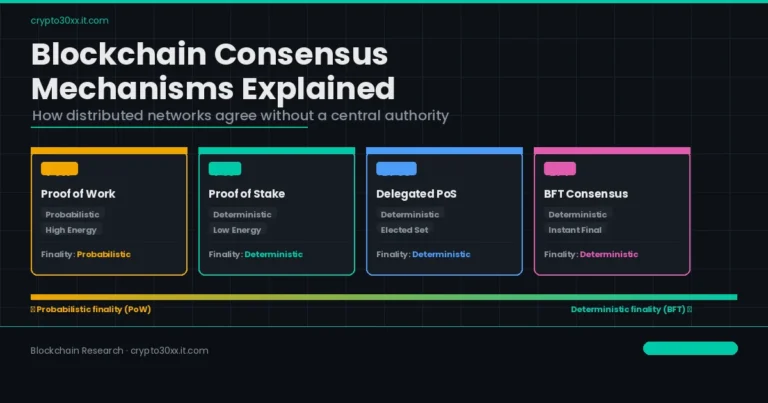
Public blockchains must solve a hard coordination problem: how do thousands of anonymous, geographically dispersed, potentially adversarial nodes agree on a single transaction history? The two dominant answers are Proof of Work and Proof of Stake.
In Proof of Work, nodes compete to solve a computationally expensive puzzle. The winner proposes the next block and receives a block reward. Honest behavior is economically rational because the hardware and energy cost of mounting an attack exceeds the expected gain at scale.
In Proof of Stake, validators lock up native tokens as collateral. They are selected to propose and attest to blocks in proportion to their stake, and face financial penalties (called slashing) for dishonest behavior. Both mechanisms are designed to function without trust between individual participants. Mathematics and economic incentives replace institutional authority.
What is a private blockchain?
A private blockchain is a permissioned distributed ledger where a single organization, or a defined group, controls who can read data, submit transactions, and participate in consensus. The blockchain data structure (chained blocks, cryptographic hashes, an append-only ledger) is preserved, but decentralization is deliberately constrained. Access is not open by design, and participants are known before they join.
The permissioned model explained
In a permissioned network, every participant is credentialed before joining. An administrative body issues digital certificates, manages identities, and enforces access policies. Transactions are broadcast only to authorized nodes. The ledger may be partially or fully invisible to outsiders.
Hyperledger Fabric is one of the most widely deployed enterprise examples. It uses a channel-based architecture where subsets of members can share private data streams invisible to other network participants.
Who controls a private blockchain?
A private blockchain has an identifiable controlling entity. That entity sets protocol rules, approves new participants, and can, in principle, modify or roll back the ledger. This is structurally different from a sufficiently decentralized public chain, where no single party holds that authority.
The controlling entity can also shut the network down. On a public chain, no single operator can unilaterally stop network operation. That distinction matters when evaluating what “immutability” actually guarantees in each context.
Key differences between public and private blockchains
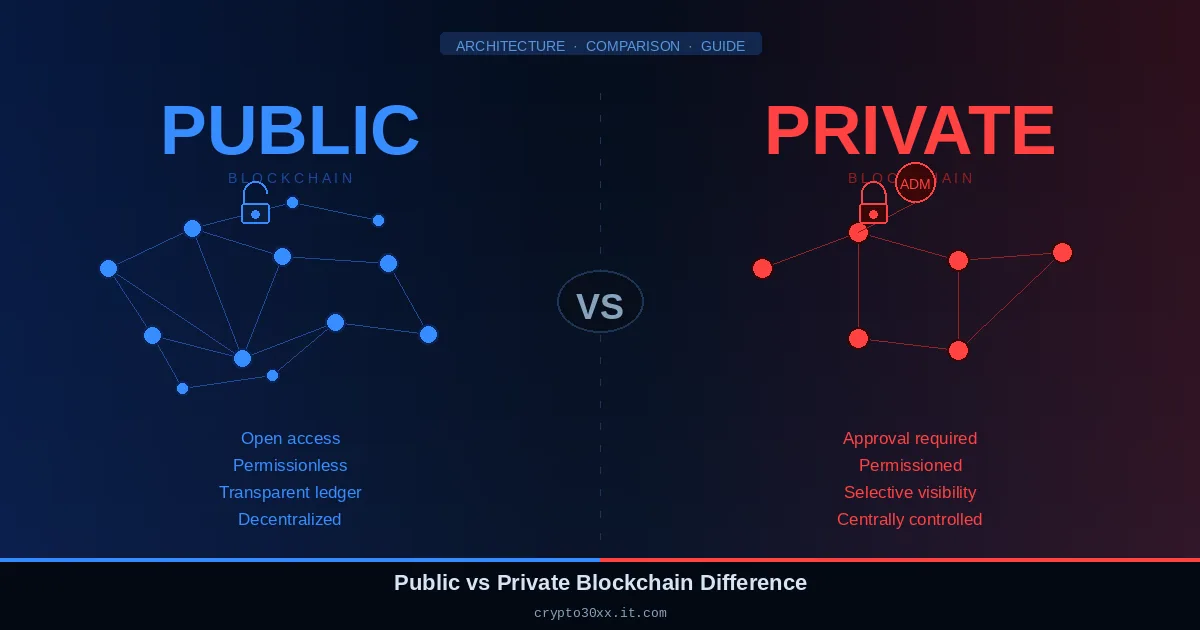
The public vs private blockchain difference is most clearly examined across six structural dimensions: access control, participant identity, ledger transparency, consensus mechanism, transaction throughput, and governance structure. Each reflects a different fundamental choice about where trust is placed and who bears the cost of producing it.
| Dimension | Public blockchain | Private blockchain |
|---|---|---|
| Access | Permissionless (open to anyone) | Permissioned (requires approval) |
| Identity | Pseudonymous or anonymous | Known, credentialed participants |
| Transparency | Fully visible ledger | Selective; data may be restricted |
| Consensus | PoW, PoS (large distributed node set) | BFT variants, Raft (small trusted set) |
| Throughput | Lower: seconds per block, limited TPS | Higher: milliseconds to seconds, hundreds+ TPS |
| Governance | Protocol rules, token holders, developers | Single operator or consortium |
| Immutability | Near-absolute; reversal requires majority control | Operator can modify rules or data |
| Energy use | High (PoW) to moderate (PoS) | Low; lightweight consensus, few nodes |
| Examples | Bitcoin, Ethereum, Litecoin | Hyperledger Fabric, Corda, Quorum |
Speed and throughput
Private blockchains process transactions substantially faster than most public blockchains. The structural reason is node count. Public chains must achieve consensus among thousands of globally distributed nodes with no pre-established trust between them. Every additional node increases coordination cost.
Private blockchains operate with a small, known validator set, often fewer than 100 nodes. Algorithms like Practical Byzantine Fault Tolerance (PBFT) or Raft reach agreement in milliseconds under these conditions. Speed is purchased at the cost of decentralization. That trade-off is intentional.
Transparency and privacy
Every transaction on a public blockchain is visible to every participant and, in most cases, to the general public through a block explorer. Addresses are pseudonymous rather than anonymous. On-chain analytics firms have developed methods for tracing transaction patterns and, in some cases, linking addresses to real-world identities.
Private blockchains restrict visibility by design. Operators implement fine-grained access controls, allowing a logistics partner to see shipment records, for example, without exposing pricing data to other participants. This selective transparency makes private chains viable in industries where data confidentiality is a legal or competitive requirement.
Decentralization and trust assumptions
This is the most fundamental difference between the two architectures. A public blockchain’s security model assumes the network functions correctly even when many participants are adversarial, because honest participation is economically incentivized and attack is expensive.
A private blockchain’s security model assumes credentialed participants are honest, or at least bound by legal agreements and business relationships. Trust is delegated to the operator or consortium. If the operator acts in bad faith, participants have legal recourse — not cryptographic recourse.
Cost and energy use
Running a Proof of Work public chain requires significant ongoing energy expenditure. That cost is not waste in protocol terms; it is the price of making chain rewrites economically prohibitive. Proof of Stake reduces energy requirements substantially while preserving a distributed validator model.
Private blockchains have minimal energy requirements. A small, known validator set using lightweight consensus protocols adds computational overhead close to that of a conventional database, without the energy burden of Proof of Work or the staking infrastructure of Proof of Stake.
What is a consortium blockchain?
A consortium blockchain (also called a federated blockchain) occupies a position between the fully open and fully closed models. It is permissioned, like a private blockchain, but governance is distributed across several independent organizations rather than concentrated in a single operator. No individual entity has unilateral control over the ledger.
How consortium chains differ from both
In a consortium model, several independent organizations (a group of competing banks, a set of logistics partners, or a coalition of healthcare providers) each operate a node and participate in consensus. No single member can add a fraudulent transaction without the others detecting and rejecting it.
Consortium chains share the throughput and data-privacy advantages of private blockchains. They offer stronger censorship resistance than a single-operator private chain, since no one party can unilaterally alter the ledger or shut the network down. They offer significantly less censorship resistance than a fully public network, where no controlling group exists at all. Trade finance, food traceability, and interbank settlement are sectors where consortium architectures have been evaluated or deployed.
Use cases: which blockchain fits which problem?
The choice between public and private blockchains is not about which architecture is technically superior. It is about matching the network’s trust model and operational profile to the actual problem. The appropriate architecture depends on who needs access to the data, how much pre-existing trust exists between participants, what throughput the application requires, and what data-confidentiality or regulatory constraints apply.
Public blockchain use cases
Public blockchains suit applications where censorship resistance, open access, and independently verifiable neutrality are core requirements:
- Cryptocurrency payments: where users transact without depending on any single institution to remain honest or operational
- Decentralized finance (DeFi): where smart contract logic must be publicly auditable and execution must be trustless by design
- Non-fungible tokens and digital ownership records: where provable scarcity and open transferability define the value proposition
- Decentralized governance: where token holders vote on protocol changes without a controlling party moderating the outcome
Private blockchain use cases
Private blockchains suit enterprise environments where participants are known, throughput requirements are high, and data must remain confidential:
- Supply chain tracking: where multiple partners need verified shared records without exposing commercial terms
- Healthcare data management: where patient records must be selectively shared between providers while remaining compliant with data protection frameworks
- Interbank settlement: where financial institutions need a shared, tamper-evident ledger that regulators can audit
- Internal audit trails: where an organization needs an immutable record of internal transactions without any external visibility
Common misconceptions about private blockchains
Two claims about private blockchains appear frequently in technical and non-technical literature. The first concerns whether a permissioned, centrally controlled system qualifies as a blockchain in any meaningful sense. The second concerns whether restricted access automatically produces stronger security. Both assumptions deserve closer examination than they usually receive.
Is a private blockchain really a blockchain?
The minimal technical definition of a blockchain is a data structure: a chain of cryptographically linked blocks, each referencing the hash of the previous one. A private blockchain uses this structure, and the description is technically accurate.
However, the properties that make public blockchains significant, namely censorship resistance, trustlessness, open participation, and immutability enforced by distributed consensus, do not transfer to permissioned systems by design.
A private blockchain controlled by a single organization that can modify the ledger or shut the network down is, from a trust-model perspective, closer to a conventional permissioned database with blockchain data structures layered on top. That distinction matters for anyone evaluating whether deploying a private blockchain produces genuinely different guarantees, or primarily different terminology.
Private doesn’t mean more secure
The logic seems intuitive: fewer participants means fewer attack surfaces. The reasoning is incomplete. On a well-decentralized public blockchain, compromising the network requires controlling a substantial share of total mining or staking power, an effort that is economically prohibitive at scale.
On a private blockchain with a small validator set, a compromised administrator credential or a coordinated attack on a handful of known nodes can undermine the entire network. Security depends on access controls and participant integrity, not on the cryptographic cost of rewriting the chain. Both models are defensible; they operate through entirely different security mechanisms, and the right model depends on the threat profile of the deployment.
FAQs
What is the main difference between a public and private blockchain? The core public vs private blockchain difference is access control. A public blockchain allows anyone to join, transact, and validate without permission. A private blockchain requires approval from a central operator or consortium. This single architectural choice produces downstream differences in transparency, throughput, governance model, and where trust is placed.
Can a private blockchain be hacked? Yes, through different mechanisms than a public chain. A private blockchain can be compromised through insider threats, credential theft, administrator access abuse, or coordinated attacks on a small validator set. Its security depends on access controls and participant integrity rather than the economic cost of rewriting the chain. Neither architecture is immune to all attack vectors.
Why are private blockchains faster than public blockchains? Private blockchains operate with a small number of known validators and can use lightweight consensus algorithms (such as PBFT or Raft) that reach agreement quickly within a trusted group. Public blockchains must coordinate thousands of anonymous, globally distributed nodes, a process that takes seconds per block rather than milliseconds.
Is Ethereum a public or private blockchain? Ethereum is a public blockchain. Anyone can run a node, submit transactions, deploy smart contracts, or participate in staking without requiring approval. The full transaction history is publicly visible through block explorers. There is no gatekeeper controlling network access.
What is a consortium blockchain? A consortium blockchain is a permissioned network governed collectively by a group of independent organizations rather than a single operator. Participants are credentialed, like in a private chain, but no single entity controls the network. This model suits industry groups that need shared, tamper-evident data without any one party holding unilateral authority.
Which industries use private blockchains? Financial services (trade finance, interbank settlement), supply chain management, healthcare data sharing, and enterprise audit applications are the most common deployment contexts. These industries require the throughput, data confidentiality, and compliance properties that private and consortium chains offer, without the open-access model of public networks.
Can a company migrate from a private blockchain to a public one? Technically, data can be migrated, but the architectural shift requires rebuilding the trust model, access controls, consensus mechanism, and performance expectations from the ground up. The move is not a configuration change. It is a full system redesign that changes the fundamental security and governance assumptions.
Does a private blockchain need a native token? Not necessarily. Many private blockchain platforms, including Hyperledger Fabric, do not use a native cryptocurrency. Public blockchains almost always require a native token to incentivize validators and pay transaction fees. Private chains substitute administrative controls and legal agreements for token-based incentive structures.
Disclaimer
This article is written for educational and research purposes only. It does not constitute financial, investment, or legal advice. Blockchain technology and cryptocurrency markets carry significant risks, including the potential for total loss of capital. Independent research and professional consultation are recommended before any financial decision.
The public vs private blockchain difference ultimately reflects two different answers to the same question: what do participants need to trust, and who should bear the burden of producing that trust? Public chains distribute trust across open networks through cryptographic incentives and economic game theory. Private chains concentrate trust within known, credentialed groups through administrative controls and legal agreements.
Neither model is inherently superior. An application requiring censorship resistance and global open access needs a public chain. An enterprise supply chain shared between ten known logistics partners almost certainly does not. Understanding the structural logic of each architecture, rather than defaulting to whichever name appears most in trade press, is what allows practitioners and researchers to make accurate, context-driven evaluations.
Dive into content that makes a difference—find real answers inside our tender teachings.