Blockchain consensus mechanisms explained: PoW, PoS, and beyond
Blockchain consensus mechanisms explained: A blockchain consensus mechanism is the protocol by which a distributed network of nodes agrees on the valid state of a shared ledger — without any central authority deciding what’s true. Every blockchain must solve the same core problem: thousands of independent computers, with no reason to trust each other, need to agree on a single transaction history. The mechanism each chain uses to reach that agreement defines its security model, energy requirements, validator incentives, and the trade-offs it makes between decentralization, throughput, and finality. Proof of Work and Proof of Stake are the two most widely deployed approaches, but the design space extends well beyond them.
What consensus mechanisms solve
In a traditional database, one server decides what data is correct. A blockchain has no such server — any node can join the network, propose a block, or attempt to manipulate the ledger. Without a consensus mechanism, an attacker could simply write whatever history they wanted.
The problem is formalized in computer science as the Byzantine Generals Problem: a group of generals (network nodes) must coordinate an attack, but some may be traitors (malicious nodes) sending false information. The question is how the honest generals reach correct agreement despite the traitors.
Byzantine fault tolerance
A system is Byzantine fault tolerant (BFT) if it can reach correct consensus even when some participants behave arbitrarily — not just fail silently, but actively lie or send conflicting messages. Most blockchain consensus mechanisms are designed to tolerate some fraction of Byzantine (malicious or faulty) nodes while still producing a valid, agreed-upon chain state.
The fraction varies by design. Bitcoin’s Proof of Work is secure as long as honest miners control more than 50% of hash power. Tendermint-based systems tolerate up to one-third Byzantine validators. Different mechanisms draw that threshold differently, with implications for how expensive an attack becomes.
How Proof of Work consensus operates
Proof of Work (PoW) is the original blockchain consensus mechanism, introduced in Bitcoin’s design. It requires block producers — called miners — to solve a computationally expensive puzzle before their block is accepted by the network.
The hash puzzle and difficulty adjustment
The puzzle requires miners to find a number (called a nonce) such that when combined with the block’s data and run through a cryptographic hash function (SHA-256 in Bitcoin), the resulting output falls below a target value. Hash functions are one-way: there is no shortcut to finding the correct nonce other than brute-force trial and error.
The network adjusts the target value — known as difficulty — approximately every two weeks in Bitcoin, targeting an average block time of ten minutes. If blocks are arriving faster than ten minutes, difficulty increases. If slower, it decreases. This self-adjustment keeps block production predictable regardless of how much total mining power joins or leaves the network.
Why PoW provides security
The economic cost of producing a block is the electricity consumed during the search for a valid nonce. To rewrite blockchain history — to execute what’s called a 51% attack — an attacker must redo all that computational work faster than the honest network continues to build the chain. The further back in history the rewrite goes, the more cumulative work must be redone, making deep reorganizations exponentially more expensive.
This is the core security property: past blocks become more secure over time as additional blocks are built on top, each adding more proof of spent energy.
The energy trade-off
The same property that makes PoW secure — real-world energy expenditure — is its most significant criticism. Mining at scale requires purpose-built hardware (ASICs) consuming large amounts of electricity. The energy is by design: removing the expenditure removes the security cost that makes attacks expensive. The debate around PoW centers on whether that cost is justified relative to alternative mechanisms that achieve similar security through different means.
How Proof of Stake consensus operates
Proof of Stake (PoS) replaces computational work with economic stake as the cost of participation. Validators deposit (stake) the network’s native token as collateral. The right to propose and attest to blocks is allocated in proportion to stake, rather than in proportion to hash power.
Validator selection and block proposal
In most PoS implementations, the validator selected to propose each new block is chosen pseudo-randomly, weighted by their stake. A validator with 1% of total staked tokens has approximately a 1% chance of being selected for any given slot. Other validators then attest (vote) to the validity of the proposed block. Blocks accumulate attestations until they reach a supermajority threshold, at which point they are considered finalized or justified.
Ethereum’s PoS implementation (Gasper consensus) divides time into 12-second slots and 32-slot epochs. Each slot has one assigned proposer and a committee of attesters drawn randomly from the full validator set.
Slashing: the penalty for misbehavior
What prevents a validator from voting on two competing blocks simultaneously (known as double-voting or equivocation) or from trying to rewrite history? In PoW, the cost is wasted electricity. In PoS, the equivalent deterrent is slashing: a validator caught misbehaving loses a portion of their staked collateral, sometimes their entire stake, and is forcibly ejected from the validator set.
Slashing makes attacks expensive in capital terms rather than energy terms. An attacker controlling enough stake to threaten the network would also lose a large fraction of that stake if the attack were detected — making the attack economically self-defeating in most designs.
The nothing-at-stake problem and how it’s solved
Early PoS designs faced a theoretical concern: because voting costs no energy, validators might rationally vote on every competing fork simultaneously, since there’s no cost to doing so. This is the nothing-at-stake problem.
Modern PoS implementations solve it through slashing conditions that penalize validators for attesting to multiple conflicting chain states. The penalty introduces the cost that makes voting on multiple forks irrational.
Delegated Proof of Stake
Delegated Proof of Stake (DPoS) introduces a representative layer. Token holders vote to elect a fixed set of block producers — typically 21 to 101 — who take turns producing blocks in a round-robin schedule. EOS and TRON use variants of this design.
DPoS achieves high throughput and fast block times because a small, known set of validators can coordinate efficiently. The trade-off is a significant reduction in decentralization: a small elected validator set is a more concentrated point of failure and a more feasible target for cartel formation or governance capture.
BFT-based consensus variants
Classical Byzantine fault-tolerant protocols — derived from the academic literature on distributed systems — take a different approach: rather than building the longest chain, they have validators communicate in rounds until a supermajority explicitly agrees on each block.
PBFT, Tendermint, and HotStuff
Practical Byzantine Fault Tolerance (PBFT), published by Castro and Liskov in 1999, was one of the first practical BFT algorithms. It requires O(n²) messages for n validators, which limits it to small validator sets.
Tendermint, used by the Cosmos ecosystem, adapts BFT for blockchain with two phases: pre-vote and pre-commit. A block is finalized when two-thirds of validators pre-commit to it. Tendermint provides instant finality — once a block is committed, it cannot be reversed — but at the cost of halting progress if more than one-third of validators go offline.
HotStuff, which underlies Meta’s Diem project and several other chains, reduces the communication complexity to O(n), making BFT consensus more scalable without sacrificing the safety and liveness properties.
BFT finality vs. probabilistic finality
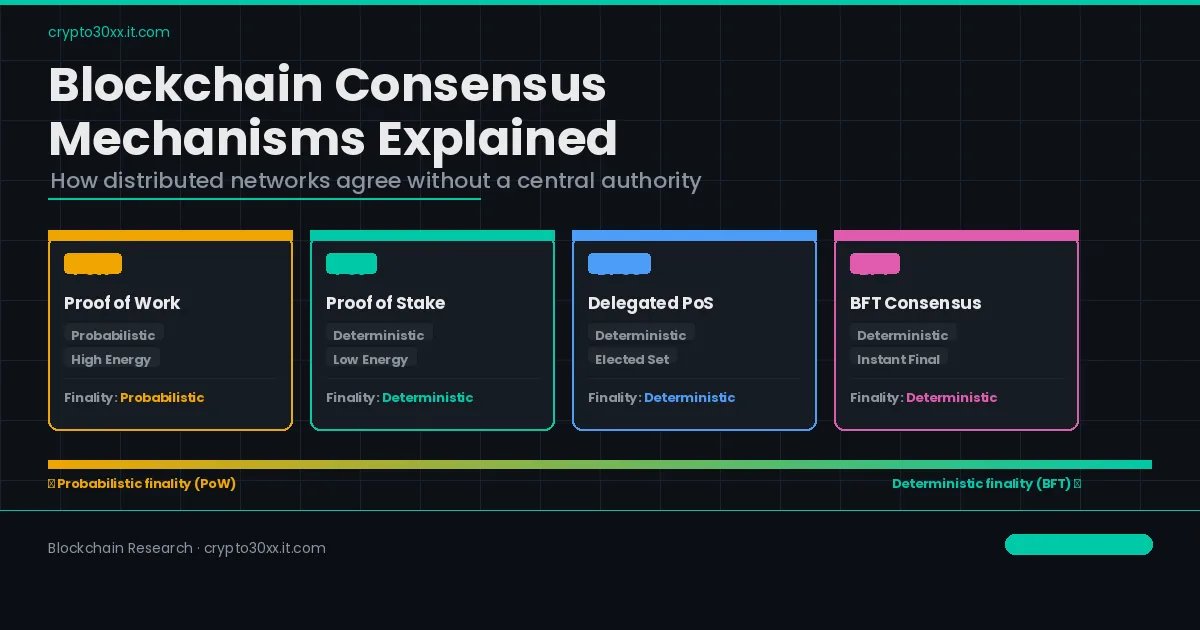
This distinction matters practically. In PoW, finality is probabilistic: a transaction is not literally irreversible but becomes exponentially harder to reverse with each additional block. Six confirmations in Bitcoin is a widely used threshold for treating a transaction as settled, representing roughly one hour of additional work.
In BFT-based systems, finality is deterministic: once a block passes the two-thirds supermajority threshold, the protocol guarantees it will not be reversed without validators violating their slashing conditions — which destroys their stake. For applications where settlement certainty matters, deterministic finality has clear advantages.
DAG-based consensus
Some blockchains replace the linear chain structure entirely with a Directed Acyclic Graph (DAG), where multiple blocks can be confirmed simultaneously. Avalanche’s consensus protocol uses a DAG-based approach on its X-Chain, where validators repeatedly sample small random subsets of peers to build confidence about transaction ordering. IOTA and Hedera Hashgraph use different DAG variants.
DAG designs can achieve high throughput because parallel block production isn’t serialized. The consensus properties and security guarantees vary significantly between implementations, making DAG-based systems one of the more complex areas to analyze.
Consensus mechanism comparison
| Mechanism | Finality type | Energy use | Decentralization | Attack cost |
|---|---|---|---|---|
| Proof of Work | Probabilistic | Very high | High (open entry) | Hash power >50% |
| Proof of Stake | Deterministic or probabilistic | Low | High (open entry, min stake) | Stake >33–51% |
| Delegated PoS | Deterministic | Very low | Low (elected set) | Capture elected validators |
| BFT (Tendermint) | Deterministic | Low | Medium (validator set size) | Stake >33% |
| DAG-based | Varies by implementation | Low | Varies | Protocol-specific |
The Ethereum Merge: a PoW-to-PoS transition
Ethereum operated on Proof of Work from its launch until the Merge, when the chain transitioned to Proof of Stake by replacing its PoW execution layer with a PoS consensus layer (the Beacon Chain, which had been running in parallel). The transition eliminated Ethereum’s mining infrastructure entirely, shifting block production to a validator set that deposits 32 ETH each to participate.
The Merge is the most significant consensus mechanism transition in blockchain history by network value affected. It reduced Ethereum’s energy consumption by an estimated 99.95% while preserving the existing chain state and transaction history. The technical execution involved no downtime and no replay of the existing chain.
This transition also changed Ethereum’s issuance model: PoW block rewards were eliminated, replaced by much smaller PoS validator rewards. Combined with the EIP-1559 fee burn mechanism, Ethereum’s net issuance became negative in periods of high network activity.
FAQs
What is a blockchain consensus mechanism?
A blockchain consensus mechanism is the protocol by which independent, distributed nodes agree on the valid state of a shared ledger without any central authority. It defines how new blocks are proposed, validated, and made permanent — and what makes it economically irrational for a participant to cheat or manipulate the record.
What is the difference between Proof of Work and Proof of Stake?
In Proof of Work, block producers compete by spending computational energy to solve a hash puzzle. In Proof of Stake, block producers are selected based on the tokens they’ve deposited as collateral, and are penalized financially for misbehavior. PoW secures the network through energy expenditure; PoS through capital at risk. Both aim to make attacks more expensive than they’re worth.
What is finality in blockchain consensus?
Finality refers to how confident the network can be that a confirmed transaction will not be reversed. Probabilistic finality (PoW) means a transaction becomes harder to reverse with each additional block but is never literally impossible to undo. Deterministic finality (BFT-based PoS) means once a block passes the supermajority threshold, the protocol guarantees it cannot be reversed without validators losing their stake.
What is a 51% attack?
A 51% attack occurs when a single entity controls more than half of a PoW network’s hash power (or a sufficient share of PoS stake) and uses that control to rewrite recent transaction history — typically to double-spend funds. The attack becomes less viable as total network participation grows, because the capital or energy required to reach the threshold increases proportionally.
What does slashing mean in Proof of Stake?
Slashing is the penalty applied to PoS validators who violate consensus rules — such as signing two different blocks for the same slot or attempting to vote on a competing chain. The penalty removes a portion (or all) of the validator’s staked collateral and ejects them from the validator set. Slashing is the mechanism that makes misbehavior economically irrational in PoS systems.
Why did Ethereum switch from PoW to PoS?
Ethereum transitioned to Proof of Stake primarily to eliminate the energy consumption required by Proof of Work mining, reduce ETH issuance (lowering sell pressure from miners), and create a foundation for future scaling upgrades like sharding. The transition also moved block production from specialized mining hardware to a more accessible validator model requiring 32 ETH and a standard server.
What is Delegated Proof of Stake?
DPoS is a variant of Proof of Stake where token holders vote to elect a fixed set of block producers — typically 21 to 101 — who produce blocks in rotation. DPoS achieves higher throughput and faster block times than standard PoS because a small, known set can coordinate efficiently, but at the cost of decentralization: a small elected validator set is more vulnerable to cartel formation and governance capture.
Which consensus mechanism is the most decentralized?
Proof of Work and open-entry Proof of Stake are generally considered the most decentralized consensus models because participation is permissionless — anyone can join by acquiring hardware or meeting the minimum stake threshold. DPoS and BFT-based systems with small validator sets trade decentralization for throughput and efficiency. No consensus mechanism is perfectly decentralized in practice; hardware manufacturing concentration (PoW) and minimum stake requirements (PoS) both introduce real-world centralization pressures.
Disclaimer
This article is written for educational and research purposes only. It does not constitute financial advice or an endorsement of any blockchain network, token, or project. All blockchain systems carry technical and financial risk. Readers should conduct independent research before making decisions of any kind.
Knowledge you can use today lives inside our immediately applicable blog posts.