Blockchain governance models explained: a complete guide
Blockchain governance models are the formal and informal systems that determine how decisions get made about a blockchain protocol, covering upgrades, parameter changes, treasury spending, and dispute resolution. These models define who holds decision-making power and what processes convert a proposal into an accepted change. Unlike traditional organizations with boards and executives, blockchain networks must coordinate thousands of anonymous, globally distributed participants, making governance design one of the most consequential architectural choices any protocol team makes. This article breaks down the main governance models, the voting mechanisms that power them, the structural trade-offs between each approach, and the documented failure modes that researchers and analysts study to understand decentralized coordination.
What is blockchain governance?
Blockchain governance is the set of rules, processes, and actors that determine how a decentralized protocol evolves over time. It covers technical upgrades, on-chain treasury allocation, staking parameter changes, and dispute resolution. Without a defined process, any modification to a protocol requires collective agreement among thousands of globally distributed participants who may hold competing interests.
Why governance matters in decentralized systems
A blockchain without a functional governance process does not stay frozen in time. It fractures. When participants disagree on a protocol change and no consensus mechanism exists to resolve the dispute, the network splits into competing chains. Bitcoin Cash separated from Bitcoin following an unresolved block-size debate. Ethereum Classic exists because the community could not agree on a response to a major smart contract exploit.
These events demonstrate that governance failure has direct technical consequences.
Good governance design solves three overlapping problems: it creates a reliable path for protocol upgrades; it manages conflicts of interest among miners, validators, developers, and token holders; and it accomplishes both without reintroducing the centralized control that blockchain architecture is designed to remove.
The two primary governance models
Blockchain governance operates through two broad structural categories: on-chain governance, where decisions are encoded and executed through the protocol itself, and off-chain governance, where decisions emerge from social consensus outside the protocol code. Both models appear across major networks, often in combination.
On-chain governance: how it works
On-chain governance embeds voting directly into the protocol. Token holders submit proposals, cast votes using their tokens, and if a vote passes defined thresholds, the protocol executes the approved change automatically without requiring manual developer intervention. Tezos pioneered this model at launch. Polkadot implements a version of it through its OpenGov framework.
The defining feature is automation. When a proposal passes, it activates on-chain without manual deployment. This removes the point of failure where a small team might delay or ignore a community vote.
The limitation is rigidity. On-chain governance can only alter parameters that were pre-defined as modifiable. Fundamental architecture changes may still require off-chain coordination first.
Off-chain governance: how it works
Off-chain governance relies on social and institutional processes outside the chain. Bitcoin operates this way. Proposals are discussed in public forums through Bitcoin Improvement Proposals (BIPs), debated by developers and miners, and implemented only when broad informal consensus forms. No token vote triggers the upgrade. Node operators and miners signal readiness by running new software.
This model is slower by design. Reaching rough consensus across a global, anonymous community takes time. What it offers in return is resistance to rapid changes pushed through by a well-funded minority.
Many protocols blend both approaches. Compound, for example, uses on-chain voting to execute treasury decisions but relies on off-chain forums such as Snapshot and Discourse for initial temperature checks and proposal refinement.
How voting mechanisms shape blockchain governance models
The voting mechanism is distinct from the governance model. A protocol can use on-chain execution while experimenting with different voting systems. Several mechanisms have emerged to address the most common failure modes, particularly the outsized influence of large token holders over collective decisions.
Token-weighted voting
Token-weighted voting is the most common mechanism in on-chain governance. Each token equals one vote. Proposals pass when a minimum quorum is reached and the result clears a threshold, often 51% or a supermajority of 66%. MakerDAO, Uniswap, Aave, and dozens of DeFi protocols use this model.
The appeal is simplicity. The problem is concentration. When a small number of addresses hold the majority of governance tokens, those addresses control protocol decisions. Governance researchers call this plutocracy: rule by the wealthiest participants rather than the most informed or most affected ones.
Quadratic voting
Quadratic voting addresses the plutocracy problem by making voting power scale as the square root of tokens committed. A participant with 100 tokens gets 10 votes. A participant with 10,000 tokens gets 100 votes, not 10,000.
The formula compresses the power gap between large and small holders without eliminating it. Gitcoin used a related mechanism, quadratic funding, to distribute grants across the Ethereum developer ecosystem, and governance researchers cite it as a structurally promising alternative to simple token weighting.
Its main vulnerability is Sybil attacks. A single actor can split tokens across many wallets to appear as multiple small holders, gaining disproportionate influence relative to their actual stake.
Conviction voting
Conviction voting assigns weight not just by token holdings but by the duration for which those tokens have been committed to a proposal. The longer a holder supports a proposal, the stronger their effective vote becomes.
This model rewards sustained community interest rather than last-minute vote mobilization, which can be gamed in time-boxed windows. The Colony network and the Gardens framework built by 1Hive implement variations of conviction voting. It naturally filters out proposals that cannot maintain community attention over time, which produces a different selection pressure than binary snapshot votes.
Governance structures compared
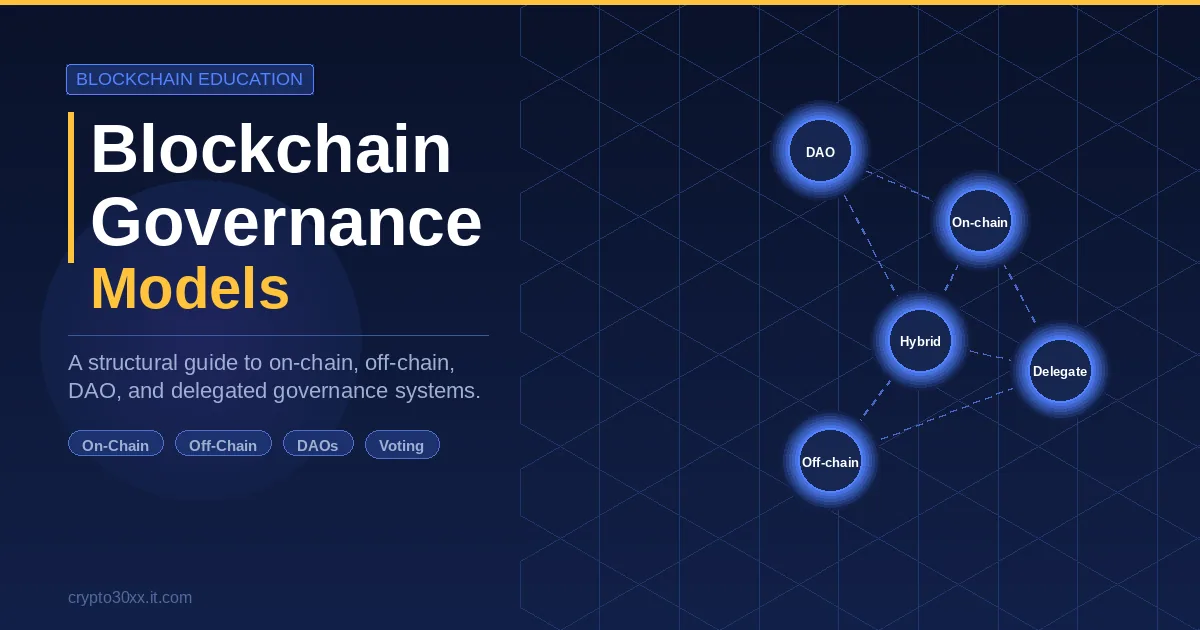
Beyond voting mechanics, protocols differ in their broader organizational structures. The table below maps the main structural types against their defining features, upgrade paths, and representative examples.
| Structure | Decision-makers | Primary mechanism | Upgrade path | Example protocols |
|---|---|---|---|---|
| DAO-based | Token holders | On-chain vote | Automatic execution | Compound, Aave |
| Foundation-led | Core team + foundation | BIP / off-chain consensus | Developer deployment | Bitcoin, early Ethereum |
| Delegated | Elected representatives | Token holders vote for delegates | On-chain vote by delegates | Tezos, Polkadot |
| Hybrid | Token holders + core team | Snapshot + on-chain | Off-chain signal then on-chain execution | Uniswap, Synthetix |
DAO-based governance
A Decentralized Autonomous Organization (DAO) replaces organizational hierarchy with smart contract-enforced rules. Governance tokens represent membership and voting power. Any token holder can submit a proposal; any holder can vote; and outcomes execute automatically.
The DAO model reaches its limits when participation drops. If only 5-10% of token holders engage in a vote, the result may reflect a small, active minority rather than the broader community. This is the voter apathy problem, among the most documented challenges in DAO governance research.
Foundation-led governance
Many major protocols launched with a nonprofit foundation that coordinates upgrades and manages developer grants. The Ethereum Foundation, Cardano’s IOG, and the Zcash Foundation operate this way. The foundation holds no absolute authority; its influence depends on developer adoption and community trust. What it provides is a coordination point that purely decentralized models sometimes lack.
Foundation-led governance tends to produce conservative, multi-team review processes before deployment. The trade-off is a slower upgrade pace and greater trust placed in a small group of humans.
Delegated governance
Delegated governance allows token holders to assign their voting power to a representative rather than voting directly on every proposal. Tezos calls its delegates bakers. Polkadot originally used an elected council. Compound and Uniswap have both developed formal delegate systems.
Delegation addresses voter apathy by concentrating participation among motivated, informed representatives. The risk is recreating representative democracy inside a system originally designed to minimize trust in intermediaries.
Real-world blockchain governance models in practice
Three protocols demonstrate distinct approaches that have generated documented case studies from researchers and developers. Each illustrates a different solution to the core challenges of decentralized coordination.
Tezos and self-amending governance
Tezos was built from its first version with formal on-chain governance. Its amendment process runs through defined stages: a proposal period, an exploration vote, a cooldown, and a promotion vote. Bakers, node operators who have staked tez, participate at each stage.
When a proposal passes all stages, it activates on-chain without developer intervention. Tezos has coordinated multiple protocol upgrades this way, each named after a city. The governance system itself can be modified through the same process, making it genuinely self-amending in a way few other protocols have replicated.
MakerDAO and token governance
MakerDAO governs the Dai stablecoin system through MKR token holders. Governance decisions include the stability fee, which functions as an interest rate on collateralized loans, debt ceilings for different collateral types, and protocol upgrades. Proposals pass through on-chain executive votes executed as spells: pre-coded smart contract calls that take effect when a sufficient MKR threshold signals approval.
MakerDAO’s governance history documents cases of low participation in critical votes and concentrated MKR holdings among early investors, making it an instructive example of both the capabilities and the failure modes of token-weighted on-chain governance.
Polkadot’s multi-track OpenGov
Polkadot’s OpenGov framework introduced a multi-track referendum system where different proposal types run on parallel tracks with different voting periods and approval thresholds. Low-stakes changes require fewer votes; high-stakes changes require broader participation and a longer deliberation window.
This design addresses the bottleneck of single-track governance, where all proposals compete for the same voting window. By matching the approval threshold to the risk level of a proposal, OpenGov creates more nuanced governance without requiring every token holder to engage with every decision.
Risks and limitations of blockchain governance models
No governance model eliminates the core tensions of collective decision-making. Understanding failure modes is as important as understanding the mechanisms. Researchers studying blockchain coordination consistently return to three categories of risk.
Plutocracy and voter apathy
Token-weighted voting creates governance power proportional to wealth, not to stake in outcomes. Venture funds that received tokens at low valuations during early funding rounds can outvote thousands of individual participants. This dynamic has been documented in DeFi governance votes where large holders reversed proposals that had broad but diffuse community support.
Voter apathy compounds the problem. Many token holders treat governance tokens primarily as speculative instruments, not participation tools. When quorum thresholds are set too high, proposals fail by default. When set too low, a small coordinated group can pass changes the wider community would reject.
Governance attacks
A governance attack occurs when an entity acquires enough voting power to pass a malicious proposal, typically one that drains the protocol’s treasury or alters parameters for the attacker’s benefit. The Beanstalk protocol suffered a well-documented governance attack in which an attacker used a flash loan to temporarily acquire enough governance tokens to pass a proposal transferring funds to their own wallet.
Flash loan-based attacks work when voting snapshots are taken from the current on-chain state rather than a time-delayed balance. Time locks on proposal execution are the standard defense: a passed vote waits a defined period before taking effect, giving participants time to exit the protocol if they disagree with the outcome.
The coordination problem
Decentralized governance faces a structural misalignment. The participants best positioned to evaluate a technical upgrade are core developers, but they are not necessarily the majority of token holders. Majority token holders may lack the technical background to assess complex changes, meaning governance outcomes can be driven by social sentiment rather than sound technical judgment.
Some protocols address this by introducing formal structures such as technical committees, security councils, or optimistic governance models, where vetted experts fast-track routine decisions while token holders retain override authority.
FAQs
What is the difference between on-chain and off-chain blockchain governance? On-chain governance encodes proposals and votes directly into the protocol, with approved changes executing automatically via smart contracts. Off-chain governance relies on social processes — forums, mailing lists, developer consensus — to reach agreement before deploying updates manually. Most major protocols use elements of both, with off-chain forums handling early deliberation and on-chain voting handling final execution.
What is a governance token? A governance token is a cryptographic asset that grants its holder voting rights over protocol decisions. Governance tokens are distinct from utility tokens and security tokens: their primary function is participation in collective decision-making, not access to services or financial returns. Common examples include MKR for MakerDAO, COMP for Compound, and UNI for Uniswap.
Can a blockchain’s governance model itself be changed? Yes. Some blockchains, like Tezos, include governance reform as an explicit category of on-chain proposal. Others require a hard fork, a fundamental software change, if token holders and developers agree to alter the decision-making structure. The governance model is not permanently fixed in most protocols, though changing it typically requires the highest level of community consensus.
What is voter apathy in blockchain governance? Voter apathy describes the pattern where most token holders do not participate in governance votes. This is common when governance tokens are held primarily as speculative instruments rather than participation tools. Low participation allows a small coordinated group to pass or block proposals that do not reflect broader community preferences, undermining the legitimacy of decentralized decision-making.
What is a governance attack, and how is it prevented? A governance attack occurs when an actor acquires temporary or permanent majority voting power and uses it to pass a proposal that benefits themselves at the protocol’s expense. Standard defenses include time locks on proposal execution, snapshot delays that measure token balances at a historical block rather than the current state, and minimum token holding periods before a participant can submit or vote on proposals.
What is delegated governance in a blockchain protocol? Delegated governance allows token holders to assign their voting power to a trusted representative who votes on their behalf. This addresses voter apathy by concentrating participation among engaged, informed delegates while preserving the right of any holder to vote directly or change their delegate. Tezos, Polkadot, Compound, and Uniswap all implement variations of this model.
How does quadratic voting differ from standard token-weighted voting? In token-weighted voting, each token equals one vote, giving large holders proportionally dominant power. In quadratic voting, each additional vote costs quadratically more tokens than the last. Accumulating 100 votes requires 10,000 tokens, while accumulating 10 votes requires only 100. This compresses the power gap between large and small holders without fully eliminating the relationship between token ownership and voting influence.
Disclaimer
This article is written for educational and research purposes only and does not constitute financial, investment, or legal advice. Blockchain governance is a technical and structural topic; nothing in this article should be interpreted as a recommendation to buy, sell, or participate in any specific protocol or token. Readers should conduct independent research and consult qualified professionals before making any financial decisions.
Blockchain governance models represent one of the most actively debated design problems in decentralized systems. The choice between on-chain and off-chain governance, the selection of a voting mechanism, and the role given to delegates or foundations all shape how a protocol responds to technical challenges, security threats, and community disagreements over time. No single model has resolved every tension; the field continues to evolve through documented experiments, failures, and incremental refinements.
For researchers and analysts, the most productive lens remains comparative: understanding what each model optimizes for, what failure modes it introduces, and what trade-offs the original designers accepted when they built it.
Let our warm reflections wash over you like a quiet morning inside our soft library every day.