Blockchain vs traditional database: differences explained
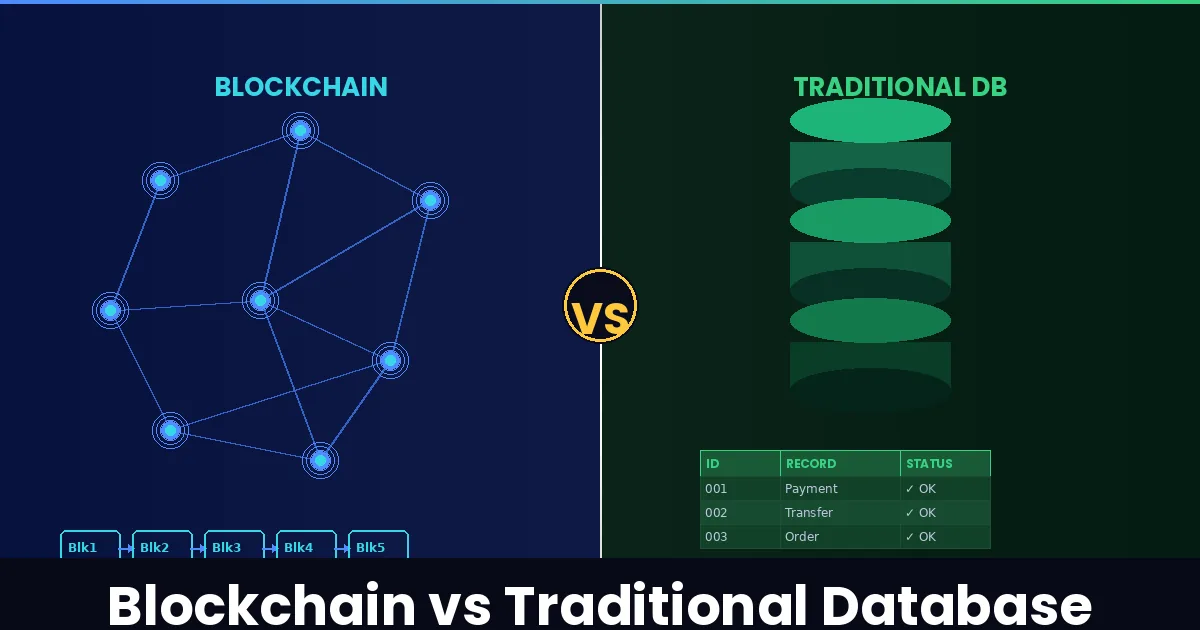
Blockchain vs traditional database: A blockchain is a distributed ledger that records data in cryptographically linked blocks across a network of independent nodes, while a traditional database is a centralized system where a single administrator controls how data is stored, modified, and accessed. Both technologies manage and persist data, but they solve fundamentally different problems. Understanding the distinction matters for anyone analyzing how digital assets function, why crypto networks behave the way they do, or how enterprises choose between these architectures for real-world applications.
What is a traditional database?
A traditional database is a structured collection of data managed by a central authority, typically an organization or server cluster. Administrators define who can read or write data, and changes are made instantly without requiring approval from external parties.
How relational databases store data
The most common type is the relational database management system, or RDBMS. Data sits in tables composed of rows and columns. Foreign keys link tables to each other, enabling complex queries across related datasets. SQL (Structured Query Language) is the standard tool for retrieving and manipulating that data.
Systems like Oracle Database, Microsoft SQL Server, and PostgreSQL power most enterprise applications — banking apps, hospital records systems, e-commerce platforms, and social media feeds all run on databases of this type.
ACID properties and why they matter
Traditional databases operate under ACID guarantees:
- Atomicity: A transaction either completes fully or rolls back entirely — no partial writes.
- Consistency: Every transaction brings the database from one valid state to another.
- Isolation: Concurrent transactions do not interfere with each other.
- Durability: Once committed, data survives system failures.
These properties make traditional databases extremely reliable for high-speed, high-volume operations. A bank processing thousands of transfers per second needs ACID compliance — a partially executed transaction that debits one account but never credits another would be catastrophic.
Strengths of traditional databases
- High throughput: modern RDBMS systems handle hundreds of thousands of transactions per second
- Low latency: reads and writes complete in milliseconds under normal conditions
- Flexible querying: SQL enables complex joins, aggregations, and filters across large datasets
- Mature tooling: decades of optimization, monitoring, and administration infrastructure exist
- Simple architecture: a single administrator can update, correct, or delete any record
Limitations of traditional databases
The central point of control is also the central point of failure. If the administrator’s server goes offline, data becomes inaccessible. If the administrator is compromised — whether by a hacker, a corrupt insider, or a legal order — the data can be altered or suppressed without any external audit trail. Parties who do not fully trust each other must either trust the database operator or build expensive verification layers on top.
What is a blockchain?
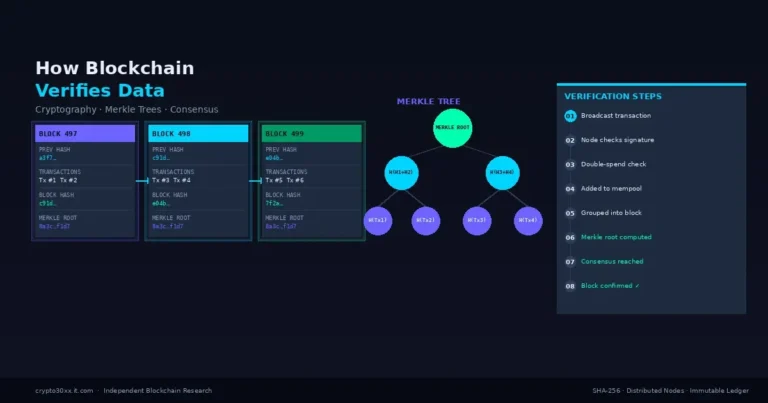
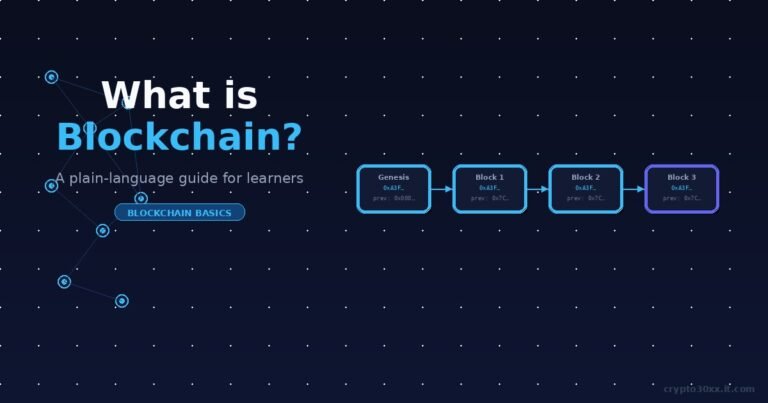
A blockchain is a distributed ledger technology where data is recorded in sequential blocks, each containing a cryptographic hash of the block before it. This chain structure makes any retroactive alteration mathematically detectable: changing one block breaks the hash reference in every block that follows.
No single party controls the ledger. Copies are held by every participating node in the network, and new data can only be appended after the network reaches consensus according to predefined rules.
How blockchain stores data
Each block contains:
- A batch of validated transactions or records
- A timestamp
- The cryptographic hash of the preceding block
- A nonce or other consensus-specific value
When a new block is proposed, nodes across the network verify it independently. Only after consensus is reached does the block get added. The accepted block becomes permanent — it cannot be edited or deleted without rewriting every block that follows and outpacing the computational work of the entire network.
Consensus mechanisms: how agreement is reached
Because no central administrator exists, blockchains rely on consensus mechanisms to determine which version of the ledger is valid. The main approaches:
Proof of Work (PoW): Nodes (miners) compete to solve a computationally expensive mathematical puzzle. The winner adds the next block and earns a reward. Bitcoin operates on PoW. The energy cost of solving these puzzles makes retroactive manipulation prohibitively expensive, but throughput is limited — Bitcoin processes roughly 7 transactions per second under typical conditions.
Proof of Stake (PoS): Validators lock up (stake) a quantity of the network’s native token as collateral. The protocol selects validators to propose blocks, weighted by stake size. Ethereum migrated to PoS in 2022. Energy consumption dropped dramatically, and throughput capacity increased significantly.
Practical Byzantine Fault Tolerance (PBFT): Used in permissioned blockchains like Hyperledger Fabric, PBFT achieves consensus by requiring a supermajority of known validators to agree before a block is committed. The tradeoff is that it works well only with a smaller, known validator set — scalability weakens as node count grows beyond a few dozen.
The choice of consensus mechanism shapes every performance characteristic of the blockchain: its throughput, its finality time, its energy profile, and its vulnerability to various attack types.
Immutability and its implications
Once data lands on a public blockchain, it stays. This is the defining architectural decision. For applications where an audit trail must be tamper-evident — a financial settlement record, a pharmaceutical shipment log, a digital asset ownership history — immutability is a feature. For applications where data routinely needs correction or deletion (a customer’s shipping address, a medical record update, a product catalog price), immutability creates operational friction.
Blockchain vs traditional database: direct comparison
The blockchain vs traditional database question is ultimately an architectural one. The table below maps both technologies across the dimensions that matter most for that decision.
| Dimension | Traditional database | Blockchain |
|---|---|---|
| Control model | Centralized (single admin) | Decentralized (distributed nodes) |
| Data structure | Tables with rows and columns | Cryptographically linked blocks |
| Write permissions | Controlled by admin | Open (permissionless) or restricted (permissioned) |
| Data mutability | Records can be updated or deleted | Append-only; past records are immutable |
| Trust model | Trust the database operator | Trust the protocol and consensus rules |
| Throughput | Hundreds of thousands of TPS | Tens to tens of thousands of TPS, depending on consensus |
| Query capability | Complex SQL queries supported | Limited native query support; requires off-chain tools |
| Transaction finality | Near-instant (milliseconds) | Seconds to minutes depending on consensus |
| Transparency | Access controlled; data is private | Fully auditable by any node (public chains) |
| Fault tolerance | Single point of failure risk | No single point of failure |
| Cost to operate | Low per-transaction cost | Gas fees or staking costs add overhead |
| Best fit | High-speed internal data management | Multi-party trust, audit trails, tokenization |
Throughput in context
The throughput gap deserves a closer look. A well-tuned relational database can handle hundreds of thousands of operations per second. Bitcoin manages roughly 7 TPS. Ethereum, post-Merge, processes around 15–30 TPS on its base layer, with Layer 2 solutions extending that capacity considerably. Permissioned blockchain systems using PBFT-style consensus can reach several thousand TPS with a small validator set.
This is not a flaw — it is a deliberate tradeoff. Blockchain’s throughput is constrained by the need for every node to independently verify and store every transaction. That verification is what produces the trustless audit trail. You pay for trust with speed.
Where each system fits: practical use cases
When traditional databases are the right choice
A traditional database fits when one trusted party controls the data, speed matters more than distributed auditability, data will need to be updated or corrected frequently, and complex queries across large related datasets are required.
Examples where this holds:
- E-commerce platforms: product catalogs, inventory counts, and user accounts change constantly and need millisecond response times
- Healthcare scheduling: appointment records need to be created, modified, and sometimes deleted by staff with appropriate access
- Internal financial systems: a company’s own accounting ledger, managed by its own finance team, has no need for external consensus
When blockchain architecture makes sense
Blockchain fits when multiple parties who do not fully trust each other need to share a single version of the truth, and when an immutable audit trail of every change is more valuable than the ability to make silent corrections.
Specific scenarios:
Cross-border payments: A payment moving between financial institutions in different countries typically passes through several intermediaries, each maintaining its own database. A shared blockchain ledger eliminates the need to reconcile competing records at settlement.
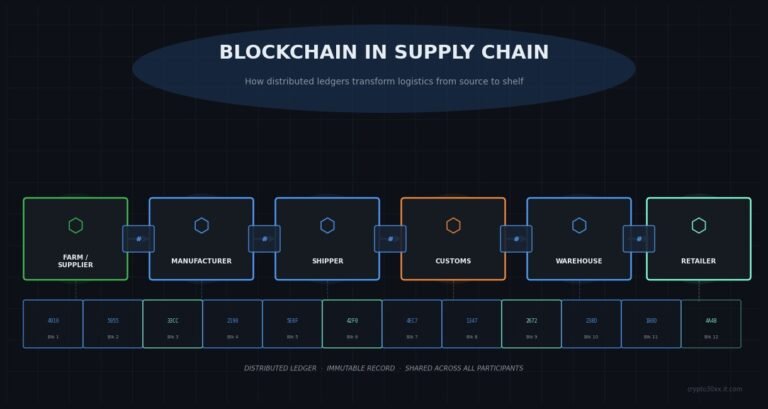
Supply chain traceability: When a shipment of goods passes from manufacturer to carrier to distributor to retailer, each party maintains its own records. A blockchain can serve as a shared log — accessible to all authorized parties — that records every custody transfer, temperature reading, or certification check in a way that no single participant can secretly alter.
Pharmaceutical anti-counterfeiting: Verifying drug provenance across a fragmented supply chain requires a record that no single party can quietly manipulate. An immutable shared ledger provides that guarantee.
Digital asset ownership: Cryptocurrency and tokenized assets require a ledger that no single institution controls, since the entire value proposition depends on the absence of a trusted intermediary.
Credential verification: Academic institutions, professional bodies, and identity providers are exploring blockchain for storing credentials that individuals own and share directly with verifiers, without requiring the issuing institution to remain online or honest.
The hybrid approach
Some architectures combine both. A company might use a traditional database for fast internal operations, then periodically hash batches of records onto a public blockchain as a tamper-evident timestamp. This preserves database speed while adding an auditable checkpoint that external parties can verify without accessing the internal database directly.
Common misconceptions
“Blockchain is more secure than a database”
Security is context-dependent. A traditional database secured by proper access controls, encryption, and infrastructure monitoring is extremely difficult to compromise. A public blockchain is resistant to a different kind of attack — one where the database administrator themselves is the threat. Neither is universally “more secure.” They defend against different adversaries.
“Blockchain eliminates the need for databases”
Blockchain does not replace relational databases for general-purpose data management. Most blockchain applications store only the minimal data needed for consensus and verification on-chain, then rely on traditional databases for everything else. The two technologies coexist in almost every production implementation.
“Blockchain is slow because the technology is immature”
The throughput constraint is largely architectural, not a matter of engineering immaturity. PoW’s bottleneck comes from the deliberate computational difficulty that secures the network. Faster consensus mechanisms exist — but they come with different trust tradeoffs. This is a design choice, not a bug to be fixed.
“Permissioned blockchains are just databases with extra steps”
Permissioned blockchain networks — where only known, credentialed participants can join — do sacrifice the fully open trustless model of public blockchains. But they preserve one key property: no single participant can unilaterally alter historical records. That matters when a consortium of competing companies needs to share a ledger without any of them acting as the single trusted administrator.
Decision framework: which architecture fits the problem?
Before choosing between blockchain and a traditional database, these questions narrow the field:
- How many parties need to write to this ledger? If the answer is one trusted organization, a database is almost certainly the right tool. If the answer is multiple parties who do not report to the same governance structure, blockchain becomes relevant.
- Does historical data ever need to be corrected? If yes — and this is true for most business data — blockchain’s immutability creates operational problems.
- Is speed a primary requirement? Real-time applications with sub-second requirements are not suitable for most public blockchain architectures.
- Who bears the cost of trust? A blockchain shifts the cost of trust from legal and contractual mechanisms to cryptographic ones. That tradeoff is worth it when the legal mechanisms are unavailable, unreliable, or expensive — typically in cross-border, multi-institution, or adversarial environments.
- Is the audit trail itself a product? For cryptocurrency, the public ledger is not a feature of the product — it is the product. The same logic applies to any application where transparent, permanent record-keeping is the core value proposition.
FAQs
What is the main difference between blockchain and a traditional database? The core difference is control. A traditional database has a central administrator who can read, write, and delete any record. A blockchain distributes that control across a network of nodes that must reach consensus before any new data is added — and no single party can alter the historical record.
Can blockchain replace a traditional database? Not for most applications. Blockchain is purpose-built for scenarios where multiple untrusted parties need a shared record that no single one of them can manipulate. Traditional databases remain far faster, cheaper to operate, and better suited for the high-volume, mutable data management that most business applications require.
Why is blockchain slower than a traditional database? Throughput is constrained by the consensus process. Every node in the network must independently verify and record each transaction. That verification is what makes the ledger trustless — but it takes time. Traditional databases skip this verification because a trusted administrator handles writes directly.
What is immutability in blockchain and why does it matter? Immutability means that data written to a blockchain cannot be changed or deleted after the fact. Each block contains a cryptographic hash of the block before it, so altering any record would invalidate every block that follows. This matters because it creates a tamper-evident audit trail — useful for financial records, supply chain logs, and digital asset ownership histories.
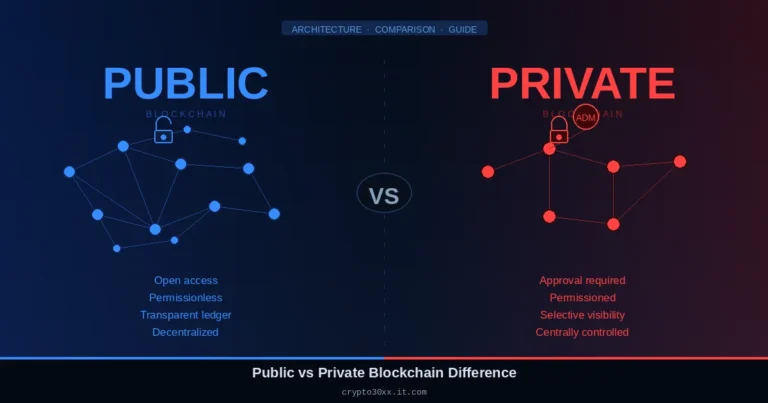
What is a permissioned blockchain and how does it differ from a public one? A permissioned blockchain restricts participation to approved members. Only credentialed nodes can join and validate transactions. Public blockchains like Bitcoin and Ethereum allow anyone to participate. Permissioned blockchains sacrifice open access in exchange for higher throughput and easier regulatory compliance — they are common in enterprise and consortium deployments.
Is blockchain more secure than a traditional database? They defend against different threats. A traditional database protects data from external attackers through access controls and encryption. A blockchain protects data from the administrator itself — no single party can secretly alter historical records. Neither is universally “more secure”; the relevant question is what threat model the application needs to defend against.
What are the transaction costs of using a blockchain? Public blockchains charge network fees (called gas on Ethereum, or transaction fees on Bitcoin) that vary with network demand. These costs are negligible for high-value transactions but prohibitive for high-frequency, low-value operations. Traditional databases have no per-transaction network fee — operational costs are fixed infrastructure expenses.
Can a hybrid system use both blockchain and a traditional database? Yes, and many production systems do exactly this. A common pattern involves using a traditional database for fast internal data management, then periodically anchoring cryptographic hashes of that data onto a public blockchain. This approach adds a tamper-evident timestamp without sacrificing database speed or flexibility.
Disclaimer
This article is written for educational and research purposes by crypto30xx.it.com, an independent blockchain education and market analysis resource. Nothing in this article constitutes financial, investment, or legal advice. Readers should conduct their own research and consult qualified professionals before making any technology or financial decisions. All examples are illustrative only.
The distinction between blockchain and traditional database is not a question of which technology is superior. It is a question of which problem each one solves. Traditional databases excel at fast, flexible, mutable data management under a trusted administrator. Blockchain solves the harder problem of maintaining a shared record among parties who cannot or do not trust each other. Most real-world applications need both — and the clearest analytical signal for choosing between them is whether the cost of distributed trust outweighs the performance constraints that trust requires.
Discover useful tips, tricks, and solutions to your daily challenges—dive into our healing room.