How blockchain verifies data: a complete technical guide
How blockchain verifies data? Blockchain verifies data through a layered process that combines cryptographic hashing, distributed node validation, Merkle tree structures, and network-wide consensus mechanisms, with no central authority involved. Each piece of data added to the chain is mathematically fingerprinted, checked independently by thousands of nodes, ordered into blocks, and locked in place through a consensus protocol. Once confirmed, altering that record requires rewriting not just one block but every block that follows it, across the majority of the network simultaneously. That structural property is what makes blockchain data verification fundamentally different from traditional database systems.
What does “data verification” mean on a blockchain?
Blockchain verification is the process by which a distributed network of computers independently confirms that a piece of data (typically a transaction or a record) that is authentic, correctly formatted, and consistent with the existing history of the ledger, before permanently adding it to the chain.
In a traditional system, a single trusted institution (a bank, a registrar, a clearing house) performs this check centrally. On a blockchain, no such institution exists. The verification role is distributed across every participating node in the network. Each node holds a full or partial copy of the ledger and applies the same rule set independently. Agreement is reached through a consensus protocol rather than through institutional authority.
The three layers of verification
Blockchain data verification operates at three distinct layers, each addressing a different attack surface:
- Cryptographic layer: Individual data items are hashed. The hash acts as a tamper-evident fingerprint: any modification produces a completely different hash output.
- Structural layer: Transactions inside a block are organized into a Merkle tree, producing a single root hash that summarizes all of them. A change to any one transaction invalidates the root.
- Network layer: Nodes independently validate each transaction and each proposed block. A consensus mechanism determines which proposed block gets added to the canonical chain.
These layers are not redundant. They address different threats: cryptography addresses data integrity, Merkle structures address efficient verification at scale, and consensus addresses agreement in a trustless environment with potentially adversarial participants.
How cryptographic hashing secures each data record
A cryptographic hash function takes an input of any length and produces a fixed-length output, called a hash or digest. The key properties that make this useful for data verification are:
- Determinism: The same input always produces the same hash.
- Avalanche effect: Changing even a single character in the input produces a completely different hash output.
- Pre-image resistance: Given a hash, it is computationally infeasible to reverse-engineer the original input.
- Collision resistance: It is computationally infeasible to find two different inputs that produce the same hash.
Bitcoin uses SHA-256 (Secure Hash Algorithm, 256-bit), which produces a 64-character hexadecimal output regardless of input size. A document that is one word long produces the same 256-bit digest as a document that is one million words long.
What the avalanche effect means in practice
Consider a transaction record: “Alice sends 1 BTC to Bob.” Hash this string with SHA-256 and it produces a specific 64-character output. Now change a single character: “Alice sends 1 BtC to Bob.” The resulting hash is completely different, with no visible relationship to the first.
This property means a validator does not need to re-read the entire original record to check whether it has been altered. Hashing it again and comparing the output to the stored hash takes milliseconds. If the two hashes match, the data is intact. If they do not match, the data has been modified.
How each block is chained to the previous one
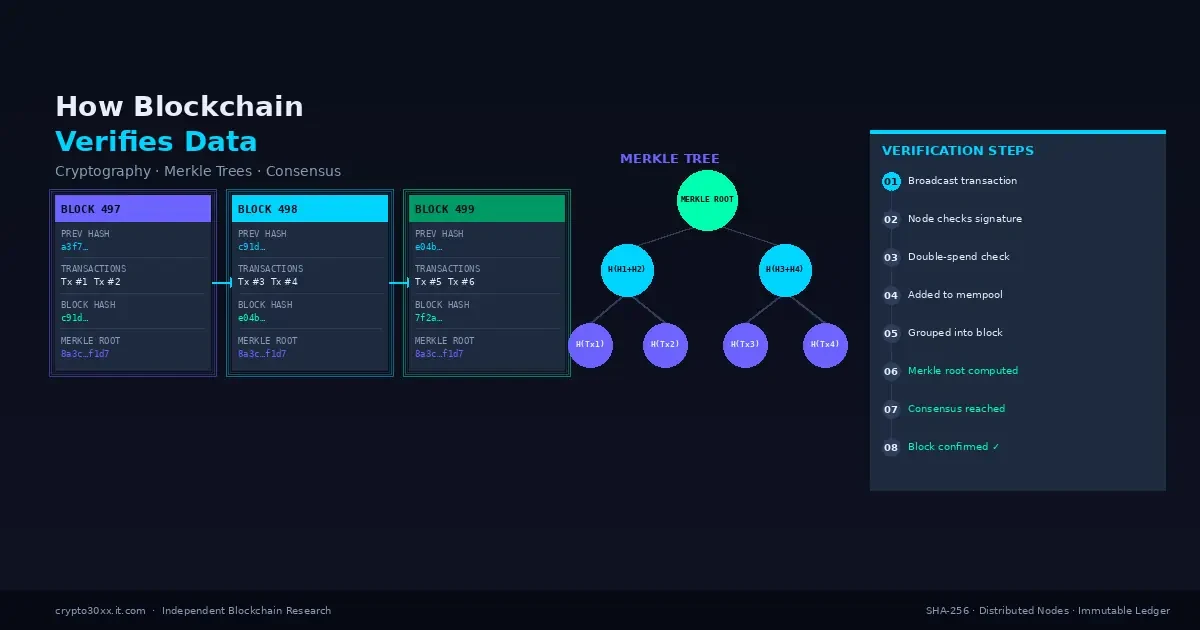
Each block in a blockchain contains, among other things, the hash of the block that immediately precedes it. This single design choice is what creates the “chain” structure and makes retroactive tampering structurally expensive.
If an attacker modifies transaction data inside block 500, the hash of block 500 changes. Block 501 stores the old hash of block 500, so block 501 is now inconsistent. To restore consistency, the attacker must recompute block 501, which changes its hash, breaking block 502, and so on, all the way to the current tip of the chain. On an active network with thousands of nodes continuously producing new blocks, catching up and then outpacing honest participants is, in practice, computationally prohibitive on mature networks.
How Merkle trees enable efficient verification at scale
A blockchain block does not store transactions in a flat list. It organizes them into a Merkle tree, a binary tree structure built entirely from hash functions.
The structure of a Merkle tree
Building a Merkle tree from a set of transactions works as follows:
- Each individual transaction is hashed using SHA-256. These hashes become the leaf nodes of the tree.
- Pairs of leaf hashes are concatenated and hashed together, producing the next level of nodes (parent nodes).
- This process repeats, each time hashing pairs of the level below, until only one hash remains.
- That final hash is called the Merkle root.
The Merkle root is stored in the block header, not the full transaction list. It is a single 256-bit value that cryptographically summarizes every transaction in the block. Any change to any single transaction, no matter how small, propagates up through the tree and produces a different Merkle root.
Why Merkle trees matter for verification efficiency
Without a Merkle tree, verifying that a specific transaction is included in a block would require downloading and checking the entire block. On a network processing thousands of transactions per block, that is expensive.
With a Merkle tree, a node can verify a specific transaction using only the hashes along the path from that transaction’s leaf node to the root: a logarithmic number of values, not a linear one. This enables a class of lightweight nodes (often called SPV nodes, for Simplified Payment Verification) to confirm specific transactions without storing the full blockchain.
| Feature | Without Merkle tree | With Merkle tree |
|---|---|---|
| Verify one transaction | Download full block | Check log₂(n) hashes |
| Detect data tampering | Rehash all transactions | Root hash changes immediately |
| Storage for verification proof | Full block data | Small set of sibling hashes |
| Suitable for mobile / light clients | No | Yes |
How nodes independently validate transactions
Before a transaction reaches a block, it passes through node-level validation. When a user broadcasts a transaction to the network, each receiving node independently checks it against the protocol’s rule set.
What each node checks
The specific checks vary slightly by protocol, but across major networks the core validation steps include:
- Digital signature verification: The transaction must be signed with the sender’s private key. Each node verifies this signature using the corresponding public key. A valid signature proves the sender authorized the transfer without revealing the private key itself.
- Double-spend check: The node confirms that the inputs being referenced have not already been spent in a confirmed transaction. This prevents the same funds from being sent twice.
- Balance sufficiency: The outputs of the transaction must not exceed the inputs. A node rejects any transaction that attempts to spend more than its source contains.
- Format and protocol compliance: The transaction must conform to the network’s structural rules: correct field sizes, valid opcodes in script-based systems, and so on.
Transactions that pass all checks are placed into the node’s mempool (memory pool), a waiting area for unconfirmed transactions. Those that fail any check are dropped and not forwarded. This distributed gate-keeping means an invalid transaction cannot even enter the verification pipeline for block inclusion.
The role of digital signatures in data authenticity
Digital signatures on blockchain transactions use asymmetric cryptography. A private key signs the transaction data; the corresponding public key allows anyone to verify that signature without ever seeing the private key. The mathematical relationship between the two keys guarantees that only the holder of the private key could have produced a valid signature on that specific data.
This solves a fundamental problem: in a system with no central authority, how does a node know that Alice actually authorized this transaction and did not have it forged? The signature provides that proof. It is tied to the specific transaction data: signing “Alice sends 1 BTC to Bob” produces a different signature than signing “Alice sends 2 BTC to Bob,” so the signature cannot be copied from one transaction to another.
How consensus mechanisms finalize verification
Node-level validation and cryptographic hashing verify that individual transactions are well-formed and correctly authorized. Consensus mechanisms solve a different and harder problem: given a set of valid transactions, which order should they be recorded in, and who gets to propose that ordering?
Proof of Work
In Proof of Work (PoW), used by Bitcoin, nodes called miners compete to solve a computationally intensive puzzle. The puzzle requires finding a value (called a nonce) such that, when combined with the block’s data and hashed with SHA-256, the result starts with a required number of leading zeros. This target adjusts over time so that, across the full network, a valid solution is found roughly every ten minutes.
Finding the nonce requires billions of trial-and-error hash computations. Verifying that a found nonce is correct takes a single hash computation. This asymmetry — expensive to produce, cheap to verify — is the security basis of PoW. The miner who finds a valid nonce broadcasts the complete block. Other nodes verify the nonce (one hash), verify all transactions inside (Merkle root check), verify the link to the previous block, then add it to their chain and begin working on the next.
The energy cost of PoW mining is not waste from a security standpoint. It is the economic barrier that makes rewriting history prohibitively expensive: to alter a block deep in the chain, an attacker would need to redo all the computational work from that block forward while simultaneously outpacing the honest network producing new blocks.
Proof of Stake
In Proof of Stake (PoS), used by Ethereum following the Merge in September 2022, validators are selected to propose new blocks based on the amount of the network’s native currency they have locked up as collateral (staked). The selection process incorporates randomness, but higher stake generally increases the probability of selection.
The security model differs from PoW. Rather than computational cost, the deterrent is economic: validators who attempt to approve fraudulent blocks risk having their staked collateral destroyed through a protocol penalty called slashing. The cost of attacking the network is therefore proportional to the value of stake that an attacker would need to accumulate and would risk losing.
Once a validator proposes a block, other validators attest to its validity. When a sufficient fraction of validators (the exact threshold varies by protocol) have attested to a block, it reaches finality, meaning the protocol guarantees it will never be reverted.
Comparing the two primary mechanisms
| Attribute | Proof of Work | Proof of Stake |
|---|---|---|
| Security model | Computational cost to attack | Economic cost (stake at risk) |
| Block proposer selection | First to solve hash puzzle | Weighted random selection |
| Energy consumption | High (continuous computation) | Low (no mining race) |
| Finality | Probabilistic (more confirmations = more secure) | Can be deterministic (protocol-level finality) |
| Primary examples | Bitcoin | Ethereum (post-Merge), Cardano, Solana |
| Vulnerability type | 51% hash rate attack | 33% / 51% stake attack |
Why verified data on a blockchain is extremely difficult to alter
Blockchain verification does not stop at the point of entry. The architecture creates persistent, ongoing verification through structural interlocking.
Each block hash depends on the block’s full contents, including the Merkle root of all transactions and the hash of the previous block. Change anything inside block 400 and its hash changes. Block 401 stores the old hash of block 400, so it immediately becomes invalid. Every subsequent block is broken in sequence. To restore a valid chain from block 400 onward, an attacker must recompute the proof of work (or equivalent) for block 400, then 401, then 402, all the way to the current chain tip, all while the honest network continues extending the chain ahead of them.
On established networks with large miner or validator communities, the resources required to execute this kind of rewrite exceed the potential gain for all but the most extreme scenarios. The probability of success decreases exponentially with each additional confirmation block added after the target.
Common misconceptions about blockchain data security
Misconception: Blockchain data cannot be deleted. Correct in practice for on-chain data: altering it is computationally impractical on mature networks. The immutability is economic and structural, not physically absolute. A theoretical attacker with sufficient resources could attempt a rewrite, but the cost grows with network size and time.
Misconception: All blockchains are equally secure. Security scales with network size. A blockchain with ten validators is structurally similar to one with ten thousand, but the economic cost to attack it is a fraction of the larger network’s. Smaller networks carry meaningfully higher risk of reorganization attacks.
Misconception: Blockchain verification prevents all fraud. Blockchain verifies that data has not been altered once it is on-chain and that the entity submitting it had valid credentials at the time. It does not verify that the underlying real-world event actually occurred. Incorrect data entered on-chain remains on-chain; this is sometimes called the “oracle problem.”
Practical applications of blockchain data verification
The verification architecture described above is not limited to financial transactions. Researchers and analysts studying blockchain applications encounter it across a range of domains.
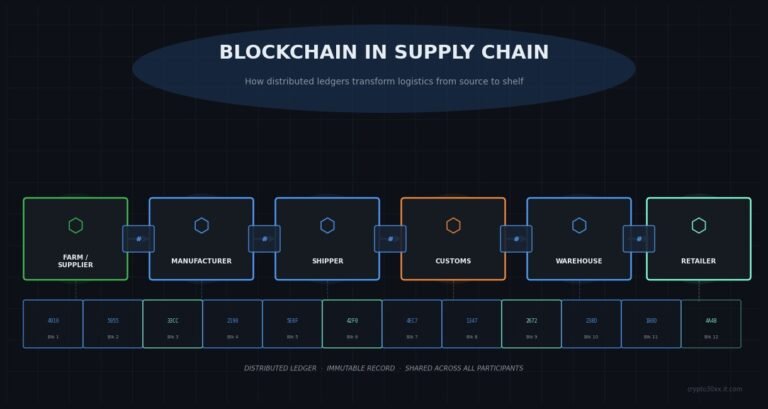
Supply chain provenance: Each step in a product’s journey from manufacturer to retailer can be recorded as a transaction on-chain. Because the record is append-only and each entry is cryptographically signed by the party adding it, downstream parties can verify the chain of custody without trusting any single record-keeper.
Digital credential verification: Academic institutions and professional certification bodies can publish credential hashes on-chain. A credential holder can share their document; a verifier hashes it and checks whether that hash exists on-chain, confirming authenticity without contacting the issuing institution.
Smart contract execution: Smart contracts are programs stored on-chain and executed automatically when predefined conditions are met. Their execution is verified by the same node consensus process as any other transaction. The contract’s outputs become part of the verified ledger state.
Data integrity auditing: Organizations that need to prove a dataset existed in a specific state at a specific point in time can hash the dataset and publish that hash as an on-chain transaction. The timestamp and hash together form a tamper-evident anchor, verifiable by any party with access to the chain.
FAQs
What is the first step in how blockchain verifies data? The process starts when a transaction is broadcast to the network. Each node that receives it independently checks the digital signature, confirms the sender has sufficient balance, verifies the transaction format, and checks that the referenced inputs have not already been spent. Only transactions passing all checks enter the mempool for potential block inclusion.
What role does SHA-256 play in blockchain data verification? SHA-256 is the cryptographic hash function Bitcoin uses to fingerprint transaction data, block headers, and the nonce solutions in Proof of Work. Any change to the underlying data produces a completely different 256-bit output, making tampering immediately detectable. Other blockchains use different hash functions; Ethereum uses Keccak-256, for example.
What is a Merkle root and why does it matter? A Merkle root is the single hash at the top of a Merkle tree, produced by recursively hashing pairs of transaction hashes until one value remains. It provides a compact, tamper-evident summary of every transaction in a block. If any transaction changes, the Merkle root changes, and the block header (which stores the Merkle root) becomes invalid.
Can blockchain data ever be changed after verification? On established networks with significant mining or validator communities, altering confirmed on-chain data is computationally or economically prohibitive because every subsequent block would also need to be recomputed while simultaneously outpacing the ongoing honest chain. The immutability is practical and structural, not physically absolute. It scales with network size and block confirmation depth.
What is the difference between transaction validation and block confirmation? Transaction validation happens at the node level: individual nodes check that a transaction is correctly signed, properly formatted, and does not attempt double-spending. Block confirmation happens at the network level: a miner or validator proposes a block containing validated transactions, and the consensus mechanism determines whether the rest of the network accepts it as part of the canonical chain.
What is the “oracle problem” in blockchain data verification? Blockchain verification confirms that on-chain data has not been altered and that the submitting entity held valid credentials. It cannot verify that the real-world event the data describes actually occurred as claimed. If incorrect data is submitted on-chain by a legitimate key holder, it becomes a permanent, verified, incorrect record. External data feeds (oracles) that connect blockchains to off-chain reality carry their own trust assumptions.
Why does the number of confirmations matter for security? Each confirmation is an additional block added to the chain after the block containing a given transaction. Each additional block increases the computational or economic cost of reorganizing the chain back to before that transaction. One confirmation is sufficient for low-value transfers; high-value transactions on PoW networks typically wait for six or more confirmations before treating the record as final.
How does Proof of Stake finality differ from Proof of Work finality? In Proof of Work, finality is probabilistic: the deeper a block is in the chain, the harder it is to reverse, but there is no protocol-guaranteed cutoff. In some Proof of Stake implementations, finality is deterministic: once a supermajority of validators attest to a checkpoint, the protocol cryptographically guarantees that block will not be reverted, short of an attack that would require the attacker to stake an amount large enough to trigger mass slashing.
Disclaimer
This article is produced for educational and research purposes by an independent blockchain analysis resource. It does not constitute financial advice, investment guidance, or a recommendation to buy, sell, or hold any digital asset. Blockchain technology involves technical risk, and any implementation of blockchain systems carries additional considerations specific to context and use case. Readers should consult qualified professionals before making any decisions based on this material.
The verification model blockchain networks use is, at its core, a substitution: trust in institutions replaced by verifiable mathematics. Cryptographic hashing makes individual records tamper-evident. Merkle trees make large sets of records efficiently verifiable. Node validation applies a shared rule set without centralized oversight. Consensus mechanisms produce network-wide agreement without a coordinator. No single one of these components is sufficient alone. It is their combination that produces data verification with the properties the protocol requires. For analysts and researchers examining specific blockchain implementations, the question worth asking is not whether these mechanisms exist but how each implementation parameterizes them: which hash function, which consensus rules, what finality threshold, and how large the validator set is. Those parameters determine the actual security properties of any given chain.
Get ready to discover something new—our featured gentle ones overflow with soft truth.