Blue chip NFT meaning: what earns a collection the label
Blue chip NFT meaning: A blue chip NFT is a non-fungible token collection that has built a sustained record of high demand, significant trading volume, and broad recognition across the digital asset market. The term is borrowed directly from traditional finance, where “blue chip” describes large-cap stocks considered the market’s most established names. Applied to NFTs, it identifies collections that have held meaningful value through multiple market cycles, attracted institutional attention, and developed identities extending beyond speculative hype into community, IP, and cultural presence.
Understanding what this label actually means, and how it gets applied, requires looking at the mechanics underneath.
What does blue chip NFT mean?
A blue chip NFT is a non-fungible token from a collection that has demonstrated consistent market depth, high floor prices relative to the broader NFT space, and a track record that outlasts short-term speculative cycles. The label does not come from a central authority. No regulator assigns it. No index automatically grants it. It emerges from sustained market behavior: collections where demand has proven durable, where notable buyers have entered publicly, and where the brand has developed enough gravity to survive bear conditions without collapsing entirely.
In traditional markets, blue chip status attaches to companies like large consumer brands or established technology firms. In NFTs, the analogy holds at the conceptual level but breaks down on the specifics. Equity blue chips have decades of audited earnings, dividend history, and regulatory filings behind them. NFT collections are often a few years old at most. The “blue chip” designation in this space is therefore relative, not absolute. It means: the top tier of a market that is itself young, illiquid by traditional standards, and structurally different from equities.
The term entered NFT vocabulary around the 2021 market expansion, when collections like CryptoPunks and Bored Ape Yacht Club began trading at prices that separated them categorically from the thousands of lower-volume projects.
How NFTs become classified as blue chip
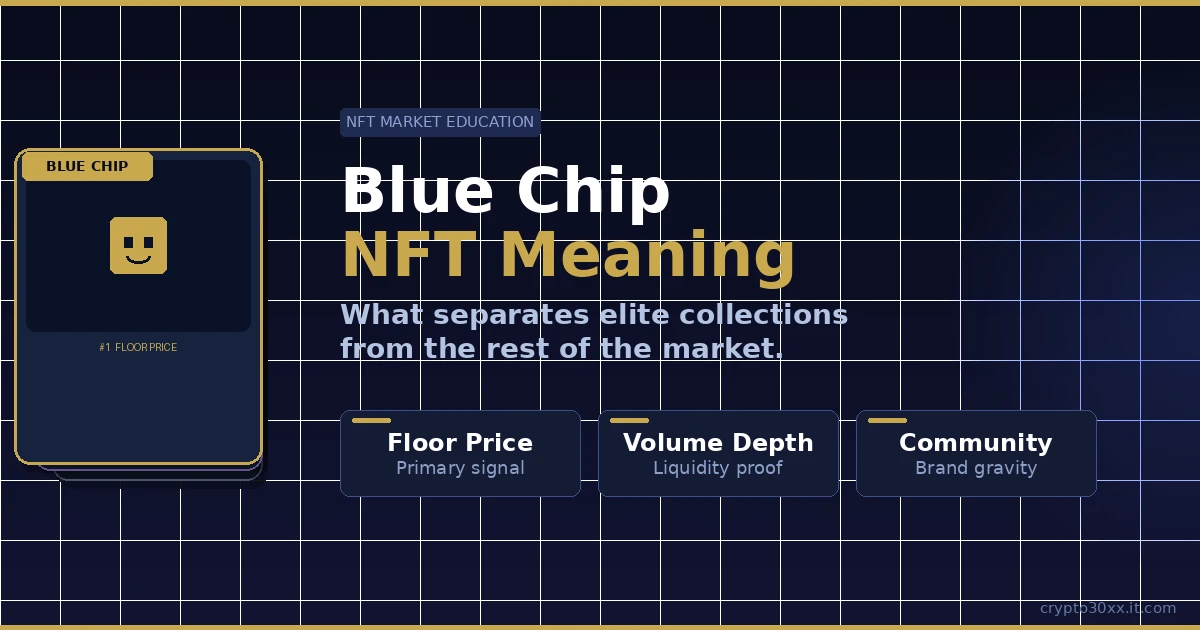
Floor price as the primary signal
The floor price of an NFT collection is the lowest price at which any item from that collection is listed on secondary markets. It is the easiest single metric for assessing where a collection sits in the market hierarchy.
Blue chip collections maintain floor prices substantially above the median NFT. This does not mean the floor is permanently high. Markets move. But a collection that maintains a recognizable floor even through broad downturns demonstrates that holders are unwilling to sell below a meaningful threshold. That resistance indicates perceived long-term value, not just short-term speculation.
Floor price is calculated based on the lowest listed item, not the average sale or the rarest token. This matters because it is accessible. Any buyer can acquire a blue chip collection’s cheapest token at the floor. Rarer items within the same collection trade at significant multiples above that floor, but the floor itself represents the minimum buy-in for membership in the collection.
Trading volume and liquidity depth
Floor price without trading volume can be misleading. A collection where three holders are asking high prices but no one is buying does not signal blue chip health. Volume matters.
Blue chip NFT collections show consistent secondary market activity. Transactions happen regularly. Buyers and sellers find each other at meaningful prices. This liquidity makes the floor price credible because it is tested by actual transactions, not just listing intentions.
Higher volume also enables price discovery. When a collection trades thousands of times per week, its floor becomes a real-time reflection of market sentiment rather than a stale listing from six months ago. Thin-volume price increases, where floor jumps on very few transactions, are structurally fragile. Concentrated ownership amplifies this: when a small number of wallets control most of a collection’s supply, price moves can reflect a handful of decisions rather than broad demand.
Brand recognition and cultural presence
Collections in this category have names. People outside the core NFT community have heard of them. Media coverage, celebrity association, and mainstream attention contribute to brand depth in ways that pure on-chain metrics cannot capture.
CryptoPunks, developed by Larva Labs and launched in 2017, is one of the earliest collections and is widely regarded as a foundational NFT project. The 10,000 pixel-art avatars were among the first to establish the PFP (profile picture) format as a cultural object. Their longevity alone provides brand credibility that newer projects simply cannot replicate.
Bored Ape Yacht Club (BAYC), launched in April 2021, became one of the highest-profile collections during the 2021-2022 cycle. Its 10,000 generative ape avatars attracted broad attention partly because holders received commercial licensing rights to their specific NFT’s image. That structural decision differentiated BAYC from collections where the artwork remained the IP of the creator.
Brand recognition matters in a market driven significantly by social signaling. Holding a recognized collection carries status value that holding an obscure collection does not.
Community strength
The community around a top-tier NFT collection functions differently from a standard consumer brand’s fan base. Holders often have genuine financial stakes. They participate in governance discussions, promote the brand publicly, and create derivative content that extends the collection’s reach.
Strong communities provide a floor of organic demand. When holders become advocates, they generate interest from potential buyers who might otherwise never encounter the collection. Discord activity, Twitter/X presence, and holder-led initiatives are all informal indicators of community health.
A community that fractures, grows inactive, or loses belief in the project’s direction has historically contributed to floor price declines even in collections that once held blue chip status.
Team credibility and roadmap execution
The team behind a collection influences market confidence. Doxxed teams (those who have publicly identified themselves) carry different accountability than anonymous developers. A history of delivering on stated plans — new utilities, collaborations, or expansions — builds trust. Teams that fail to execute on promises, or that abandon projects after minting revenue is collected, destroy that trust quickly.
Established collections generally have teams that have remained active over multiple market cycles and demonstrated ongoing engagement with their communities.
Blue chip vs. non-blue chip NFTs: a structural comparison
| Characteristic | Blue chip NFT collection | General NFT collection |
|---|---|---|
| Floor price | Sustained and relatively high | Often minimal or near zero |
| Secondary market volume | Regular and measurable | Often thin or nonexistent |
| Market age | Typically 2+ years of activity | May be weeks to months old |
| Brand recognition | Widely known outside core NFT community | Limited to early buyers |
| Community engagement | Active, holder-driven | Often inactive after mint |
| Team transparency | Identified or long track record | Often anonymous |
| Resilience in bear markets | Partial floor maintenance | Often near-total collapse |
| IP and utility development | Often ongoing | Rarely developed post-mint |
This table represents tendencies, not guarantees. A collection can meet several of these criteria and still decline significantly. The comparison is structural, not predictive.
Well-known collections associated with blue chip status
CryptoPunks
One of the earliest NFT collections on Ethereum, CryptoPunks consists of 10,000 pixel-art character images. They were initially distributed for free in 2017 and became among the most historically significant collections in the NFT space. Yuga Labs (creator of BAYC) later acquired the rights to CryptoPunks and Meebits from Larva Labs. Their age and cultural precedence make them a reference point for the entire category.
Bored Ape Yacht Club
BAYC is a collection of 10,000 generative ape images, each with distinct traits. It became one of the highest-profile NFT projects during the 2021-2022 expansion, known for its commercial IP licensing model, celebrity holders, and associated ecosystem including the Mutant Ape Yacht Club (MAYC) and other Yuga Labs projects. BAYC has experienced significant floor price swings across market cycles.
Azuki
Azuki is an anime-aesthetic collection of 10,000 NFTs launched in early 2022. It gained substantial traction due to its art style and community development, and reached significant floor prices during the peak of the 2022 market. Like other collections, it experienced significant floor compression in the subsequent downturn.
Pudgy Penguins
Pudgy Penguins underwent significant changes after its original launch, including a team transition that brought new leadership and a different strategic direction. The collection expanded into physical products including plush toys, which provided a non-digital revenue and visibility stream uncommon in the NFT space. This kind of brand extension is one model for what utility beyond digital ownership can look like.
The collections listed here are referenced as examples for educational purposes. Their historical presence in conversations about blue chip NFTs is documented. This does not constitute a recommendation to acquire any of them.
Risks specific to blue chip NFTs
Relative volatility remains high
Compared to traditional blue chip assets, these collections are substantially more volatile. Floor prices have dropped by 80% or more from peak to trough even for well-established collections. In USD terms, the gap between all-time highs and subsequent floors has been significant across multiple projects. The “blue chip” label implies relative stability within the NFT market — not stability by any broader financial standard.
Liquidity is structural, not guaranteed
NFTs are not liquid assets by design. Each token in a collection is unique. When selling, a holder depends on finding a buyer willing to pay their price at that moment. In bear conditions, buyers disappear. Thin volume can make it difficult to exit a position at any price resembling the entry price. This is categorically different from selling a stock on an exchange with a deep order book.
Concentrated ownership makes this worse. When a small number of wallets hold large portions of a collection’s supply, price behavior reflects those holders’ decisions disproportionately. A single large holder exiting can pressure the floor in ways that no equivalent pattern exists in diversified equity markets.
Market manipulation and wash trading
Academic research has documented widespread wash trading in NFT markets. Wash trading involves buying and selling between wallets controlled by the same entity to generate the appearance of volume. This inflates reported trading activity and can make a collection appear more liquid than it is.
While blue chip collections with genuine organic demand are less susceptible to this distortion than obscure projects, the broader market’s volume figures are unreliable. Evaluating a collection’s real liquidity requires examining unique buyer counts, not just total transaction volume.
The “blue chip” label is not permanent
Collections previously described as blue chip have lost that status. Floor prices have declined to the point where the collections no longer command premium positioning in the market. Projects where team engagement declined, where the broader narrative shifted, or where competing collections captured community attention have seen their status erode.
The label describes past market behavior. It does not guarantee future behavior.
No underlying cash flow or earnings
Traditional blue chip stocks represent fractional ownership of businesses that generate revenue, pay dividends, and have auditable financial statements. NFTs represent ownership of a specific digital token. The value is driven by demand, cultural relevance, and market sentiment. There is no earnings yield, no balance sheet, and no claim on underlying business assets. This structural difference matters when assessing how NFT valuations are formed and why they can move rapidly in either direction.
Smart contract and custodial risk
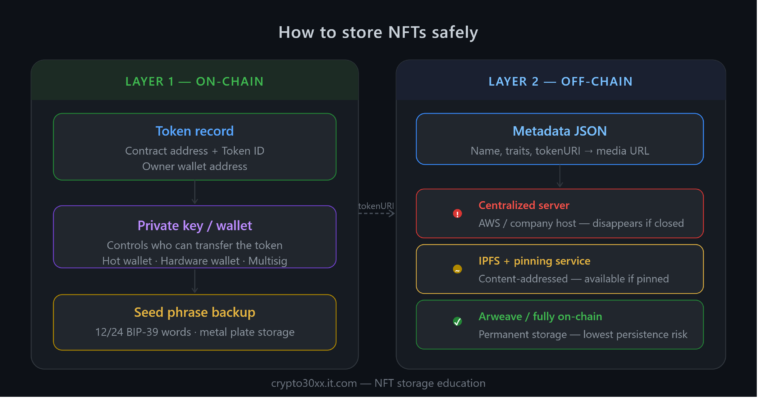
NFTs exist on blockchain networks. If the smart contract has vulnerabilities, if the marketplace facilitating transactions experiences problems, or if a holder loses access to their wallet’s private keys, recovery options are limited. Self-custody requires careful key management. Platform risk is real.
How the “blue chip” label compares to traditional finance
The phrase travels from poker (blue chips have the highest table value) through traditional finance (blue chip stocks are the market’s most established names) into the NFT context. At each step, the underlying logic is similar: among many options of varying quality, a small tier stands out for durability and recognition.
Where the analogy breaks down is in the measurement criteria. Traditional blue chip stocks have standardized valuation metrics. NFT collections have no earnings, no revenue multipliers, and no audited accounts. Their “value” is determined by what a buyer is willing to pay, which depends heavily on narrative, community, and market conditions that can shift faster than in equity markets.
This does not make blue chip NFTs comparable to blue chip equities. It means the term describes relative positioning within the NFT market, not an absolute quality standard applicable across asset classes.
How to evaluate whether a collection holds blue chip characteristics
These are the signals that analysts and observers examine. None of them individually confirms blue chip status. Patterns across multiple signals carry more weight than any single metric.
- Floor price history: Has the floor maintained itself through at least one significant market downturn? Or did it collapse and not recover?
- Volume consistency: Is trading happening regularly, or does the collection only show volume during speculative runs?
- Unique holder count: A collection with broad holder distribution is structurally different from one where a handful of wallets dominate.
- Team activity: Is the team still engaged? Are there documented deliveries against earlier commitments?
- Community health: Is the community active, or have the channels gone quiet?
- IP and utility development: Has the collection built anything beyond the original mint? Physical partnerships, licensing, events?
- Age: Has the collection existed through multiple market cycles, or only in favorable conditions?
Wash trading inflates volume figures. Tools that track unique buyer counts and verified transaction patterns provide a more reliable view than raw volume alone.
FAQs
What exactly does “blue chip NFT” mean? A blue chip NFT belongs to a collection that has demonstrated sustained high demand, strong floor prices relative to the NFT market, significant trading volume, and brand recognition that extends beyond its initial launch period. The term borrows from traditional finance and describes relative standing within the NFT market, not an absolute quality standard.
Is a blue chip NFT a safe investment? No asset described as a blue chip NFT should be assumed safe in any conventional sense. These collections have experienced floor price declines of 80% or more from their peaks. Liquidity can thin quickly in bear conditions. They carry substantially higher volatility than traditional blue chip equities and are not directly comparable to them. This article is written for educational purposes and does not constitute investment advice.
What is a floor price and why does it matter for blue chip NFTs? The floor price is the lowest listing price for any NFT within a specific collection on secondary markets. It is the minimum cost to enter that collection and serves as a proxy for overall demand. Blue chip collections maintain floors that reflect genuine buyer demand, tested by actual transactions. A floor maintained through sustained trading activity is more meaningful than one where few sales occur.
How did CryptoPunks become considered a blue chip NFT? CryptoPunks were launched in 2017, making them among the earliest NFT collections on Ethereum. Their historical precedence, the cultural weight of being a pioneer in the PFP format, and sustained demand across multiple market cycles contributed to their positioning. Age and provenance carry weight in a market where most collections are less than a few years old.
Can a blue chip NFT lose that status? Yes. Several collections once discussed as blue chip have seen floor prices decline to the point where the designation no longer applies. Status in this market reflects current and historical demand. Teams that disengage, communities that fracture, or market conditions that shift narratives away from a collection can all erode whatever standing it had built.
What is wash trading and does it affect blue chip NFTs? Wash trading involves buying and selling between wallets controlled by the same person to generate artificial volume. Research has documented this across NFT markets broadly. While prominent collections with genuine organic demand are less vulnerable, volume figures across the market are generally unreliable. Examining unique buyer counts gives a cleaner signal of real activity than total transaction volume.
How is a blue chip NFT different from a regular NFT? The structural differences are in demand depth, liquidity, brand recognition, and market age. Regular NFTs (the vast majority of collections) trade rarely, have thin or nonexistent secondary markets, lack developed communities, and often become worthless shortly after mint. Blue chip collections have demonstrated repeated cycles of meaningful trading activity and have built identities that attract continued buyer interest.
Is the “blue chip” label regulated or officially defined anywhere? No. There is no regulatory body or standards organization that grants or monitors the blue chip NFT designation. It is a market convention, applied informally by participants, analysts, and media. Because of this, different observers may apply the label to different collections based on different criteria. That ambiguity is part of understanding what the term means in practice.
Disclaimer
This article is published by crypto30xx.it.com for educational and informational purposes only. It does not constitute financial, investment, or legal advice, and should not be interpreted as a recommendation to buy, sell, or hold any digital asset or NFT collection. NFTs and digital assets carry substantial risk, including the potential loss of the full amount involved. Past market behavior does not predict future results. Readers should conduct their own research and consult qualified professionals before making any financial decisions.
The blue chip NFT meaning comes down to relative positioning: within a market where most collections lose all trading activity quickly, a small number maintain meaningful demand, developed communities, and recognizable brands across multiple market cycles. That relative durability is what the label describes. It does not import the stability characteristics of traditional blue chip equities, and treating it as equivalent to that standard produces a significant misreading of the actual risk profile. Understanding the mechanics — floor price, volume depth, community, team accountability, and the structural absence of underlying cash flows — is what allows a researcher or learner to assess claims about any specific collection on something firmer than market sentiment alone.
Step into a world of better ideas with our concept-rich blog articles.