How NFTs get their value: a complete pricing guide
NFTs, or non-fungible tokens, get their value from a combination of verifiable scarcity, perceived utility, creator reputation, and market demand. Each NFT is a unique blockchain record linked to specific content or a defined right. That uniqueness is verifiable, transferable, and permanent. What a buyer pays for an NFT reflects how much they believe others will pay in the future, the practical value the token carries, and the credibility of the creator behind it. This guide explains the structural factors behind how NFTs get their value, covering economics, smart contract mechanics, market signals, and the distinction between durable and speculative pricing. It is written for learners, analysts, and researchers seeking to understand NFT valuation mechanics.
What is an NFT and why uniqueness creates pricing conditions
A non-fungible token is a blockchain-issued record that verifies unique ownership of a specific digital item or right. Unlike a fungible cryptocurrency, where one unit is interchangeable with any other, each NFT carries a distinct on-chain identifier that cannot be duplicated. That non-fungibility is the structural origin of NFT value: scarcity requires uniqueness, and uniqueness must be verifiable. Without blockchain-based verification, any digital file can be copied at zero marginal cost, which eliminates scarcity entirely.
The on-chain ownership record
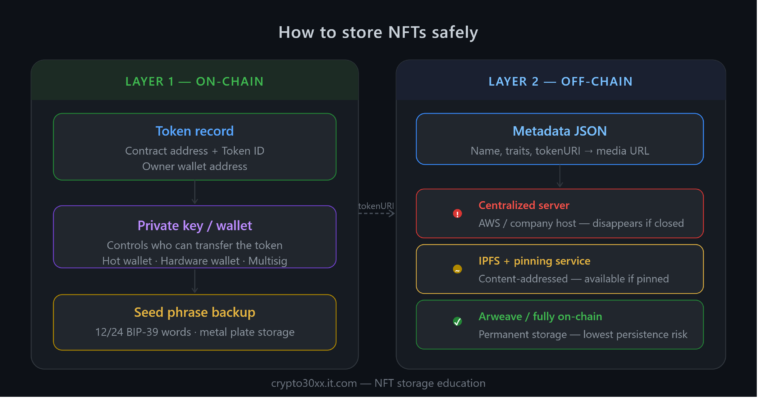
When an NFT is minted, a transaction is permanently written to a blockchain. Ethereum and Solana are among the most widely used networks for NFT standards, though others also support token issuance. The transaction records the token’s unique identifier, the creator’s address, and metadata pointing to the associated content.
That record cannot be altered without violating the chain’s consensus rules. Immutability is what makes ownership provable and transferable: a buyer acquiring an NFT can independently verify the full ownership history using any compatible blockchain explorer, without relying on the seller’s word or a centralized intermediary.
The metadata typically points to a digital file — an image, audio clip, or video. The NFT itself is the token record, not the file it references. What a buyer acquires is the chain-verified right to claim original token ownership. That distinction matters because the underlying file is often freely viewable by anyone; the verified token record has exactly one holder at any time.
Why non-fungibility enables price differentiation
Pricing requires differentiation between units. If every token in a collection were identical, a single market price would cover all of them. Non-fungibility breaks that uniformity: each token must be individually evaluated based on its traits, ownership history, and context.
This creates the conditions for wide price spreads within a single collection. A common-trait token might trade near the floor price while a rare-trait token commands a significant premium. That spread — and the market’s effort to quantify it — is where NFT pricing complexity originates.
How NFTs get their value: six core factors
NFTs get their value from six interconnected forces: supply design, creator reputation, utility, community demand, provenance, and market liquidity. No single factor explains price across all collections. The weighting of each force varies by collection type, market phase, and the specific token being evaluated.
Scarcity and supply design
Supply mechanics are encoded in the smart contract before a collection launches. A creator who mints 100 tokens has produced a structurally scarcer asset than one who mints 100,000 — assuming all else is equal — but raw supply alone does not determine value. The distribution of trait rarity within a collection matters just as much.
Most NFT collections use a layered trait system: each token is generated by combining attributes from different categories, such as background color, clothing, accessories, and expression. Tokens with rare trait combinations, assigned algorithmically at mint, trade at premiums above the floor price. Rarity scoring tools aggregate trait probabilities into a numerical rank that collectors use as a pricing input.
The core economic principle: perceived scarcity drives demand when buyers believe the supply will not be diluted. If a creator issues additional tokens competing with the original set, or if a copycat collection fragments attention, the scarcity premise weakens and pricing typically responds.
Creator and brand reputation
The creator’s identity carries direct weight in NFT valuation. Established artists, recognized brands, and credible development teams generate buyer confidence because their history signals commitment. A collection from a creator with a documented record of delivering utility and maintaining community engagement will command a higher baseline than an anonymous collection with identical visual quality.
Brand extensions from organizations outside crypto — sports leagues, entertainment companies, independent musicians — borrow their parent brand’s existing recognition. That borrowed credibility functions as a pricing input, giving buyers an external reference point for assessing legitimacy and long-term project viability.
For independent artists, reputation builds through verifiable on-chain history: previous collections, secondary market performance over time, and documented community interaction.
Utility and access rights
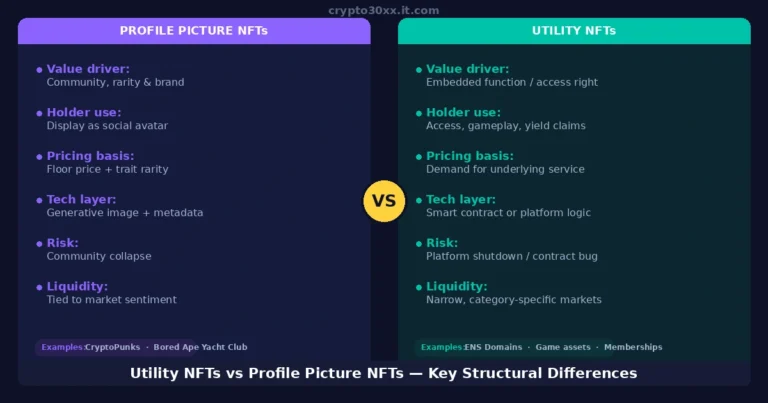
Utility refers to rights or functions a holder can exercise beyond simply owning the token. Common utility structures include:
- Private community or forum access
- Revenue-sharing or royalty rights specified in the smart contract
- Functional in-game assets within a blockchain game
- Governance voting rights in a decentralized protocol
- Physical product redemption linked to the token
Utility creates a pricing floor grounded in something other than sentiment. If holding an NFT provides ongoing access to a service, rational pricing cannot fall indefinitely below the cost of that service. That utility floor is generally more durable than a floor driven purely by collector speculation.
Collections that promised utility but failed to deliver have historically seen severe price collapses. The speculative premium on future utility evaporated when the utility did not materialize, leaving no functional floor to hold price.
Community and cultural demand
Community functions as a demand engine. Collections with active owner communities create social proof: holding a token signals membership in a recognized group. That membership can carry tangible economic benefits, including access and networking, along with status signals that translate into measurable willingness to pay.
Cultural demand is harder to quantify but visible in secondary trading volume, social media activity, and the count of distinct wallet holders. Collections that appear in mainstream coverage or become widely used as profile images attract buyers who value the cultural signal itself, separate from any functional utility.
This overlap with status-good economics matters: the value of a status signal depends partly on who else holds it and how visible that signal is in the contexts that matter to potential buyers.
Provenance and historical record
Provenance refers to the on-chain record of who previously held a specific token. A token that passed through the wallet of a recognized collector, or that was part of a documented high-profile sale, carries that history permanently in its transfer record.
Provenance value behaves like the premium on a physical object previously owned by a notable figure. The token itself does not change. The record of its ownership history changes its perceived status, and that status can translate into a measurable price difference relative to tokens with identical traits but ordinary ownership histories.
Liquidity and trading depth
An NFT’s value is also a function of how easily it can be sold. A token in a collection with thin secondary market volume is difficult to exit at its quoted price, even when the floor appears stable.
Collections with deep secondary activity — measured by transaction count and the number of distinct active buyers over a defined period — provide more reliable price discovery. Illiquid collections are structurally vulnerable to large price moves on small order flow, which means the quoted floor price can be misleading as an indicator of true market value.
The mechanics of NFT pricing
NFT prices are expressed through specific market mechanisms: floor price, ceiling price, royalty structure, and secondary market volume. Understanding how these mechanisms work clarifies what price signals actually indicate about a collection’s health and the forces driving how NFTs get their value in practice.
Floor price, ceiling price, and the spread between them
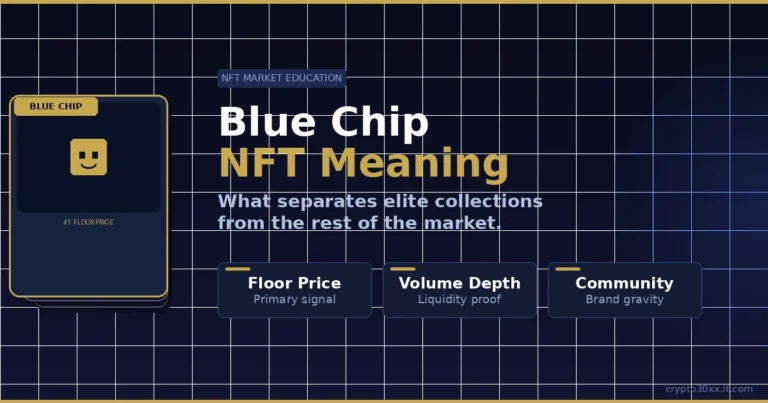
The floor price is the lowest active listing in a collection at any given time. It is the minimum a buyer must pay to enter the collection and is widely tracked as a health metric. Its key limitation: a rising floor price means sellers are removing cheaper listings — either because they sold or because owners raised their asks — not necessarily that new buyers are entering at the new level. Thin orderbooks can produce apparent floor appreciation without real demand.
The ceiling — the highest sale recorded within the collection — shows what the market’s most motivated buyer paid for the rarest or most desirable token. The spread between floor and ceiling reflects how much buyers differentiate between common and rare trait combinations.
| Market signal | What it indicates |
|---|---|
| Rising floor, low volume | Thin supply; limited real demand |
| Rising floor, high volume | Strong buyer depth; healthy market |
| Falling floor, high volume | Motivated selling; potential capitulation |
| Stable floor, declining volume | Reduced attention; market cooling |
| Wide floor-to-ceiling spread | Rarity premium actively valued by buyers |
| Narrow floor-to-ceiling spread | Commodity-like trading; low rarity preference |
How royalties work and what they signal
Most NFT smart contracts encode a royalty percentage — typically between 5% and 10% — that routes a share of each secondary sale to the original creator’s wallet. The transfer is automatic: no manual payment is needed. The royalty executes as a component of the sale transaction.
Royalties create an ongoing economic relationship between the creator and market activity. A creator who has built sustained secondary trading volume earns revenue proportional to it, which creates a financial incentive to maintain collection value through continued utility or community development.
Secondary market volume is a stronger valuation signal than primary mint revenue. It reflects price discovery between owners not emotionally committed to the collection at inception. High secondary volume with stable average sale prices indicates genuine market depth. High volume with rapidly declining averages indicates distressed selling.
Intrinsic value vs. speculative premium
NFT prices typically contain two components: intrinsic value, grounded in something the token does or represents, and speculative value, based on the expectation that future demand will be higher. Most NFT collections carry both in different proportions, and that ratio affects how resilient the price is to market-wide downturns.
Defining intrinsic value for NFTs
Intrinsic value in the NFT context does not carry the same meaning as in traditional finance. It does not refer to discounted cash flows or tangible underlying assets. For NFTs, intrinsic value means verifiable, present-tense functionality: a token granting access to a private forum has intrinsic value proportional to what that access is worth to the holder. A gaming NFT functioning as an in-game weapon has intrinsic value proportional to its in-game utility.
A useful analytical test: would the NFT hold any functional value if its entire community disappeared overnight? If yes, intrinsic value exists. If no, pricing is entirely speculative.
Why speculative premiums collapse rapidly
Speculative value is self-referential: the token is worth what the next buyer believes it is worth. When expectations turn negative, speculative value can fall sharply and quickly — with no change to the underlying token or the artwork it represents. This explains why NFT collections can lose 90% or more of their peak value in short periods without any technical failure.
The pattern across multiple market cycles shows that collections with documented functional utility maintain a larger share of value during broad downturns than collections priced entirely on sentiment or narrative. The utility provides a structural floor; the narrative does not.
The role of market cycle timing in NFT valuations
NFT pricing does not exist in isolation from broader digital asset markets. When liquidity conditions tighten across crypto markets, speculative assets typically reprice first and most severely. NFTs, as relatively illiquid speculative assets in many categories, tend to exhibit amplified drawdowns during risk-off periods.
Understanding this relationship helps separate collection-specific signals from market-wide forces. A collection that holds floor price while the broader NFT market declines may be demonstrating genuine demand resilience. A collection that rises with a broad market lift may simply be speculative correlation.
How to read NFT market data analytically
Researchers and analysts examining NFT markets without participating in them can work directly from publicly available on-chain data. Blockchain transparency means every transfer, every sale price, and every wallet balance is readable without trusting any intermediary, making NFTs one of the more data-accessible asset categories for market structure research.
On-chain metrics that matter
Several quantitative signals help locate where a collection’s value is grounded:
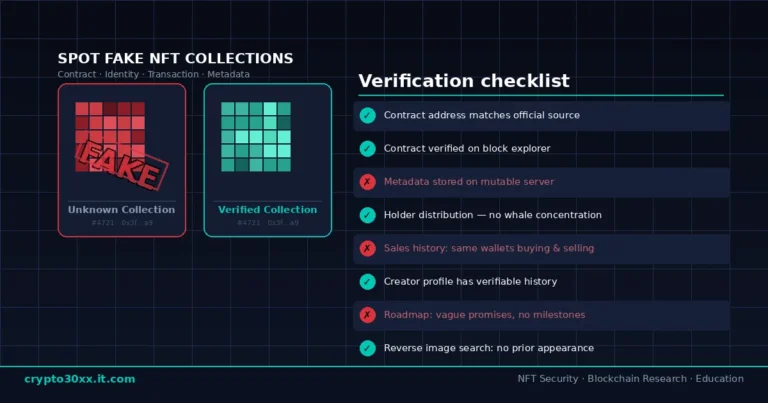
- Unique wallet holders: Distinct addresses holding at least one token. High holder counts relative to supply suggest distribution rather than whale concentration.
- Wallet concentration: If a small number of addresses control most of a collection’s supply, the floor price is structurally vulnerable to coordinated selling pressure.
- Sales velocity: How frequently tokens change hands over a defined period. Declining velocity often precedes price declines, particularly when combined with stable or rising floor prices.
- Royalty compliance rate: On marketplaces where royalty payment is optional, the percentage of trades paying the creator royalty signals community norms and market health.
- Smart contract audit status: Whether the contract has been reviewed by an independent security firm. Audited contracts carry lower technical risk than unaudited ones for both buyers and researchers tracking the space.
Detecting wash trading and artificial volume
Wash trading involves selling a token between two wallets controlled by the same party, artificially inflating volume and creating a misleading price history. It is detectable on-chain by examining whether buyer and seller addresses share funding sources or exhibit coordinated activity across multiple transactions.
Platforms that filter for wash trading indicators provide cleaner volume data than raw marketplace figures. Analysts using unfiltered data should verify large volume spikes against holder and transfer patterns before treating that volume as representative of genuine demand. Volume that does not translate into holder count growth is a signal worth investigating further.
FAQs
Do NFTs have real value or is the pricing purely speculative? NFTs can carry real, functional value — event access, governance rights, in-game utility — but many are priced largely on speculative demand. The proportion of intrinsic versus speculative value varies significantly by collection and is one of the most important distinctions for anyone analyzing the asset class with rigor.
What determines a collection’s floor price? The floor price is the lowest active listing in a collection at any given time. It reflects the minimum cost of entry and moves based on seller behavior, not solely on buyer pressure. A rising floor can indicate sellers removing inventory as readily as it indicates new buyers entering the market.
Can an NFT lose all its value? Yes. An NFT can become effectively worthless if demand disappears, if promised utility fails to materialize, if the creator abandons the project, or if the broader market for that category declines sharply. Blockchain-verified ownership confirms a holder’s token exists — it does not protect against a collapse in demand for it.
How does rarity affect NFT price within a collection? Tokens with rarer trait combinations historically trade at premiums above the collection floor. Rarity is quantified through trait probability — a trait appearing in 1% of a 10,000-token collection is structurally scarcer than one appearing in 40% of it. Rarity ranking tools aggregate these probabilities into scores that collectors use as pricing inputs alongside floor and ceiling data.
Why do some NFTs sell for very high amounts? High-value sales typically reflect a combination of creator reputation, cultural significance, documented provenance, and speculative demand from buyers who believe scarcity and community will sustain future value. Record sales are outliers driven by exceptional circumstances and concentrated buyer interest — they are not representative of typical collection pricing.
Does the blockchain guarantee that an NFT holds its value? No. The blockchain verifies ownership and uniqueness. It does not protect against demand collapse, creator abandonment, metadata failure, or platform obsolescence. Blockchain verification is a necessary condition for NFT value to exist — it is not a sufficient condition for that value to persist over time.
What is the difference between an NFT’s price and its value? Price is what the market pays at a specific moment. Value is the underlying rationale for why someone would pay that price. The two can diverge significantly: price may exceed functional value during speculative periods and fall below it during downturns. Tracking the gap between observable price and identifiable value drivers is a core exercise in NFT market analysis.
Disclaimer
This article is published for educational and research purposes only. It does not constitute financial, investment, or legal advice, and no part of it should be interpreted as a recommendation to buy, sell, or hold any NFT, token, or digital asset. NFT and cryptocurrency markets carry substantial risk of loss; past pricing behavior does not predict future outcomes.
NFTs get their value from the intersection of scarcity, utility, creator credibility, community demand, provenance, and market liquidity. The speculative component is real and often the dominant pricing force — meaning prices can move sharply in either direction without any change to the underlying token. For analysts studying this market, the most durable signal is the ratio of functional utility to speculative premium: collections with real, operational utility have a structural floor; collections priced entirely on expectation do not.
Your reading list just got better—add our must-read expert posts to the top.