Mining reward halving impact: a complete guide
Mining reward halving impact describes the cascading economic and network-wide effects that follow each programmed reduction in the block subsidy paid to proof-of-work miners. When a halving event triggers, miners immediately earn 50% fewer newly minted coins per block. That single change compresses revenue, forces a competitive shakeout among mining operations, and reduces the rate at which new supply enters circulation. Those three effects propagate outward across miner economics, network hash rate, transaction fee dynamics, and long-run supply structure. Understanding each layer is essential for anyone studying how PoW-secured blockchains stay functional after their issuance schedules shrink.
What is a mining reward halving?
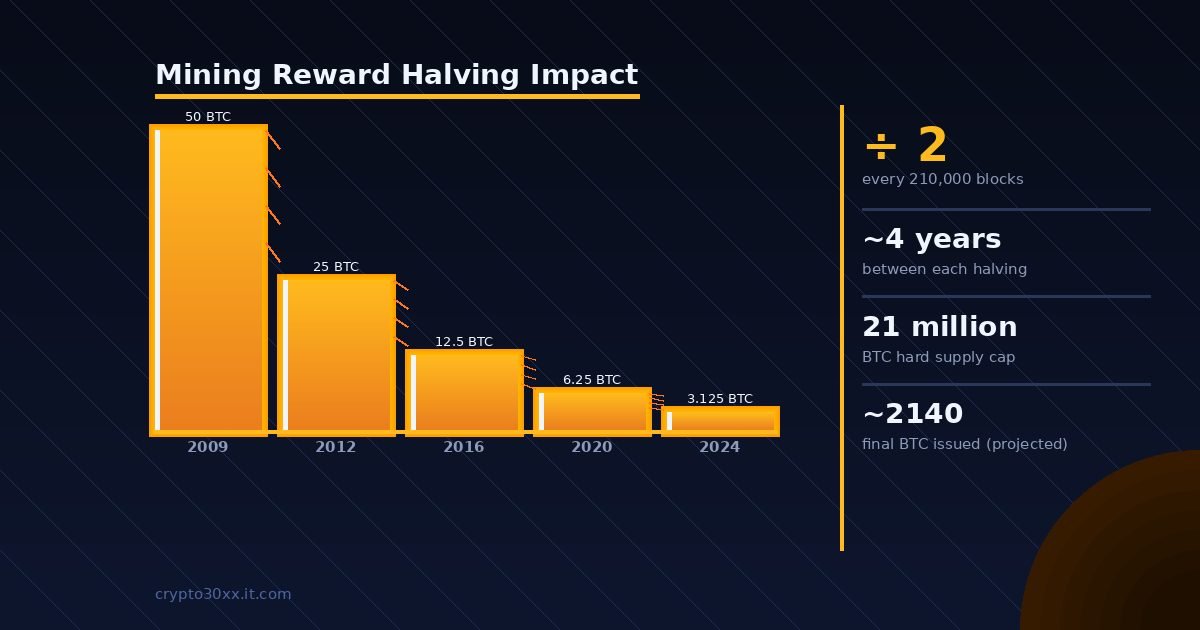
A mining reward halving is a protocol-enforced event that cuts the block subsidy paid to proof-of-work miners by exactly 50%, occurring at a fixed interval defined in the blockchain’s code. For Bitcoin, this interval is every 210,000 blocks — roughly four years at the target block time of ten minutes. The mechanism requires no human decision, no vote, and no override: the node software enforces it automatically at the predetermined block height.
Bitcoin’s reward schedule runs as follows:
| Halving | Block height | Block subsidy (BTC) |
|---|---|---|
| Genesis (launch) | 0 | 50 |
| 1st halving | 210,000 | 25 |
| 2nd halving | 420,000 | 12.5 |
| 3rd halving | 630,000 | 6.25 |
| 4th halving | 840,000 | 3.125 |
| 5th halving (projected) | 1,050,000 | 1.5625 |
The subsidy continues halving until it eventually rounds to zero — a point projected to arrive around the year 2140, by which time the full 21 million BTC supply cap will have been issued. Miners will then rely entirely on transaction fees for compensation.
Why Satoshi Nakamoto built this in
The halving schedule was described in Bitcoin’s original whitepaper and encoded in its first software release. The design solved a specific monetary problem: how to distribute new coins without a central authority, while ensuring that the total supply remained finite and predictable. By tying issuance to block production — and cutting that issuance on a schedule — Bitcoin creates a supply curve that is transparent, verifiable, and immune to arbitrary change. This stands in structural contrast to commodity mining, where production rises in response to rising prices, and to fiat currency, where issuance reflects policy decisions.
How the halving mechanism works
Every valid block that a miner produces contains a special first transaction — the coinbase transaction — that awards the miner a set quantity of newly created coins plus any transaction fees included in the block. The block subsidy portion is the element that halves. Transaction fees, by contrast, are set by users and paid regardless of the halving schedule.
The 210,000-block trigger
The block height counter in Bitcoin’s protocol increments with each mined block. At height 210,000, the node software automatically halves the maximum permitted subsidy in the coinbase transaction. Any block claiming a larger subsidy is rejected by the network as invalid. There is no advance warning, no grace period, and no rollback — the switch is instantaneous, effective with the first block mined after the threshold.
Illustrating the daily supply shift
Bitcoin targets one block approximately every ten minutes, producing roughly 144 blocks per day. Before the fourth halving, at 6.25 BTC per block, approximately 900 new BTC entered circulation daily. After the halving reduced the subsidy to 3.125 BTC, that figure dropped to approximately 450 new BTC per day. In annualized terms, the network went from issuing roughly 328,500 BTC per year to roughly 164,250 BTC per year — a 50% reduction in new supply flow, effective from one block to the next.
Immediate impact on miner economics
The most direct consequence of a halving falls on the miners who secure the network. On the day a halving fires, their revenue from new-coin issuance drops by exactly half. Operational costs — electricity, hardware depreciation, facility overhead, cooling — do not fall at all. That asymmetry is the central tension mining operations must manage.
The profitability equation
A mining operation’s profitability depends on three variables: the quantity of new coins earned per unit of hash rate (the block subsidy), the market value of those coins, and the operating cost to run the hardware. After a halving:
- If coin price remains unchanged and difficulty is constant, revenue per unit of hash rate falls by 50%.
- If coin price rises enough to offset the subsidy cut, margins can recover or even expand.
- If coin price falls while the subsidy has already been halved, operations face a severe squeeze.
Consider a simplified illustration. Suppose a mining operation spends $100,000 per month in electricity and earns 10 BTC monthly in block rewards. At a coin price that made each BTC worth $15,000, the operation generated $150,000 in revenue against $100,000 in costs — a $50,000 gross margin. After a halving, the same operation earns only 5 BTC monthly. At the same coin price, revenue drops to $75,000, and the margin inverts to a $25,000 loss. The cost structure has not changed at all.
Hash rate and miner capitulation
When margins compress, the least efficient operations — those with older hardware, higher electricity costs, or lower access to cheap power — become unprofitable first. They shut down machines. When enough hash rate exits, block production slows below the ten-minute target. The difficulty adjustment mechanism then fires, reducing the computational work required to mine a valid block. This makes mining slightly easier and restores profitability for the remaining operators.
This process is sometimes called “miner capitulation.” It is a self-correcting cycle built into proof-of-work consensus:
- Halving fires → revenue per hash unit falls
- Marginally profitable miners exit → network hash rate drops
- Blocks slow down
- Difficulty adjusts downward → mining becomes cheaper per unit
- Surviving miners capture a larger share of the reduced reward pool
- If coin prices recover, new hardware deployments resume and hash rate climbs back
Historically, this cycle has resolved within weeks to a few months after each halving. Hash rate has ultimately climbed to new highs after every halving event, reflecting sustained long-run demand for block space and eventual price recovery.
Miner capitulation vs. miner consolidation
These two outcomes are distinct and worth separating:
| Outcome | What happens | Who survives |
|---|---|---|
| Miner capitulation | Unprofitable machines go offline temporarily; difficulty adjusts | Efficient operators at current costs |
| Industry consolidation | Smaller, undercapitalized operations exit permanently; larger fleets absorb market share | Well-capitalized, low-cost miners |
Capitulation is a short-run correction. Consolidation is a structural shift. After each halving, both occur simultaneously — capitulation resolves within a few difficulty periods, while consolidation continues for months as weaker operations close or get acquired.
The difficulty adjustment: the network’s built-in stabilizer
Bitcoin’s difficulty adjustment is the mechanism that prevents a halving from destabilizing block production. It recalibrates every 2,016 blocks — approximately two weeks — by comparing the actual time it took to mine the previous 2,016 blocks against the expected time of 20,160 minutes.
- If blocks arrived faster than expected, difficulty rises (mining becomes harder)
- If blocks arrived slower than expected, difficulty falls (mining becomes easier)
The algorithm has no awareness of halvings, prices, or miner intent. It only measures block timing and adjusts accordingly. This means the network self-corrects mechanically: if a halving drives 15% of hash rate offline and blocks slow, difficulty drops in the next adjustment window, automatically redistributing the reward pool among a smaller, more efficient set of miners.
This is the structural reason Bitcoin has survived four halvings without a collapse in block production. The difficulty adjustment acts as a shock absorber that converts an economic disruption into a temporary calibration.
Supply dynamics and the scarcity argument
From a supply-side perspective, each halving is a programmatic reduction in the rate of new-coin issuance. The total circulating supply continues to grow, but at a slower and slower rate with each cycle. This declining issuance rate is the foundation of Bitcoin’s scarcity narrative.
Stock-to-flow and why it matters
The stock-to-flow (S2F) ratio compares an asset’s total existing supply (stock) to its annual new production (flow). A higher ratio indicates that new production is small relative to the existing supply — in other words, a more scarce asset.
Gold has historically carried a stock-to-flow ratio of roughly 60–65, meaning total above-ground gold supply would take 60–65 years to replicate at current annual mining rates. After the 2020 halving, Bitcoin’s S2F ratio reached approximately 56 — comparable to gold. After the 2024 halving reduced the subsidy to 3.125 BTC, Bitcoin’s S2F ratio climbed to an estimated range of 113–120, nearly double that of gold.
The S2F model, introduced by pseudonymous analyst PlanB in 2019, attempts to predict Bitcoin’s price from this ratio. It has attracted significant academic and industry attention for its historical correlation with Bitcoin’s price trajectory across multiple halving cycles. Critics note that the model is based on limited data points (four halvings), cannot account for demand-side shocks, and may not hold as market structure matures. These are substantive methodological objections, not dismissals — researchers treat the S2F as one analytical lens among several, not a predictive instrument.
Supply-side impact on market dynamics
Halvings reduce the rate at which new coins flow from miners into the market. Miners must sell at least a portion of their rewards to cover operating costs. When the supply of newly minted coins reaching the market drops 50%, demand must either fall proportionally or prices will face upward pressure. This is a supply-side effect — it says nothing about what demand will do.
Historical post-halving price patterns are consistent with a delayed supply-shock thesis:
- First halving (November 2012): reward dropped from 50 BTC to 25 BTC; significant price appreciation followed in the subsequent 12 months
- Second halving (July 2016): reward dropped from 25 BTC to 12.5 BTC; a bull cycle followed over the next 18 months
- Third halving (May 2020): reward dropped from 12.5 BTC to 6.25 BTC; a multi-month bull cycle followed through late 2021
- Fourth halving (April 2024): reward dropped from 6.25 BTC to 3.125 BTC; price had already reached prior all-time highs before the event fired
The 2024 cycle broke the prior pattern in one important way: Bitcoin had already set a new record high before the halving, not after it. Researchers have attributed this to institutional inflows via spot ETF products and broader macroeconomic conditions, suggesting that demand-side factors increasingly shape post-halving price behavior rather than supply mechanics alone. The supply shock may be getting priced in earlier each cycle as market participants anticipate it years in advance.
Transaction fees: the long-run replacement for block subsidies
The long-run sustainability of proof-of-work security after halvings reduce subsidies to near zero is one of the most analytically significant open questions in blockchain research. Bitcoin’s security model rests on block subsidies as the dominant component of miner revenue. Over time, subsidies will approach zero, and miners will depend almost entirely on transaction fees.
The fee revenue transition
Fee revenue is variable. It rises during periods of high network congestion and falls when block space is plentiful. After each halving, miners have an increased incentive to prioritize transactions with higher fee bids, since the subsidy component of each block’s value has shrunk. Patterns from the 2024 halving illustrated this: the first blocks after the halving event generated unusually high fee revenue because of inscription-related demand, temporarily cushioning the subsidy reduction for participating miners.
The fee market dynamic creates a natural mechanism for miner compensation even as subsidies decrease — but only if demand for block space remains strong. A network with low fee demand and low block subsidies faces a structural security challenge, because the total revenue available to secure the chain falls.
Security budget implications
Miners invest in hardware and electricity because block rewards — subsidies plus fees — justify the cost. The total value of those rewards is sometimes called the “security budget.” A higher security budget attracts more hash rate, raises the cost of a 51% attack, and makes the network more resistant to double-spend attempts. As halvings reduce the subsidy, the security budget depends increasingly on fee revenue to maintain hash rate at levels that deter attackers.
This is not an imminent concern — the transition plays out across decades of future halvings. But it is a structural design question that researchers monitor as a key long-run variable in Bitcoin’s economic model.
Common misconceptions about halving impact
“Mining becomes unprofitable after a halving”
Not across the board. Efficiency varies widely across mining operations. Operations with access to low-cost or stranded energy sources, and those running the most energy-efficient hardware by hash-per-watt metrics, can remain profitable at significantly lower reward levels. The halving selectively eliminates marginally profitable operations while leaving low-cost producers intact. It is a competitive event, not an extinction event.
“Hash rate collapses after a halving”
Hash rate typically dips in the weeks following a halving as unprofitable machines go offline. But the difficulty adjustment reduces the work required to earn rewards, partially restoring profitability for remaining miners. Historically, hash rate has recovered to pre-halving levels and then surpassed them as Bitcoin’s price appreciated and new hardware came online. A temporary hash rate dip is the mechanism working as designed — not a sign of network failure.
“The price always rallies immediately after a halving”
Historically, major post-halving price cycles have played out over months, not days. The supply-shock effect from reduced miner selling pressure is gradual. It takes time for the reduced daily issuance to affect available market supply. Price responses have shown a consistent lag of several months to over a year across prior cycles. The 2024 cycle added complexity: substantial price appreciation occurred before the halving, compressing the usual pre-to-post differential.
“Halvings are unique to Bitcoin”
They are not. Several other proof-of-work cryptocurrencies use similar supply-reduction schedules. Litecoin, for example, halves its block reward on the same 840,000-block schedule with a four-year approximate cycle. The mechanics are identical; the scale, market depth, and security budget differ significantly. Each PoW chain with a hard supply cap and a declining issuance schedule faces the same structural questions about long-run miner compensation.
FAQs
What is the mining reward halving in simple terms? A halving is a coded event that automatically cuts the number of new coins a miner receives per confirmed block by 50%. For Bitcoin, this fires every 210,000 blocks — roughly once every four years — and continues until the 21 million supply cap is reached around 2140.
Does the halving affect transaction fees or only block subsidies? Only the block subsidy is reduced by the halving. Transaction fees are set by users and collected by miners regardless of subsidy levels. Over time, as subsidies shrink, fees are expected to become the dominant component of miner revenue, which is why analysts watch fee market development as part of long-run network security analysis.
Why do miners keep running after a halving if revenue drops 50%? Two mechanisms offset the revenue drop. First, the difficulty adjustment makes mining slightly easier as unprofitable machines exit, meaning the remaining miners earn a larger share of the reduced reward pool per unit of hash rate. Second, if the coin’s market price rises enough after the halving, the value of each block reward in fiat terms can recover or exceed pre-halving levels even with fewer coins per block.
Is the halving schedule fixed or can it change? The schedule is encoded in Bitcoin’s consensus rules. Changing it would require a hard fork — a protocol change that existing nodes would reject unless they also updated. Given Bitcoin’s decentralized structure and the strong community consensus around its fixed-supply model, altering the halving schedule is considered extraordinarily unlikely in practice.
How does halving affect Bitcoin’s inflation rate? Each halving reduces Bitcoin’s annual issuance rate, which directly lowers its inflation rate. Before the fourth halving, Bitcoin’s annual inflation rate was under 2%. After the halving cut daily issuance from approximately 900 BTC to 450 BTC, the annualized rate dropped to under 1% — below the inflation rates of most fiat currencies and lower than gold’s estimated annual supply growth.
What happens when the final Bitcoin is mined? When the block subsidy reaches zero — projected near 2140 — miners will only collect transaction fees. Whether that fee revenue is sufficient to sustain the hash rate needed to secure the network at scale is one of the most discussed open questions in Bitcoin economics. This is not an urgent concern for current participants, but it is a structural design question that researchers continue to analyze.
What is miner capitulation and is it harmful? Miner capitulation describes the exit of unprofitable mining operations after a halving reduces revenue below their break-even point. It temporarily reduces total network hash rate, which causes blocks to slow slightly. The difficulty adjustment then fires, lowering the computational requirement and restoring equilibrium. The process is a normal and expected consequence of PoW economics — it is the mechanism by which the network selects for efficiency, not a sign of network failure.
Do other cryptocurrencies have halving events? Yes. Several PoW chains with fixed supply caps use similar programmatic issuance reductions. Litecoin uses a halving schedule comparable to Bitcoin’s. Different chains set different block intervals and halving frequencies, but the underlying economic logic — declining issuance to enforce scarcity — is the same across all of them.
Disclaimer
This article is written for educational and research purposes only. It does not constitute financial, investment, or trading advice. Cryptocurrency markets carry substantial risk, including the potential for total loss of capital. Nothing in this article should be construed as a recommendation to buy, sell, or hold any digital asset. Readers should conduct independent research and consult qualified financial professionals before making any investment decisions.
The mining reward halving is not a market event — it is a protocol rule. Its impact on miners, supply dynamics, and network security follows from that rule with mathematical certainty. What cannot be known in advance is how market participants will price the resulting supply change, how fee markets will develop as subsidies shrink, or how mining technology will evolve to maintain efficiency through future halvings. Those variables are where uncertainty lives. The mechanism itself is designed to be predictable, transparent, and verifiable by anyone who reads the code.
Stay motivated all month long with our consistently inspiring featured articles.