Mining hardware types explained: CPU, GPU, FPGA, ASIC
Meta Description: Mining hardware types explained: learn how CPU, GPU, FPGA, and ASIC miners work, their efficiency trade-offs, and how each fits proof-of-work mining.
Mining hardware types are the physical computing devices used to perform proof-of-work computations in cryptocurrency networks, each differing in hash rate output, power efficiency, programmability, and cost. Four categories define the field: central processing units (CPUs), graphics processing units (GPUs), field-programmable gate arrays (FPGAs), and application-specific integrated circuits (ASICs). Each represents a distinct engineering trade-off between flexibility and raw mining performance. Understanding these differences matters for anyone studying how blockchains like Bitcoin secure themselves, why mining infrastructure has evolved the way it has, and what role hardware plays in network decentralization. This guide explains each type from first principles — how it works, where it performs, and where it falls short.
What is proof-of-work mining hardware?
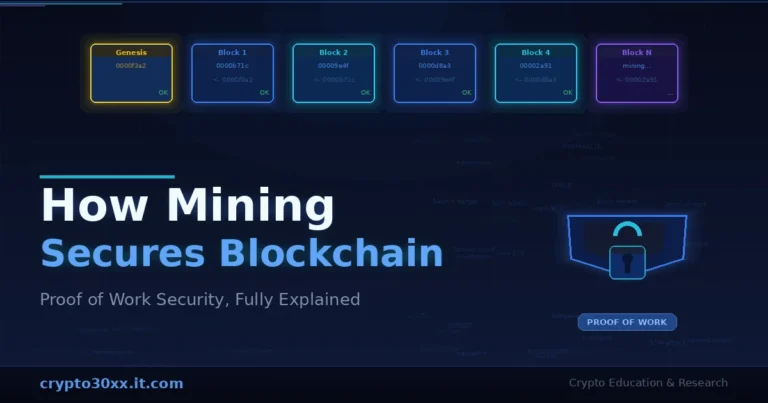
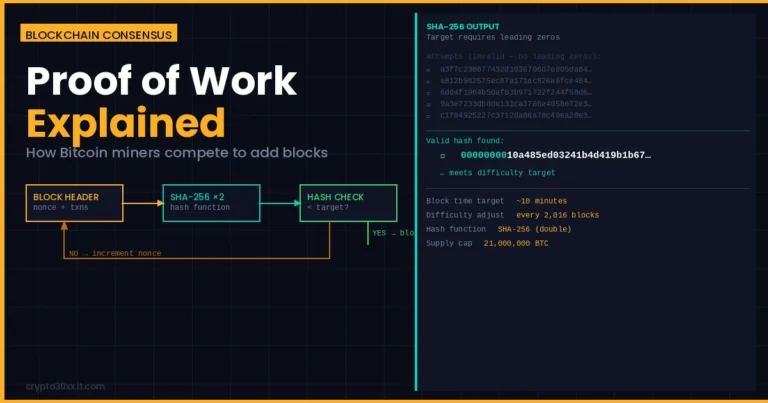
Proof-of-work mining hardware is any computing device that repeatedly hashes block header data until the output meets the network’s difficulty target. The device executes a specific cryptographic algorithm — SHA-256 for Bitcoin, Scrypt for Litecoin, RandomX for Monero — billions of times per second, competing against every other miner on the network to find a valid block hash first. The miner that succeeds adds the block to the chain and claims the block reward. This competition is the economic engine underlying proof-of-work security.
Speed alone is not the deciding factor. A device that produces more valid hashes per joule of electrical energy consumed has a structural cost advantage over time. This is why hardware efficiency — measured as hash rate per watt — matters as much as raw performance figures.
Why algorithm design determines hardware fitness
Not all mining algorithms respond equally to hardware specialization. SHA-256, the algorithm underlying Bitcoin, is dominated by repetitive binary operations that can be reduced to extremely efficient silicon circuits. Other algorithms — particularly memory-hard ones — are deliberately engineered to neutralize that advantage, keeping general-purpose hardware viable.
The consequence: there is no single “best” mining hardware type. Fitness depends on which algorithm the target network uses, what local electricity costs, and what the operator’s budget and flexibility requirements are.
From general to specialized: how hardware evolved
Mining hardware has followed a consistent trajectory across every large proof-of-work network. General-purpose devices appear first, then progressively more specialized alternatives emerge and displace them. CPUs came first by default. GPUs outperformed them on most algorithms. FPGAs offered better efficiency with retained programmability. ASICs eventually dominated wherever the economics justified building them.
This progression reflects a basic competitive reality: when block rewards are large enough, miners invest in superior hardware until the efficiency advantage is competed away or becomes exclusive to a small set of purpose-built machines.
The four main types of mining hardware
Mining hardware types divide into four categories based on architecture — CPU, GPU, FPGA, and ASIC — each with a distinct performance profile, cost structure, and degree of algorithm flexibility. The right choice for any mining application depends on the target algorithm, local power costs, capital budget, and how much flexibility the operator needs to redirect hardware if conditions change.
CPU mining: the original approach
A CPU, or central processing unit, is the general-purpose processor at the heart of every personal computer and server. It was the default mining hardware in the earliest proof-of-work networks simply because no alternative existed. CPUs are engineered for versatility: they handle sequential logic, complex branching, floating-point arithmetic, and varied instruction sets with equal competence.
For mining, that versatility is a liability. A typical consumer CPU has between 4 and 64 cores, each capable of a limited number of hash operations per second. On SHA-256, a modern CPU achieves somewhere in the range of a few hundred megahashes per second (MH/s) — far below what any specialized hardware produces on the same algorithm.
Where CPU mining remains viable
Some networks were designed from the ground up to resist hardware specialization. Monero’s RandomX algorithm uses large memory footprints, varied instruction sequences, and frequent context switches that are intentionally difficult for GPUs and ASICs to accelerate efficiently. On such networks, consumer CPUs remain competitive mining tools, which aligns with those networks’ stated goal of accessible, decentralized participation. Outside of CPU-optimized algorithms, CPU mining is not economically viable on any large, competitive network.
GPU mining: parallel processing power
A GPU, or graphics processing unit, was originally built for rendering graphics — a workload that requires executing thousands of relatively simple calculations simultaneously across many cores. That architecture maps well to proof-of-work hashing, which similarly demands massive parallelism over sequential complexity.
Where a high-end CPU has a handful of powerful cores, a modern GPU contains hundreds or thousands of smaller cores operating in parallel. On algorithms suited to parallelism — including Ethash, ProgPoW, and Equihash — a mid-range GPU outperforms a CPU by several orders of magnitude in hash rate. GPU mining rigs typically mount 4 to 12 GPUs on a single motherboard-and-riser setup, collectively drawing substantial power.
Algorithm flexibility
The primary advantage of GPU mining over ASICs: a GPU can be reprogrammed to run a different algorithm when one network becomes less profitable. An operator whose primary algorithm becomes uncompetitive can redirect the same hardware to a different GPU-compatible network without buying new equipment. This reprogrammability gives GPUs a longer productive lifespan across diverse mining ecosystems.
Power and efficiency considerations
GPU mining draws considerably more power per unit than CPU mining and generates significant heat. Efficiency varies by model and generation; real-world numbers depend on overclocking settings, undervolting configurations, and cooling conditions. On their target algorithms, GPUs deliver moderate efficiency — better than CPUs, and meaningfully worse than ASICs on algorithms where both are viable.
FPGA mining: programmable efficiency
An FPGA, or field-programmable gate array, is a type of integrated circuit that can be reconfigured after manufacture. Unlike a standard processor with fixed logic, an FPGA’s internal circuit structures are programmable using hardware description languages such as Verilog or VHDL. This means a developer can configure the chip to execute a specific hashing algorithm with near-custom-chip efficiency, then reprogram it to run a different algorithm when needed.
What this means in practice: FPGAs typically outperform GPUs in hash rate per watt on algorithms they have been optimized for. An FPGA configured for a specific algorithm concentrates all available transistors on that computation, without the overhead of a general-purpose GPU’s graphics pipeline, memory architecture, or shader units.
Performance and cost profile
FPGAs occupy the mid-tier of the mining hardware spectrum. They achieve higher efficiency than GPUs but cannot match a purpose-built ASIC on the same algorithm. The entry barrier is meaningful: professional-grade FPGAs carry substantial price tags, and configuring them for mining requires either technical proficiency in hardware programming or access to pre-built bitstream files — ready-to-flash configurations from third-party developers. The resale market for FPGAs is broader than for ASICs, since FPGAs serve legitimate engineering, research, and industrial applications outside of mining. This alternate utility provides some residual value if the mining application becomes uneconomic.
ASIC mining: built for one job
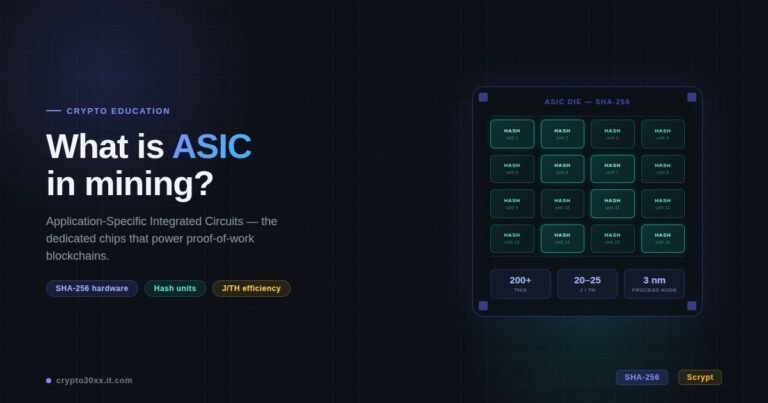
An ASIC, or application-specific integrated circuit, is a chip engineered at the transistor level to perform one function only. Mining ASICs exist for specific algorithms: SHA-256 for Bitcoin, Scrypt for Litecoin and Dogecoin, Blake2b for Siacoin, X11 for Dash, and others. Every logic gate, memory cell, and data path on the chip is optimized for that single algorithm, with no resources allocated to anything else.
This specialization produces performance that general-purpose hardware cannot approach. A leading SHA-256 ASIC delivers hash rates measured in terahashes per second (TH/s). A high-end GPU on the same algorithm might reach fractions of a gigahash per second — a gap of roughly six orders of magnitude.
The efficiency advantage quantified
To illustrate the scale of difference: on SHA-256, a typical modern GPU might achieve approximately 0.1 GH/s. A mid-range SHA-256 ASIC commonly produces output in the range of 100–200 TH/s. That gap spans approximately six orders of magnitude in raw hash rate, with the ASIC also consuming less energy per terahash. This efficiency differential is why ASIC miners dominate the Bitcoin network, and why Bitcoin’s total hash rate is measured in exahashes per second (EH/s) rather than petahashes or terahashes.
The inflexibility cost
ASICs cannot be reprogrammed. A SHA-256 ASIC will only ever run SHA-256. If a network changes its algorithm — as several networks have done specifically to resist ASIC dominance — hardware built for the old algorithm becomes immediately worthless as a mining tool. There is no secondary use case for a dedicated mining ASIC: no gaming application, no AI inference, no 3D rendering. When mining viability ends, its market value approaches zero.
Hardware comparison: efficiency, cost, and flexibility
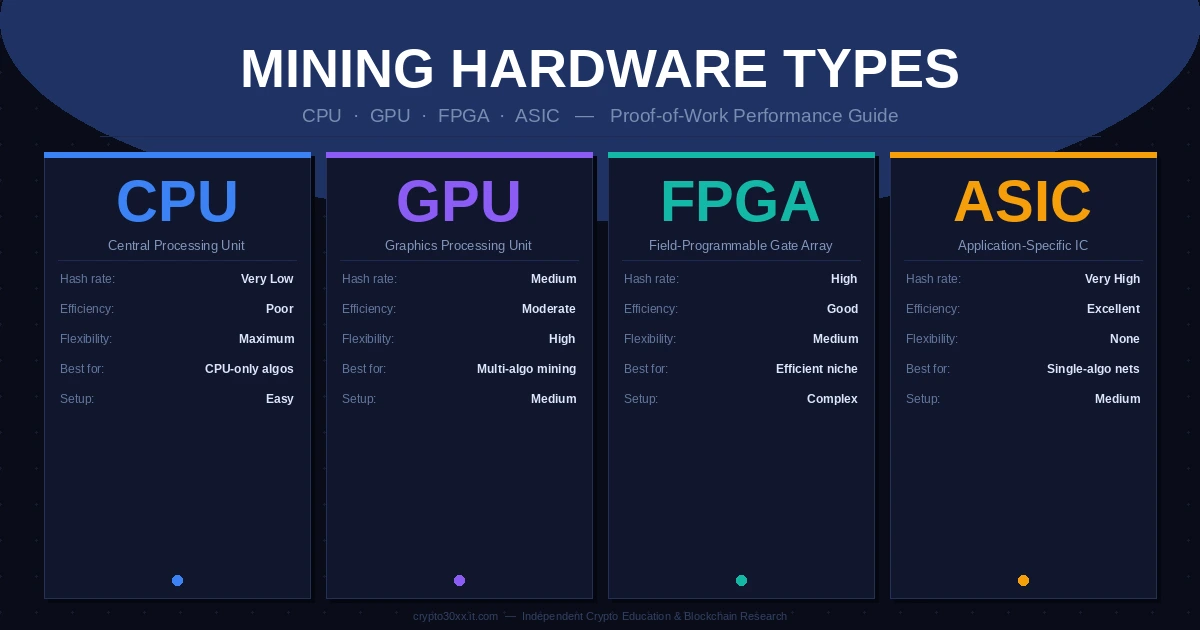
No single mining hardware type wins on every dimension. CPUs offer maximum flexibility at low efficiency. GPUs balance programmability with meaningful hash rate. FPGAs deliver near-ASIC efficiency while retaining algorithm portability. ASICs reach the highest performance ceiling and best energy efficiency, but lock the operator permanently into one algorithm with no fallback. The table below places all four categories side by side on the criteria that matter most for mining analysis.
| Hardware | Hash rate output | Energy efficiency | Algorithm flexibility | Reprogrammable? | Entry complexity | Alternate use case |
|---|---|---|---|---|---|---|
| CPU | Very low | Poor | Maximum | Yes | Low | Computing, servers |
| GPU | Medium | Moderate | High | Yes | Medium | Gaming, AI, rendering |
| FPGA | High | Good | Medium | Yes (via HDL) | High | Engineering, R&D |
| ASIC | Very high | Excellent | None | No | Low–medium | None |
Performance ratings are relative comparisons within the same algorithm class. Actual figures vary by model, generation, and algorithm.
Risks, limitations, and trade-offs
Every category of mining hardware carries trade-offs that extend beyond the raw performance metrics visible in a specification sheet. Hardware obsolescence cycles, upfront capital requirements, thermal and acoustic infrastructure demands, and the structural effects of hardware specialization on network decentralization are all material factors for analyzing how proof-of-work mining ecosystems function.
Hardware obsolescence cycles
Mining hardware depreciates in mining value faster than most computing equipment. When a new ASIC generation launches, it typically delivers 50–200% more hash rate per watt than its predecessor. Older units either become unprofitable at median electricity costs or migrate to lower-difficulty networks where they remain marginally competitive. GPU miners face similar pressure from successive GPU generations, though the general-purpose resale market — gaming, professional graphics, AI workloads — provides a value floor that ASICs lack entirely.
Upfront capital and break-even dynamics
All mining hardware requires capital before any reward is earned. Break-even timeframes depend on multiple simultaneously shifting variables: network difficulty (which adjusts as more hash rate enters or leaves), the block reward level, local electricity cost per kilowatt-hour, and the hardware’s specific power draw. None of these variables remain static. A difficulty adjustment on a major proof-of-work network can extend or compress a hardware unit’s payback period significantly without any change to the hardware itself.
Heat, noise, and infrastructure requirements
ASIC miners generate heat and noise at levels that make residential installation impractical without dedicated infrastructure. Industrial mining facilities house ASICs with purpose-built ventilation systems, sound attenuation panels, and electrical distribution configured for continuous high-draw loads. GPU rigs operate at lower noise levels but still require managed thermal environments. These infrastructure costs are frequently underestimated in break-even analyses and can significantly affect actual operating economics.
Centralization effects of hardware specialization
A structural concern with ASIC dominance on any network is that mining capacity concentrates among entities with access to large capital, low-cost power contracts, and direct relationships with ASIC manufacturers — who sometimes mine new hardware for their own account before making it available for public sale. Some networks have adopted ASIC-resistant algorithms specifically to maintain GPU and CPU miner competitiveness, distributing the network’s hash rate more widely. Other networks accept ASIC concentration as an acceptable trade-off for maximum security budget at scale.
Algorithm forks as hardware risk
A network governance decision can render ASIC hardware worthless overnight. Several proof-of-work networks have implemented anti-ASIC hard forks, changing their hashing algorithm to neutralize the efficiency advantage that ASIC manufacturers had built into dedicated hardware. Operators holding ASICs for the old algorithm are left with machines that cannot mine the updated network and have no viable resale market. GPU operators face the same risk, though less acutely: GPU hardware retains non-mining utility, so algorithm changes reduce profitability rather than eliminate all hardware value.
Cloud mining: an infrastructure-free alternative
Cloud mining is not a physical hardware category but a service layer built on top of one. Providers own and operate physical mining equipment — typically ASIC farms — and sell contracts entitling buyers to a proportional share of hash rate output and the rewards it generates. The buyer pays a fee and receives mining proceeds without ever handling physical equipment.
This arrangement removes the need to purchase, configure, cool, power, and maintain hardware. The trade-offs are different rather than absent: contract terms may become uneconomic if mining profitability declines, providers may lack transparency about actual hardware conditions, and a subset of cloud mining offerings have historically involved fraudulent representations of hash rate capacity. Understanding cloud mining requires understanding the underlying physical mining hardware types first, because the economics of any cloud mining contract ultimately trace back to the efficiency and operating cost of the machines generating the hash rate.
FAQs
What is the most energy-efficient type of mining hardware? ASICs are the most energy-efficient mining hardware for the specific algorithm they were designed to run. On SHA-256, a modern ASIC delivers orders of magnitude more hash rate per watt than any GPU or CPU. The trade-off is total inflexibility — an ASIC cannot be reprogrammed for any other algorithm or repurposed for any other computing task.
Can a standard computer CPU mine cryptocurrency? CPU mining is not economically viable on large networks like Bitcoin, where ASIC hardware dominates the total hash rate completely. It retains practical relevance on networks with algorithms engineered to resist hardware specialization — Monero’s RandomX being the most prominent example — where CPUs remain genuinely competitive with more specialized hardware.
What does hash rate measure in cryptocurrency mining? Hash rate measures how many cryptographic hash computations a mining device performs per second. Higher hash rate means more chances per second to produce a valid block hash and earn the block reward. The unit scales from kilohashes per second (KH/s) for low-end devices to terahashes per second (TH/s) and exahashes per second (EH/s) for large ASIC operations and full networks.
Why do some cryptocurrency networks use ASIC-resistant algorithms? ASIC-resistant algorithms are designed so that the performance advantage a purpose-built ASIC would have over a GPU is minimal, making it economically unattractive to build ASICs for that algorithm. The goal is typically to prevent mining from concentrating among industrial operators and to keep network participation accessible to people with consumer hardware.
How does an FPGA differ from an ASIC in mining applications? An FPGA is reconfigurable — its internal logic can be reprogrammed after manufacture to execute different algorithms. An ASIC’s logic is permanently fixed to one function at manufacture and cannot be changed afterward. FPGAs offer more algorithm flexibility at some efficiency cost relative to a dedicated ASIC. ASICs outperform FPGAs on their target algorithm but have no fallback if that algorithm becomes unprofitable or is changed by the network.
How does mining hardware type affect blockchain decentralization? When hardware becomes highly specialized and expensive, mining concentrates among fewer, better-capitalized operators. This reduces the number of independent participants validating the chain through proof-of-work. GPU and CPU mining, because the hardware is multi-purpose and more widely available, historically enabled broader participation before ASICs entered large networks.
Is it technically possible to mine Bitcoin with a GPU? Any device that can execute SHA-256 can mine Bitcoin in a technical sense. In practice, even the highest-performing GPU produces a hash rate so far below modern ASIC output that the GPU would contribute a negligible share of the total network hash rate — almost certainly spending more on electricity than it earns in block rewards.
Disclaimer
This article is published for educational and research purposes only. It does not constitute financial, investment, or operational advice, and should not be interpreted as a recommendation to purchase mining hardware or participate in any mining operation. Mining economics depend on variables — hardware acquisition cost, electricity price, network difficulty, and block reward levels — that shift continuously and without warning. Readers should conduct independent research and consult qualified professionals before making any financial decisions.
The four mining hardware types — CPU, GPU, FPGA, and ASIC — represent a spectrum from maximum flexibility to maximum efficiency. CPUs pioneered proof-of-work mining and retain niche viability on CPU-optimized networks. GPUs extended performance while preserving the ability to switch algorithms. FPGAs brought near-custom efficiency without permanent algorithm commitment. ASICs drove performance to its practical ceiling at the cost of total inflexibility and significant concentration effects on network participation. Analyzing this hardware hierarchy is essential for understanding how proof-of-work blockchains secure themselves, how mining economics evolve across hardware generations, and why algorithm design choices carry real structural consequences for who participates in consensus.
Go beyond the basics with our advanced knowledge blog posts for serious learners.